1238 results for "Poetry"

Nocturne in chrome & sunset yellow

Hill, Tobias
In this latest collection of poems, Hill invokes people and place, mythologizing and demythologizing city lives as they are led. From poignant vignettes and celebrations to urban-pastoral and elegy, these poems extend Hill’s romance with London’s psychic and surreal fabric. Selected as a Next Generation poet, Hill continues to delight us with sensuous observation and imaginative embrace.“Hill’s special territory, in poetry and prose, is the ‘urban-pastoral’ … his native North London is transformed, with many deftly dark touches, into an uneasy realm of the imagination. Hill clearly appreciated Simon Armitage’s storytelling persona; he also drew upon observation of the natural world in ways associated with Ted Hughes. Much of his imagery is by turns delicately ‘Japanese’, or reminiscent of the heyday of Craig Raine’s ‘Martian’ style. Hill has a romantic dimension in his work that is all his own. As a young man with an intense curiosity about the world, his work is full of sensual images, vignettes of city life – and romance … these are poems of flirtation and desire.”—contemporarywriters.co.uk“The closeup detail taken directly from nature, then skewed through 90° to give the reader something completely new, even unique … with this third collection, Hill promises to be a real force in poetry, displaying an utterly contemporary understanding of how nature continues to work.”—Poetry Review“There is a fin de siècle decadence about them … not least in their brightly coloured diction, their luxuriant descriptiveness, their louche postures.”—Poetry Wales“Superb conjurations of place.”—Adam Mars Jones“Compassionate and intelligent … so full of action and interest and that brings alive such an array of people and places, that it is difficult to believe they sprang from the pen of one writer.”—Rachel Cusk
Salt 2007 67 pages

Midnight in the city of clocks

Hill, Tobias
This lively second collection from a young, much-travelled writer, falls into two parts. ‘Transit’ includes poems of abroad, especially Japan, where Tobias Hill lived for two years. ‘Back to the City’ is about London, from hangover to Underground; Hiroshima; and the `City of Clocks’, a fusion of cities and ages. They are poems crammed with a young man’s curiosity and eye for detail, and show his great ability for story-telling. Tobias Hill lives in London, and besides writing (his short stories and novels are published by Faber) he reviews and edits several new magazines. “Hill’s special territory, in poetry and prose, is the ‘urban-pastoral’ … his native North London is transformed, with many deftly dark touches, into an uneasy realm of the imagination. Hill clearly appreciated Simon Armitage’s storytelling persona; he also drew upon observation of the natural world in ways associated with Ted Hughes. Much of his imagery is by turns delicately ‘Japanese’, or reminiscent of the heyday of Craig Raine’s ‘Martian’ style. Hill has a romantic dimension in his work that is all his own. As a young man with an intense curiosity about the world, his work is full of sensual images, vignettes of city life – and romance … these are poems of flirtation and desire.”—contemporarywriters.co.uk“The closeup detail taken directly from nature, then skewed through 90° to give the reader something completely new, even unique … with this third collection, Hill promises to be a real force in poetry, displaying an utterly contemporary understanding of how nature continues to work.”—Poetry Review“There is a fin de siècle decadence about them … not least in their brightly coloured diction, their luxuriant descriptiveness, their louche postures.”—Poetry Wales“Superb conjurations of place.”—Adam Mars Jones“Compassionate and intelligent … so full of action and interest and that brings alive such an array of people and places, that it is difficult to believe they sprang from the pen of one writer.”—Rachel Cusk
Salt Publishing,UK 2007 65 pages

Musings With The Angel Of Death Poems of Love, Life and Longing

Simcha Paull Raphael
Intense and deeply personal, this compilation of poetry, grapples with the reality of death, loss, and finding meaning in the face of life's finitude in contemporary times. For over three decades, Simcha Paull Raphael has written scholarly books on death and the afterlife, including his groundbreaking study Jewish Views of the Afterlife. In this collection of thirty-six poems, Raphael invites us into the inner sanctum of his own intimate wrestling with death and loss. As Rabbi Jill Hammer writes in the Foreword: "Raphael has done the brave work of exposing his own emotional life, the inner workings of his drive to address mortality and immortality. In a sense, he has let us know the behind-the-scenes of his academic and spiritual work." The poems herein reflect and wrestle with a spectrum of topics: the gamut of Jewish death rituals (funeral & shiva, Kaddish & Yizkor); personal tributes to the author's deceased parents; his journey of making meaning in the face of grief and loss; challenges of love and marriage; the vicissitudes of family life; and thoughtful poetic reflections on the state of the world today. As a book mirroring the universal journey of awakening to the reality of life's finality and eternity, Musings with the Angel of Death speaks to the heart and soul.
Albion-Andalus Books 2024-03-27 172 pages

Sam White and the seven inner demons

White, Samantha Blair
Sam White and the seven inner demons is a poetry chapbook about healing. A journey of self-reflection and overcoming cycles of abuse. Inspired by fairytales, this chapbook begins with a walk into the woods. Here, we learn, as a coping mechanism, SW fades in and out of disassociation and is on a winding path of recovery. The following is one stream of consciousness poem divided into seven parts and inspired by the seven dwarfs. Instead of seven tiny men living in a cottage, these poems personify the inner demons that live inside SW's head. Often seeking refuge everywhere but in herself, SW feels caught in a never-ending vortex of darkness. By the end of the chapbook, she has learned that she can escape the cycle of abuse once she knows how to stand up for and save herself.
Independently published 2022-02-25 43 pages

Inner Voices Selected Poems, 1963-2003

Richard Howard
The poems of Richard Howard are noted for their unique dramatic force and for preserving, in their graceful, exquisitely wrought lines, human utterance at its most urbane. Inner Voices , the first volume to draw together material from Howard's twelve books of poems, leaves no doubt as to why he has been called "a powerful presence in American poetry for 40 years" ( The New York Times Book Review ).
Farrar, Straus and Giroux 2005-10-12 440 pages

A messenger comes

Back, Rachel Tzvia
Poetry. Rachel Tzvia Back's third full-length book of poems, A MESSENGER COMES is a harrowing book that takes the reader to the edge of grief. As Hank Lazer's writes, while Back's book is "beautifully rich and emotionally engaging, this is no simple book of consolation. In its steadfast beauty, it is a book of questions: can grief be sustained? What can we learn from the grief of another? Thus this is a messenger we will want and need to welcome time and again."
Singing Horse Press 2012 108 pages

At the end of the day: selected poems and an introductory essay

Lopate, Phillip
Poetry. Though known today mostly as an essayist, Phillip Lopate worked seriously as a poet for fifteen years during the 1970s and 1980s. As Henri Cole writes: "Phillip Lopate may be an American ambassador of nonfiction, but he is also a youthful, taciturn, love-seeking New York poet, whose poems--plainspoken, personal, darkly humorous--quietly gather strength while confronting the beautiful and ugly in city life. I admire their vitality and honesty."
Marsh Hawk Press 2010 191 pages

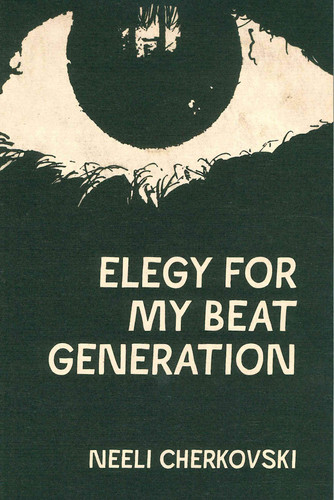
Elegy for my beat generation

Cherkovski, Neeli
Poetry. The latest collection from prolific poet, literary chronicler, and man on the scene, Neeli Cherkovski, pays homage to his aging and gone friends from the heyday of all their lives, contemplates upon his own dwindling days, celebrates each moment passing by, and attempts to come to grips with ultimate ends. Neeli Cherkovski was born a poet and through hard, lifelong work, turned himself into a constant maker. These poems result from a close alignment between fingers, pencil, paper, and brain.
Lithic Press 2018 115 pages

Forced march: selected poems

Radnóti, Miklós
Forced March is a new edition of Radnóti’s selected poems, in the powerful and moving translations of Clive Wilmer and George Gömöri. Poet Dick Davis explains why this book is so important: ‘Radnóti has emerged as the major poetic voice to record the civilian experience of World War II in occupied Europe. His poems are an extraordinary record of a mind determined to affirm its civilization in the face of overwhelming odds. He is one of the very greatest poets of the twentieth century, and Clive Wilmer’s and George Gömöri’s versions are by far the best that exist in English.’ By the time the Second World War broke out, Miklós Radnóti was already an established poet. When the Nazis took over his home-town of Budapest, Radnóti was sent to a labour camp at Bor in occupied Serbia. Then, in 1944, as the Germans retreated from the eastern front, Radnóti and his fellow labourers were force-marched back into Hungary. On 9 November, too weak to carry on, he and many comrades were executed by firing-squad. When the bodies were exhumed the following year, Radnóti was identified by a notebook of poems in his greatcoat pocket. These poems, published in 1946 as Foaming Sky, secured his position as one of the giants of modern Hungarian poetry.
Enitharmon in association with the European Jewish Publication Society 2003-08-01 96 pages

What is a Bong Tree? Articles and Talks 1976-2021

Michael Rosen
"What is a Bong Tree? brings together a big selection of Michael Rosen's writings and talks over five decades. They are about the centrality of literature, including children's literature, in the lives of all of us; about the power of poetry to inspire, console and entertain; and about the need to argue and campaign for these liberating forces in the face of ignorant and reductionist actions by successive governments in the United Kingdom, which have narrowed and impoverished children's experience of literature by pressing it into the service of a regime dominated by tests and examinations. The pieces here refer frequently to Michael's childhood and upbringing, and offer a generous tribute to his parents, Connie and Harold Rosen, and their influence on him and his subsequent work. Tonally, the pieces carry Michael's trademark: they're witty and insouciant; they carry serious ideas unseriously. Parents, teachers, librarians, academics, in fact anyone concerned with the nurture and education of children, and with the place of culture - in its widest sense - in our society, will find much pleasure and practical encouragement here." John Richmond, Editor
Michael Rosen 2022-02-07 492 pages

Poems born in Bergen-Belsen

Rosensaft, Menachem Z.
"A volume of poetry in which the author confronts God, the perpetrators of the Holocaust, and the bystanders to the genocide in which six million Jews were murdered. Menachem Rosensaft also reflects on other genocides, physical separation during the COVID-19 pandemic, and why Black lives matter, among other themes that inspire the reader to make the ghosts of the past an integral part of their present and future"--
Kelsay Books 2021 115 pages

The Dice Cup

Max Jacob
In the first years of the 20th century, friends Max Jacob, Pablo Picasso and Guillaume Apollinaire, with associated artists and writers including Georges Braque, Jean Cocteau, Amedeo Modigliani, Henri Matisse, Gertrude Stein, Pierre Reverdy and Alfred Jarry, gathered in a ramshackle house in Paris. From its improvised studios and stages emerged the early expressions of Modernism: Cubism, Dada, Surrealism, incorporation of collage in painting and vernacular in poetry. Jacob's masterwork, The Dice Cup (Le Cornet à Dés), has never before been available in a full English edition. This completely new translation includes the Preface of 1916, with Jacob's critique of Rimbaud, Baudelaire and Mallarme, and his strictures and inspirations for the true prose poem: "The author who has situated his work can use all the enchantments: language, rhythm, musicality and spirit." "I am convinced that artistic emotion ceases where analysis and thought intersect: something else provokes thought and gives the feeling of beauty." "A work of art is a force that attracts, that absorbs the available forces of the one who comes close to it." "The poem is a constructed object... the prose poem is a jewel." from The Dice Cup: THE PRESS: I entered timidly: there was an ostrich that was losing its feathers and, on a white stucco pedestal, a bronze bird whose plumage was represented by a series of engraved shells. It was Mr. Abel Hermant or someone like Mr. Abel Hermant who appeared, as soon as the hallway door opened: "Ah! young man!" said he, "you come for the hundred sous!" I learned later that a hundred sous were given to everybody who came there. At the mention of a hundred sous, the ostrich dropped a feather and the bronze bird flew away. Anyway, the vestibule was deserted and dusty, pins were kept in iron boxes painted with the portraits of great men, Cuvier, Buffon, etc... "Ah! Young man," repeated Mr. Abel Hermant or someone of the same ilk, "you come for the hundred sous!" And the birds re-commenced their motions. "No, sir! It's free! It's a free delivery!" My future spiritual guide did not listen any further: "free delivery" had edified him, he turned his back on me. The ostrich put on his policeman's hat and looked at me with worried curiosity. The bronze bird was even more bronze.
Independently Published 2019-08-31 268 pages