1206 results for "Technology"

DNA in Halakhah

Bleich, J. David
"Judaism and Jewish law are eternal and immutable. But the world changes and presents novel challenges. Modern science and developing technology create facts on the ground that raise relevant contemporary questions of which Halakhah must take cognizance. Fingerprint examination, blood typing and DNA matching were all unknown until recent decades. Jewish law posits strict laws of evidence and generally excludes circumstantial evidence for most purposes. Rabbi Bleich's comprehensive work explores the nature of DNA evidence in establishing paternity, the relief of agunot, mamzerut, inheritance, identity as a Jew and as a kohen, the so-called "Jewish" gene and the kohen gene." -- Publisher's description.
Ktav Publishing House 2021 270 pages

Wheelworld

Harrison, Harry
Wheelworld: An unforgiving planet where the sun is about to rise and will not set for another four years; where an ancient peasant hierarchy still rules a society equipped with the highest technology; where the people are as dependent on visiting ships as they are on the very air they breathe; home for some, but for Jan Kulozik it is an eternal prison. And when the ships don't come, Jan finds himself at the center of an epic struggle for power... and survival. Wheelworld is the second visionary volume in Harry Harrison's phenomenal To the Stars trilogy.
Granada 1981 188 pages

A matter of choices: memoirs of a female physicist

Ajzenberg-Selove, Fay
When Fay Ajzenberg-Selove became a nuclear physicist, the number of women in the field could be counted on one hand. In this engaging memoir, Fay Ajzenberg-Selove writes candidly about her difficult journey to international recognition in physics. She is frank about the ways being a woman has made a difference in her opportunities and choices as a scientist--and how, by being a woman, she has made a difference in the world of physics. Ajzenberg-Selove came to America at the age of 15 after narrowly escaping the Nazi takeover of France. She had planned to become an engineer like her father, but switched to physics after she was told the only engineering jobs open to women were in drafting: Marie Curie's example proved to her that women could do physics. Her first attempt at graduate work at Columbia University was a disaster, but she was sturck with the intellectual beauty of the field. After taking a Ph.D. in physics at University of Wisconsin, she did post-doctoral work with Thomas Lauritsen at the California Institute of Technology, where she began writing the first of a series of major review papers on the nuclear spectroscopy of the light nuclei, a subject of fundamental importance to nuclear physics, astrophysics, and applied physics. She continued this work and experimental research for thirty-eight years while teaching at Boston University, Haverford College, and the University of Pennsylvania. During her early career, Ajzenberg-Selove was shielded by her male mentors from experiencing much of the discrimination directed against women in science. Her simultaneous battles to become a tenured professor and to overcome breast cancer opened her eyes and confirmed her as a feminist. The lay reader and the scientist alike will be fascinated by Ajzenberg-Selove's clear portrayal of her interlinked lives as physicist, teacher, wife of particle physicist, Walter Selove, and a woman who relishes both competition and friendship in a male-dominated field. An invaluable book for anyone contemplating a career in science.
Rutgers University Press 1994 234 pages

Modern Japanese organization and decision-making

Vogel, Ezra F.
This book constitues the first attempt of its kinds to probe the major features of modern Japanese organization that have played such a critical role in Japan's extraordinarily rapid economic development. The contributors inclue prominent academic business consultants such a Peter Drucker of the United states and Kazuo Noda of Japan; Japanese government officials such as Yoshihisa Ojimi, former Administrative Vice-Minister of the Ministry of International Trade and Industry, and Taishiro Shirai, a member of the Central Labor Relations Commission; as well as outstanding Western experts on modern Japanese organization. The essays deal not only with Japanese government and business but also with teh structures of a newspaper and a university and with the role of Japanese intellectuals in modern organization. The portrait of Japanese organization that emerges is much more dynamic and volatile than has been generally supposed. One finds business and government managers creatively using so-called "traditional practices" in novel ways and undertaking bold departures to achieve new purposes. The findings contradict the view that decision sten from below. Not only do executive have an important role in initiating action; but lower-level officials function within a context defined by their superiors. Far greater tensions and conflict exist within organizations than is commonly reported by outsiders, especially in institutions like the university where conflicts often paralyze the decision-making process. Similarly, there is far greater divergence of interest among different sectors of society than one might infer from the stereotypical view of "Japan, Inc." And since the high level of consensus supporting the fundamental commitment to economic growth is now weakening increasing divergence may be anticipated in the future. This title is part of UC Press's Voices Revived program, which commemorates University of California Press's mission to seek out and cultivate the brightest minds and give them voice, reach, and impact. Drawing on a backlist dating to 1893, Voices Revived makes high-quality, peer-reviewed scholarship accessible once again using print-on-demand technology. This title was originally published in 1975.
University of California Press 1975 340 pages

Interconnecting the network of networks

Noam, Eli M.
This book describes the transformation of telecommunications from national network monopolies to a new system, the "network of networks," and the glue that holds it together, interconnection. By their very nature, monopoly-owned networks provided a small number of standardized, nationwide services. Over the past two decades, however, new forces in the world economy began to unravel this traditional system. The driving force behind the change was the shift toward an information-based economy. Especially for large organizations, the price, control, security, and reliability of telecommunications became variables requiring organized attention. Thus, monopoly began to give way to the "network of networks," the foundation of today's telecommunications and Internet infrastructure. Taking a broad, multidisciplinary perspective Eli Noam discusses the importance and history of interconnection policy, as well as recent policy reforms both within the United States and around the globe. Other important topics he discusses include interconnection prices, the unbundling of interconnection, and the technology of interconnection. He concludes with an examination of social and policy issues, including the free flow of content, universal service and privacy protection, and the future of telecommunications.
MIT Press 2001 318 pages

The End of the Beginning Life, Society and Economy on the Brink of the Singularity

Ben Goertzel,Ted George Goertzel
A deep, diverse edited volume addressing the most critical issues regarding the future of humanity and intelligence -- with chapters authored by a who's-who of leading futurist thinkers and doers. According to Vernor Vinge, Ray Kurzweil and a rapidly increasing chorus of techno-futurists, we are living on the brink of a technological Singularity - a time when machines will become vastly more intelligent than humans. In such a scenario, death, disease and everyday material scarcity will be radically diminished, and life will be dramatically different in many other ways. But what will the path to this amazing future look like? How will human life grow and unfold as technology advances and Singularity approaches? The chapters in this book approach this issue from the perspectives of multiple visionary authors from around the globe, covering topics such as the impact of life extension, the future of money and exchange, the future of human psychology, biological self-modification, intelligence enhancement, automation and escalating unemployment, the possibility of global war between pro and anti technology forces, the impact of future technology on Asia and Africa, the emerging Global Brain, the future of surveillance and privacy, and much more. There are no easy or definite answers here - but lots of fascinating questions to explore. CONTENTS Chapter One: Predicting the Age of Post-Human Intelligences , by Ted Goertzel and Ben Goertzel Chapter Two: A Tale of Two Transitions , by Robin Hanson Chapter Three: Longer Lives on the Brink of Global Population Contraction: A Report from 2040 , by Max More Chapter Four: Implanting Post-Human Intelligence in Human Bodies , by John Hewitt Chapter Five: The Singularity and the Methuselarity: Similarities and Differences , by Aubrey de Grey Chapter Six: Robotics and AI: Impacts Felt on Every Aspect of Our Future World , by Daryl Nazareth Chapter Seven: Robotics, AI, the Luddite Fallacy and the Future of the Job Market , by Wayne Radinsky Chapter Eight: Moral Responsibility and Autonomous Machines , by David Burke Chapter Nine: How Will the Artilect War Start? , by Hugo de Garis Chapter Ten: Return to Eden? Promises and Perils on the Road to Global Superintelligence , by Francis Heylighen Chapter Eleven: Distributing Cognition: From Local Brains to the Global Brain , by Clément Vidal Chapter Twelve: A World of Views: A World of Interacting Post-human Intelligences , by Viktoras Veitas and David Weinbaum (Weaver) Chapter Thirteen: Chinese Perspectives on the Approach to the Singularity , by Mingyu Huang Chapter Fourteen: Africa Today and the Shadow of the Coming Singularity , by Hruy Tsegaye Chapter Fifteen: The World's First Decentralized System for Financial and Legal Transaction , by Chris Odom Chapter Sixteen: Beyond Money: Offer Networks, a Potential Infrastructure for a Post-Money Economy , by Ben Goertzel Chapter Seventeen: Sousveillance and AGI , by Ben Goertzel and Stephan Vladimir Bugaj Chapter Eighteen: The Future of Human Nature , by Ben Goertzel Chapter Nineteen: Capitalism, Socialism, Singularitarianism , by Ted Goertzel Chapter Twenty: Toward a Human-Friendly Post-Singularity World , by Ben Goertzel Chapter Twenty-one: Looking Backward from 2100 , by Ben Goertzel and Ted Goertzel
Humanity+ Press 2015 737 pages

A Cosmist Manifesto Practical Philosophy for the Posthuman Age

Ben Goertzel
The term Cosmism was introduced by Tsiolokovsky and other Russian Cosmists around 1900. Goertzel's "Cosmist Manifesto" gives it new life and a new twist for the 21st century. Cosmism, as Goertzel presents it, is a practical philosophy for the posthuman era. Rooted in Western and Eastern philosophy as well as modern technology and science, it is a way of understanding ourselves and our universe that makes sense now, and will keep on making sense as advanced technology exerts its transformative impact as the future unfolds. Among the many topics considered are AI, nanotechnology, uploading, immortality, psychedelics, meditation, future social structures, psi phenomena, alien and cetacean intelligence and the Singularity. The Cosmist perspective is shown to make plain old common sense of even the wildest future possibilities.
Humanity 2010-07 360 pages

Google me: one-click democracy

Cassin, Barbara
"Google is a champion of cultural democracy, but without culture and without democracy." In this witty and polemical critique the philosopher Barbara Cassin takes aim at Google and our culture of big data. While impressed by the search engine's brilliance, Cassin enlists her formidable knowledge of the rhetorical tradition to challenge on the Google myth of a "good" tech company and its "democracy of clicks," laying bare the philosophical poverty and political naiveté ́hat underwrites its founding slogans: "Organize the world's information," and "Don't be evil." For Cassin, this conjunction of globalizing knowledge and moral imperative is frighteningly similar to the way American demagogues justify their own universalizing mission before the world. While sensitive to the possibilities of technology and to Google's playful appeal, Cassin shows what is lost when a narrow worship of information becomes dogma, such that research comes to mean data mining and other languages become provincial "flavors" folded into an impoverished Globish, or global English. As the Internet continues to intensify the neoliberal effacement of difference and corporate reduction of the common, Cassin's refreshing polemic takes technology seriously enough to scrutinize the beliefs upon which it operates.
Fordham University Press 2018 148 pages

Structure and mechanism in protein science: a guide to enzyme catalysis and protein folding

Fersht, Alan
The three-dimensional structure of proteins -- Chemical catalysis -- The basic equations of enzyme kinetics -- Measurement and magnitude of individual rate constants -- The pH dependence of enzyme catalysis -- Practical methods for kinetics and equilibria -- Detection of intermediates in enzymatic reactions -- Stereochemistry of enzymatic reactions -- Active-site-directed and enzyme-activated irreversible inhibitors : "affinity labels" and "suicide inhibitors" -- Conformational change, allosteric regulation, motors, and work -- Forces between molecules, and binding energies -- Enzyme-substrate complementarity and the use of binding energy in catalysis -- Specificity and editing mechanisms -- Recombinant DNA technology -- Protein engineering -- Case studies of enzyme structure and mechanism -- Protein stability -- Kinetics of protein folding -- Folding pathways and energy landscapes.
World Scientific 2017 631 pages

To catch the lightning: a novel of American dreaming

Cheuse, Alan
"Until someone tells you, you never know in whose dreams you appear..." - From the prologue of To Catch the Lightning What is the price of our dreams? Beginning in the late 1890s, Edward Sheriff Curtis undertook the seemingly overwhelming odyssey of capturing the past, of documenting and photographing the fading way of life of the American Indian. In To Catch the Lightning , Alan Cheuse has created a remarkable portrait of the man who would become a legend. Drawn on his epic journey by a series of female muses, Curtis turns his lens on a landscape of unparalleled beauty and tradition. Curtis@ desire to complete his destiny as foretold by Chief Joseph, to photograph all of the hundreds of western American Indian tribes, is a haunting tale of the struggle between ambition and duty. The architect of the finest lasting visual record of a culture close to extinction, Curtis stands as a testament to the power of the sacrifices we make for the dreams that compel us. With the ear of a poet and the eye of a historian, Cheuse has crafted a masterwork of American historical fiction. Lyrical, beautifully written, and impressively researched, To Catch the Lightning is a novel of the American spirit. PRAISE FOR TO CATCH THE LIGHTNING: "To Catch the Lightning is a story of loss - of choices made and prices paid, of the future coming fast and the past disappearing faster. Cheuse@s narrative is refracted through multiple voices, each distinct, but each containing its own poetic precision. A wonderful, wonderful book of quiet power and great beauty." - Karen Joy Fowler, author of Wit@s End and The Jane Austen Book Club "To Catch the Lightning tells Curtis@ story vividly and eloquently. It is a great American story, about a life spent preserving and honoring those elements of life which are most respected and beloved. Alan Cheuse is to be congratulated for this vivid novel." - William Kittredge, author of The Willow Field and The Next Rodeo "Bravo to Cheuse for this incarnation of a major and unfairly forgotten American artist, capturing an era so crucial in native American, and therefore American history. I found it immediate and innovative." - Diane Johnson, author of Le Divorce and Lulu in Marrakech "The photography and cinema of Edward Curtis exist at the intersection of art, history, anthropology, and technology. He was an essentially American kind of genius, and Alan Cheuse has transformed his life into compelling fiction that digs deep into the mystery and sacrifice and selfishness of creative vision." - Charles Frazier, author of Cold Mountain and Thirteen Moons "... the narrative brims with keen insight." - Publishers Weekly "Curtis devoted his life to creating the most significant and comprehensive retrospective of American Indian culture, which he viewed as @one of the great races of mankind.@ Curtis correctly predicted that the culture was near extinction ... and much of his work remains the only recorded history of a civilization even then becoming the stuff of legend." - ForeWord Magazine Catch Alan Cheuse in your town: Key West, FL: January - Key West Lit
Sourcebooks Landmark 2008 502 pages

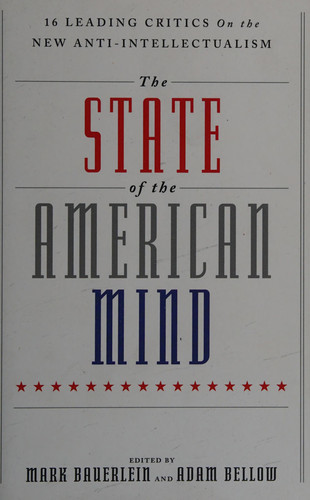
The state of the American mind: 16 leading critics on the new anti-intellectualism

Mark Bauerlein,Adam Bellow
In 1987, Allan Bloom’s The Closing of the American Mind was published; a wildly popular book that drew attention to the shift in American culture away from the tenants that made America—and Americans—unique. Bloom focused on a breakdown in the American curriculum, but many sensed that the issue affected more than education. The very essence of what it meant to be an American was disappearing. That was over twenty years ago. Since then, the United States has experienced unprecedented wealth, more youth enrolling in higher education than ever before, and technology advancements far beyond what many in the 1980s dreamed possible. And yet, the state of the American mind seems to have deteriorated further. Benjamin Franklin’s “self-made man” has become a man dependent on the state. Independence has turned into self-absorption. Liberty has been curtailed in the defense of multiculturalism. In order to fully grasp the underpinnings of this shift away from the self-reliant, well-informed American, editors Mark Bauerlein and Adam Bellow have brought together a group of cultural and educational experts to discuss the root causes of the decline of the American mind. The writers of these fifteen original essays include E. D. Hirsch, Nicholas Eberstadt, and Dennis Prager, as well as Daniel Dreisbach, Gerald Graff, Richard Arum, Robert Whitaker, David T. Z. Mindich, Maggie Jackson, Jean Twenge, Jonathan Kay, Ilya Somin, Steve Wasserman, Greg Lukianoff, and R. R. Reno. Their essays are compiled into three main categories: States of Mind: Indicators of Intellectual and Cognitive Decline These essays broach specific mental deficiencies among the population, including lagging cultural IQ, low Biblical literacy, poor writing skills, and over-medication. Personal and Cognitive Habits/Interests These essays turn to specific mental behaviors and interests, including avoidance of the news, short attention spans, narcissism, and conspiracy obsessions. National Consequences These essays examine broader trends affecting populations and institutions, including rates of entitlement claims, voting habits, and a low-performing higher education system. The State of the American Mind is both an assessment of our current state as well as a warning, foretelling what we may yet become. For anyone interested in the intellectual fate of America, The State of the American Mind offers an accessible and critical look at life in America and how our collective mind is faring.
Templeton Press 2015-06-16 260 pages

Curious notions

Turtledove, Harry
In a parallel-world 21st-century San Francisco where the Kaiser's Germany won World War One and went on to dominate the world, Paul Gomes and his father Lawrence are secret agents for our timeline, posing as traders from a foreign land. They run a storefront shop called Curious Notions, selling what is in our world routine consumer technology-record players, radios, cassette decks--all of which is better than anything in this world, but only by a bit. Their real job is to obtain raw materials for our timeline. Just as importantly, they must guard the secret of Crosstime Traffic--for of the millions of parallel timelines, this is one of the few advanced enough to use that secret against us. Now, however, the German occupation police are harrassing them. They want to know where they're getting their mysterious goods. Under pressure, Paul and Lawrence hint that their supplies comes from San Francisco's Chinese...setting in motion a chain of intrigues that will put the entire enterprise of Crosstime Traffic at deadly risk.
Tor Books 2004-10 272 pages

Curious Notions A Novel of Crosstime Traffic

Harry Turtledove
In a parallel-world 21st-century San Francisco where the Kaiser's Germany won World War One and went on to dominate the world, Paul Gomes and his father Lawrence are secret agents for our timeline, posing as traders from a foreign land. They run a storefront shop called Curious Notions, selling what is in our world routine consumer technology-record players, radios, cassette decks--all of which is better than anything in this world, but only by a bit. Their real job is to obtain raw materials for our timeline. Just as importantly, they must guard the secret of Crosstime Traffic--for of the millions of parallel timelines, this is one of the few advanced enough to use that secret against us. Now, however, the German occupation police are harassing them. They want to know where they're getting their mysterious goods. Under pressure, Paul and Lawrence hint that their supplies comes from San Francisco's Chinese...setting in motion a chain of intrigues that will put the entire enterprise of Crosstime Traffic at deadly risk. Curious Notions is the second book in Harry Turtledove's Crosstime Traffic series.
Tor Publishing Group 2004-10-01 272 pages

The language revolution

Crystal, David
We are living through the consequences of a linguistic revolution. Dramatic linguistic change has left us at the beginning of a new era in the evolution of human language, with repercussions for many individual languages. In this book, David Crystal, one of the world's authorities on language, brings together for the first time the three major trends which he argues have fundamentally altered the world's linguistic ecology: first, the emergence of English as the world's first truly global language; second, the crisis facing huge numbers of languages which are currently endangered or dying; and, third, the radical effect on language of the arrival of Internet technology. Examining the interrelationships between these topics, Crystal encounters a vision of a linguistic future which is radically different from what has existed in the past, and which will make us revise many cherished concepts relating to the way we think about and work with languages. Everyone is affected by this linguistic revolution. The Language Revolution will be essential reading for anyone interested in language and communication in the twenty-first century.
Polity Press 2004-03-12 142 pages

The Art of Warfare in Biblical Lands In the Light of Archaeological Study

Yigael 1917-1984 Yadin
This work has been selected by scholars as being culturally important and is part of the knowledge base of civilization as we know it. This work is in the public domain in the United States of America, and possibly other nations. Within the United States, you may freely copy and distribute this work, as no entity (individual or corporate) has a copyright on the body of the work. Scholars believe, and we concur, that this work is important enough to be preserved, reproduced, and made generally available to the public. To ensure a quality reading experience, this work has been proofread and republished using a format that seamlessly blends the original graphical elements with text in an easy-to-read typeface. We appreciate your support of the preservation process, and thank you for being an important part of keeping this knowledge alive and relevant.
Creative Media Partners, LLC 2021-09-09 270 pages

This Crazy Time Living Our Environmental Challenge

Tzeporah Berman,Mark Leiren-Young
Passionate, profound and funny, Berman is inspiring people from all walks of life to get off the sidelines and fight the good fight--and win. This unique book--part manifesto from a leader, part humorous activist memoir from a soccer mom--offers a wryly honest, behind-the-scenes, ultimately uplifting look at the state of the planet. For almost 20 years, Tzeporah Berman has been one of our most influential environmentalists. A founder of ForestEthics and PowerUp Canada, she was instrumental in shaping the tactics and concerns of the modern environmental movement. In her early 20s she faced nearly one thousand criminal charges and 6 years in prison for her role organizing blockades in Canada's rainforest. She later transformed her tactics and sat down with CEOs and political leaders to reshape their policies and practices. In her new role at Greenpeace International she is fighting the problem of our time: climate change. This Crazy Time is an impassioned plea for a better world.
Alfred A. Knopf Canada 2012-06-19 384 pages

Marxism Unmasked From Delusion to Destruction

Ludwig Von Mises
We can't sit under Mises at his famous Vienna private seminar. We can't go back in time and attend his New York seminar, or follow him to his speaking engagements that he held in the 50s and 60s.But thanks to this second volume in a thrilling series (here is volume one), we do have access to what he said. He is warm, funny, passionate, and learned. This book provides a candid look at the man and his teaching style. It demonstrates his dazzling command over the material, and teaches in a breezier way than his treatises.This volume contains nine lectures delivered over one week, from June 23, to July 3, 1952, at the San Francisco Public Library. Mises was at his prime as a teacher and lecturer. He shares a lifetime of learning on topics that were (and remain) central to American public life.As the title indicates, his main focus is on Marxism. He discusses Marx and his place in the history of ideas, the destruction wrought by his dangerous ideology, the manner in which his followers have covered up his errors, and how the Marxists themselves have worked for so long to save Marxism from itself. He discusses Marxist claims about history and refutes the smear of the industrial revolution.The approach is systematic but casual. So the reader encounters wonderful insights in the form of short asides. For example: "The worst thing that can happen to a socialist is to have his country ruled by socialists who are not his friends."As a lecturer, he is steady and relentless. The reader can nearly "hear" him speaking through the prose. And there are times when Mises reveals a level of rhetorical passion that you would never encounter in print. That's because what is printed here are not pre-prepared lectures in the sense that they were written out. They were transcribed by Bettina Bien Greaves from what he actually said.Thus can we hear this passage:It is not true, as Marx said, that the improvements in technology are available only to the exploiters and that the masses are living in a state much worse than on the eve of the Industrial Revolution. Everything the Marxists say about exploitation is absolutely wrong! Lies! In fact, capitalism made it possible for many persons to survive who wouldn't have otherwise.Some readers of Mises's larger works have said that while his rigor is dazzling, the man himself can seem remote. Whether or not you agree with this observation, Mises comes across in these lectures as brilliant but very warm and charming in an old world sense.This approach is particularly fruitful in the last four of the lectures, which cover topics such as savings, interest, inflation, profit and loss, and the place of foreign investment. The lecture on interest rates, for example, must surely rank as one of the best explanations of this complicated topic. He recounts the history of the attempt to suppress interest rates, from the ancient world to the modern period. He explains why this cannot work because interest is merely the objective sign of a phenomenon that is integral to human action. As he moves on to money, Mises reveals himself to be tougher on the issue of fiduciary media than he was when he wrote his 1912 book The Theory of Money and Credit.In response to a question Mises says: "In the future no additional banknotes should be issued, no additional credit should be entered on a bank subject to check, unless there is 100 percent coverage in money."Also not to be missed is Mises's wry defense of "money cranks": at least they were only more consistent than the advocates of Keynesian and monetarism.Mises was clearly pressed for time, so he had to be at once thorough and move quickly through the material. It's still not "light reading" by the normal standards, but for people who want to see a great mind at work, this has a wonderful element of spontaneity about it that attracts and teaches at the same time.
Ludwig von Mises Institute 2019 110 pages

Sensational Moments in Science

Karl Kruszelnicki
This discussion of a range of interesting scientific phenomena deals with topics such as chaos theory, fingerprints, vampires, Damascus steel, and antibiotics. Discusses associated technology, and also the history behind various scientific discoveries. The author is the Julius Sumner Miller Fellow at the University of Sydney. He has appeared on popular TV and radio science shows, and published widely on various aspects of science.
ABC Books 1995 178 pages

Notes from the Holocene: a brief history of the future

Sagan, Dorion
In a thought-provoking, humorous, and engaging style, Dorion Sagan combines philosophy, science, and an understanding of illusion to probe the deep questions of existence. Operating on the precept that the universe is far weirder than we might imagine, Sagan-- son of acclaimed scientists Carl Sagan and Lynn Margulis--uses his knowledge of philosophy, science, sleight-of-hand magic, and the fantastical writings of Philip K. Dick to explore some of the deepest questions we face on Earth. He provides fresh insights as to why we are here, the nature of technology, the prognosis for humanity, the living nature of our planet, and a reasoned explanation to why our universe is probably just one of an infinite number. Sagan also provides answers to twelve pressing questions: Why does life exist? Why do we drink water? Can we save the Earth from global warming? Are human beings central and special? Is it possible that we've arisen by pure chance? Is the Earth an organism? Are we part of its exo-brain? If it is alive, can it reproduce? Can the universe? What does the future hold in store for us? Does God exist? What is the nature of ultimate reality? Notes from the Holocene is a prime example of the writing coming from a new generation of scientific writers. It will inspire readers to think for themselves while leaving them chuckling with tongue-in-cheek anecdotes--a rare combination that Sagan delivers with ease. And yes, as geneticist J.B.S. Haldane says, "the universe is not only stranger than we imagine, but stranger than we can imagine."
Chelsea Green Pub 2007 226 pages

Menachem's seed: a novel

Djerassi, Carl
In Menachem's Seed , Carl Djerassi , world-renowned scientist and inventor of the birth-control pill, brings us a new novel that explores the human--and passionate--side of science. Melanie Laidlaw and Menachem Dvir meet at a series of international conferences where jet-setting scientists come together to discuss the global implications of their discoveries. Melanie runs a foundation that awards grants for innovations in reproductive technology; Menachem is an infertile nuclear engineer and a married man. Naturally, they fall in love. What follows is a story of sexual steam, stolen seed, and religious conversion--a very modern romance that hinges on a cutting-edge scientific breakthrough. As Melanie and Menachem discover, what science makes possible, only two hearts can make right.
Penguin Books 1998-09-01 196 pages