14302 results for "History"

Der Judenstaat: Theodor Herzl

Herzl, Theodor
This is the original German edition of Der Judenstaat by Theodor Herzl, republished by Comprehendible Classics. For our new modern English translation, please visit our Author Page. "The Jewish State" (“Der Judenstaat”) by Theodor Herzl is considered one of the most important texts of modern Zionism. Written in 1896, this work significantly influenced the Zionist movement and the establishment of the modern State of Israel. Herzl, a Jewish journalist and political thinker from Austria, argued that the best way to avoid the widespread and rampant antisemitism was to create an independent Jewish state. In The Jewish State, Herzl paints a vivid picture of a homeland for the Jewish people, and shares intricate details about the foundations of this envisioned nation. He also explores the topic of identity and the relentless pursuit of a place to belong. Herzl's vision is a testament to the extraordinary capacity of an individual's ideas to mold the course of history. In fact, he's often called the father of modern political Zionism, and is officially referred to as "the spiritual father of the Jewish State" in the Israeli Declaration of Independence. This is a republication by Comprehendible Classics. We are on a mission to breathe new life into old books that have shaped our society. We believe that the most thought-provoking, inspiring and even controversial texts should be accessible to everyone. As part of our mission we also republish the original work in its original language, for anyone who wishes to compare the two, or simply is on the lookout for the original text. You can find all our titles and stay up to date with new releases by following us on social media @comprehendibleclassics or subscribing to our Amazon author page.
Independently published 2023-11-11 134 pages

Queen Victoria and the Bonapartes

THEO. ARONSON
One would expect the rulers of England and France to have a relationship of some kind, if only political. But the personal relationships that developed between Victoria and Albert of Great Britain, and their counterparts across the channel, were rather surprising. Ambitious and flamboyant, Napoleon III of France and his wife the Empress Eugenie could hardly have been more different to the British monarch and her consort. And while Victoria was enchanted by that very difference, over the years their relationship was frequently strained by political and military events. But when the world of Napoleon III and Eugenie began to crumble, it was to their British friends that they fled. And when Eugenie lost her husband and her only child in swift succession, the publicly ice-cool Queen Victoria revealed her true character as she welcomed a heartbroken Eugenie into her own family. In Queen Victoria and the Bonapartes , Theo Aronson reveals a little-known aspect of Queen Victoria's life and deploys his skill as a writer and researcher to great effect, showing us the complex and often surprising characters behind the great names of history. Praise for Queen Victoria and the Bonapartes : 'Relying primarily on correspondence between the Queen, Empress, Emperor and other family members and officials (much of it previously unpublished), Aronson delivers another superbly readable and engaging history' - Shawn Day, Randomosity 'I enjoyed reading this book very much indeed, & would most certainly recommend it to those seeking a more human experience of history' - Goodreads review Theo Aronson is the author of over twenty works of royal historical biography, published in eleven languages. Among the widely read are Grandmama of Europe, The King in Love, Napoleon and Josephine and a biography of Princess Margaret . In the course of researching and writing these books he has interviewed major and minor members of Britain's royal family and members of the royal households, as well as various officials, servants, friends and others whose lives are in some way connected with the monarchy.
Amazon Digital Services LLC - Kdp 2023-03-30 268 pages

Season finale: the unexpected rise and fall of the WB and UPN

Daniels, Susanne
In the mid-1990s, two major Hollywood studios, Warner Bros. and Paramount Pictures, each launched their own broadcast television network with the hope of becoming the fifth major player in an industry long dominated by ABC, CBS, NBC, and, more recently, Fox. Despite the odds against them, the WB and UPN went on to alter the landscape of primetime television, only to then merge as the CW network in 2006—each a casualty of conflicting personalities, relentless competition, and a basic failure to anticipate the future of the entertainment business. Unfolding amid this backdrop of high-stakes business ventures, fanatical creative struggles, and corporate power plays, Season Finale traces the parallel stories of the WB and UPN from their prosperous beginnings to their precipitous demise. Following the big money, big egos, and big risks of network television, Susanne Daniels, a television executive with the WB for most of its life, and Cynthia Littleton, a longtime television reporter for Variety, expose the difficult reality of trying to launch not one but two traditional broadcast networks at the moment when cable television and the Internet were ending the dominance of network television. Through in-depth reportage and firsthand accounts, Daniels and Littleton expertly re-create the creative and business climate that gave birth to the WB and UPN, illustrating how the race to find suitable programming spawned a heated rivalry between the two but also created shows that became icons of American youth culture. Offering insider stories and never-before-published details about shows such as Buffy the Vampire Slayer, Dawson's Creek, 7th Heaven, Gilmore Girls, Smallville, Felicity, Girlfriends, Everybody Hates Chris, and America's Next Top Model, Daniels and Littleton provide an exhaustive account of the two creative teams that ushered these groundbreaking programs into the hearts, minds, and living rooms of Americans across the country. But in spite of these successes, the WB and UPN unraveled, and here the authors elucidate the corporate miscalculations that led to their undoing, examining the management missteps and industry upheaval that brought about their rapid decline and the surprising teamwork that united them as the CW. The result is a cautionary and compelling entertainment saga that skillfully captures a precarious moment in television history, when the dramatic transformation of the broadcast networks signaled an inevitable shift for all pop culture.
Harper 2007 381 pages

Learning on the left: political profiles of Brandeis University

Whitfield, Stephen J.
Brandeis University is the United States' only Jewish-sponsored nonsectarian university, and while only being established after World War II, it has risen to become one of the most respected universities in the nation. The faculty and alumni of the university have made exceptional contributions to myriad disciplines, but they have played a surprising formidable role in American politics. Stephen J. Whitfield makes the case for the pertinence of Brandeis University in understanding the vicissitudes of American liberalism since the mid-twentieth century. Founded to serve as a refuge for qualified professors and students haunted by academic antisemitism, Brandeis University attracted those who generally envisioned the republic as worthy of betterment. Whether as liberals or as radicals, figures associated with the university typically adopted a critical stance toward American society and sometimes acted upon their reformist or militant beliefs. This volume is not an institutional history, but instead shows how one university, over the course of seven decades, employed and taught remarkable men and women who belong in our accounts of the evolution of American politics, especially on the left. In vivid prose, Whitfield invites readers to appreciate a singular case of the linkage of political influence with the fate of a particular university in modern America.
Brandeis University Press 2020-09-15 581 pages

Rediscovering Russia in Asia: Siberia and the Russian Far East

Stephen Kotkin,David Wolff
In 1581 a Cossack raider crossed the Ural Mountains to plunder and claim for Tsar Ivan IV the land called "Sibir" by its Tatar inhabitants. Within half a century, Moscow's reach would extend nearly six thousand miles to the east. Thus Russia has a long history as part of Asia. Does it have a future there as well? Rediscovering Russia in Asia takes the reader on a trans-Siberian expedition to encounter the peoples, cultures, and riches of Russia's eastern expanses. The expert guides are scholars with the language skills and the sense of adventure to explore a "crossroads of civilizations" at long last reopened to the world.
M.E. Sharpe 1995 356 pages

Shakespearean negotiations: the circulation of social energy in Renaissance England

Greenblatt, Stephen J.
Stephen Greenblatt has been at the center of a major shift in literary interpretation toward a critical method that situates cultural creation in history. Shakespearean Negotiations is a sustained and powerful exemplification of this innovative method, offering a new way of understanding the power of Shakespeare's achievement and, beyond this, an original analysis of cultural process.
University of California Press 1988 205 pages

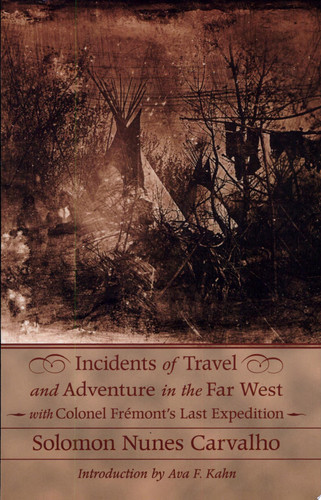
Incidents of travel and adventure in the Far West: with Colonel Fremont's last expedition across the Rocky Mountains, including three months' residence in Utah, and a perilous trip across the great American desert to the Pacific

Carvalho, Solomon Nunes
n August 1853, an American-born Sephardic Jew, Solomon Nunes Carvalho, accepted John Fremont's invitation to join his fifth expedition to find the best overland route to California. A Baltimore artist, inventor, and daguerreotypist, Carvalho was given the job of creating a photographic record of the lands and peoples along the way. Fremont's party left the Missouri on September 14, 1853, traveled up the Kansas River, overland to the Arkansas, upriver past Bent's Fort to the Huerfano, and traversed the Sandhill Pass into the Rocky Mountains. Beset by heavy snows and intense cold, they were reduced to eating their horses and mules and the occasional beaver or porcupine while making their way in midwinter across the Grand, Green, and Sevier Rivers. Suffering from frostbite, scurvy, and dysentery, Carvalho left the expedition in Utah; spent four months among the Mormons in Salt Lake City, where he observed with keen interest their system of spiritual wives; and reached California in 1854. Carvalho became the first Jewish writer to publish accounts of the Great American West and was also one of the first people to photograph the American West. Although only one of his plates is known to survive, others became the models for wood and steel engravings that broadcast the image of the West throughout the world. This Bison Books edition restores the discourses on Mormon doctrine omitted from previous twentieth-century editions. Ava F. Kahn is a visiting scholar at the California Studies Center, University of California, Berkeley. Her books include Jewish Voices of the California Gold Rush: A Documentary History, 1849-1880; Jewish Life in the American West: Perspectives on Migration, Settlement, and Community; and California Jews (coedited with Marc Dollinger).
University of Nebraska Press 2004-01-01 130 pages

The letters of Sigmund Freud and Otto Rank: inside psychoanalysis

Freud, Sigmund
Sigmund Freud’s relationship with Otto Rank was the most constant, close, and significant of his professional life. Freud considered Rank to be the most brilliant of his disciples. The two collaborated on psychoanalytic writing, practice, and politics; Rank was the managing director of Freud’s publishing house; and after several years helping Freud update his masterpiece, The Interpretation of Dreams , Rank contributed two chapters. His was the only other name ever to be listed on the title page. This complete collection of the known correspondence between the two brings to life their twenty-year collaboration and their painful break. The 250 letters compiled by E. James Lieberman and Robert Kramer humanize and dramatize psychoanalytic thinking, practice, and organization from 1906 through 1925. The letters concern not just the work and trenchant contemporaneous observations of Freud and Rank but also their friendships, supporters, rivals, families, travels, and other personal and professional matters. Most interestingly, the letters trace Rank’s growing independence, the father-son schism over Rank’s “anti-Oedipal” heresy, his surprising reconciliation with Freud, and the moment when they parted ways permanently. A candid picture of how the pioneers of modern psychotherapy behaved with their patients, colleagues, and families—and each other—the correspondence between Freud and Rank demonstrates how psychoanalysis developed in relation to early twentieth-century science, art, philosophy, and politics. A rich primary source on psychiatry, history, and culture, The Letters of Sigmund Freud and Otto Rank is a cogent and powerful narrative of early psychoanalysis and its two most important personalities.
Johns Hopkins University Press 2012-01-31 365 pages

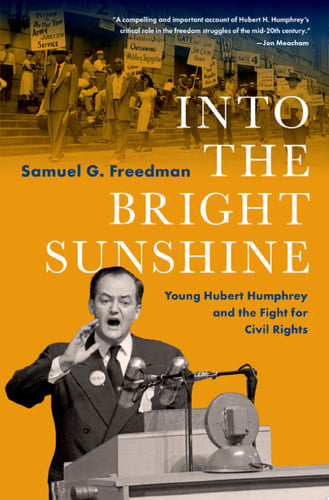
Into the bright sunshine: young Hubert Humphrey and the fight for civil rights

Freedman, Samuel G.
"Hubert Humphrey, a fallen hero and a dying man, rose on rickety legs to approach the podium of the Philadelphia Convention Hall, his pulpit for the commencement address at the University of Pennsylvania. He clutched a sheaf of paper with his speech for the occasion, typed and double-spaced by an assistant from his extemporaneous dictation, and then marked up in pencil by Humphrey himself. A note on the first page, circled to draw particular attention, read simply, "30 years ago--Here." In this place, at that time, twenty-nine years earlier to be precise, he had made history. From the dais now, Humphrey beheld five thousand impending graduates, an ebony sea of gowns and mortarboards, broken by one iconoclast in a homemade crown, two in ribboned bonnets, and another whose headgear bore the masking-tape message HI MA PA. In the horseshoe curve of the arena's double balcony loomed eight thousand parents and siblings, children, and friends. Wearing shirtsleeves and cotton shifts amid the stale heat, they looked like pale confetti from where Humphrey stood, and their flash cameras flickered away, a constellation of pinpricks"--
Oxford University Press 2023 488 pages

Rywka's Diary: The Writings of a Jewish Girl from the Lodz Ghetto

Lipszyc, Rywka,Friedman, Anita
Product Description The newly discovered diary of a Polish teenager in the Lodz ghetto during World War II—originally published by Jewish Family & Children’s Services of San Francisco, now available in a revised, illustrated, and beautifully designed trade edition. After more than seventy years in obscurity, the diary of a teenage girl during the Holocaust has been revealed for the first time. Rywka’s Diary is at once an astonishing historical document and a moving tribute to the many ordinary people whose lives were forever altered by the Holocaust. At its heart, it is the diary of a girl named Rywka Lipszyc who detailed the brutal conditions that Jews in the Lodz ghetto, the second largest in Poland, endured under the Nazis: poverty, hunger and malnutrition, religious oppression, and, in Rywka’s case, the death of her parents and siblings. Handwritten in a school notebook between October 1943 and April 1944, the diary ends literally in mid-sentence. What became of Rywka is a mystery. A Red Army doctor found her notebook in Auschwitz after its liberation in 1945 and took it back with her to the Soviet Union. Rywka’s Diary is also a moving coming-of-age story, in which a young woman expresses her curiosity about the world and her place in it and reflects on her relationship with God—a remarkable affirmation of her commitment to Judaism and her faith in humanity. Interwoven into this carefully translated diary are photographs, news clippings, maps, and commentary from Holocaust scholars and the girl’s surviving relatives, which provide an in-depth picture of both the conditions of Rywka's life and the mysterious end to her diary. Moving and illuminating, told by a brave young girl whose strong and charismatic voice speaks for millions, Rywka’s Diary is an extraordinary addition to the history of the Holocaust and World War II. From the Back Cover The newly discovered diary of a Polish teenager in the Lodz ghetto during World War II—originally published by Jewish Family & Children’s Services of San Francisco, now available in a revised, illustrated, and beautifully designed trade edition. After more than seventy years in obscurity, the diary of a teenage girl during the Holocaust has been revealed for the first time. Rywka’s Diary is at once an astonishing historical document and a moving tribute to the many ordinary people whose lives were forever altered by the Holocaust. At its heart, it is the diary of a girl named Rywka Lipszyc who detailed the brutal conditions that Jews in the Lodz ghetto, the second largest in Poland, endured under the Nazis: poverty, hunger and malnutrition, religious oppression, and, in Rywka’s case, the death of her parents and siblings. Handwritten in a school notebook between October 1943 and April 1944, the diary ends literally in mid-sentence. What became of Rywka is a mystery. A Red Army doctor found her notebook in Auschwitz after its liberation in 1945 and took it back with her to the Soviet Union. Rywka’s Diary is also a moving coming-of-age story, in which a young woman expresses her curiosity about the world and her place in it and reflects on her relationship with God—a remarkable affirmation of her commitment to Judaism and her faith in humanity. Interwoven into this carefully translated diary are photographs, news clippings, maps, and commentary from Holocaust scholars and the girl’s surviving relatives, which provide an in-depth picture of both the conditions of Rywka's life and the mysterious end to her diary. Moving and illuminating, told by a brave young girl whose strong and charismatic voice speaks for millions, Rywka’s Diary is an extraordinary addition to the history of the Holocaust and World War II. About the Author Dr. Anita Friedman leads Jewish Family and Children's Services (JFCS) of the San Francisco Bay Area, one of the largest and oldest family service institutions in the United States. She oversees the JFCS Holocaust Center, which is dedicated to remembrance, research, a
Harper Paperbacks 2017-09-15 240 pages

Raquela

Ruth Gruber
A National Jewish Book Award-winning biography: A look at the early years of Israel's statehood, experienced through the life of a pioneering nurse. During her extraordinary career, nurse Raquela Prywes was a witness to history. She delivered babies in a Holocaust refugee camp and on the Israeli frontier. She crossed minefields to aid injured soldiers in the 1948 Arab-Israeli War and organized hospitals to save the lives of those fighting the 1967 Six-Day War. Along the way, her own life was a series of triumphs and tragedies mirroring those of the newly formed Jewish state. Raquela is a moving tribute to a remarkable woman, and an unforgettable chronicle of the birth of Israel through the eyes of those who lived it.
Open Road Integrated Media, Incorporated 2014-01-21 478 pages

Putting meat on the American table: taste, technology, transformation

Horowitz, Roger
Engagingly written and richly illustrated, Putting Meat on the American Table explains how America became a meat-eating nation -- from the colonial period to the present. It examines the relationships between consumer preference and meat processing -- looking closely at the production of beef, pork, chicken, and hot dogs. Roger Horowitz argues that a series of new technologies have transformed American meat. He draws on detailed consumption surveys that shed new light on America's eating preferences -- especially differences associated with income, rural versus urban areas, and race and ethnicity. Putting Meat on the American Table will captivate general readers and interest all students of the history of food, technology, business, and American culture.
The Johns Hopkins University Press 2006 170 pages

Stravinsky and the Russian traditions: a biography of the works through Mavra

Taruskin, Richard
This book undoes 50 years of mythmaking about Stravinsky's life in music. During his spectacular career, Igor Stravinsky underplayed his Russian past in favor of a European cosmopolitanism. Richard Taruskin has refused to take the composer at his word. In this long-awaited study, he defines Stravinsky's relationship to the musical and artistic traditions of his native land and gives us a dramatically new picture of one of the major figures in the history of music. Taruskin draws directly on newly accessible archives and on a wealth of Russian documents. In Volume One, he sets the historical scene: the St. Petersburg musical press, the arts journals, and the writings of anthropologists, folklorists, philosophers, and poets. Volume Two addresses the masterpieces of Stravinsky's early maturityÑ Petrushka, The Rite of Spring, and Les Noces . Taruskin investigates the composer's collaborations with Diaghilev to illuminate the relationship between folklore and modernity. He elucidates the Silver Age ideal of "neonationalism"Ñthe professional appropriation of motifs and style characteristics from folk artÑand how Stravinsky realized this ideal in his music. Taruskin demonstrates how Stravinsky achieved his modernist technique by combining what was most characteristically Russian in his musical training with stylistic elements abstracted from Russian folklore. The stylistic synthesis thus achieved formed Stravinsky as a composer for life, whatever the aesthetic allegiances he later professed. Written with Taruskin's characteristic mixture of in-depth research and stylistic verve, this book will be mandatory reading for all those seriously interested in the life and work of Stravinsky.
University of California Press 1996 800 pages

Day One

Peter H. Wyden
From the author of Bay of Pigs and Betrayal and Survival in Hitler’s Germany comes a full scope look at the bombing of Hiroshima, from the race to create the bomb to its detrimental dropping on Japan and the terrifying consequences that are still affecting the world over seventy years later. Hiroshima was an event of such magnitude that it divided history into two periods: before and after the bomb. It led to the first day of a new age in which all life would be at risk. Almost seventy years later, as Peter Wyden began this book, the world was still dealing with the fallout of the bomb’s creation. Wyden draws on eyewitness accounts, interviews, and documents never before published in order to trace the nuclear state of the modern world to the historical roots of Hiroshima. Skillfully weaving together all the strands, stories, and characters, including the scientific, political, moral, military, and human viewpoints, Wyden provides a full understanding of how the bomb was created, why it was used, and what the aftermath of those decisions has been.
Simon & Schuster 2014-04-09 456 pages

Al Smith and his America

Handlin, Oscar
The legendary image of America as a land of opportunity was challenged in 1928 by Al Smith's race for the presidency. Could the governor from New York, a Catholic from the Lower East Side, really become president? His candidacy began a dark episode in American history as Al Smith found himself a victim of the very society that, ironically, gave him his greatest opportunity. p This sympathetic account of Smith's political career demonstrates that a changing society in the decades after World War I propelled Americans toward isolationism and a reassertion of comfortable verities about religion and ethnicity. Oscar Handlin notes that Americans were fundamentalists in 1928, and their anti-Catholicism affected the outcome of the presidential election. But religion was only one symptom of the American anxiety that prejudiced attitudes toward the city, toward foreigners, toward the League of Nations and Prohibition. Disillusioned and betrayed by an unsuccessful peace, Americans searched for external causes on which to lay blame, and Al Smith seemed to epitomize the alien forces that were undermining the nation.
Northeastern University Press 1987-10-30 207 pages

Israel, the embattled ally

Safran, Nadav
Through thirty turbulent years, the United States has been deeply enmeshed in Israel’s destiny. Seldom in the history of international relations has such a world power been involved so intensely for so long with such a small power. How this phenomenon came to pass and how it will affect the future are explained in this compelling history of Israel and its relations with the United States—from the 1947 United Nations resolution through Kissinger’s shuttle diplomacy to Carter’s peace campaign.To form the backdrop for this extraordinary relationship, Nadav Safran paints a detailed portrait of the historical forces that combined to create the Jewish state. He unfolds panel after panel of Israeli life—its physical environment, people, economy, politics, and religion. He examines Israel’s responses to the many security crises it has faced since becoming a nation, and presents a clear and thorough exposition of its defense strategy and descriptions of all its wars.Safran then presents his brilliant analysis of Israel and America in international politics. Cutting through the tangle of the Arab–Israeli conflict, the East–West struggle, the disagreement among Western powers, the conflicts within and among the Arab states, and the impact of special interest groups in the United States on its foreign policy, Safran deftly pursues fluctuations in the American–Israeli relationship as it moved from simple friendship to an alliance of friends. A concluding chapter recapitulates the highlights of that evolution and projects its relevance for the future of the Middle East and American–Israeli relations.
Belknap Press of Harvard University Press 1978-02-27 633 pages

Conceived in liberty

Rothbard, Murray N.
The new single-volume edition of Conceived in Liberty is here! After so many years of having to juggle four volumes, the Mises Institute has finally put it altogether in a single, 1,616-page book. This makes it easier to read, and makes clearer just what a contribution this book is to the history of libertarian literature. There's never been a better time to remember the revolutionary and even libertarian roots of the American founding, and there's no better guide to what this means in the narrative of the Colonial period than Murray Rothbard. For anyone who thinks of Murray Rothbard as only an economic theorist or political thinker, this giant book is something of a surprise. It is probably his least known treatise. It offers a complete history of the Colonial period of American history, a period lost to students today, who are led to believe American history begins with the US Constitution. Rothbard's ambition was to shed new light on Colonial history and show that the struggle for human liberty was the heart and soul of this land from its discovery through the culminating event of the American Revolution. These volumes are a tour de force, enough to establish Rothbard as one of the great American historians. It is a detailed narrative history of the struggle between liberty and power, as we might expect, but it is more. Rothbard offers a third alternative to the conventional interpretive devices. Against those on the right who see the American Revolution as a "conservative" event, and those on the left who want to invoke it as some sort of proto-socialist uprising, Rothbard views this period as a time of accelerating libertarian radicalism. Through this prism, Rothbard illuminates events as never before. The volumes were brought out in the 1970s, but the odd timing and uneven distribution prevented any kind of large audience. They were beloved only by a few specialists, and sought after by many, thanks to their outstanding reputation. The Mises Institute is pleased to be the publisher of this integrated book. This single volume covers the discovery of the Americas and the colonies in the 17th century, the period of "salutary neglect" in the first half of the 18th century, the advance to revolution, from 1760-1775 and the political, military, and ideological history of the revolution and after.
Mises Institute 2011 1616 pages