58,196 results in 0.07 seconds

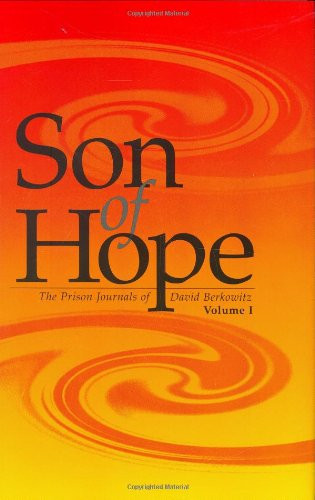
Son of hope: the prison journals of David Berkowitz

Berkowitz, David Richard
From late 1975 through 1977, over a 13-month period, David Berkowitz went on a killing spree in the New York metropolitan area--a spree that left six people dead and seven wounded. When Berkowitz--dubbed the Son of Sam--was finally captured, he confessed to his crimes and in 1978 was sentenced to 365 consecutive years in prison. Ten years into David's prison sentence a fellow inmate began to share with him Christ's love, hope and forgiveness. Eventually, David Berkowitz accepted Jesus Christ's as his Lord and Savior and has been walking as a Christian for more than 18 years. David's prison journals offer irrefutable evidence that God has indeed done a marvelous and miraculous work on this man's life. Several Christian organizations now refer to David's testimony as an example of the life-transforming power of the Gospel.
Morning Star Communications 2006 338 pages

David Copperfield's Tales of the Impossible

David Copperfield
David Copperfield, the world's foremost illusionist, gathers together in this anthology a stunning collection of stories about the world of magic. Contributing writers include Harlan Ellison, Larry Bond, Dtephen Donaldson, John Jakes, and many more. This unique volume includes Copperfield's own introduction to each story and discussions of the magic involved in each plot.
HarperCollins Publishers 1996-08 473 pages

The inheritance

Sanger, David E.
After seven years covering the White House for the New York Times, Chief Washington Correspondent David E. Sanger offers a clear, detailed and accessible analysis of the Bush administration's legacy, its few successes, and its stunning string of failures, many of them the collateral damage of the decision to invest so much of America, and Britain's, future on what once seemed like an easy mission in Iraq. Now, from rebuilding Afghanistan to preventing Iran and North Korea from becoming nuclear-armed states, cracking down on the proliferation of nuclear renegades, and reducing economic indebtedness to India and China, the challenges facing Barack Obama are more complex than those facing any other incoming president of the last half century. Mapping the political landscape that Bush now vacates, this book examines the international arenas that will remain the focus of the entire western world throughout the years to come. 'Somehow David Sanger has broken through the secrecy and the government gobbledygook to tell us how we got to where we are and the choices this leaves for the next administration. He reveals inside stuff that we have never heard in detail that will surprise and sometimes shock, yet he has framed it all in language that the specialist will appreciate and the layman can understand. One of the most important books of the year.' - Bob Schieffer, Chief Washington Correspondent, CBS News
Bantam 2009 498 pages

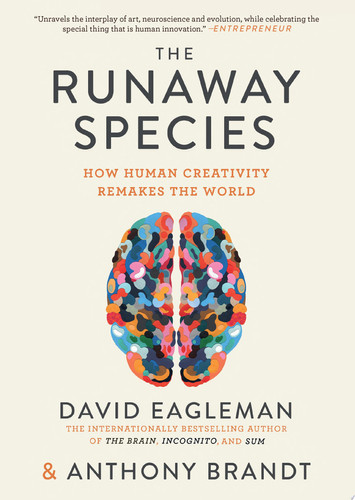
The Runaway Species How Human Creativity Remakes the World

David Eagleman,Anthony Brandt
This enlightening examination of creativity looks “at art and science together to examine how innovations . . . build on what already exists and rely on three brain operations: bending, breaking and blending” ( The Wall Street Journal ) The Runaway Species is a deep dive into the creative mind, a celebration of the human spirit, and a vision of how we can improve our future by understanding and embracing our ability to innovate. David Eagleman and Anthony Brandt seek to answer the question: what lies at the heart of humanity’s ability—and drive—to create? Our ability to remake our world is unique among all living things. But where does our creativity come from, how does it work, and how can we harness it to improve our lives, schools, businesses, and institutions? Eagleman and Brandt examine hundreds of examples of human creativity through dramatic storytelling and stunning images in this beautiful, full–color volume. By drawing out what creative acts have in common and viewing them through the lens of cutting–edge neuroscience, they uncover the essential elements of this critical human ability, and encourage a more creative future for all of us. “ The Runaway Species approach[es] creativity scientifically but sensitively, feeling its roots without pulling them out.” — The Economist
Catapult 2018-06-19 304 pages

The road to somewhere: the populist revolt and the future of politics

Goodhart, David
A robust and timely investigation into the political and moral fault-lines that divide Brexit Britain and Trump's America -- and how a new settlement may be achieved. Several decades of greater economic and cultural openness in the West have not benefited all our citizens. Among those who have been left behind, a populist politics of culture and identity has successfully challenged the traditional politics of Left and Right, creating a new division: between the mobile "achieved" identity of the people from Anywhere, and the marginalized, roots-based identity of the people from Somewhere. This schism accounts for the Brexit vote, the election of Donald Trump, the decline of the center-left, and the rise of populism across Europe. David Goodhart's compelling investigation of the new global politics reveals how the Somewhere backlash is a democratic response to the dominance of Anywhere interests, in everything from mass higher education to mass immigration.
Hurst & Company 2019 280 pages

Earth in human hands: shaping our planet's future

Grinspoon, David Harry
For the first time in Earth's history, our planet is experiencing a confluence of rapidly accelerating changes prompted by one species: humans. Climate change is only the most visible of the modifications we've made--up until this point, inadvertently--to the planet. And our current behavior threatens not only our own future but that of countless other creatures. By comparing Earth's story to those of other planets, astrobiologist David Grinspoon shows what a strange and novel development it is for a species to evolve to build machines, and ultimately, global societies with world-shaping influence. Without minimizing the challenges of the next century, Grinspoon suggests that our present moment is not only one of peril, but also great potential, especially when viewed from a 10,000-year perspective. Our species has surmounted the threat of extinction before, thanks to our innate ingenuity and ability to adapt, and there's every reason to believe we can do so again. Our challenge now is to awaken to our role as a force of planetary change, and to grow into this task. We must become graceful planetary engineers, conscious shapers of our environment and caretakers of Earth's biosphere. This is a perspective that begs us to ask not just what future do we want to avoid, but what do we seek to build? What kind of world do we want? Are humans the worst thing or the best thing to ever happen to our planet? Today we stand at a pivotal juncture, and the answer will depend on the choices we make.
Grand Central Publishing 2016-12-06 522 pages

Problems With People

Guterson, David
From the award-winning, bestselling author of Snow Falling on Cedars — a n extraordinary collection of short stories spanning across America, Nepal, South Africa, and Germany that explores the mysteries of love and our complex desire for connection. “First-rate.... Humorous, ironic, and satiric.... Each story is realistic, bordering on surrealistic.” — The Boston Globe These stories showcase Guterson’s gifts for psychological nuance, emotional suspense, and evocation of the natural world. In these pages, we meet, among others, a lonely landlord trying to reach out to his tenants; a middle-aged widower looking for love online; an American Jew traveling to Berlin to confront his haunted past. Celebrating the surprises that lurk within the dramas of our daily lives, Problems with People marks the return of a contemporary American master to the form that launched his literary career.
Random House USA 2015-03-03 163 pages

The other

Guterson, David
When two boys--John William Barry and Neil Countryman-- meet in 1972 at age sixteen, they're brought together by what they have in common: a fierce intensity and a love of the outdoors that takes them, together and often, into Washington's remote backcountry, where they must rely on their wits--and each other--to survive. Soon after graduating from college, Neil sets out on a path that will lead him toward a life as a devoted schoolteacher and family man. But John Willliam makes a radically different choice, dropping out of college and moving deep into the woods, convinced that it is the only way to live without hypocrisy. When John enlists Neil to help him disappear completely, Neil finds himself drawn into a web of secrets and often agonizing responsibility, deceit, and tragedy--one that will finally break open with a wholly unexpected, life-altering revelation.--From publisher description.
Alfred A. Knopf 2008 255 pages

Hating Whitey And Other Progressive Causes

David Horowitz
"Ideological hatred of whites has become a growth industry, boosted by "civil rights" activists and liberal academics. These once-youthful radicals, now entrenched in positions of power and influence, peddle a warmed-over version of the Marxist creed that supported the communist empire and excuses intolerance to the point of murder. Betraying the legacy of Martin Luther King, this unholy alliance of black civil rights leaders and white radicals threatens to undermine America's moral, political, and economic institutions. ... Undeterred, so it seems, by America's Anglo-Saxon roots, people of every race and creed still flock by the millions to these shores, claiming a share of our unparalleled rights and opportunities. Yet, with staggering hypocrisy, a clique of racial warlords and academic malcontents indict our every institution for racial oppression."--Publisher description.
Spence Publishing Company 2000-08 300 pages

The Popes against the Jews

Kertzer, David I.
With the emergence of modern antisemitism in the 19th century, the Catholic Church made a strong distinction between ecclesiastical anti-Judaism and "pagan" antisemitism. The Church admitted its share in the former, but negated its support of the latter - the Jew-hatred that ultimately led to the Holocaust. Argues that historical scrutiny does not support this claim. After the defeat of Napoleon, the Papal States returned their Jews to the ghettos and staunchly opposed their emancipation, which was a symbol for the dangers of modernity. As modern antisemitic movements took shape in the 19th century, the Church was a major player in them, warning people of the "Jewish peril." Its stance toward ritual murder accusations in the 19th-20th centuries was ambivalent at best; nor was the Church free of racism. Highlights the role of Catholic periodicals such as "La Civilta Cattolica" and "L'Osservatore Romano" in supporting antisemitism. Dwells on the role of the Vatican's representatives in France, Austria, and interwar Poland in backing antisemitism.
Kuperard 2001-09-18 355 pages

A country of strangers: Blacks and Whites in America

Shipler, David K.
A Country of Strangers is a magnificent exploration of the psychological landscape where blacks and whites meet. To tell the story in human rather than abstract terms, the Pulitzer Prize-winning writer David K. Shipler bypasses both extremists and celebrities and takes us among ordinary Americans as they encounter one another across racial lines. We learn how blacks and whites see each other, how they interpret each other's behavior, and how certain damaging images and assumptions seep into the actions of even the most unbiased. We penetrate into dimensions of stereotyping and discrimination that are usually invisible, and discover the unseen prejudices and privileges of white Americans, and what black Americans make of them. We explore the competing impulses of integration and separation: the reference points by which the races navigate as they venture out and then withdraw; the biculturalism that many blacks perfect as they move back and forth between the white and black worlds, and the homesickness some blacks feel for the comfort of all-black separateness. There are portrayals of interracial families and their multiracial children--expert guides through the clashes created by racial blending in America. We see how whites and blacks each carry the burden of our history. Black-white stereotypes are dissected: the physical bodies that we see, the mental qualities we imagine, the moral character we attribute to others and to ourselves, the violence we fear, the power we seek or are loath to relinquish. The book makes clear that we have the ability to shape our racial landscape--to reconstruct, even if not perfectly, the texture of our relationships. There is an assessment of the complexity confronting blacks and whites alike as they struggle to recognize and define the racial motivations that may or may not be present in a thought, a word, a deed. The book does not prescribe, but it documents the silences that prevail, the listening that doesn't happen, the conversations that don't take place. It looks at relations between minorities, including blacks and Jews, and blacks and Koreans. It explores the human dimensions of affirmative action, the intricate contacts and misunderstandings across racial lines among coworkers and neighbors. It is unstinting in its criticism of our society's failure to come to grips with bigotry; but it is also, happily, crowded with black people and white people who struggle in their daily lives to do just that. A remarkable book that will stimulate each of us to reexamine and better understand our own deepest attitudes in regard to race in America.
Vintage Books 1998-09-01 607 pages

Out of gas: the end of the age of oil

Goodstein, David L.
Our rate of oil discovery has reached its peak and will never be exceeded; rather, it is certain to decline - perhaps rapidly - forever forward. Meanwhile, in the 20th century we have developed lifestyles firmly rooted in the promise of an endless, cheap supply. inevitable fossil fuel shortage we face and our most urgent environmental policy decisions. He outlines the drastic effects a fossil fuel shortage will bring down on us and shows us that there is an important silver lining to the need to switch to other sources of energy, for when we have burned up all the available oil, the earth's climate will have moved toward a truly life-threatening state.
W.W. Norton 2004 140 pages

Ours was the shining future: the story of the American dream

Leonhardt, David
"The stagnation of living standards for most Americans over the past few decades has been the defining trend of modern life in the United States. Wealth and educational attainment have all slowed to a crawl in the twenty first century, while life expectancy has declined, economic inequality has soared, and the Black-White wage gap is as large as it was when Harry Truman was president. How did this happen in the world's most powerful country? Drawing from decades of writing about the economy for the New York Times, as well as years spent digging through archives, Pulitzer Prize-winning writer David Leonhardt tells the story of the past century of the American economy, starting with the Great Depression and the invention of the term "American dream." UNTITLED explains how the United States built the most prosperous mass economy in history after the Depression, then examines how that economy unraveled after our postwar boom. Its central argument is that three forces, above all, have dictated the economy's rise and fall: political power through grass-roots movement, culture, and investment in making life better for the future. Filled with the clear, lucid writing for which Leonhardt is known, UNTITLED is an enlightening economic history, featuring the unforgettable figures who helped shape the American dream: Frances Perkins, Eisenhower, Cesar Chavez, Betty Friedan, Robert Kennedy, Grace Hopper, Paul Hoffman, and more"--
Random House 2023-10-24 492 pages

True Talents

David Lubar
It's been over a year since fourteen-year-old Eddie "Trash" Thalmeyer and his friends from Edgeview Alternative School found out about their special hidden talents. Trash can move things with his mind, Torchie is a fire-starter, Cheater reads minds, Lucky finds lost objects, Flinch can predict the future, and Martin can see into people's souls. Now back home with their families, all the boys want to do is get back to their normal lives, start attending high school, and keep in touch with their friends from Edgeview. When Trash tests his power in a bank and accidentally steals a fistful of cash, he is kidnapped by the ruthless leader of a shadowy company whose purpose is to gather information about psychic phenomena—and who is willing to do anything to get it.... Torchie, Cheater, Lucky, Flinch, and Martin join forces to rescue their friend using their hidden talents, and discover their true talents in the process.
Macmillan 2008-03-04 320 pages

Haikus for Jews

Bader, David
Why is this haiku book different from all other haiku books? For centuries, the Japanese haiku has been one of the world's most dazzling poetic forms. In just three short lines, it captures the sublime beauty of nature--the croak of the bullfrog, the buzzing of the dragonfly, the shriek of the cicada, the scream of the cormorant. Now, with Haikus for Jews, there is finally a collection that celebrates the many advantages of staying indoors. Inspired by ancient Zen teachings and timeless Jewish noodging, this masterful work is filled with insights that will make you exclaim, "Ah!" or at least "Oy!" Whether you are Jewish or you simply enjoy a good kosher haiku, these chai-kus (so called because of their high chutzpah content) are certain to amuse. What's more, with each poem limited to seventeen syllables, Haikus for Jews is perfect for people in a hurry. Find out why God has made these The Chosen Haikus.
Random House International 1999-09-07 109 pages