5053 results for "Biography"

What You See Is What You Get

Alan Sugar
From a Hackney council estate to the House of Lords, this is the extraordinary story of one of our greatest entrepreneurs. Alan Sugar was born in 1947 and brought up on a council estate in Clapton, in Hackney. As a kid he watched his dad struggle to support the family, never knowing from one week to the next if he'd have a job. It had a huge impact on him, fuelling a drive to succeed that was to earn him a sizeable personal fortune. Now he describes his amazing journey, from schoolboy enterprises like making and selling his own ginger beer to setting up his own company at nineteen; from Amstrad's groundbreaking ventures in hi-fi and computers, which made him the darling of the stock exchange, to the dark days when he nearly lost it all; from his pioneering deal with Rupert Murdoch to his boardroom battles at Tottenham Hotspur FC. He takes us into the world of The Apprentice, and describes his appointment as advisor to the government and elevation to the peerage. Like the man himself, this autobiography is forthright, funny and sometimes controversial.
Macmillan 2010 609 pages

The Civil War: Red River to Appomattox

Shelby Foote
Selected by the Modern Library as one of the 100 best nonfiction books of all time On the occasion of the 150th anniversary of the Civil War, the Modern Library publishes Shelby Foote's three-volume masterpiece in a new boxed set including three hardcovers and a new trade paperback, American Homer: Reflections on Shelby Foote and His Classic Civil War: A Narrative, edited by and with an introduction from Pulitzer Prize winner Jon Meacham and including essays by Michael Beschloss, Ken Burns, Annette Gordon-Reed, and others. Random House publisher Bennett Cerf commissioned southern novelist Shelby Foote to write a short, one-volume history of the American Civil War. Thirty years and a million and a half words later--every word having been written out longhand with nib pens dipped into ink--Foote published the third and final volume of what has become the classic narrative of that epic war. As he approached the end of the final volume, Foote recounted this scene in a letter to his friend, the novelist Walker Percy: "I killed Lincoln last week--Saturday, at noon. While I was doing it (he had his chest arched up, holding his last breath to let it out) some halfassed doctor came to the door with vols I and II under his arm, wanting me to autograph them for his son for Xmas. I was in such a state of shock, I not only let him in; I even signed the goddam books, a thing I seldom do. Then I turned back and killed him and had Stanton say, 'Now he belongs to the ages.' A strange feeling, though. I have another 70-odd pages to go, and I have a fear they'll be like Hamlet with Hamlet left out. Christ, what a man. It's been a great thing getting to know him as he was, rather than as he has come to be--a sort of TV image of himself, with a ghost alongside." When Percy read the final book, he wrote to Foote: "It's a noble work. I'm still staggered by the size of the achievement. . . . It is The Iliad ." A selection of these letters, along with essays by Jon Meacham, Michael Beschloss, Ken Burns, Annette Gordon-Reed, Michael Eric Dyson, Julia Reed, Robert Loomis, Donald Graham, John M. McCardell, Jr., and Jay Tolson, are included in American Homer, the bonus paperback book available only in the Modern Library boxed set of The Civil War. Shelby Foote's tremendous, sweeping narrative of the most fascinating conflict in our history--a war that lasted four long, bitter years, an experience more profound and meaningful than any other the American people have ever lived through--begins with Jefferson Davis's resignation from the United States Senate and Abraham Lincoln's departure from Springfield for the national capital. It is these two leaders, whose lives continually touch on the great chain of events throughout the story, who are only the first of scores of exciting personalities that in effect make The Civil War a multiple biography set against the crisis of an age. Four years later, Lincoln's second inaugural sets the seal, invoking "charity for all" on the Eve of Five Forks and the Grant-Lee race for Appomattox. Here is the dust and stench of war, a sort of Twilight of the Gods. The epilogue is Lincoln in his grave, and Davis in his postwar existence--"Lucifer in Starlight." So ends a unique achievement--already recognized as one of the finest histories ever fashioned by an American--a narrative that re-creates on a vast and brilliant canvas the events and personalities of an American epic: the Civil War.
Random House 2011 2984 pages

My Name Is Celia / Me Llamo Celia: The Life of Celia Cruz / La Vida De Celia Cruz (English and Spanish Edition)

Monica Brown
This bilingual book allows young readers to enter Celia Cruz's life as she becomes a well-known singer in her homeland of Cuba, then moves to New York City and Miami where she and others create a new type of music called salsa.School Library Journal has namedMy Name is Celia [a]n exuberant picture-book biography . . . a brilliant introduction to a significant woman and her music.
Taylor Trade Pub 2015-03-01 32 pages

Time, love, memory: a great biologist and his quest for the origins of behaviour

Weiner, Jonathan
The story of Nobel Prize–winning discoveries regarding the molecular mechanisms controlling the body’s circadian rhythm. How much of our fate is decided before we are born? Which of our characteristics is inscribed in our DNA? Weiner brings us into Benzer's Fly Rooms at the California Institute of Technology, where Benzer, and his asssociates are in the process of finding answers, often astonishing ones, to these questions. Part biography, part thrilling scientific detective story, Time, Love, Memory forcefully demonstrates how Benzer's studies are changing our world view--and even our lives. Jonathan Weiner, winner of the Pulitzer Prize for The Beak of the Finch , brings his brilliant reporting skills to the story of Seymour Benzer, the Brooklyn-born maverick scientist whose study of genetics and experiments with fruit fly genes has helped revolutionize or knowledge of the connections between DNA and behavior both animal and human.
Vintage Books 1999 300 pages

Sandy Koufax: a lefty's legacy

Leavy, Jane
In an era when too many heroes have been toppled from too many pedestals, Sandy Koufax stands apart and alone, a legend who declined his own celebrity. As a pitcher, he was sublime, the ace of baseball lore. As a human being, he aspired to be the one thing his talent and his fame wouldn't allow: a regular guy. A Brooklyn kid, he was the product of the sedate and modest fifties who came to define and dominate baseball in the sixties. In Sandy Koufax: A Lefty's Legacy, former award-winning Washington Post sportswriter Jane Leavy delivers an uncommon baseball book, vividly re-creating the Koufax era, when presidents were believed and pitchers aspired to go the distance. He was only a teenager when Dodgers owner Walter O'Malley proclaimed him "the Great Jewish Hope" of the franchise. But it wasn't until long after the team had abandoned Brooklyn that the man became the myth. Old-fashioned in his willingness to play when he was injured and in his acute sense of responsibility to his team, Koutax answered to an authority higher than manager Walter Alston. When he refused to pitch the opening game of the 1965 World Series because it fell on Yom Kippur, the holiest day of the Jewish calendar, he inadvertently made himself a religious icon and an irrevocably public figure. A year later, he was gone -- done with baseball at age thirty. No other sports hero had retired so young, so well, or so completely. Despite Sandy Koufax's best efforts to protect his privacy, his legend has grown larger ever since. Part biography, part cultural history, Sandy Koufax: A Lefty's Legacy gets as close to that legend as he will allow. Through meticulous reporting and interviews with five hundred of his friends, teammates, and opponents, Leavy penetrates the mythology to discover a man more than worthy of myth.
HarperCollins 2002-09-17 282 pages

Darwin and the Darwinian revolution

Himmelfarb, Gertrude
In her enduring study of the impact of Darwinism on the intellectual climate of the nineteenth century, Gertrude Himmelfarb brings massive documentation to bear in challenging the conventional view of Darwin's greatness. Touching on biography, history, and philosophy, she traces the origins and development of Darwin's views against the opinions of his time; assesses the influences on him; and shows what he intended his theory to mean, what his readers took it to mean,
I.R. Dee 1996 510 pages

A Hunger Artist

Kafka, Franz
Written during Kafka's final years as he battled tuberculosis, A Hunger Artist was the last work he personally prepared for publication before his death in 1924. The story appeared first in Die Neue Rundschau before being published as part of a collection by Verlag Die Schmiede. Max Brod recounted that Kafka revised the text extensively while staying at the Kierling sanatorium near Vienna, perhaps seeing parallels between the artist's physical withering and his own condition. The story chronicles the decline of a professional faster whose art form - public starvation displays - falls out of fashion with changing times. Set against the backdrop of Europe's post-war transformation, the text captures the death of old cultural forms and the public's shifting appetites for entertainment. The hunger artist's insistence on fasting beyond forty days - the maximum his impresario allows - points to the gap between artistic purity and commercial demands. His body becomes a battlefield where artistic integrity clashes with market forces, while his cage in the circus suggests how art gets relegated to sideshows in an age of mass entertainment. The hunger artist's final confession - that he fasted simply because he could never find food he liked - strips away the spiritual and artistic pretensions surrounding his performance. This revelation transforms the story from allegory about artistic sacrifice into something more ambiguous and personally haunting. The text resonates with Kafka's own complicated relationship to food, his sense of alienation from Prague's literary culture, and his struggles with tuberculosis that made eating difficult in his final years. When circus workers clear away the hunger artist's body like so much straw, replacing him with a young panther full of vital energy, the story delivers its sharpest bite - showing how quickly culture discards what it once celebrated, how thoroughly new forms devour the old. This modern translation from the original German is a fresh, accessible and beautifully rendered text that brings to life Kafka's great literary work. This edition contains extra amplifying material including an illuminating afterword, a timeline of Kafka's life and works alongside of the historical events which shaped his art, and a short biography, to place this work in its socio-historical context.
Independently published 2025-01-20 103 pages

Great Society A New History

Amity Shlaes
The New York Times bestselling author of The Forgotten Man and Coolidge offers a stunning revision of our last great period of idealism, the 1960s, with burning relevance for our contemporary challenges. "Great Society is accurate history that reads like a novel, covering the high hopes and catastrophic missteps of our well-meaning leaders." --Alan Greenspan Today, a battle rages in our country. Many Americans are attracted to socialism and economic redistribution while opponents of those ideas argue for purer capitalism. In the 1960s, Americans sought the same goals many seek now: an end to poverty, higher standards of living for the middle class, a better environment and more access to health care and education. Then, too, we debated socialism and capitalism, public sector reform versus private sector advancement. Time and again, whether under John F. Kennedy, Lyndon Johnson, or Richard Nixon, the country chose the public sector. Yet the targets of our idealism proved elusive. What's more, Johnson's and Nixon's programs shackled millions of families in permanent government dependence. Ironically, Shlaes argues, the costs of entitlement commitments made a half century ago preclude the very reforms that Americans will need in coming decades. In Great Society, Shlaes offers a powerful companion to her legendary history of the 1930s, The Forgotten Man, and shows that in fact there was scant difference between two presidents we consider opposites: Johnson and Nixon. Just as technocratic military planning by "the Best and the Brightest" made failure in Vietnam inevitable, so planning by a team of the domestic best and brightest guaranteed fiasco at home. At once history and biography, Great Society sketches moving portraits of the characters in this transformative period, from U.S. Presidents to the visionary UAW leader Walter Reuther, the founders of Intel, and Federal Reserve chairmen William McChesney Martin and Arthur Burns. Great Society casts new light on other figures too, from Ronald Reagan, then governor of California, to the socialist Michael Harrington and the protest movement leader Tom Hayden. Drawing on her classic economic expertise and deep historical knowledge, Shlaes upends the traditional narrative of the era, providing a damning indictment of the consequences of thoughtless idealism with striking relevance for today. Great Society captures a dramatic contest with lessons both dark and bright for our own time.
HarperCollins Publishers 2020-11-24 528 pages

Gandhi

Alice B. McGinty
Key Features Description Mohandas Gandhi's 24-day March to the Sea, from March 12 to April 5, 1930, was a pivotal moment in India's quest to become an independent country no longer ruled by Great Britain. With over 70 marchers, Gandhi walked from his hometown near Ahmedabad to the seacoast near Dandi. The march was a non-violent means to protest the taxes that Great Britain had imposed on salt - not the salt that the Indians could get from the sea, but the salt that Great Britain forced them to buy. Gandhi believed that peaceful protests were an effective way to challenge British law, and his peaceful but ultimately successful movement became known as Satyagraha. Mohandas Gandhi's 24-day March to the Sea, from March 12 to April 5, 1930, was a pivotal moment in India's quest to become an independent country no longer ruled by Great Britain. With over 70 marchers, Gandhi walked from his hometown near Ahmedabad to the seacoast near Dandi. The march was a non-violent means to protest the taxes that Great Britain had imposed on salt - not the salt that the Indians could get from the sea, but the salt that Great Britain forced them to buy. Gandhi believed that peaceful protests were an effective way to challenge British law, and his peaceful but ultimately successful movement became known as Satyagraha. Product Details Item #: NTS573476 ISBN13: 9780545734769 Format: Paperback Book Pages: 40 Genre: Biography and Autobiography, Informational Text Grades: 4 - 7 Lexile® Measure: 880L Guided Reading Level: GR Level P DRA Level: 34 - 38 ACR Level: 4.8 Gandhi Paperback Book 5.96 Out Of Stock Out Of Stock Email me when back in stock Top {{#if inStock}} {{#if isSubscribe}} {{button.label}} {{else}} {{button.label}} {{/if}} {{/if}} {{#if isOutofStock}} {{oosMessage}} {{#if isTSO}} Email me when back in stock {{/if}} {{/if}} {{#if isLearnMore}} {{#if learnMoreUrl}} {{button.label}} {{/if}} {{#if learnMorePhone}} Contact Us{{learnMoreNumber}} {{/if}} {{/if}} x {{query}} in All ({{match.model.model}}) {{query}} in {{facet.myHashMap.value | facetValue}} ({{facet.myHashMap.count}}) What can we help you find? Search PRIVACY POLICY TERMS OF USE TM ® & © 2021 Scholastic Inc. All Rights Reserved. if(_satellite) {_satellite.pageBottom();} commonUtil.enableMouseflow(); Key Features Item #: NTS573476 ISBN13: 9780545734769 Format: Paperback Book Pages: 40 Genre: Biography and Autobiography, Informational Text Grades: 4 - 7 Lexile® Measure: 880L Guided Reading Level: GR Level P DRA Level: 34 - 38 ACR Level: 4.8
scholastic 2013

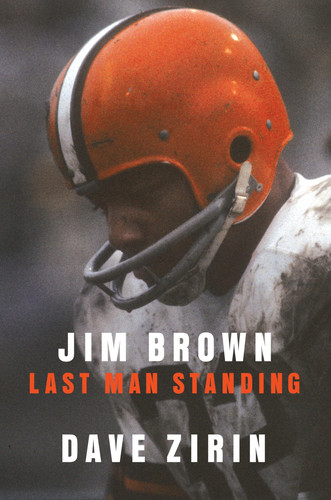
Jim Brown: last man standing

Zirin, Dave
A unique biography of Jim Brown—football legend, Hollywood star, and controversial activist—written by acclaimed sports journalist Dave Zirin. Jim Brown is recognized as perhaps the greatest football player to ever live. But his phenomenal nine-year career with the Cleveland Browns is only part of his remarkable story, the opening salvo to a much more sprawling epic. Brown parlayed his athletic fame into stardom in Hollywood, where it was thought that he could become “the black John Wayne.” He was an outspoken Black Power icon in the 1960s, and he formed Black Economic Unions to challenge racism in the business world. For this and for his decades of work as a truce negotiator with street gangs, Brown—along with such figures as Muhammad Ali, Bill Russell, and Billie Jean King—is revered as a socially conscious athlete. On the most hypermasculine cultural canvases of the United States—NFL football, the Black Power movement, Hollywood's blaxploitation films, gang intervention both inside and outside prison walls—Jim Brown has made his mark. Yet in the landscape of the most toxic expression of “what makes a man”—numerous accusations of violence against women—he has left a jagged mark as well. Dave Zirin's book redefines an American icon, and not always in a flattering light. At eighty-one years old, Brown continues to speak out and look for fights. His recent public support of Donald Trump and criticism of Colin Kaepernick are just the latest examples of someone who seems restless if he is not in conflict. Jim Brown is a raw and thrilling account of Brown's remarkable life and a must-read for sports fans and students of the black freedom struggle.
Blue Rider Press 2018-05-15 320 pages

The Romanovs: 1613-1918

Sebag Montefiore, Simon
The Romanovs were the most successful dynasty of modern times, ruling a sixth of the world's surface for three centuries. How did one family turn a war-ruined principality into the world's greatest empire? And how did they lose it all? This is the intimate story of twenty tsars and tsarinas, some touched by genius, some by madness, but all inspired by holy autocracy and imperial ambition. Simon Sebag Montefiore's gripping chronicle reveals their secret world of unlimited power and ruthless empire-building, overshadowed by palace conspiracy, family rivalries, sexual decadence and wild extravagance, with a global cast of adventurers, courtesans, revolutionaries and poets, from Ivan the Terrible to Tolstoy and Pushkin, to Bismarck, Lincoln, Queen Victoria and Lenin. To rule Russia was both imperial-sacred mission and poisoned chalice: six of the last twelve tsars were murdered. Peter the Great tortured his own son to death while making Russia an empire, and dominated his court with a dining club notable for compulsory drunkenness, naked dwarfs and fancy dress. Catherine the Great overthrew her own husband (who was murdered soon afterward), enjoyed affairs with a series of young male favorites, conquered Ukraine and fascinated Europe. Paul I was strangled by courtiers backed by his own son, Alexander I, who in turn faced Napoleon's invasion and the burning of Moscow, then went on to take Paris. Alexander II liberated the serfs, survived five assassination attempts and wrote perhaps the most explicit love letters ever composed by a ruler. The Romanovs climaxes with a fresh, unforgettable portrayal of Nicholas II and Alexandra, the rise and murder of Rasputin, war and revolution--and the harrowing massacre of the entire family. Dazzlingly entertaining and beautifully written from start to finish, The Romanovs brings these monarchs--male and female, great and flawed, their families and courts--blazingly to life. Drawing on new archival research, Montefiore delivers an enthralling epic of triumph and tragedy, love and murder, encompassing the seminal years 1812, 1914 and 1917, that is both a universal study of power and a portrait of empire that helps define Russia today.
Alfred A. Knopf 2016 744 pages

William Howard Taft

Rosen, Jeffrey
The only man to serve as president and chief justice, who approached every decision in constitutional terms, defending the Founders’ vision against new populist threats to American democracy William Howard Taft never wanted to be president and yearned instead to serve as chief justice of the United States. But despite his ambivalence about politics, the former federal judge found success in the executive branch as governor of the Philippines and secretary of war, and he won a resounding victory in the presidential election of 1908 as Theodore Roosevelt’s handpicked successor. In this provocative assessment, Jeffrey Rosen reveals Taft’s crucial role in shaping how America balances populism against the rule of law. Taft approached each decision as president by asking whether it comported with the Constitution, seeking to put Roosevelt’s activist executive orders on firm legal grounds. But unlike Roosevelt, who thought the president could do anything the Constitution didn’t forbid, Taft insisted he could do only what the Constitution explicitly allowed. This led to a dramatic breach with Roosevelt in the historic election of 1912, which Taft viewed as a crusade to defend the Constitution against the demagogic populism of Roosevelt and Woodrow Wilson. Nine years later, Taft achieved his lifelong dream when President Warren Harding appointed him chief justice, and during his years on the Court he promoted consensus among the justices and transformed the judiciary into a modern, fully equal branch. Though he had chafed in the White House as a judicial president, he thrived as a presidential chief justice.
Times Books, Henry Holt and Company 2018-03-20 183 pages