5744 results for "Literature"

Buddy Rich's Modern Interpretation

Buddy Rich
(Music Sales America). Buddy Rich's Modern Interpretation of Snare Drum Rudiments contains systematic instruction for the beginner student who wants to learn to play drums. It is also a great value to the teacher and professional drummer who wishes to increase his knowledge of rudiments. In addition to the elementary principles of music, there are 83 lessons of exercises and rudiments, 21 reading exercises, 10 exercises employing rudiments and advanced rhythmic studies. Mr. Rich's ability and genius in the drum world make this tutorial one of the landmarks of drum literature. In this 2-DVD edition, Ted MacKenzie reveals for the first time the Rich-Adler technique as it was intended. Making it accessible to all drummers, beginners and advanced alike. The DVDs include demonstrations of all the basic drum lessons and rudiments. DVD 1 includes the lessons played in non-bounce, matched technique format; DVD 2 includes the lessons played in bounce, traditional technique format.
EMI Music Publishing, Limited 1998-12 96 pages

Broken glass

Miller, Arthur
This Student Edition of Broken Glass is perfect for students of literature and drama and offers an unrivalled and comprehensive guide to Miller's play. It features an extensive introduction by Alan Ackerman which includes a chronology of Miller's life and times, a summary of the plot and commentary on the characters, themes, language, context and production history of the play. Together with over twenty questions for further study and detailed notes on words and phrases from the text, this is the definitive edition of the play. Set in Brooklyn in 1938, Broken Glass is Miller's moving study of marital relations, Jewish identity and anti-Semitism that won the Olivier Award for Best New Play in 1994. Sylvia Gellburg is stricken by a mysterious paralysis in her legs for which the doctor can find no cause. He soon realises that she is obsessed by the devastating news from Germany, where government thugs have begun smashing Jewish stores. But through a series of meetings with her husband Phillip he learns that this experience is intermeshed with their strange relationship and the deceptions and hostilities that lie at the heart of their marriage. Professor Alan Acklerman's expertly edited edition of the play provides a wide-ranging study of Kristallnacht, and of American and European responses to the Holocaust, the situation of Jews in America from the 1930s to the 1990s, the Great Depression and other Holocaust and Jewish drama.
Methuen Drama 2011 100 pages

DN Thou Shalt Not Be Aware

Miller, Alice
Child abuse is beginning to be recognized as something more significant than an isolated family affair. The title of Alice Miller's book, first published in Germany in 1981, spells out the unspoken commandment that such abused children - indeed, all of us - have been obeying since early childhood. We have all been made to feel from our earliest days that we are to blame for anything shameful that happens to us, so that our awareness of these inflicted abuses dims. Alice Miller demonstrates that this centuries-old tradition also finds expression in Freud's notions of "the Oedipus complex" and "infantile sexuality" - his drive theory - which put the blame on the child. Freud maintained that his patients who claimed to have been sexually molested as children were only "fantasizing" as a defense against their own sexual desires for their innocent parents. This theory helped to conceal the fact that sexual abuse of children occurs frequently and results in later emotional disturbances in the victims of such abuse - because they are not allowed awareness of it. In fairy tales, works of literature, and dreams, Alice Miller maintains, the truth about childhood can emerge, precisely because it is not recognized as such. Detailed examples from Kafka, Flaubert, Beckett, and Virginia Woolf offer proof of her thesis and illustrate her understanding of human creativity.
Plume 1991-10-31

A Walker in the City

Alfred Kazin
Alfred Kazin burst onto the American literary scene in 1942, when his first book, "On Native Grounds," announced the arrival of an important new literary critic. "A Walker in the City," his second, signaled the other direction his career would follow: author of several intense, intimate, and lyrical memoirs. Years later he would admit how he struggled writing it. He thought he wanted to concentrate on New York itself, describing a series of walks around the city. But what emerged was the story of his own boyhood encounters with it, starting from Brownsville, the Brooklyn Jewish neighborhood of his birth, then stretching out to alluring, mysterious Manhattan and from there to the world. Each walk is simultaneously a journey out and a journey in: outward, from the neighborhood to the land beyond, the great, electric, canyoned streets of the city; inward, into his own soul, as it grows and falls in love with books and language and literature, with music and metaphysics and politics, with the city and the country and the world and rapturously tries to take them all in.
Fine Communications 1997 176 pages

Bookends: collected intros and outros

Chabon, Michael
A brilliant, idiosyncratic collection of introductions and afterwords (plus some liner notes) by New York Times bestselling and Pulitzer Prize winning author Michael Chabon—“one of contemporary literature’s most gifted prose stylists” (Michiko Kakutani, New York Times). In Bookends, Pulitzer Prize winning author Michael Chabon offers a compilation of pieces about literature—age-old classics as well as his own—that presents a unique look into his literary origins and influences, the books that shaped his taste and formed his ideas about writing and reading. Chabon asks why anyone would write an introduction, or for that matter, read one. His own daughter Rose prefers to skip them. Chabon's answer is simple and simultaneously profound: "a hope of bringing pleasure for the reader." Likewise, afterwords—they are all about shared pleasure, about the "pure love" of a work of art that has inspired, awakened, transformed the reader. Ultimately, this thought-provoking compendium is a series of love letters and thank-you notes, unified by the simple theme of the shared pleasure of discovery, whether it's the boyhood revelation of the most important story in Chabon's life (Ray Bradbury's "The Rocket Man"); a celebration of "the greatest literary cartographer of the planet Mars" (Edgar Rice Burroughs, with his character John Carter); a reintroduction to a forgotten master of ghost stories (M. R. James, ironically "the happiest of men"); the recognition that the worlds of Wes Anderson's films are reassembled scale models of our own broken reality (as is all art); Chabon's own rude awakening from the muse as he writes his debut novel, The Mysteries of Pittsburgh; or a playful parody of lyrical interpretation in the liner notes for Mark Ronson's Uptown Special, the true purpose of which, Chabon insists, is to "spread the gospel of sensible automotive safety and maintenance practices." Galaxies away from academic or didactic, Bookends celebrates wonder—and like the copy of The Phantom Tollbooth handed to young Michael by a friend of his father he never saw again—it is a treasured gift.
Harper Perennial 2019-01-22 175 pages

More alive and less lonely: on books and writers

Lethem, Jonathan
"A collection of bestselling, NBCC prize-winning author Jonathan Lethem's finest writing on the subject of writers and writing. A readerly wake-up call from one of America's finest and most acclaimed working writers. Picking up where his NBCC Award finalist collection The Ecstasy of Influence left off, More Alive and Less Lonely collects more than a decade of Lethem's finest writing on writing, with new and previously unpublished material, including: impassioned appeals for forgotten writers and overlooked books, razor-sharp essays, and personal accounts of his most extraordinary literary encounters and discoveries. Only Lethem, with his love of cult favorites and the canon alike, can write with equal insight about the stories of modern masters like Lorrie Moore and Salman Rushdie, graphic novelist Chester Brown, science fiction outlier Philip K. Dick, and classic icons like Moby-Dick. Edited by novelist Christopher Boucher (Golden Delicious), More Alive and Less Lonely deserves a place on every serious reader's bookshelf. Lethem's joyful approach to literature will inspire you to dive back into your favorite books and then point you towards what to read next"--
Melville House 2017 300 pages

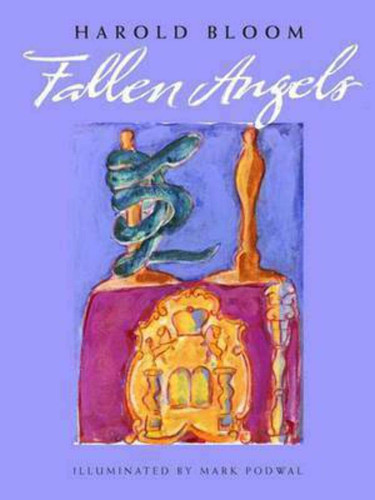
Fallen angels

Bloom, Harold
Harold Bloom, our preeminent literary critic, essays to explain the meaning of angels in world literature In this lovely gift book published for the holiday season, Harold Bloom again combines his lifelong interests in religion and literature. He begins by observing our present-day obsession with angels, which reached its greatest intensity as the current millennium approached. For the most part, these popular angels are banal, even insipid. Bloom is especially concerned with a particular subspecies of angels: fallen angels. He proceeds to examine representations of fallen angels from Zoroastrian texts and the Bible to Milton's Paradise Lost to Tony Kushner's Angels in America, arguing that familiarity with this rich literary tradition improves our reading and spiritual lives. Bloom's text is accompanied by more than a dozen original watercolors, line drawings, and illuminated letters by award-winning artist Mark Podwal. Every angel is terrifying, Rilke wrote. For Bloom, too, this is true in one sense, since he maintains that all angels are fallen angels. The image of Satan, the greatest of fallen angels, retains the ability to fascinate and frighten us, he argues, because we share a close kinship with him. Indeed, from a human perspective, we must agree that we are fallen angels. Fallenness is ultimately a human condition: the recognition of our own mortality. Throughout world literature angels have always served as metaphors for death. We may take consolation, however, in our double awareness that angels also represent love and the celebration of human possibilities.
Yale University Press 2007-10-30 71 pages

The Diaries of Franz Kafka

Franz Kafka
A NEW YORK TIMES BEST BOOK OF THE YEAR • An essential new translation of the author’s complete, uncensored diaries—a revelation of the idiosyncrasies and rough edges of one of the twentieth century’s most influential writers. “An invaluable addition to Kafka’s oeuvre.”— The New York Times An essential new translation of Franz Kafka’s complete, uncensored diaries—a revelation of the idiosyncrasies and rough edges of one of the twentieth century’s most important, influential, and visionary writers Dating from 1909 to 1923, Franz Kafka’s Diaries contains a broad array of writing, including accounts of daily events, assorted reflections and observations, literary sketches, drafts of letters, records of dreams, and unrevised texts of stories. This volume makes available for the first time in English a comprehensive reconstruction of Kafka’s handwritten diary entries and provides substantial new content, restoring all the material omitted from previous publications—notably, names of people and undisguised details about them, a number of literary writings, and passages of a sexual nature, some of them with homoerotic overtones. By faithfully reproducing the diaries’ distinctive— and often surprisingly unpolished—writing as it appeared in Kafka’s notebooks, translator Ross Benjamin brings to light not only the author’s use of the diaries for literary invention and unsparing self-examination but also their value as a work of genius in and of themselves.
Random House 2024-09-03 704 pages

Gabriële

Berest, Anne,Berest, Claire
"The year is 1908, the height of the Belle Époque, and a brilliant, young French woman named Gabriële, newly graduated from the most elite music school in Europe, meets a volcanic Spanish artist named Francis. Following a whirlwind romance, they marry and fall headlong into a Paris that is experimenting with new forms of living, thinking, and creating. Soon after marrying Francis, Gabriële meets Marcel, another young artist, five years her junior. Soon, Francis, Marcel, and Gabriële are all involved in a fervent affair that will change the course of art history and redefine the avant-garde. As the Belle Époque gives way to rebellion and revolution, and the world descends into the devastation of World War I, Francis Picabia, Marcel Duchamp, and Gabriële Buffet revolutionize art and open up new ways of seeing and thinking, along the way posing a vital question for their age and ours: what is the connection between new ways of loving and new ways of creating? Moving between Paris, New York, Berlin, Zurich, Barcelona, London, and Saint-Tropez, Gabriële is as audacious, uninhibited, intimate, and unforgettable as its central character, the mercurial, pioneering Gabriële Buffet."--
Europa Editions 2025-04-22 350 pages

J.M. Coetzee and ethics: philosophical perspectives on literature

Anton Leist,Peter Singer
In 2003, South African writer J. M. Coetzee was awarded the Nobel Prize in Literature for his riveting portrayals of racial repression, sexual politics, the guises of reason, and the hypocrisy of human beings toward animals and nature. Coetzee was credited with being "a scrupulous doubter, ruthless in his criticism of the cruel rationalism and cosmetic morality of western civilization." The film of his novel Disgrace , starring John Malkovich, brought his challenging ideas to a new audience. Anton Leist and Peter Singer have assembled an outstanding group of contributors who probe deeply into Coetzee's extensive and extraordinary corpus. They explore his approach to ethical theory and philosophy and pay particular attention to his representation of the human-animal relationship. They also confront Coetzee's depiction of the elementary conditions of life, the origins of morality, the recognition of value in others, the sexual dynamics between men and women, the normality of suppression, and the possibility of equality in postcolonial society. With its wide-ranging consideration of philosophical issues, especially in relation to fiction, this volume stands alone in its extraordinary exchange of ethical and literary inquiry.
Columbia University Press 2010 400 pages

The future of science is female: the brilliant minds shaping the 21st century

Stone, Zara
The Future of science is female, by award-winning journalist Zara Stone, shares the fascinating stories of how diverse and powerful women have (and continue to) shape science and humanity. Filled with real-life inspiration for today's amazing girls, these stories show how women can break gender norms and succeed in the "traditionally masculine" fields of coding, science, robotics, and beyond! Learn about the challenges and adventures everyday heroes face as they race to fix everything the world has messed up.--
Mango Publishing Group 2020 145 pages

Looking at Lincoln

Kalman, Maira
A brief look at the life of United States president Abraham Lincoln. Celebrate Lincoln's remarkable life in a fresh and exciting way. In this picture book Lincoln's legacy is everywhere. But who was he, really? Among the many other things, we discover our sixteenth president was a man who believed in freedom for all, had a dog named Fido, loved Mozart, apples, and his wife's vanilla cake, and kept his notes in his hat.
Puffin Books 2017-01-03 48 pages

Action optical illusions

Seckel, Al
How can a flat page have pictures that actually seem to move ? That's what these 90 action illusions--the largest such compilation ever assembled--succeed in doing. Through the magic of visual effects, including the careful use of color and brightness, static images become animated and solid shapes deform right before your eyes. Some of the illusions appear to hover in the air; others produce afterimages of bright color or produce a sensation of swirling. In a number of cases, it's necessary to shift the entire page to get the trick, or to use peripheral vision for the full effect. You'll be stunned as perfect squares appear out of nowhere, patterns pulse, and yellow dots flash.
Sterling Pub 2005 96 pages