1644 results for "Biography"

Musts, maybes, and nevers: a book about the movies

Picker, David V.
"From James Bond to the Beatles, from Saturday Night Fever to Grease, from Daniel Day-Lewis to Dustin Hoffman, from Steve Martin to Cheech and Chong. As president of United Artists, Paramount, and Columbia, producer of The Jerk, Lenny, and The Crucible, [David Picker's] seen it all, loved it all (well, most of it), and now he's sharing it all. When the show is over you will have learned about the deals, the hits, the flops, the good guys, the bad guys, and all the rest"--Amazon.com.
CreateSpace Independent Publishing 2013 330 pages

Love and struggle: my life in SDS, the Weather Underground, and beyond

Gilbert, David
"Written from the maximum-security prison where he has lived for almost 30 years, this enlightening memoir chronicles the militant career of David Gilbert, a radical activist whose incarceration is due to his involvement in the 1981 Brinks robbery, an attempted expropriation that resulted in four deaths. From his entry into the world of political activism as the founder of Students for a Democratic Society at Columbia University to his departure from public life in order to help build the clandestine resistance to war and racism known as the Weathermen, Gilbert relates all of the victories he has achieved and obstacles he has encountered during his struggle to build a new world. In telling the intensely personal story he is stripped of all illusions and assesses his journey from liberal to radical to revolutionary with rare humor and frankness"--Amazon.com, viewed March 2, 2012.
PM Press 2012 336 pages

Getting to the heart of the matter: my 36 years in the Senate

Levin, Carl
"Representing Michigan for thirty-six years in the U.S. Senate, Carl Levin, the longest-serving senator in Michigan history, was known for his dogged pursuit of the truth, his commitment to holding government accountable, and his basic decency. Getting to the Heart of the Matter: My 36 Years in the Senate is his story - from his early days in Detroit as the son of a respected lawyer to the capstone of his career as chair of both the Senate Armed Services Committee and the Senate Permanent Subcommittee on Investigations. Levin's career placed him at the center of some of our nation's most critical points in modern times: from the aftermath of the 1967 Detroit riots, to the Clinton impeachment, through 9/11 and the wars in Iraq and Afghanistan, and the 2008 financial crisis. He met with numerous world leaders, including Egypt's Anwar Sadat and China's Jiang Zemin. Getting to the Heart of the Matter recounts Levin's experiences, thoughts, and actions during these historic moments. Consisting of seventeen chapters, the book takes the reader through Levin's early life in Detroit of the 1940s, 50s, and 60s where he met his wife, started a family, practiced law and served as the first General Counsel for the newly created Michigan Civil Rights Commission and the chief appellate defender for Detroit's Legal Aid Office. Elected to the Detroit City Council in 1969, where Levin served for eight years including four as Council president, the book describes how his fight against the Department of Housing and Urban Development's devastating housing practices in the neighborhoods of Detroit led him to run for the U.S. Senate with a pledge to make government work more effectively. Winning election six times, Levin had an illustrious career in the Senate where he challenged leaders in government and the private sector for the greater good of the nation. Levin describes how, as a Democrat, throughout his time in the Senate, he worked with Republican senators who often held different policy positions in order to find common ground to achieve national goals, and how he and his Senate staff searched for creative solutions to trade issues, support for the auto industry and manufacturing sector, U.S. military action in Iraq and Afghanistan, and efforts to protect the Great Lakes and the environment, among many other issues. Levin's hope in writing this memoir is that by sharing his deeply held beliefs about the responsibility of elected officials, the book will serve as a resource for people beginning a career in, or contemplating running for, public office. Readers with an interest in politics, history, facts, and perseverance will find kinship in this book" -- provided by the publisher
Wayne State University Press 2021 338 pages

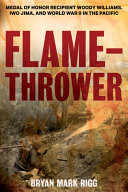
Flamethrower: Medal of Honor recipient Woody Williams, Iwo Jima, and World War II in the Pacific

Rigg, Bryan Mark
"Imagine strapping on a highly flammable 70-pound pack and entering combat as a surefire walking target-and you'd only begin to understand the job, and the horror, of Marine Corps flamethrower man. That's precisely what Hershel "Woody" Williams did in World War II, most importantly in February 1945 on Iwo Jima, one of the Pacific War's toughest battles. A few days into the battle, Marines were fighting hard for an airfield, and his captain asked Woody if he could do anything. He responded, "I'll try"-and for the next four hours, he virtually singlehandedly took on and ultimately destroyed seven enemy pillboxes and helped secure the airfield. Accomplished military historian Bryan Mark Rigg reconstructs Williams' remarkable story, from his youth in West Virginia to his experiences on Guadalcanal, Saipan, Guam, and most significantly Iwo Jima. In Rigg's telling, Williams's Medal of Honor action is not "just" a brave deed, but one of only a few strategically significant brave deeds-one that secured a strategic objective during a major campaign. Rigg tells Williams' story vividly, and objectively, and places it in the context of the broader Pacific theater of World War II."--
Stackpole Books 2020 544 pages

Just kids from the Bronx: telling it the way it was : an oral history

Alda, Arlene
"A down-to-earth, inspiring book about the American promise fulfilled." -President Bill Clinton "Fascinating . . . . Made me wish I had been born in the Bronx." -Barbara Walters A touching and provocative collection of memories that evoke the history of one of America's most influential boroughs-the Bronx-through some of its many success stories The vivid oral histories in Arlene Alda's Just Kids from the Bronx reveal what it was like to grow up in the place that bred the influencers in just about every field of endeavor. The Bronx is where Michael Kay, the New York Yankees' play-by-play broadcaster, first experienced baseball; where J. Crew's CEO Millard ("Mickey") Drexler found his ambition; where Neil deGrasse Tyson and Dava Sobel fell in love with science; and where local music making inspired singer-songwriter Dion DiMucci and hip-hop's Grandmaster Melle Mel. The parks, the pickup games, the tough and tender mothers, the politics, the gangs, the food-for people who grew up in the Bronx, childhood recollections are fresh. Arlene Alda's own Bronx memories were a jumping-off point from which to reminisce with a nun, a police officer, an urban planner, and with Al Pacino, Carl Reiner, Colin Powell, Maira Kalman, Bobby Bonilla, Mary Higgins Clark, and many other leading artists, athletes, scientists, and entrepreneurs-experiences spanning six decades of Bronx living. Alda then arranged these pieces of the past, from looking for violets along the banks of the Bronx River to the wake-up calls from teachers who recognized potential, into one great collective story, a filmlike portrait of the Bronx from the early twentieth century until today.
Henry Holt and Company 2015-03-03 310 pages

Philip Roth: stung by life

Zipperstein, Steven J.
"Philip Roth (1933-2018) is one of the most celebrated American writers of his age. Born in Newark, New Jersey -- where his short stories and thirty-one books were often set -- he wrote with immense ambition and drive, along with a keen awareness of what must be done to produce great literature. Yet despite rubbing shoulders with the Kennedys and engaging in a spate of famous and infamous romances, he viewed himself as socially withdrawn, living much like an "unchaste monk" (his words). In this original and lucid biography, Steven J. Zipperstein captures Roth's complex life and the astonishing range of his self-reflective writings-from "Goodbye, Columbus" and "Portnoy's complaint" to the Pulitzer Prize-winning "American pastoral" and "The plot against America." Employing extensive archival research and well over one hundred interviews, including conversations with Roth himself, Zipperstein provides an intimate and probing look at one of the twentieth century's most influential authors, placing his work in the context of Jewishness, freedom, and sexuality in America"-- Provided by publisher.
Yale University Press 2025-10-14 346 pages

Memoirs of war, 1914-15

Bloch, Marc
Great historians have seldom described the notable events in which they themselves participated. Marc Bloch - author of Feudal Society, the classic study of medieval social systems and co-founder of the influential French historical journal Annales - is an exception, In his powerful memoir The Strange Defeat, he analysed the fall of France in 1940 from the viewpoint of combatant as well as historian. And in his Memoirs of War, 1914-15, here in its first English translation (originally published in hard covers in 1980 by Cornell University Press), Bloch left a keen and affecting account of his earliest experience of war. Carole Fink's introduction includes a brief biography of Bloch, discusses the effect of the war upon his intellectual development, and assesses his achievements as a historian. Though Bloch survived the savage trench warfare of the First World War, he was shot by a Gestapo firing squad in 1944 for his participation in the Resistance. Trenchant, inspiring, and tersely written, Memoirs of War, 1914-15 is a monument to a great scholar and fierce patriot.
Cambridge University Press 1988 180 pages

Family sayings

Ginzburg, Natalia
Family Sayings is Natalia Ginzburg's masterpiece and a classic of contemporary Italian literature. Although it asks to be read as fiction, the author, one of Italy's finest twentieth-century writers, admits that it is highly autobiographical. The book spans the period from the rise of Fascism through World War II (in which her first husband perished at the hands of the Nazis) and its aftermath. Its subject is the other people in Ginzburg's family. Woven around the inconsequential, revealing remarks that are repeated in a family until they become its affectionate private code, rich in memory and association, this is one of the rare true evocations of a family in modern literature. Family Sayings is at the same time a living history that documents the life of the assimilated Jewish Ginzburg family and the culture to which they belonged. Winner of the Strega Prize-Italy's Pulitzer for literature-this intimate and candid portrait is no less relevant today than when it was first published in 1963. --
Arcade Pub 2013 181 pages

Shut up, I'm talking: and other diplomacy lessons I learned in the Israeli government : a memoir

Levey, Gregory
"Shut Up, I'm Talking" is a smart, hilarious insider take on Israeli politics that reads like the bastard child of Thomas Friedman and David Sedaris. Now a political writer for Salon, Gregory Levey stumbled into a job as speechwriter for the Israeli delegation to the United Nations at age twenty-five and suddenly found himself, like a latter-day Zelig, in the company of foreign ministers, U.S. senators, and heads of state. Much to his surprise, he was soon attending U.N. sessions and drafting official government statements. The situation got stranger still when he was transferred to Jerusalem to write speeches for Prime Minister Ariel Sharon. "Shut Up, I'm Talking" is a startling account of Levey's journey into the nerve center of Middle Eastern politics at one of the most turbulent times in Israeli history. During his three years in the Israeli government, the Second Intifada continued on in fits and starts, Yasser Arafat died, Hamas came to power, and Ariel Sharon fell into a coma. Levey was repeatedly thrust into highly improbable situations -- from being the sole "Israeli" delegate (even though he's Canadian) at the U.N. General Assembly, with no idea how "his" country wanted to vote; to nearly inciting an international incident with his high school French translation of an Arab diplomat's anti-Israel remarks; to communicating with Israeli intelligence about the suspected perpetrators of suicide bombings; to being offered leftover salami from Ariel Sharon's lunch. As Levey got better acquainted with the personalities in the government's inner sanctum, he witnessed firsthand the improvisational and ridiculously casual nature of the country's behind-the-scenes leadership -- and realized that he wasn't the only one faking his way through politics. With sharp insight and great appreciation for the absurd, Levey offers the first-ever look inside Israel's politics from the perspective of a complete outsider, ultimately concluding that the Israeli government is no place for a nice Jewish boy.
Free Press 2008-04-22 267 pages

The shadow president: Ted Kennedy in opposition

Hersh, Burton
At the heart of The Shadow President is a controversial idea - that, more than is brothers, Ted Kennedy has come to be the most influential political figure of this generation. His challenge to Jimmy Carter in the 1980 primaries, his bitter rearguard defense of social programs during the Reagan-Bush years, and the many upheavals in his personal life are all fully treated here.
Steerforth Press 1997-05-01 219 pages

The Beatles White album and the launch of Apple

Bruce Spizer
"The Beatles White Album and the Launch of Apple " is the tenth book on the Beatles by critically acclaimed Beatles author/historian Bruce Spizer. His latest book covers all aspects of the Beatles 1968 double album titled "The Beatles," but more commonly referred to as "The White Album" due to its pure white cover. The book opens with chapters of the start of Apple and the first four singles released by Apple, including the Beatles single "Hey Jude"/"Revolution." The book then moves on to chapters about how "The White Album" was received upon its release in the U.S., U.K. and Canada. Other chapters deal with the turbulent year 1968, details on the recording sessions and recollections from fans. The book contains 150 color and original black and white images through.
498 Productions, L.L.C. 2018-11-22 183 pages

Greta and Cecil

Souhami, Diana
This dual biography reveals, as never before, the secret life and the extraordinary relationship of Hollywood's legendary pair: Greta Garbo and Cecil Beaton, the celebrated Hollywood photographer who immortalized her image. With provocative details about their personal lives and a subtle focus on their work, Diana Souhami divulges the secrets of Greta and Cecil's unconventional loves and obsessions. It is a compelling tale of a strange romance where boundaries merge between image and reality, fact and fantasy, male and female, and art and life. Their ardent affair, Garbo's discreet liaisons with the women she loved, and Beaton's charismatic yet emotionally distraught personality are brought to life in Diana Souhami's hallmark style. Photographs, letters, and a wealth of new research reveal the obsessions, true desires, and secrets of Hollywood behind closed doors.
HarperSanFrancisco 1994 271 pages

Legacy: one family, a cup of tea and the company that took on the world

Harding, Thomas
A panoramic new history of modern Britain, as told through the story of one extraordinary family, and one groundbreaking company. In the early 1800s, Lehmann Gluckstein and his family escaped the pogroms of Eastern Europe and made their way to Whitechapel in London's East End. There, starting with nothing, they worked tirelessly to pull themselves out of poverty, creating a small tobacco factory that grew to become the largest catering company in the world: J. Lyons. For over a century, Lyons was on every high street, in every home, in every coffee and teacup. It was an ascent from rags to riches in the face of many obstacles: poverty, hatred and anti-Semitism stood between this poor immigrant family and the British Dream. Legacy charts the rise and fall of one of the most influential dynasties in British history through the lives of five astonishing generations. Both sweeping and intimate, it is a story of sacrifice and selflessness, betrayal and personal tragedy, and Empire and its cost. It is also an illuminating new exploration of Britain and its place in the world, from the bestselling author of Hanns and Rudolf and The House by the Lake.
William Heinemann 2019 561 pages

Opening the great depths: the bathyscaph Trieste and pioneers of undersea exploration

Polmar, Norman,Mathers, Lee J.
Developed by French physicist Auguste Piccard and his son Jacques, the bathyscaph Trieste was a scientific marvel that allowed unprecedented scientific, technical, and military feats in the ocean depths. France and the United States both acquired and subsequently developed variants of the original bathyscaph. While both France and the United States employed the bathyscaph as a tool for scientific investigation of the deepest ocean depths, the U.S. Navy developed and employed the Trieste for military missions as well. From its earliest years, participants in the Trieste program realized that they were making history, blazing a trail into previously unexplored and unexploited depths, developing new capabilities and opening a new frontier. Comparisons with developments in space and the space-race between the United States and the Soviet Union often were made concerning the Trieste program and contemporary developments in undersea technologies and capabilities. The Trieste opened the entire oceans to exploration, exploitation, and operations. The bathyscaph was a first-generation system, a Model-T that spawned an entirely new industry and encouraged new concepts for deep-ocean naval operations. Advances in deep-sea technologies lacked the gee-whiz factor of the concurrent space race, but were highly significant in the development of new technology, new knowledge, and new military capabilities. Opening the Great Depths is the story of the three Trieste deep-ocean vehicles, their officers and enlisted men, and the civilians, often told in their own words, documenting for the first time the earliest years of humanity's probing into Earth's final frontier.
Naval Institute Press 2021 359 pages

The year I was Peter the Great

Kalb, Marvin L.
The year 1956 was an extraordinary year in modern Russian history. It was called "the year of the thaw"--a time when Stalin's dark legacy of dictatorship died in February only to be reborn later that December. This historic arc from rising hope to crushing despair opened with a speech by Nikita Khrushchev, then the unpredictable leader of the Soviet Union. He astounded everyone by denouncing the one figure who, up to that time, had been hailed as a "genius," a wizard of communism--Josef Stalin himself. Now, suddenly, this once unassailable god was being portrayed as a "madman" whose idiosyncratic rule had seriously undermined communism and endangered the Soviet state. This amazing switch from hero to villain lifted a heavy overcoat of fear from the backs of ordinary Russians. It also quickly led to anti-communist uprisings in Eastern Europe, none more bloody and challenging than the one in Hungary, which Soviet troops crushed at year's end. Marvin Kalb, then a young diplomatic attaché at the U.S. Embassy in Moscow, observed this tumultuous year that foretold the end of Soviet communism three decades later. Fluent in Russian, a doctoral candidate at Harvard, he went where few other foreigners would dare go, listening to Russian students secretly attack communism and threaten rebellion against the Soviet system, traveling from one end of a changing country to the other and, thanks to his diplomatic position, meeting and talking with Khrushchev, who playfully nicknamed him Peter the Great. In this, his fifteenth book, Kalb writes a fascinating eyewitness account of a superpower in upheaval and of a people yearning for an end to dictatorship
The Brookings Institution 2017-10-10 290 pages