1011 results for "Science"

Lost Tribes and Promised Lands The Origins of American Racism

Ronald Sanders
THE COMPLETE ORIGINAL EDITION! An utterly revelatory work. Unprecedented in scope, detail, and ambition. In Lost Tribes and Promised Lands, celebrated historian and cultural critic Ronald Sanders offers a compelling and ideology-shattering history of racial prejudice and myth as shaped by political, religious, and economic forces from the 14th Century to the present day. Written with clear-eyed vigor, Sanders draws on a broad history of art, psychology, politics, and religion to inform his striking and soundly-reasoned assertions. Lost Tribes and Promised Lands nimbly zig-zags through space and time, doggedly chipping away at the myopic history of discovery and righteous conquest that has been reiterated for decades by the same ideological forces responsible for centuries of mythological prejudice and racial strife. Placing 14th Century Spanish intolerance (specifically anti-Semitism) as the origins of American racism toward African and Native Americans, Sanders elegantly weaves complex threads of colonial economics, religious exceptionalism, and xenophobia into a heady and often-infuriating thesis on the history of racism. Finally back in print in a complete and cost-accessible edition (when the book was out of print, demand for this important work was so intense that used copies sold for thousands of dollars). Find out why! Lost Tribes and Promised Lands is a gripping and hegemony-exploding treatise on the history of race in the New World.
Echo Point Books and Media 2015 456 pages

One hand jerking: reports from an investigative satirist

Krassner, Paul
Counterculture legend Paul Krassner gazes on the fires of pop culture, politics and celebrity and returns unscathed to help us make sense of our senseless world, with an introduction by Lewis Black (The Daily Show) and a foreword by Harry Shearer (The Simpsons, Le Show). From cults to pornography, from Charles Manson to Homer Simpson, from the war on drugs to the invasion of Iraq, from Dolly Parton to Lenny Bruce, from circumcision to propaganda, this collection epitomizes Krassner's credo, "Irreverence is our only sacred cow."
Seven Stories Press 2005 318 pages

The American Dream in the Information Age

Otto Newman,R. De Zoysa,Richard De Zoysa
America's current transformation from an industrial to a new information-based culture presents new challenges as well as new perspectives on old debates. This book offers a comprehensive survey of America's changing values. It examines notions of American exceptionalism and how the 'melting pot' is coping with race relations and changing demographics; it assesses the agenda of government, the domestic and global constraints, and how social exclusion can be tackled. Current changes in the US are likely to be a harbinger for other societies, and the authors examine new models of civic society, of learning and of reconfiguring social values for a fast-changing world.
Palgrave Macmillan UK 1999-01-01 229 pages

With Heroic Truth The Life of Edward R. Murrow

Norman Finkelstein
Edward R. Murrow was one of America's "most dedicated and eloquent spokesmen. The people of the free world are deeply in his debt. So is broadcast journalism, which, in so many ways, he helped establish and to which he was one of the finest practitioners. He set standards of excellence that remain unsurpassed. His thoughtful spirit of inquiry, his profound insight and his single-minded devotion to quality were without parallel in radio, television or any other medium." -Memorial plaque, CBS Broadcast Center, New York City
iUniverse 2005 196 pages

God in the Machine Video Games as Spiritual Pursuit

Liel Leibovitz
What might Heidegger say about Halo, the popular video game franchise, if he were alive today? What would Augustine think about Assassin’s Creed ? What could Maimonides teach us about Nintendo’s eponymous hero, Mario? While some critics might dismiss such inquiries outright, protesting that these great thinkers would never concern themselves with a medium so crude and mindless as video games, it is important to recognize that games like these are becoming the defining medium of our time. We spend more time and money on video games than on books, television, or film, and any serious thinker of our age should be concerned with these games, what they are saying about us, and what we are learning from them. Yet video games remain relatively unexplored by both scholars and pundits alike. Few have advanced beyond outmoded and futile attempts to tie gameplay to violent behavior. With this rumor now thoroughly and repeatedly disproven, it is time to delve deeper. Just as the Museum of Modern Art in Manhattan recently acquired fourteen games as part of its permanent collection, so too must we seek to add a serious consideration of virtual worlds to the pantheon of philosophical inquiry. In God in the Machine, author Liel Leibovitz leads a fascinating tour of the emerging virtual landscape and its many dazzling vistas from which we are offered new vantage points on age-old theological and philosophical questions. Free will vs. determinism, the importance of ritual, transcendence through mastery, notions of the self, justice and sin, life, death, and resurrection all come into play in the video games that some critics so quickly write off as mind-numbing wastes of time. When one looks closely at how these games are designed, their inherent logic, and their cognitive effects on players, it becomes clear that playing these games creates a state of awareness vastly different from when we watch television or read a book. Indeed, the gameplay is a far more dynamic process that draws on various faculties of mind and body to evoke sensations that might more commonly be associated with religious experience. Getting swept away in an engaging game can be a profoundly spiritual activity. It is not to think , but rather to be , a logic that sustained our ancestors for millennia as they looked heavenward for answers. As more and more of us look “screenward,” it is crucial to investigate these games for their vast potential as fine instruments of moral training. Anyone seeking a concise and well-reasoned introduction to the subject would do well to start with God in the Machine . By illuminating both where video game storytelling is now and where it currently butts up against certain inherent limitations, Liebovitz intriguingly implies how the field and, in turn, our experiences might continue to evolve and advance in the coming years.
Templeton Press 2015-05-26 160 pages

Helen Matthews Lewis Living Social Justice in Appalachia

Helen M. Lewis
Often referred to as the leader of inspiration in Appalachian studies, Helen Matthews Lewis linked scholarship with activism and encouraged deeper analysis of the region. Lewis shaped the field of Appalachian studies by emphasizing community participation and challenging traditional perceptions of the region and its people. Helen Matthews Lewis: Living Social Justice in Appalachia , a collection of Lewis's writings and memories that document her life and work, begins in 1943 with her job on the yearbook staff at Georgia State College for Women with Mary Flannery O'Connor. Editors Patricia D. Beaver and Judith Jennings highlight the achievements of Lewis's extensive career, examining her role as a teacher and activist at Clinch Valley College (now University of Virginia at Wise) and East Tennessee State University in the 1960s, as well as her work with Appalshop and the Highland Center. Helen Matthews Lewis connects Lewis's works to wider social movements by examining the history of progressive activism in Appalachia. The book provides unique insight into the development of regional studies and the life of a dynamic revolutionary, delivering a captivating and personal narrative of one woman's mission of activism and social justice.
University Press of Kentucky 2014-01-29 276 pages

Built Before the Flood The Problem of the Tiahuanaco Ruins

H. S. Bellamy
The ancient site of Tiahuanaco in Bolivia is one of the greatest archaeological mysteries in the world. Some experts date it to 17,000 years ago, although no one has conclusively determined its age. Located at the southern end of Lake Titicaca at about 13,000 feet above sea level, one can find oceanic seashells in the area and ruins of extensive docks on an earlier shoreline. How could this be? This book takes a radical approach by presenting evidence, found at Tiahuanaco, for Earth having had a different moon in the remote past. According to the author, the gravitational pull of this moon caused higher water levels in the area. It also caused a different rotational spin of our planet that is accurately documented in the ancient calendar, found and interpreted by the author and others, that appears on the face of Tiahuanaco's most iconic landmark, the Gate of the Sun. This well researched book contains many notes, charts, and diagrams to support the author's claims, as well as an Index and Bibliography for further reference.
Book Tree 2019-10-12 208 pages

ReVisions Seeing Torah Through a Feminist Lens

Elyse Goldstein
What does it mean to re-vision Torah? "I use the title ReVisions for this book because I want readers both to revise--in the classic definition of reexamine and alter--and to see the text anew, to have a new vision, a 'revision,' of Torah.... It begins with the notion that women see the text differently than men do, ask different questions and bring different answers.... This book is not about rewriting the Torah. It is about rereading it." --from the Introduction Rabbi Elyse Goldstein--woman, rabbi, scholar, and feminist--challenges and defends, rereads and reinterprets the ancient text, revealing to modern readers a way to see Judaism anew, for a new vision--a "revision"--of the Torah. Goldstein boldly brings the Torah into a contemporary context at the same time she honestly reconciles its past.
Jewish Lights Publishing 2001 207 pages

Masala Mamas Recipes and Stories from Indian Women Changing Their Communities Through Food and Love

Elana Sztokman
In the Kalwa slum in Mumbai, India, where harsh conditions make is difficult for some children to study, an amazing group of women is working to make sure that kids go to school. Meet the Masala Mamas, 16 women who live in the Kalwa slum who are dedicating their lives to providing hot meals for kids in school. Every morning, they cook hundreds of meals -- hot, nutritious meals from fresh, local ingredients and aromatic spices. They cook with extra special love, care, and dedication because their customers are the most important people in the world: children.
Lioness Books 2022-11 232 pages

First Philosophy Lectures 1923/24 and Related Texts from the Manuscripts (1920-1925)

Edmund Husserl
This volume presents, for the first time in English, Husserl’s seminal 1923/24 lecture course First Philosophy ( Erste Philosophie ) together with a selection of material from the famous research manuscripts of the same time period. The lecture course is divided into two systematic, yet interrelated parts (“Critical History of Ideas” and “Theory of the Phenomenological Reduction”). It has long been recognized by scholars as among the most important of the many lecture courses he taught in his career. Indeed it was deemed as crucially important by Husserl himself, who composed it with a view toward eventual publication. It is unsurprising, then, that First Philosophy is the only lecture course that is consistently counted among his major works. In addition to furnishing valuable insights into Husserl’s understanding of the history of philosophy, First Philosophy is his most sustained treatment of the phenomenological reduction,the central concept of his philosophical methodology. The selection of supplemental texts expands on the topics treated in the lectures, but also add other themes from Husserl’s vast oeuvre. The manuscript material is especially worthwhile, because in it, Husserl offers candid self-criticisms of his publicly enunciated words, and also makes forays into areas of his philosophy that he was loath to publicize, lest his words be misunderstood. As Husserl’s position as a key contributor to contemporary thought has, with the passage of time, become increasingly clear, the demand for access to his writings in English has steadily grown. This translation strives to meet this demand by providing English-speaking readers access to this central Husserlian text. It will be of interest to scholars of Husserl’s work, non-specialists, and students of phenomenology.
Springer Netherlands 2020-08-10 640 pages

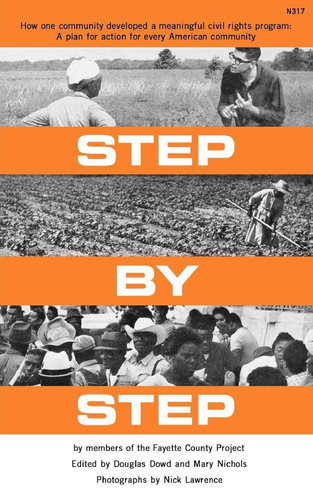
Step by Step Evolution and Operation of the Cornell Students' Civil-Rights Project in Tennessee, Summer, 1964

Douglas Dowd
The book arose out of the authors' experiences in a project which was itself unique: The Cornell-Tompkins Committee for Free and Fair Elections in Fayette County, Tennessee. The project entailed six to eight weeks of living in Fayette County by forty-five volunteers, mostly students from Cornell University, in the summer of 1964. The project was financed entirely, to an amount exceeding fifteen thousand dollars, by the contributions of students, faculty, and townspeople in and around Cornell University, and by contributions from more distant places solicited by those involved at Cornell.Of the many things learned from the Cornell project, one of the most important was how responsive a community can become when confronted with a concrete civil rights program, one with which it can identify, one small enough to be feasible and intelligible, but still compelling in terms of the needs involved.The authors believe that many thousands of Americans can find no good answer to the questions "What can I do." not because they are unwilling to do much, nor because there is little to be done, but because they lack the knowledge of what is needed where, and how and with whom one can go about responding to such needs. The book therefore undertakes, step by step, to describe and explain the development of the project at Cornell and its workings during the summer in Tennessee, and reasons that similar steps can be taken by others, with appropriate variations. It concludes with a detailed appendix listing civil rights projects and organizations desperately in need of help, whether in terms of money or volunteers or both.
W. W. Norton, Incorporated 1965-04 132 pages

Helping Young Refugees and Immigrants Succeed Public Policy, Aid, and Education

G. Holton
In a unique effort, this book brings together, for the first time, scholarly analyses by eminent researchers of the historical, social, legal, and cultural influences on the young newcomers' lives as well as reports by practitioners in major aid organizations about the concrete work that their organizations have been carrying out.
Palgrave Macmillan US 2010-10-18 316 pages

The Cancer Biopathy

Wilhelm Reich
What is cancer? Traditionally, medical science has thought of it as an invasive tumor arising spontaneously in an otherwise healthy organism. Consequently, it has naïvely devised increasingly intricate techniques to eradicate the tumor and treat its complications. These techniques have had varying degrees of success. In contrast, Reich defines cancer not as a tumor-the tumor is merely a late manifestation of the disease-but as a systemic disease due to chronic thwarting of natural sexual functioning. The ensuing biopathic shrinking of the organism is revealed initially in emotional despair and resignation, which leads eventually to a disturbance of cellular metabolism, with the tumor as its most visible manifestation. In this radically different scientific investigation of a process that ends, literally, in the putrefaction of the living body due to chronic suffocation of the tissues, Reich has arrived at the conclusion that "cancer is the most significant somatic expression of the biophysiological effect of sexual stasis." If this is so, there is a far greater possibility for the prophylaxis of cancer than for its treatment. Reich's contribution to an understanding of cancer is based on his years of clinical, social, and laboratory study of human emotions and his discovery of the specific energy processes manifested in them. A detailed account of this discovery forms the opening chapters of the book, providing the experimental and theoretical basis for the later chapters in which he presents his findings on the emotional background of the disease, the crucial role played by inadequate sexual functioning that causes a general devitalization and shrinking, the origin of the cancer cell, experimental therapy with laboratory animals and human beings, and, finally, the problems and possibilities of prevention.
WRM PRESS 2023-11-03 492 pages