2604 results for "World History"

The creation of feminist consciousness: from the Middle Ages to eighteen-seventy

Lerner, Gerda
A pioneer in women's studies and long-term activist for women's issues, and a past president of the Organization of American Historians, Gerda Lerner is one of the founders and foremost scholars of Women's History. The Creation of Patriarchy, the first book in her two-volume magnum opus Women and History (1986) received wide review attention and much acclaim, winning the prestigious Joan Kelly Prize of the American Historical Association for the best work on Women's History that year. Ms hailed the book for providing "a grand historical framework that was impossible even to imagine before the enlightenment about women's place in the world provided by her earlier work and that of other feminist scholars." New Directions for Women said it "may well be the most important work in feminist theory to appear in our generation." Patriarchy traced the development of the ideas, symbols, and metaphors by which men institutionalized their domination of women. Now, in The Creation of Feminist Consciousness, the eagerly awaited concluding volume of Women and History, Lerner documents the twelve-hundred-year struggle of women to free their minds from patriarchal thought, to create Women's History, and to achieve a feminist consciousness. In a richly documented narrative filled with inspiring portraits of women, Lerner ranges from the Middle Ages to the late 19th century, tracing several important ways by which women strove for autonomy and equality. One of the most remarkable sections examines over twelve hundred years of feminist Bible criticism. Since objections to women's thinking, teaching, and speaking in public were based on biblical authority--most notably, passages from Genesis and the writings of St. Paul--women returned again and again to these texts, in an attempt to subvert patriarchal dominance and establish their equality with men. This survey of biblical criticism allows Lerner to illustrate her most important insight--the discontinuity of women's history. She describes how women's history was not passed on from generation to generation, forcing women in effect to reinvent the wheel over and over again. In a series of fascinating portraits of individual women who resisted patriarchal indoctrination, Lerner discusses women mystics such as Hildegard of Bingen, Julian of Norwich and later Protestant mystics, and brings to life the many women of great literary talent, from Christine de Pisan to Louise Labe to Emily Dickinson, who simply bypassed patriarchal thought and created alternate worlds for themselves. Documenting the 1,200 year struggle of women to free their minds from patriarchal thought, create a women's history, and achieve a feminist consciousness, this brilliant work charts new ground for feminist theory, the history of ideas, and the development of women's place in our intellectual tradition.
Oxford University Press 1993 395 pages

Historiography in the twentieth century: from scientific objectivity to the postmodern challenge

Iggers, Georg G.
A preeminent intellectual historian here examines the profound changes in ideas about the nature of history and historiography. Georg G. Iggers traces the basic assumptions upon which historical research and writing have been based since history's emergence as a professional discipline in the nineteenth century, and describes how the newly emerging social sciences transformed historiography following World War II. The discipline's greatest challenge may have come in the last two decades, when postmodern ideas forced a reevaluation of the relationship of historians to their subject and called into question the very possibility of objective history. Iggers sees the contemporary discipline as a hybrid, moving away from a classical, macro-historical approach toward microhistory, cultural history, and the history of everyday life. Still, while the postmodern critique of traditional historiography offers important correctives to historical thought and practice, it "has not destroyed the historian's commitment to recapturing reality or his or her belief in a logic of inquiry."
Wesleyan University Press, published by University Press of New England 1997 182 pages

You say you want a revolution? radical idealism and its tragic consequences

Chirot, Daniel
"This book poses the question of why revolutions--from the French Revolution through the Russian and more recent revolutions--tend to produce tragic outcomes. As the author puts it: 'I have become intrigued with the idea of writing a short book on why so many revolutions turn into bloody catastrophes. Though a huge amount has obviously been written about revolutions, I think a good short review of why they so often disappoint so badly could find a good audience. Of course the planned book would not please those with different views. I want to insist on the contingent nature of what happened rather than seeing revolutions in a Marxist way as necessary and inevitable steps toward world historical progress. I also believe that key individuals make a big difference, so the purely structural analyses that predominate in sociology and political science lack an important element. Then, too, the age of revolutions is far from over, and while I don't really think that history repeats itself, there are recurrent patterns to watch out for.' Chirot proceeds by exploring the combination of extremism and incompetence that characterize most revolutionary movements, the effects of counter-revolutionary forces in complications post-revolutionary regimes, the often tyrannical application of idealistic norms on societies experiencing revolutionary change, and the corruption and oppression that often characterize post-revolutionary regimes. He plans to end the book with a chapter on what can be learned from his study with respect to future revolutionary movement"--
Princeton University Press 2020-03-03 171 pages

New York mid-century: post-war capital of culture, 1945-1965

Cohen-Solal, Annie,Goldberger, Paul,Gottlieb, Robert
This is the story of how the Big Apple emerged as the cultural capital of the postwar world in all fields of creative endeavour art, architecture, design, music, theatre and dance. It was a period of intense cross-fertilization, as poets and critics mixed with artists, dealers, musicians, designers, architects, dancers, and choreographers. Richly illustrated with hundreds of paintings, drawings, photographs, elevations, plans, posters, programmes and ephemera, this is a stirring evocation of a remarkably fertile period in the city's history, the styles and aesthetics of which are now very much back in vogue
Thames & Hudson 2014 399 pages

Prague in danger: the years of German occupation, 1939-45 : memories and history, terror and resistance, theater and jazz, film and poetry, politics and war

Demetz, Peter
A dramatic account of life in Czechoslovakia's great capital during the Nazi Protectorate With this successor book to Prague in Black and Gold, his account of more than a thousand years of Central European history, the great scholar Peter Demetz focuses on just six short years--a tormented, tragic, and unforgettable time. He was living in Prague then--a "first-degree half-Jew," according to the Nazis' terrible categories--and here he joins his objective chronicle of the city under German occupation with his personal memories of that period: from the bitter morning of March 15, 1939, when Hitler arrived from Berlin to set his seal on the Nazi takeover of the Czechoslovak government, until the liberation of Bohemia in April 1945, after long seasons of unimaginable suffering and pain. Demetz expertly interweaves a superb account of the German authorities' diplomatic, financial, and military machinations with a brilliant description of Prague's evolving resistance and underground opposition. Along with his private experiences, he offers the heretofore untold history of an effervescent, unstoppable Prague whose urbane heart went on beating despite the deportations, murders, cruelties, and violence: a Prague that kept its German- and Czech-language theaters open, its fabled film studios functioning, its young people in school and at work, and its newspapers on press. This complex, continually surprising book is filled with rare human detail and warmth, the gripping story of a great city meeting the dual challenge of occupation and of war.
Farrar, Straus and Giroux 2008-04-15 274 pages

GI Jews: how World War II changed a generation

Moore, Deborah Dash
Whether they came from Sioux Falls or the Bronx, over half a million Jews entered the U.S. armed forces during the Second World War. Uprooted from their working- and middle-class neighborhoods, they joined every branch of the military and saw action on all fronts. Deborah Dash Moore offers an unprecedented view of the struggles these GI Jews faced, having to battle not only the enemy but also the prejudices of their fellow soldiers. Through memoirs, oral histories, and letters, Moore charts the lives of fifteen young Jewish men as they faced military service and tried to make sense of its demands. From confronting pork chops to enduring front-line combat, from the temporary solace of Jewish worship to harrowing encounters with death camp survivors, we come to understand how these soldiers wrestled with what it meant to be an American and a Jew. Moore shows how military service in World War II transformed this generation of Jews, reshaping Jewish life in America and abroad. These men challenged perceptions of Jews as simply victims of the war, and encouraged Jews throughout the diaspora to fight for what was right. At the same time, service strengthened Jews' identification with American democratic ideals, even as it confirmed the importance of their Jewish identity. GI Jews is a powerful, intimate portrayal of the costs of a conflict that was at once physical, emotional, and spiritual, as well as its profound consequences for these hitherto overlooked members of the "greatest generation."
Belknap 2006-04 368 pages

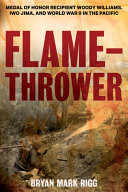
Flamethrower: Medal of Honor recipient Woody Williams, Iwo Jima, and World War II in the Pacific

Rigg, Bryan Mark
"Imagine strapping on a highly flammable 70-pound pack and entering combat as a surefire walking target-and you'd only begin to understand the job, and the horror, of Marine Corps flamethrower man. That's precisely what Hershel "Woody" Williams did in World War II, most importantly in February 1945 on Iwo Jima, one of the Pacific War's toughest battles. A few days into the battle, Marines were fighting hard for an airfield, and his captain asked Woody if he could do anything. He responded, "I'll try"-and for the next four hours, he virtually singlehandedly took on and ultimately destroyed seven enemy pillboxes and helped secure the airfield. Accomplished military historian Bryan Mark Rigg reconstructs Williams' remarkable story, from his youth in West Virginia to his experiences on Guadalcanal, Saipan, Guam, and most significantly Iwo Jima. In Rigg's telling, Williams's Medal of Honor action is not "just" a brave deed, but one of only a few strategically significant brave deeds-one that secured a strategic objective during a major campaign. Rigg tells Williams' story vividly, and objectively, and places it in the context of the broader Pacific theater of World War II."--
Stackpole Books 2020 544 pages

Imperfect justice: looted assets, slave labor, and the unfinished business of World War II

Eizenstat, Stuart
A personal memoir by Eizenstat, who served under President Carter in several capacities, including secretary of state on Holocaust issues, relating his experiences in negotiations with governments of and/or business representatives from Switzerland, Austria, France, and Germany to pay compensation to Holocaust victims or their heirs for looted property and for suffering (slave labor) under the Nazis. Swiss gold, stolen art, and other stolen property of individuals and communities were finally repaid through agreements reached or encouraged by U.S. class-action suits. In addition to the "imperfect justice" of financial recompense, notes the moral success of furthering the truth and inspiring international efforts at Holocaust education. also discusses the author's role in helping establish the U.S. Holocaust Memorial Museum.
Public Affairs 2003 401 pages

Hitler's spies: German military intelligence in World War II

Kahn, David
A German patrol wiggles through Russian lines to return with details of Soviet defenses. An expert Luftwaffe interrogator teases secret information from downed Allied airmen. Two spies steal ashore in Maine and make their way into New York City. Filled with episodes of intrigue and adventure, Hitler's Spies reveals the workings of German intelligence-the famed Abwehr, the dreaded SD, the codebreakers, the spies, and the intelligence gatherers of the Foreign Office-and explains its failure to best the Allies. Draws on original documents and extensive interviews.
Macmillan 1978 671 pages

Jewish reactions to the Holocaust

Bauer, Yehuda
A revised version of two courses of lectures delivered as part of the Broadcast University series of Israel Army Radio. Discusses the struggle of Jews for survival under Nazi rule, and attempts at aid and rescue by Jews in the Western democracies and Palestine, by foreign governments, and by "Righteous Gentiles". Emphasizes that the Nazis decided to murder all the Jews only in autumn 1940; until then no one could have foreseen the Holocaust to come. When the first reports of mass murder were received, they met with disbelief on the part of most Jews as well as non-Jews. This lack of awareness explains why the potential victims were slow to escape or resist; and, in conjunction with the prevalence of antisemitism and the political impotence of world and Palestinian Jewry, it also explains the failure of the outside world to come to their rescue. Among the topics covered are the search for countries of asylum; the Transfer Agreement; illegal immigration to Palestine; the ghettos and the Judenräte; the resistance groups and armed uprisings in the ghettos; Jewish partisans; underground rescue groups; negotiations with SS functionaries for Jewish lives; and the British Foreign Office's blocking of rescue proposals.
MOD Books 1989 226 pages

Mirrors of destruction: war, genocide, and modern identity

Bartov, Omer
Reflects on the interrelationship between war, genocide, and identity in the 20th century. Contends that World War I provided a pattern for the industrial killing that reached its apex in the Nazi Holocaust. Comparing France and Germany, both of which looked for an "elusive enemy" to help them cope with the trauma of World War I, notes that Germany found it in the Jews. This perception allowed the Germans to see themselves as victims and their actions against the Jews as self-defense. The search for "elusive enemies" (to blame for perpetrating the genocide) and "elusive victims" (e.g. the French or German people) continued after the war. Compares the French, German, and Jewish postwar discourses of the Holocaust. Presenting themselves as the main victims of Nazism, the French and Germans have tended to neglect Jews as the main victims. Criticizes writings by Hannah Arendt, Ka-Tzetnik, and some other postwar writers on the Holocaust and its roots.
Oxford University Press 2000 302 pages

Maimonides: life and thought

Halbertal, Moshe
Maimonides was the greatest Jewish philosopher and legal scholar of the medieval period, a towering figure who has had a profound and lasting influence on Jewish law, philosophy, and religious consciousness. This book provides a comprehensive and accessible introduction to his life and work, revealing how his philosophical sensibility and outlook informed his interpretation of Jewish tradition. Moshe Halbertal vividly describes Maimonides's childhood in Muslim Spain, his family's flight to North Africa to escape persecution, and their eventual resettling in Egypt. He draws on Maimonides's letters and the testimonies of his contemporaries, both Muslims and Jews, to offer new insights into his personality and the circumstances that shaped his thinking. Halbertal then turns to Maimonides's legal and philosophical work, analyzing his three great books - Commentary on the Mishnah, the Mishneh Torah, and the Guide of the Perplexed. He discusses Maimonides's battle against all attempts to personify God, his conviction that God's presence in the world is mediated through the natural order rather than through miracles, and his locating of philosophy and science at the summit of the religious life of Torah. Halbertal examines Maimonides's philosophical positions on fundamental questions such as the nature and limits of religious language, creation and nature, prophecy, providence, the problem of evil, and the meaning of the commandments. A stunning achievement, Maimonides offers an unparalleled look at the life and thought of this important Jewish philosopher, scholar, and theologian.
Princeton University Press 2015-06-02 385 pages

Evolution and Culture

Marshall David Sahlins,Thomas G. Harding
About the Book Books about Civilization are concerned with the development of structured societies that grow to require urban planning, develop social and cultural elites, and forms of writing for record keeping, complex organization and transfer of ideas. Almost invariably, the process of civilization results in the growth of empires, and subjugation of less civilized peoples. Titles include: Ancient Man: The Beginning of Civilizations, Syllabus: Introduction to the History of European Civilization, Evolution and Culture, The Pivot of Civilization, The Western Hemisphere Idea: Its Rise and Decline, The decay of capitalist civilisation, and The fate of empires; being an inquiry into the stability of civilisation. About us Trieste Publishing's aim is to provide readers with the highest quality reproductions of fiction and non-fiction literature that has stood the test of time. Our titles are produced from scans of the original books and as a result may sometimes have imperfections. To ensure a high-quality product we have: thoroughly reviewed every page of all the books in the catalog repaired some of the text in some cases, and rejected titles that are not of the highest quality. You can look up "Trieste Publishing" in categories that interest you to find other titles in our large collection. Come home to the books that made a difference
Trieste Publishing Pty Limited 2017-09-26 156 pages

Stories of the Babylonian Talmud

Rubenstein, Jeffrey L.
Jeffrey L. Rubenstein continues his grand exploration of the ancient rabbinic tradition of the Talmudic sages, offering deep and complex analysis of eight stories from the Babylonian Talmud to reconstruct the cultural and religious world of the Babylonian rabbinic academy. Rubenstein combines a close textual and literary examination of each story with a careful comparison to earlier versions from other rabbinic compilations. This unique approach provides insight not only into the meaning and content of the current forms of the stories but also into how redactors reworked those earlier versions to address contemporary moral and religious issues. Rubenstein's analysis uncovers the literary methods used to compose the Talmud and sheds light on the cultural and theological perspectives of the Stammaim — the anonymous editor-redactors of the Babylonian Talmud. Rubenstein also uses these stories as a window into understanding more broadly the culture of the late Babylonian rabbinic academy, a hierarchically organized and competitive institution where sages studied the Torah. Several of the stories Rubenstein studies here describe the dynamics of life in the academy: master-disciple relationships, collegiality and rivalry, and the struggle for leadership positions. Others elucidate the worldview of the Stammaim, including their perspectives on astrology, theodicy, and revelation.
Johns Hopkins University Press 2010-07-12 316 pages

The bomb

Zinn, Howard
As an active WWII bombardier returning from the end of the war in Europe and preparing for combat in Japan, Howard Zinn read the headline "Atomic Bomb Dropped on Japan" and was glad—the war would be over. "Like other Americans," writes Zinn, "I had no idea what was going on at the higher levels, and had no idea what that 'atomic bomb' had done to men, women, children in Hiroshima, any more than I ever really understood what the bombs I dropped on European cities were doing to human flesh and blood." During the war, Zinn had taken part in the aerial bombing of Royan, France, and in 1966, he went to Hiroshima, where he was invited to a "house of rest" where survivors of the bombing gathered. In this short and powerful book, the backstory of the making and use of the bomb, Zinn offers his deep personal reflections and political analysis of these events, and the profound influence they had in transforming him from an order-taking combat soldier to one of our greatest anti-authoritarian, anti-war historians. Simultaneous publication this August in the U.S. and Japan commemorates the 65th anniversary of the USA's two atomic bombings of Japan by calling for the abolition of all nuclear weapons and an end to war as an acceptable solution to human conflict. "It's my favorite. . . . He wrote the book to remind himself and to remind us that anybody can throw the wrench in the machinery, and we often should." -- Bill Moyers "Part history, part memoir, part sermon, The Bomb is meant to wake up citizens, to rouse them to reject 'the abstractions of duty and obedience' and to refuse to heed the call of war." —Jonah Raskin, The Rag Blog
City Lights Books 2010-08-01 91 pages

The Protocols of the Wise Men of Zion

Bernstein, Herman
This is the history of a Lie-of a cruel and terrible Lie invented for the purpose of defaming the entire Jewish people. Given out as fiction, by a German anti-Semitic writer, involved in the Waldeck forgery case, who concealed his identity under the pen-name of an Englishman, it was gradually changed and elaborated, and finally groomed as fact. Agents of the Russian secret police department and of the unscrupulous “Black Hundreds” then utilized this fiction as the framework for the “protocols” through which they sought to crush the Jews and prop up the tottering Russian dynasty. Tsarism destroyed itself, but the agents of Tsarism, still dreaming of their past glory and of a restoration of their privileges, are at work again, both here and abroad. Out of the scrapheap of Russian autocracy, they have exhumed their old weapons and are striking at the Jews again. Upon the structure of the old myths they are striving to erect new falsehoods in order to intensify everywhere chaos and confusion and dissatisfaction so that they may attain their own dastardly and selfish ends.
Herman Bernstein 2017-07-03 86 pages