14302 results for "History"

Leonardo's mirror and other puzzles

Moscovich, Ivan
One of the world's top puzzle- and game-makers compiled this visually stunning assortment of 86 mathematical challenges. Ivan Moscovich presents his own inventions along with classic mind-bogglers from throughout history. Each promotes creative thinking, providing intellectual satisfaction as well as entertainment. These thought-provoking puzzles offer fresh insights into many concepts common to art, science, and everyday life. They include a tribute to Leonardo da Vinci that involves his famous hidden messages as well as several of his dissection dilemmas. "The Hamilton Way" concerns the problem of visiting all of the vertices of a graph, and "Catenary: The Gravity Curve" suggests a captivating experiment with a chain or a necklace. Each puzzle is accompanied by colorful graphics that help explain the underlying mathematics. Complete answers appear at the end, presenting not only solutions but also explanations that illustrate simple mathematical principles.
Dover 2011-01-01 128 pages

Waging peace: Israel and the Arabs, 1948-2003

Rabinovich, Itamar
Considerably expanded to include the impact of the 2003 war in Iraq and its aftermath, this new edition of Waging Peace provides a unique insight into the critical debate on the future of peace in the Middle East. A former chief negotiator for Israel, noted scholar-diplomat Itamar Rabinovich examines the complete history of Arab-Israeli relations beginning in 1948. He then gives a vivid account of the peace processes of 1992-1996 and the more dispiriting record since then. His updated analysis on Iraq, Ehud Barak, and Ariel Sharon - and on the expanding role of the United States in the Middle East - sheds new light on the long and tumultuous history between Arabs and Jews." "As Rabinovich brings the conflict into this century, he widens the scope of his proposals for achieving normalized and peaceful Arab-Israeli relations. While he considers the conflict between Israel and the Palestinians - a classic dispute between two national movements claiming the same land - Rabinovich also studies the broader political, cultural, and increasingly religious conflict between Israel and Arab nationalism and discusses the region in an international context.
Princeton University Press 2004-04-18 326 pages

The brink of peace: the Israeli-Syrian negotiations

Rabinovich, Itamar
A major casualty of the assassin's bullet that struck down Israeli Prime Minister Yitzhak Rabin was a prospective peace accord between Syria and Israel. For the first time, a negotiator who had unique access to Rabin, as well as detailed knowledge of Syrian history and politics, tells the inside story of the failed negotiations. His account provides a key to understanding not only U.S. diplomacy in the Middle East but also the larger Arab-Israeli peace process. During the period from 1992 to 1996, Itamar Rabinovich was Israel's ambassador to Washington, and the chief negotiator with Syria. In this book, he looks back at the course of negotiations, terms of which were known to a surprisingly small group of American, Israeli, and Syrian officials. After Benjamin Netanyahu's election as Israel's prime minister in May 1996, a controversy developed. Even with Netanyahu's change of policy and harder line toward Damascus, Syria began claiming that both Rabin and his successor Peres had pledged full withdrawal from the Golan Heights. Rabinovich takes the reader through the maze of diplomatic subtleties to explain the differences between hypothetical discussion and actual commitment. "To the students of past history and contemporary politics," he writes, "nothing is more beguiling than the myriad threads that run across the invisible line which separates the two." The threads of this story include details of Rabin's negotiations and their impact through two subsequent Israeli administrations in less than a year, the American and Egyptian roles, and the ongoing debate between Syria and Israel on the factual and legal bases for resuming talks. The author portrays all sides and participants with remarkable flair and empathy, as only a privileged player in the events could do. In any assessment of future negotiations in the Middle East, Itamar Rabinovich's book will prove indispensable.
Princeton University Press 1999-07-21 304 pages

Essays on Hitler's Europe

Deák, István
Istv¾n De¾k is one of the world's most knowledgeable and clearheaded authorities on the Second World War, and for decades his commentary has been among the most illuminating and influential contributions to the vast discourse on the politics, history, and scholarship of the period. Writing chiefly for the New York Review of Books and the New Republic , De¾k has crafted review essays that cover the breadth and depth of the huge literature on this ominous moment in European history when the survival of democracy and human decency were at stake. ø Collected here for the first time, these articles chart changing reactions and analyses by the regimes and populations of Europe and reveal how postwar governments, historians, and ordinary citizens attempt to come to terms with?or to evade?the realities of the Holocaust, war, fascism, and resistance movements. They track the acts of scoundrels and the collusion of ordinary citizens in the so-called Final Solution but also show how others in authority and on the street heroically opposed the evil of the day. With its depth, conciseness, and interpretive power, this collection allows readers to consider more clearly and completely than ever before what has been said, how thought has shifted, and what we have learned about these momentous, world-changing events.
University of Nebraska Press 2001-01-01 222 pages

From the ghetto to the melting pot: Israel Zangwill's Jewish plays : three playscripts

Zangwill, Israel
In his historic play The Melting Pot, Israel Zangwill (1864–1926) introduced into our discourse a potent metaphor that for nearly a hundred years has served as a key definition of the United States. The play, enthusiastically espoused by President Theodore Roosevelt, to whom it was dedicated, offered a grand vision of America as a dynamic process of ethnic and racial amalgamation. By his own admission, The Melting Pot grew out of Zangwill's intense involvement in issues of Jewish immigration and resettlement and was grounded in his interpretation of Jewish history. Zangwill, Anglo Jewry's most renowned writer, began writing seriously for the stage in the late 1890s. At the time, the negative stereotype of the so-called Stage Jew was still deeply entrenched in the theatrical mainstream, so much so that Jewish playwrights writing for the English-language stage avoided altogether the portrayal of Jewish life. Zangwill shattered this silence in 1899 with the American premiere of Children of the Ghetto―his first full-length drama, and the first English-language play devoted in its entirety to the depiction of Jewish life in an authentic and positive fashion. The play's groundbreaking production drew tremendous attention and generated heated debates, but since the script was never published, the memory of the passions it generated dimmed, and its whereabouts eventually became unknown. After more than a century, theater historian Edna Nahshon has discovered the original manuscript of this milestone text, as well as that of another unpublished Zangwill play, The King of Schnorrers, and the original version of The Melting Pot. Nahshon brings these three works together in print for the first time in From the Ghetto to the Melting Pot. Edna Nahshon's in-depth introduction to this volume includes a biography of Israel Zangwill that especially pertains to these works and situates them within the Anglo-American theater of the time. The essays preceding each play provide rich and hitherto unknown information on the scripts, their stage productions, and their popular and critical reception. While some issues addressed in From the Ghetto to the Melting Pot are uniquely Jewish, others are universal and typical of the negotiation of self-presentation by ethnic and minority groups, particularly within the American experience.
Wayne State University Press 2006 559 pages

The Economic Point of View

Israel M. Kirzner
Israel Kirzner is an outstanding student of Mises's, and here is his sweeping defense of the Misesian definition of the scope and meaning of economic science. He compares the Misesian view of human action with the neoclassical and classical school, and contrasts their views on rationality, human choice, scarcity, and scientific method. The book came out in 1960, before Rothbard's treatise and before the growth of the Austrian movement. It therefore exercised an important influence on the rising generation. Its contribution is to place the Misesian perspective within the context of the history of thought, demonstrating its unique contribution.
Ludwig von Mises Institute 2007 228 pages

The godless constitution: the case against religious correctness

Kramnick, Isaac
The Godless Constitution is an urgent and timely reexamination of the roots of church-state separation in American politics - and a ringing refutation of the misguided claims of the religious right. In this important polemic two distinguished scholars of American political ideas and religion refute this dangerous attempt to introduce what they term "religious correctness" into our politics, by reminding us that the absence of any mention of God in the Constitution was a conscious action on the framers' part, intended to prevent the bloody religious controversies that so marked European history. They also emphasize that church-state separation was seen as a guarantee of - not a hindrance to - religions liberty. Fully respecting the importance of religion in the public sphere, yet forthright in defining proper limits, The Godless Constitution offers a bracing return to the first principles of American democracy - and a guide to keeping them intact in the forthcoming presidential campaign.
Norton 1996 191 pages

Liquidation

Kertész, Imre
Ten years have passed since the fall of Communism. B., a writer of great repute -whose birth and survival in Auschwitz defied all probability -has taken his own life. His friend Kingbitter discovers among his papers a play entitled Liquidation, in which he reads an erie foretelling of the personal and political crises that he and B.'s other friends now face. Having survived the Holocaust and the years of Communist rule, having experienced the surge of hope that rose up from the rubble of the Wall, they are left with little other than a sense of chaos and an utter loss of identity.Kingbitter's find precipitates a frantic search for the novel that B. may or may not have left behind. That B. was having an affair with Sarah, one of Kingbitter's companions, while Kingbitter himself was having an affair with B.'s ex-wife Judit, serves only to complicate matters further.An intricately layered story of history and humanity -powerful, disturbing, lyrical, achingly suspenseful and brilliantly told.
Vintage 2007 129 pages

On thermonuclear war

Kahn, Herman
On Thermonuclear War was controversial when originally published and remains so today. It is iconoclastic, crosses disciplinary boundaries, and finally it is calm and compellingly reasonable. The book was widely read on both sides of the Iron Curtain and the result was serious revision in both Western and Soviet strategy and doctrine. As a result, both sides were better able to avoid disaster during the Cold War. The strategic concepts still apply: defense, local animosities, and the usual balance-of-power issues are still very much with us. Kahn's stated purpose in writing this book was simply: "avoiding disaster and buying time, without specifying the use of this time." By the late 1950s, with both sides H-bomb-armed, reason and time were in short supply. Kahn, a military analyst at Rand since 1948, understood that a defense based only on thermonuclear arnaments was inconceivable, morally questionable, and not credible. The book was the first to make sense of nuclear weapons. Originally created from a series of lectures, it provides insight into how policymakers consider such issues. One may agree with Kahn or disagree with him on specific issues, but he clearly defined the terrain of the argument. He also looks at other weapons of mass destruction such as biological and chemical, and the history of their use. The Cold War is over, but the nuclear genie is out of the bottle, and the lessons and principles developed in On Thermonuclear War apply as much to today's China, Russia, Iran, and North Korea as they did to the Soviets.
Transaction Publishers 2007 668 pages

#StayWoke Go Broke: Why South Africa Won't Survive America's Culture Wars (and what You Can Do about It)

Helen Zille
It's time to fight back. Each day, more South Africans are targeted, labelled, and hounded out of society for expressing their opinions - ordinary opinions that just a few years ago were accepted as rational common sense. Have you been "cancelled" by an online mob that won't stop harassing you until you're fired from your job? Helen Zille almost was - but she survived by fighting back. In #StayWoke: Go Broke , the bestselling author and defining South African political figure explains why the woke Left constitutes a greater threat to South Africa's future than the populist Right does. Now more than ever, liberals must strengthen their spines and fight for their values - or be eviscerated in the Culture Wars raging across the English-speaking world. If you're looking for an incisive, indispensable survival guide through this tumultuous period of South African history, then #StayWoke: Go Broke is for you. Buy it now.
Independently Published 2021-04-25 216 pages

The scholar's Haggadah: Ashkenazic, Sephardic, and Oriental versions

Guggenheimer, Heinrich
Heinrich Guggenheimer presents the first Haggadah to treat the texts of all Jewish groups on an equal footing and to use their divergences and concurrences as a key to the history of the text and an understanding of its development. While many commentaries have been written on the Haggadah during the last one thousand years - most delineating the spiritual meaning or the ritual details of the Passover ceremonies - few historical investigations have dealt with texts that are not wholly Ashkenazic. Available for the first time to the reader is a Haggadah that includes the customs and ceremonies of not only Ashkenazic and Sephardic Jewry, but of Yemenite Jews as well. Additionally, the author provides a commentary that not only offers a key to the roots of the Passover ceremonies and an introduction to the thought and practice of talmudic-rabbinic Judaism, but also presents a history of the development of text and practice of the Seder celebration. While Yemenite Jewry still follows texts and prescriptions of Maimonides practically in their original form, unchanged for at least 800 years, European Ashkenazic and Sephardic practices have undergone many changes. While the history of Yemenite Jews is riddled with oppression and migration, the Moslem rulers of their country never extended their persecutions to Jewish books. On the other hand, the history of European Jews is dominated by continuous pogroms, beginning with the first crusade, and a permanent war of the Church against Jewish learning that resulted in many public burnings of the Talmud and rabbinic treatises
Jason Aronson 1995-05-01 418 pages

The world of lucha libre: secrets, revelations, and Mexican national identity

Levi, Heather
The World of Lucha Libre is an insider’s account of lucha libre , the popular Mexican form of professional wrestling. Heather Levi spent more than a year immersed in the world of wrestling in Mexico City. Not only did she observe live events and interview wrestlers, referees, officials, promoters, and reporters; she also apprenticed with a retired luchador (wrestler). Drawing on her insider’s perspective, she explores lucha libre as a cultural performance, an occupational subculture, and a set of symbols that circulate through Mexican culture and politics. Levi argues that the broad appeal of lucha libre lies in its capacity to stage contradictions at the heart of Mexican national identity: between the rural and the urban, tradition and modernity, ritual and parody, machismo and feminism, politics and spectacle. Levi considers lucha libre in light of scholarship about sport, modernization, and the formation of the Mexican nation-state, and in connection to professional wrestling in the United States. She examines the role of secrecy in wrestling, the relationship between wrestlers and the characters they embody, and the meanings of the masks worn by luchadors. She discusses male wrestlers who perform masculine roles, those who cross-dress and perform feminine roles, and female wrestlers who wrestle each other. Investigating the relationship between lucha libre and the mass media, she highlights the history of the sport’s engagement with television: it was televised briefly in the early 1950s, but not again until 1991. Finally, Levi traces the circulation of lucha libre symbols in avant-garde artistic movements and its appropriation in left-wing political discourse. The World of Lucha Libre shows how a sport imported from the United States in the 1930s came to be an iconic symbol of Mexican cultural authenticity.
Duke University Press 2008-10-24 265 pages

The American Presidency (Routledge Revivals)

Laski, Harold J.
First Published in 1940, The American Presidency is the first full length study of the presidency in action in America to be written by an Englishman. It explains the working of the complicated system over which the President presides and particularly the vexed question of the dual control of foreign relations in the United States. Professor Laski offers a new theory of the place of the presidency in American life and, incidentally, throws light on the inner nature of the other great Anglo-Saxon democracy. His book is more than a formal description. It is essentially a novel interpretation of the greatest elective office in the democratic world. This is a must-read historical reference work for students of politics, American politics, and American history.
Routledge 2026-01-19 286 pages

The idea of nationalism: a study in its origins and background

Kohn, Hans
In this sixtieth anniversary edition of The Idea of Nationalism , Craig Calhoun probes the work of Hans Kohn and the world that first brought prominence to this unparalleled defense of the national ideal in the modern West. At its publication, Saturday Review called it "an enduring and definitive treatise.... [Kohn] has written a book which is less a history of nationalism than it is a history of Western civilization from the standpoint of the national idea." This edition includes an extensive new introduction by Craig Calhoun, which in itself is a substantial contribution to the history of ideas. The Idea of Nationalism comprehensively analyzes the rise of nationalism, the idea's content, and its worldwide implications from the days of Hebrew and Greek antiquity to the eve of the French Revolution. As Calhoun explains, Kohn was particularly qualified to undertake this study. He grew up in Prague, the vigorous heart of Czech nationalism, participated in the Zionist student movement, studied the question of nationality in multinational cultures, spent the World War One years in Asian Russia, and later traveled extensively in the Near East studying the nationalist movements of western and southern Asia. The work itself is the product of Kohn's later years at Harvard University. In The Idea of Nationalism, Kohn presents the single most influential articulation of the distinction between civic and ethnic nationalism. This has shaped nearly all ensuing research and public discussion and deeply informed parallel oppositions of early and late, Western and Eastern varieties of nationalism. Kohn also argues that the age of nationalism represents the first period of universal history. Civilizations and continents are brought into ever closer contact; popular participation in politics is enormously increased; and the secular state is ever more significant. The Idea of Nationalism is important both in itself and because it so deeply shaped all the work that followed it. After sixty years his interpretations and analyses remain acute and instructive.
Transaction Publishers 2005 735 pages

Before, during, & after: poems

Sirowitz, Hal
The title of Hal Sirowitz's new collection Before, During, and After, is all about the one word it elides: Sex. In this book, Sirowitz shares the ups and downs of his romantic history from adolescence to adulthood. Sometimes Hal strikes out, sometimes he gets lucky, but he kisses and tells in the inimitable Sirowitz style that has inspired hilarity and Hal-O-Mania from New York to Norway. And of course, his mother still has plenty to say on the subject.
Soft Skull Press 2003-11-11 124 pages

The Trial and Death of Jesus

Cohn, Haim Hermann
Haim Cohn, a Justice of the Supreme Court of Israel, and a scholar of Jewish legal history , offers a profound and respectful engagement of the Gospel narrative of the trail and death of Jesus. Using information we possess from various scholarly sources concerning the law and procedures (both Jewish and Roman) pertaining at the time, Justice Cohn presents a searching forensic and historical analysis to create a legal, political and religious context of the events as they may really have happened.
Ktav Pub & Distributors Inc 1980 419 pages

Leading from the Center Why Moderates Make the Best Presidents

Gil Troy
George Washington, Abraham Lincoln, Theodore Roosevelt, Franklin Delano Roosevelt, John F. Kennedy-most would agree their presidencies were among the most successful in American history. But what made these very different men such effective leaders? According to presidential historian Gil Troy, these presidents succeeded not because of their bold political visions, but because of their moderation. Although many of the presidential hopefuls for 2008 will claim to be moderates, the word cannot conceal a political climate defined by extreme rhetoric and virulent partisanship. InLeading From the Center, Gil Troy argues that this is a distinctlyun-American state of affairs. The great presidents of American history have always sought a golden mean-from Washington, who brilliantly mediated between the competing visions of Thomas Jefferson and Alexander Hamilton, to Lincoln, who rescued the Union with his principled pragmatism, to the two Roosevelts, who united millions of Americans with their powerful, affirmative, nationalist visions. As America lines up to select a president for the future, Gil Troy astutely reminds us of the finest traditions of presidential leadership from our nation’s past.
ReadHowYouWant.com 2009-11-04 316 pages

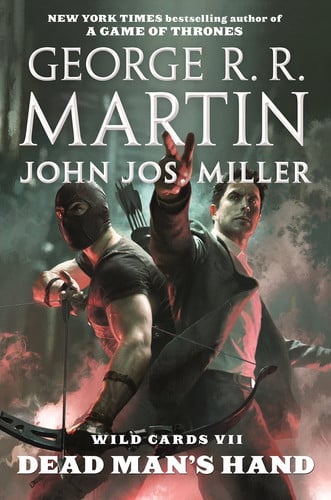
Wild Cards VII: Dead Man's Hand Book Four of the Puppetman Quartet

George R. R. Martin,John Jos. Miller,Wild Cards Trust
Dead Man's Hand combines the writing talents of George R. R. Martin & John Jos. Miller Chrysalis, the glass-skinned queen of the Joker underworld, has been found brutally murdered in her popular restaurant, the Crystal Palace. New two men are out to find her killer: Jay Ackroyd, the Ace private investigator who discovered her ruined body, and the vigilante archer known as the Yeoman, who has been framed for the crime. Their quest leads them on a nightmare odyssey of madness, violence, passion, and political intrigue that will forever alter the fates of Aces and Jokers everywhere. Experience this gripping tale of mystery and suspense, brought to you from the incredible imaginations of George R. R. Martin and John Jos. Miller in their first collaborative novel. EXPLORE THE WILD CARDS UNIVERSE An alien virus has changed the course of history, and the surviving population of Manhattan struggles to understand the new world left in its wake. Natural humans share the rough city with those given extraordinary—and sometimes terrifying—traits. While most manage to coexist in an uneasy peace, not everyone is willing to adapt. The Wild Cards Universe The Original Triad #1 Wild Cards #2 Aces High #3 Jokers Wild The Puppetman Quartet #4: Aces Abroad #5: Down and Dirty #6: Ace in the Hole #7: Dead Man’s Hand The Rox Triad #8: One-Eyed Jacks #9: Jokertown Shuffle #10: Dealer’s Choice #11: Double Solitaire #12: Turn of the Cards The Card Sharks Triad #13: Card Sharks #14: Marked Cards #15: Black Trump #16: Deuces Down #17: Death Draws Five The Committee Triad #18: Inside Straight #19: Busted Flush #20: Suicide Kings The Fort Freak Triad #21: Fort Freak #22: Lowball #23: High Stakes The American Triad #24: Mississippi Roll #25: Low Chicago #26: Texas Hold 'Em
Tor Publishing Group 2017-06-13 352 pages

The Crisis of German Ideology: Intellectual Origins of the Third Reich

George L. Mosse
In our time two major revolutionary movements - Marxism and National Socialism - have left their mark upon the world. Yet, whereas Marxism is generally recognized as representing an intellectual and ideological tradition extending back for at least a century, National Socialism is not. Rather, to many, the ideological bases of National Socialism were the product of a small group of unbalanced minds. To others, the Nazi ideology was merely a propaganda tactic designed to win the support of the masses. Still others have found the ideas underlying National Socialism so nebulous and incomprehensible that they have dismissed them as unimportant.In fact, though, these ideas are deeply embedded in German history. They were current - indeed, eminently respectable - among several generations of Germans prior to Hitler's rise. Strange, even demonic ideas they were, certainly - racial thought, Germanic Christianity, nature mysticism, sun worship, theosophy - but for many Germans long before the Hitler period they suggested the possibility of political and historical salvation.In this book, George L. Mosse traces these currents of thought through 19th and 20th century German history, discussing the role they played and the longings they gratified during nearly a century of German life. He reveals how the anti-liberal and anti-democratic ideology comprising these peculiarly German ideas became institutionalized in the schools, youth movements, veterans' groups, political parties; how the "German revolution" called for by the ideology's exponents was transformed by Hitler into an "anti-Jewish revolution"; and how the Nazis fully assimilated these ideas into an effective political program as they rose to power.
Howard Fertig 1997-03-01