
1644 results for "Biography"

Wassily Leontief and input-output economics

Wassily Leontief,Erik Dietzenbacher,Michael L. Lahr
Wassily Leontief (1905–1999) was the founding father of input-output economics, for which he received the Nobel Prize in 1973. This book offers a collection of papers in memory of Leontief by his students and close colleagues. The first part, 'Reflections on Input-Output Economics', focuses upon Leontief as a person and scholar as well as his personal contributions to economics. It includes contributions by Nobel Laureate Paul A. Samuelson who shares his memories of a young Professor Leontief at Harvard and ends with the last joint interview with Wassily and his wife, to date previously unpublished. The second part, 'Perspectives of Input-Output Economics', includes theoretical and empirical research inspired by Leontief's work and offers a wide-ranging sample of the state of interindustry economics, a field Leontief founded. This is a strong collection likely to appeal to a wide range of professionals in universities, government, industry and international organizations.
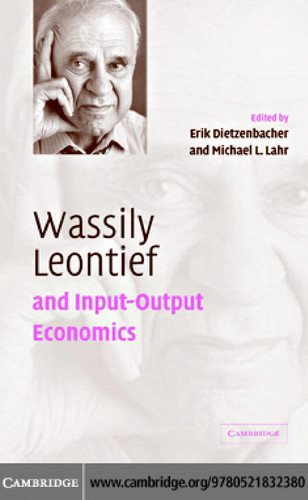
Cambridge University Press 2004-03-25 396 pages

Generation exodus: the fate of young Jewish refugees from Nazi Germany

Laqueur, Walter
Relates the multiple ways adopted by young German Jews (born mainly between 1914-28) to escape from Nazi Germany. Their destinations included Palestine, Great Britain, the USA, South America, and China. Dwells on the routes of escape - sometimes dangerous, and on the organizational framework of the escape - sometimes part of a political underground. Some young persons managed to survive in Germany. Many Jews, both those who escaped and those who remained in Germany, joined the anti-Nazi struggle in multiple forms - from the underground in Berlin to joining up with the Red Army. Many countries of destination were reluctant to accept the refugees, in part due to antisemitism. Other possible frameworks (e.g. communists) were also not eager to help Jews. The majority of the émigrés did not return to Germany after the war.
Brandeis University Press, Published by University Press of New England 2001 345 pages

Crusoes in Siberia

Soros, Tivadar
If you want to know where the brothers Paul and George Soros got their business skills, look no further than this little adventure story told by their father. In simple, understated style, Tivadar Soros tells how he and his companions broke out of their Siberian prisoner-of-war camp at the time of the Russian Revolution and traveled on foot through inhospitable mountains to freedom. And this was just preparation for the equally horrendous conditions that Tivadar and his family endured in World War II. -- "As a schoolboy, I used to join my father in the swimming pool after school, and after swimming he would regale me with an installment of his adventures. In this way they became an important part of my childhood." (George Soros) -- "I and my brother consider it to be our good fortune to grow up observing how our father lived and dealt with the problems of the world." (Paul Soros)
Mondial 2010 93 pages

Theo: the autobiography of Theodore Bikel

Bikel, Theodore
An award-winning actor on screen and stage ( The Defiant Ones , The African Queen , The Sound of Music , My Fair Lady , Fiddler on the Roof ), an activist for civil rights and progressive causes worldwide, and a singer whose voice has won him great applause, Theodore Bikel here tells his own compelling life story. Born in Austria, raised in Palestine, educated in England, and with a stellar career in the United States and around the world, Bikel offers a personal history parallel to momentous events of the twentieth century. In an eloquent, fiercely committed voice, he writes of the Third Reich, the birth of the State of Israel, the McCarthy witch hunts of the 1950s, and the tumultuous 1960s in America. In a new postscript to this paperback edition, he looks at recent events in the Middle East and takes both sides to task for their excesses.
University of Wisconsin Press 2002-09-05 452 pages

With the Weathermen: the personal journal of a revolutionary woman

Stern, Susan
Drugs. Sex. Revolutionary violence. From its first pages, Susan Stern's memoir With the Weathermen provides a candid, first-hand look at the radical politics and the social and cultural environment of the New Left during the late 1960s. The Weathermen--a U.S.-based, revolutionary splinter group of Students for a Democratic Society--advocated the overthrow of the government and capitalism, and toward that end, carried out a campaign of bombings, jailbreaks, and riots throughout the United States. In With the Weathermen Stern traces her involvement with this group, and her transformation from a shy, married graduate student into a go-go dancing, street-fighting "macho mama." In vivid and emotional language, she describes the attractions and difficulties of joining a collective radical group and in maintaining a position within it. Stern's memoir offers a rich description of the raw and rough social dynamics of this community, from its strict demands to "smash monogamy," to its sometimes enforced orgies, and to the demeaning character assassination that was led by the group's top members. She provides a distinctly personal and female perspective on the destructive social functionality and frequently contradictory attitudes toward gender roles and women's rights within the New Left. Laura Browder's masterful introduction situates Stern's memoir in its historical context, examines the circumstances of its writing and publication, and describes the book's somewhat controversial reception by the public and critics alike.
Rutgers University Press 2007 387 pages

Alejandro Tsakimp: a Shuar healer in the margins of history

Rubenstein, Steven
In the heavily forested foothills of the Andes Mountains in Ecuador, a Shuar healer named Alejandro Tsakimp leads many lives. He is a peasant who sells cattle and lumber, a member of the Shuar Federation, a son and a brother, a husband and a father, a student and a worker, and, finally, a troubled shaman. Being a healer has long been both a burden and a resource, for the power to cure is also the power to kill, and shamans like Tsakimp are frequently in danger from accusations of witchcraft. But the situation of the Shuar today is especially perilous, and Tsakimp must constantly negotiate relations of power not only with rival shamans and his patients, but with the better-educated and richer officials of the Shuar Federation and his own siblings as well. In his own words, Alejandro Tsakimp tells of his lives and relationships, the practice of shamanism, and the many challenges and triumphs he has encountered since childhood. He was born at the time when Shuar were first confronting the impact of Ecuadorian colonialism, which had triggered devastating intertribal conflict over the production and trade of shrunken heads and intratribal feuding fueled by accusations of witchcraft. Tsakimp was first exposed to healing practices when he was cured in the womb by a shaman. Later he actively pursued this knowledge in the hopes of curing his father, another shaman, who was ill from witchcraft. His father's death in 1990 created conflict among his heirs, who were the first generation of Shuar to inherit property. Tsakimp's family fiercely competed for the property and eventually accused one another of witchcraft and parricide. Anthropologist Steven Rubenstein, who began working with Tsakimp in 1989, has skillfully edited Tsakimp's stories and provides essential background information. Ruben-stein argues that although these stories reveal tensions between individual and collective autonomy on the colonial frontier, they also resist simplistic dichotomies such as state versus indigene and modern versus traditional. Alejandro Tsakimp provides a revealing look at the relationship between anthropologist and shaman and an insightful glimpse into the complicated lives of South American Indians today.
University of Nebraska Press 2002-01-01 322 pages

West of Jesus: surfing, science, and the origins of belief

Kotler, Steven
A spiritual and scientific surf quest. After spending two years in bed with Lyme disease, Steven Kotler had lost everything: his health, his job, his girl, and, he was beginning to suspect, his mind. Kotler, not a religious man, suddenly found himself drawn to the sport of surfing as if it were the cornerstone of a new faith. Why, he wondered, when there was nothing left to believe in, could he begin to believe in something as unlikely as surfing. What was belief anyway? How did it work in the body, the brain, our culture, and human history? Into this mix came a strange story. In 2003, on a surf trip through Mexico, Kotler heard of "the conductor," a mythical surfer who could control the weather. He'd heard this same tale eight years earlier, in Indonesia, but this time something clicked. With the help of everyone from rebel surfers to rocket scientists, Kotler undertakes a three year globetrotting quest for the origins of this legend. The results are a startling mix of big waves and bigger ideas: a surfer's journey into the biological underpinnings of belief itself.
Bloomsbury Pub 2006-06-13 261 pages

Karl Marx: philosophy and revolution

Avineri, Shlomo
"Karl Marx (1818-1883)--philosopher, historian, sociologist, economist, current affairs journalist, and editor--was one of the most influential and revolutionary thinkers of modern history, but he is rarely thought of as a Jewish thinker, and his Jewish background is either overlooked or misrepresented. Here, distinguished scholar Shlomo Avineri argues that Marx's Jewish origins did leave a significant impression on his work. Marx was born in Trier, then part of Prussia, and his family had enjoyed equal rights and emancipation under earlier French control of the area. But then its annexation to Prussia deprived the Jewish population of its equal rights. These developments led to the reluctant conversion of Marx's father, and similar tribulations radicalized many young intellectuals of that time who came from a Jewish background. Avineri puts Marx's Jewish background in its proper and balanced perspective, and traces Marx's intellectual development in light of the historical, intellectual, and political contexts in which he lived."--Publisher's description.
Yale University Press 2019-08-06 217 pages

Battling for peace: a memoir

Peres, Shimon
"One of the great statesmen of our century, Shimon Peres, winner of the 1994 Nobel Peace Prize, has shaped the history of Israel and the future of the Middle East. In the seventies, as Israel's minister of defense, he engineered the legendary Entebbe raid against PLO terrorists; in the eighties, as prime minister, he saved the Israeli economy from near collapse; and as foreign minister, Shimon Peres is now a key negotiator in the peace accords that he helped bring about. In Battling for Peace, he tells, for the first time, the story of his amazing career. As we follow Peres from his ancestral home in Poland to Israel, from the youth village of Ben-Shemen to Kibbutz Alumot, from youth movement leader to prime minister, we are introduced both to a man and to a nation. A thoughtful, disciplined, and immensely resourceful young man, Peres was singled out by Israel's great leader David Ben-Gurion, who appointed him, while still in his twenties, director general of the Ministry of Defense. From this point on, Peres's life was inseparable from his country's history. Peres writes of his bitter quarrels with Golda Meir and Yitzhak Rabin, and of his great admiration for Ben-Gurion, Moshe Dayan, and Francois Mitterrand. He discusses the origins of Israel's nuclear program, and tells how he led the way toward the Oslo agreement, describing his secret talks with King Hussein in London ten years ago, and revealing how a chance for peace was thwarted by self-serving politicians and timid American diplomacy"--OCLC
Random House 1995-05-10 350 pages

The best American history essays on Lincoln

Sean Wilentz,Organization of American Historians
This new volume in the Best American History Essays series brings together classic writing from top American historians on one of our greatest presidents. Ranging from incisive assessments of his political leadership, to explorations of his enigmatic character, to reflections on the mythos that has become inseparable from the man, each of these contributions expands our understanding of Abraham Lincoln and shows why he has been such an object of enduring fascination. Contributions include:* James McPherson on Lincoln the military strategist* Richard Hofstadter on the Lincoln legend* Edmund Wilson on his contribution to American letters* John Hope Franklin on the Emancipation Proclamation* James Horton on Lincoln and race* David M. Potter on the secession* Richard Current on Lincoln's political genius* Mark Neely on Lincoln and civil liberties
Palgrave Macmillan 2009-02-13 252 pages

A hope in the unseen: an American odyssey from the inner city to the Ivy League

Suskind, Ron
At Ballou Senior High, a crime-infested school in Washington, D.C., honor students have learned to keep their heads down. Like most inner-city kids, they know that any special attention in a place this dangerous can make you a target of violence. But Cedric Jennings will not swallow his pride, and with unwavering support from his mother, he studies and strives as if his life depends on it--and it does. The summer after his junior year, at a program for minorities at MIT, he gets a fleeting glimpse of life outside, a glimpse that turns into a face-on challenge one year later: acceptance into Brown University, an Ivy League school. At Brown, finding himself far behind most of the other freshmen, Cedric must manage a bewildering array of intellectual and social challenges. Cedric had hoped that at college he would finally find a place to fit in, but he discovers he has little in common with either the white students, many of whom come from privileged backgrounds, or the middle-class blacks. Having traveled too far to turn back, Cedric is left to rely on his faith, his intelligence, and his determination to keep alive his hope in the unseen--a future of acceptance and reward that he struggles, each day, to envision.
Broadway Books 2005 390 pages