898 results for "Evolution"

Religious freedom and the constitution

Eisgruber, Christopher L.
Religion has become a charged token in a politics of division. In disputes about faith-based social services, public money for religious schools, the Pledge of Allegiance, Ten Commandments monuments, the theory of evolution, and many other topics, angry contestation threatens to displace America's historic commitment to religious freedom. Part of the problem, the authors argue, is that constitutional analysis of religious freedom has been hobbled by the idea of "a wall of separation" between church and state. That metaphor has been understood to demand that religion be treated far better than other concerns in some contexts, and far worse in others. Sometimes it seems to insist on both contrary forms of treatment simultaneously. Missing has been concern for the fair and equal treatment of religion. In response, the authors offer an understanding of religious freedom called Equal Liberty. Equal Liberty is guided by two principles. First, no one within the reach of the Constitution ought to be devalued on account of the spiritual foundation of their commitments. Second, all persons should enjoy broad rights of free speech, personal autonomy, associative freedom, and private property. Together, these principles are generous and fair to a wide range of religious beliefs and practices. With Equal Liberty as their guide, the authors offer practical, moderate, and appealing terms for the settlement of many hot-button issues that have plunged religious freedom into controversy. Their book calls Americans back to the project of finding fair terms of cooperation for a religiously diverse people, and it offers a valuable set of tools for working toward that end.
Harvard University Press 2007 333 pages

Timelike Diplomacy: Singularity Sky and Iron Sunrise

Stross, Charles
An exclusive two-in-one novel from the Science Fiction Book Club, set in Charles Stross’ Eschaton Universe: Singularity Sky and Iron Sunrise. Singularity Sky: Spaceship engineer Martin Springfield and U.N. diplomat Rachel Mansour hail from an Earth that has gone through the Singularity, an accelerated technological and social evolution far beyond anything we can imagine. The Singularity was triggered by the Eschaton, a super-powerful being descended from humanity that can travel in time and that essentially rules the universe. Springfield and Mansour meet on the home world of the New Republic, a repressive, backwater society that has outlawed virtually all advanced technology other than that necessary for interstellar warfare. When one of the New Republic's colonial worlds is besieged by the Festival, an enigmatic alien intelligence, the Republic counterattacks, using time travel in an attempt to put its warships in position to catch the Festival by surprise. Springfield and Mansour, working for different masters, have both been assigned the task of either diffusing the crisis or sabotaging the New Republic's warfleet, no matter what the cost. Iron Sunrise: In the 24th century, a McWorld ("bland, comfortable, tolerant... boring") called New Moscow apparently has been destroyed by trade rival New Dresden—but not before New Moscow launched its own Slower-Than-Light (STL) counterstrike: a massive ship accelerated to 80% the speed of light. The U.N., now central Earth government, knows New Dresden was set up. They need the STL's recall code, now known only to a handful of New Moscow's ambassadors—but someone has been systematically assassinating them. U.N. special operative Rachel Mansour and her husband, engineer Martin Springfield, must protect the last living ambassador and find out who's really responsible for the whole mess.
Science Fiction Book Club 2004 682 pages

The Sacred Fire The Story of Sex in Religion

Ben Zion Goldberg
"There is a huge amount of academic 19th century literature relating to sacred sexuality. However, there are not many books which cover this subject matter for the general reader: this book is one of the few. Goldberg approaches the culturally sensitive issue of the intersection of religion and sex frankly and in some depth. That said, this work has a few problems which need to be kept in mind while reading it. There is not much in the way of apparatus aside from a bibliography: not even the Bible quotes are attributed. Goldberg also invents a number of descriptive passages, particularly in the second section. While these go a long way towards dimensionalizing this material, they include a number of purely speculative details which are not identified as such. Perhaps the best part of this book is the discussion of the evolution of the attitude towards sexuality in Christianity. Goldberg also describes a number of little-known curious cults such as the Russian Skopzi, the mediaeval flagellants, and others. Long out of print, but available used, this book serves as a useful introduction to the subject and sheds light on some little known corners of the subject of sacred sexuality." (Quote from sacred-texts.com) Table of Contents Publisher's Preface; The Erotic Motive In Primitive Religion; Far Away And Long Ago; Primitive Man In Love And Faith; In The Foundry Of The Gods; The Spirit Of Love In God And Man; Love's Hidden Ways; In The Temple Of The Gods; A Day With Baal; A Night With Aphrodite; At A Dionysian Mystery; Twilight With Moloch; The Dance Of The Saktas; In The House Of The Lord; Prologue; Love In The Synagogue; Romance In The Church; Marriage In The Mosque; Longing In The Dark; The Spirit Of Revolt In Religion; Rebels In The Faith; Love The Force Of Rebellion; The Revolt Against Religion; The Revolt Against God; The Revolt A
Forgotten Books 1930 288 pages

Pitching My Tent On Marriage, Motherhood, Friendship, and Other Leaps of Faith

Anita Diamant
From the bestselling author of The Red Tent and Good Harbor , a collection of intimate, autobiographical reflections on the milestones, revelations, and balancing acts of life as a wife, mother, friend, and member of a religious community. Before The Red Tent won her international literary acclaim, Anita Diamant was a columnist in Boston. Over the course of twenty years, she wrote essays that reflected the shape and evolution of her life, as well as the trends of her generation. In the end, her musings about love and marriage, birth and death, nature versus nurture, politics and religion—and everything from female friendships to quitting smoking—have created a public diary of the progress of her life that resonated deeply with her readers. Now, Pitching My Tent collects the finest columns of a writer who is a reporter by training and a storyteller by heart, all revised and enriched with new material. Personal, inspiring, and often funny, Pitching My Tent displays the warmth, humor, and wisdom that Diamant's legions of fans have come to cherish.
Scribner 2005-10-04 240 pages

Bibliodeath: my archives (with life in footnotes)

Codrescu, Andrei
"In our brave new world, techno-evolution is often decried as the death knell of the written word. Award-winning author Andrei Codrescu demolishes this doomsday provocation in Bibliodeath: My Archives (With Life in Footnotes). Our moment of bibliodeath marks a tectonic shift under the ocean of human consciousness and the written word. As words migrate from the book into other means of transport, we are "privy to ... the passage of the soul from one body into another, a reincarnation that is not a meta-physics." A suspenseful meditation planted in a bed of alluring stories-cum-footnotes, Codrescu wades into the bibliodeath waters to examine his own evolution as a writer. From the poetic lines of an unlined notebook in 1960s Romania to the founding of Exquisite Corpse in 1983 to his ongoing commentary on NPR's All Things Considered, his journey is an archive of reinvention. Codrescu's literal Archives and his unsentimental and savage faith in reinvention take in the history of the literate world, the transformation of the printed word, and language itself. This picaresque adventure of a mind at work spans the fin-de-siécle to the 21st century, as the bibliodeath of one medium meets the birth of the next. The evolution of technology must deal with the indomitable bond between language and the human being. In the story of Codrescu, "leaving the traces of one's passage is worth the labor of a lifetime."--Back cover.
Antibookclub 2012 147 pages

Theater and social change

Alisa Solomon
From the Federal Theater Projects of the Great Depression to the disruptive performances of the 1960s and 1970s, theater has played an important role in American radicalism. This special issue of “/i>a href="http://www.dukeupress.edu/theater> Theater reports on socially conscious, politically active theaters in the United States. Despite the evaporation of Cold War passions and the rise of conservatism in the 1980s and 1990s, such theater work remains a persistent and evolving presence on the political landscape. Since the first inauguration of George W. Bush, new opportunities have arisen for political performance and for significant new challenges to these artists. T heater and Social Change not only tracks the historical evolution of political theater but also explores the current state and future prospects of different modes, including agit-prop, demonstrations, solo performance, Augusto Boal's Theater of the Oppressed, and community-based production. With such notable contributors as Anna Deavere Smith, Jonathan Kalb, Holly Hughes, and Tony Kushner, the issue offers a diverse assemblage of personal statements, conversations, photographs, interviews, and performance text. Contributors include: Reverend Billy, Jan Cohen-Cruz, Arlene Goldbard, Sharon Green, Lani Guinier, Holly Hughes, Jonathan Kalb, Tony Kushner, Judith Malina, Robbie McCauley, John O'Neal, Claudia Orenstein, Bill Rauch, Julie Salverson, Anna Deavere Smith, Alisa Solomon, Roberta Uno
Duke University Press 2002 170 pages

The uses of history: understanding the Soviet Union and Russia

Dallin, Alexander
Exploring Soviet and Russian history, politics, and foreign policy, The Uses of History brings together the classic essays of renowned scholar Alexander Dallin. The author provides insightful analysis and nuanced interpretations of such key-and controversial-issues as the domestic sources of Soviet foreign policy, Stalin's leadership in World War II, Russian-American relations in the Reagan era, the causes of the collapse of the USSR, and the disappointments of Russia's post-Soviet evolution. With his incisive assessment of the biases and blunders in American interpretations, Dallin rejects single-factor explanations for Soviet and Russian domestic and foreign policies, instead examining the complex interplay of internal and external conditions, institutions, mindsets, and the role of individual leaders. All readers interested in Soviet and post-Soviet history will find this collection a stimulating and deeply knowledgeable resource.
Rowman & Littlefield Publishers 2009-10-16 271 pages

The point of view of the universe: Sidgwick and contemporary ethics

Lazari-Radek, Katarzyna de,Singer, Peter
What does the idea of taking 'the point of view of the universe' tell us about ethics? The great nineteenth-century utilitarian Henry Sidgwick used this metaphor to present what he took to be a self-evident moral truth: the good of one individual is of no more importance than the good of any other. Ethical judgments, he held, are objective truths that we can know by reason. The ethical axioms he took to be self-evident provide a foundation for utilitarianism. He supplements this foundation with an argument that nothing except states of consciousness have ultimate value, which led him to hold that pleasure is the only thing that is intrinsically good. Are these claims defensible? Katarzyna de Lazari-Radek and Peter Singer test them against a variety of views held by contemporary writers in ethics, and conclude that they are. This book is therefore a defence of objectivism in ethics, and of hedonistic utilitarianism. The authors also explore, and in most cases support, Sidgwick's views on many other key questions in ethics: how to justify an ethical theory, the significance of an evolutionary explanation of our moral judgments, the choice between preference-utilitarianism and hedonistic utilitarianism, the conflict between self-interest and universal benevolence, whether something that it would be wrong to do openly can be right if kept secret, how demanding utilitarianism is, whether we should discount the future, or favor those who are worse off, the moral status of animals, and what is an optimum population.
Oxford University Press 2016 403 pages

Basic writings

Rée, Paul
This book contains the first English translations of The Origin of the Moral Sensations and Psychological Observations, the two most important works by the German philosopher Paul Rée. These essays present Rée’s moral philosophy, which influenced the ideas of his close friend Friedrich Nietzsche considerably. Nietzsche scholars have often incorrectly attributed to him arguments and ideas that are Rée’s and have failed to detect responses to Rée’s works in Nietzsche’s writings. Rée’s thinking combined two strands: a pessimistic conception of human nature, presented in the French moralists’ aphoristic style that would become a mainstay of Nietzsche’s own writings, and a theory of morality derived from Darwin’s theory of natural selection. Rée’s moral Darwinism was a central factor prompting Nietzsche to write On the Genealogy of Morals and the groundwork for much of today’s “evolutionary ethics.” In an illuminating critical introduction, Robin Small examines Rée’s life and work, locating his application of evolutionary concepts to morality within a broader history of Darwinism while exploring Rée’s theoretical and personal relationship with Nietzsche. In placing Nietzsche in his intellectual and social context, Small profoundly challenges the myth of Nietzsche as a solitary thinker.
University of Illinois Press 2003-06-09 178 pages

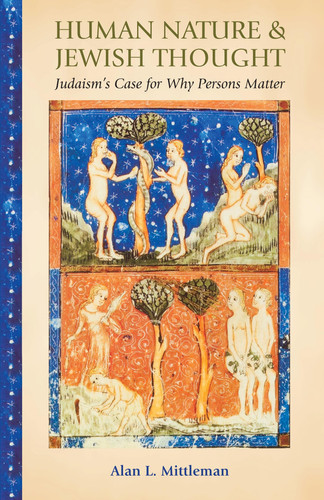
Human nature & Jewish thought: Judaism's case for why persons matter

Mittleman, Alan
This book explores one of the great questions of our time: How can we preserve our sense of what it means to be a person while at the same time accepting what science tells us to be true-namely, that human nature is continuous with the rest of nature? What, in other words, does it mean to be a person in a world of things? Alan Mittleman shows how the Jewish tradition provides rich ways of understanding human nature and personhood that preserve human dignity and distinction in a world of neuroscience, evolutionary biology, biotechnology, and pervasive scientism. These ancient resources can speak to Jewish, non-Jewish, and secular readers alike. Science may tell us what we are, Mittleman says, but it cannot tell us who we are, how we should live, or why we matter. Traditional Jewish thought, in open-minded dialogue with contemporary scientific perspectives, can help us answer these questions. Mittleman shows how, using sources ranging across the Jewish tradition, from the Hebrew Bible and the Talmud to more than a millennium of Jewish philosophy. Among the many subjects the book addresses are sexuality, birth and death, violence and evil, moral agency, and politics and economics. Throughout, Mittleman demonstrates how Jewish tradition brings new perspectives to-and challenges many current assumptions about-these central aspects of human nature. A study of human nature in Jewish thought and an original contribution to Jewish philosophy, this is a book for anyone interested in what it means to be human in a scientific age.
Princeton University Press 2015 215 pages

The Evolution of Property from Savagery to Civilization

Paul Lafargue
Unlike some other reproductions of classic texts (1) We have not used OCR(Optical Character Recognition), as this leads to bad quality books with introduced typos. (2) In books where there are images such as portraits, maps, sketches etc We have endeavoured to keep the quality of these images, so they represent accurately the original artefact. Although occasionally there may be certain imperfections with these old texts, we feel they deserve to be made available for future generations to enjoy.
Swan Sonnenschein 2012-08 198 pages

Personhood of God Biblical Theology, Human Faith and the Divine Image

Yochanan Muffs
A fascinating exploration of the many faces of God and what they reveal about our own humanity. He was a whole pantheon in Himself.... He constantly appeared in many and ever-changing roles lest He be frozen and converted into the dumb idols He Himself despised. God was a polyvalent personality who, by mirroring to man His many faces, provided the models that man so needed to survive and flourish. This is the true humanity of God. --from the Introduction In scholarly but accessible terms, with many startling and controversial insights, renowned Bible scholar Dr. Yochanan Muffs examines the anthropomorphic evolution of the Divine Image--from creator of the cosmos to God the father, God the husband, God the king, God the "chess-player," God the ultimate master--and how these different images of God have shaped our faith and world view. Muffs also examines how expressions of divine power, divine will and divine love throughout the Bible have helped develop the contemporary human condition and our enriching dialectic between faith and doubt.
Jewish Lights Publishing 2009-03 242 pages

Mind Medicine

Uri Geller
Mind Medicine: The Secret of Powerful Healing From the back of the book: Uri Geller reveals how to harness the healing power of your mind to transform your whole life. Lavishly illustrated throughout, this unique book includes: - An exploration of the mind-body symbiosis as a crucial part of the healing process - An assessment of ancient healing wisdoms and how they can be combined with modern medicine - Insights into the nature of ill health and healing from today's leading therapists and doctors - Healing therapies for the four energy bodies: physical, mental, emotional, and spiritual - Powerful meditations, contemplations, and affirmations to enable you to gain access to your unconscious self "Uri as a light-giver is telling us to wake up our minds to the great abundance we have inside. If there is more to life than the visible world, then it is through Uri and others like him that the world opens up to the greater dimension of untapped possibilities. He is a living symbol of the potential future evolution of the human race." - Marc Seifer, Ph.D., Lecturer in Psychology, New York; author of over 70 publications in the US
Barnes and Noble 2001 224 pages

Hebrew feminist poems from antiquity to the present: a bilingual anthology

Shirley Kaufman,Galit Hasan-Rokem,Galīt Ḥazan-Rōqem,Tamar Hess
Each bilingual volume in The Defiant Muse series includes 60 to 80 poems by both well-known and rediscovered poets, selected on the basis of their individual merit and as illustrations of the evolution of feminist thought and feeling. Reflecting their own cultural milieus as well as enduring themes, the poets write of love and friendship, revolution and peace, religion, nature, isolation, work, and family. The Dutch, French, German, and Italian volumes represent their respective countries; the Hispanic volume includes poems from the many Spanish-speaking nations; and the Hebrew volume encompasses writing in Hebrew from around the world. The poems are presented in their original languages alongside English translations. Each volume includes an introduction, placing the poetry in historical and aesthetic perspective, and full biographical and bibliographical notes on the poets.
Feminist Press at the City University of New York 1999 270 pages

The Performer Art, Life, Politics

Richard Sennett
An acclaimed sociologist's exploration of the connections among performances in life, art, and politics "A thought-provoking, essayistic and touchingly personal exploration of the ethics and aesthetics of performance from one of the leading intellectuals of our time."--Lucasta Miller, The Spectator , "Best Books of 2024" "Constantly fascinating and often illuminating."--Simon Callow, New York Review of Books In The Performer , Richard Sennett explores the relations between performing in art (particularly music), politics, and everyday experience. It focuses on the bodily and physical dimensions of performing, rather than on words. Sennett is particularly attuned to the ways in which the rituals of ordinary life are performances. The book draws on history and sociology, and more personally on the author's early career as a professional cellist, as well as on his later work as a city planner and social thinker. It traces the evolution of performing spaces in the city; the emergence of actors, musicians, and dancers as independent artists; the inequality between performer and spectator; the uneasy relations between artistic creation and social and religious ritual; the uses and abuses of acting by politicians. The Janus-faced art of performing is both destructive and civilizing.
Yale University Press 2025-10-28 256 pages