8468 results for "History"

War-shock, the psycho-neuroses in war: psychology and treatment

Eder, Montague David
This is a reproduction of a book published before 1923. This book may have occasional imperfections such as missing or blurred pages, poor pictures, errant marks, etc. that were either part of the original artifact, or were introduced by the scanning process. We believe this work is culturally important, and despite the imperfections, have elected to bring it back into print as part of our continuing commitment to the preservation of printed works worldwide. We appreciate your understanding of the imperfections in the preservation process, and hope you enjoy this valuable book.
Nabu Press 2010 172 pages

The music of the prophets: the resettlement of the Jews in England, 1655-56

Wandor, Michelene
In 1290, the Jews were banished from England. In 1655-1656, Jews once more became a part of British society, returning to the London of Oliver Cromwell, Pepys and Henry Purcell. To commemorate the 350th anniversary of this return, Michelene Wandor has written a sensuous dramatic narrative poem evoking seventeenth-century London, and telling the story of the two men who made this return possible: Oliver Cromwell and Menasseh ben Israel. "Music of the Prophets" is the third in a sequence of long poems celebrating the presence of the Jews in England. The text seduces and challenges with a delicacy and flow, combining open-form experiment with a musical delight in counterpoint, irony and wit.
Arc Publications 2006 57 pages

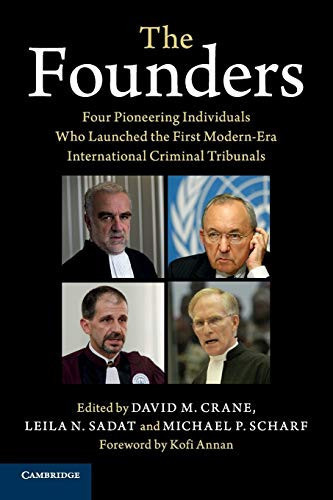
The founders: four pioneering individuals who launched the first modern-era international criminal tribunals

David M. Crane,Leila N. Sadat,Michael P. Scharf
"The Balkan Wars, the Rwanda genocide, and the crimes against humanity in Cambodia and Sierra Leone spurred the creation of international criminal tribunals to bring the perpetrators of unimaginable atrocities to justice. When Richard Goldstone, David Crane, Robert Petit, and Luis Moreno-Ocampo received the call - each set out on a unique quest to build an international criminal tribunal and launch its first prosecutions. Never before have the founding International Prosecutors told the behind-the-scenes stories of their historic journey. With no blueprint and little precedent, each was a path-breaker. This book contains the first-hand accounts of the challenges they faced, the obstacles they overcame, and the successes they achieved in obtaining justice for millions of victims"--
Cambridge University Press 2018-03-15 165 pages

The Philosophy of Don Hasdai Crescas

Meyer Waxman
Unlike some other reproductions of classic texts (1) We have not used OCR(Optical Character Recognition), as this leads to bad quality books with introduced typos. (2) In books where there are images such as portraits, maps, sketches etc We have endeavoured to keep the quality of these images, so they represent accurately the original artefact. Although occasionally there may be certain imperfections with these old texts, we feel they deserve to be made available for future generations to enjoy.
HardPress 2012 188 pages

Cubist Poems

Max Weber
Unlike some other reproductions of classic texts (1) We have not used OCR(Optical Character Recognition), as this leads to bad quality books with introduced typos. (2) In books where there are images such as portraits, maps, sketches etc We have endeavoured to keep the quality of these images, so they represent accurately the original artefact. Although occasionally there may be certain imperfections with these old texts, we feel they deserve to be made available for future generations to enjoy.
HardPress 2012 74 pages

Field of honour

Aub, Max
A contemporary of Lorca and Buñuel in Spain’s Second Republic, Max Aub escaped into a life of exile after General Franco seized Barcelona. His masterpiece, acknowledged in Spain as one of the best accounts of the Spanish Civil War, is the five-novel cycle known as The Magic Labyrinth —never before translated into English. A playwright as well as a novelist, he brings the period alive through vibrant dialogue and a story that navigates the factional intrigues that eventually erupted onto the streets in violence. The protagonist of the first novel is Rafael López Serrador, whose coming of age in Barcelona introduces a cast from all walks of city life—Catalan nationalists, anarchists, Falangists, government ministers and showgirls. Just as central a character is Barcelona itself, lovingly depicted. Rafael’s adventures bring him into contact with the forces that were to destroy the Republic and determine the bloody course of the Spanish Civil War. Masterfully translated by Gerald Martin, author of Gabriel García Márquez: A Life , Max Aub’s novel is set to introduce to an English-speaking audience a classic of Spanish and Latin American literature—an account of the Spanish Civil War to compare with Ernest Hemingway’s For Whom the Bell Tolls .
Verso Books 2009-09-07 253 pages

A Dream of Treason

Maurice Edelman
This work has been selected by scholars as being culturally important and is part of the knowledge base of civilization as we know it. This work is in the public domain in the United States of America, and possibly other nations. Within the United States, you may freely copy and distribute this work, as no entity (individual or corporate) has a copyright on the body of the work. Scholars believe, and we concur, that this work is important enough to be preserved, reproduced, and made generally available to the public. To ensure a quality reading experience, this work has been proofread and republished using a format that seamlessly blends the original graphical elements with text in an easy-to-read typeface. We appreciate your support of the preservation process, and thank you for being an important part of keeping this knowledge alive and relevant.
Creative Media Partners, LLC 2018-10-15 258 pages

Mary Russell Mitford

Mary Russell 1787-1855 Mitford,Elizabeth Ed Lee,John Ruskin
This work has been selected by scholars as being culturally important, and is part of the knowledge base of civilization as we know it. This work was reproduced from the original artifact, and remains as true to the original work as possible. Therefore, you will see the original copyright references, library stamps (as most of these works have been housed in our most important libraries around the world), and other notations in the work. This work is in the public domain in the United States of America, and possibly other nations. Within the United States, you may freely copy and distribute this work, as no entity (individual or corporate) has a copyright on the body of the work. As a reproduction of a historical artifact, this work may contain missing or blurred pages, poor pictures, errant marks, etc. Scholars believe, and we concur, that this work is important enough to be preserved, reproduced, and made generally available to the public. We appreciate your support of the preservation process, and thank you for being an important part of keeping this knowledge alive and relevant.
Creative Media Partners, LLC 2016-08-28 354 pages

A kingdom of priests: ancestry and merit in ancient Judaism

Himmelfarb, Martha
According to the account in the Book of Exodus, God addresses the children of Israel as they stand before Mt. Sinai with the words, "You shall be to me a kingdom of priests and a holy nation" (19:6). The sentence, Martha Himmelfarb observes, is paradoxical, for priests are by definition a minority, yet the meaning in context is clear: the entire people is holy. The words also point to some significant tensions in the biblical understanding of the people of Israel. If the entire people is holy, why does it need priests? If membership in both people and priesthood is a matter not of merit but of birth, how can either the people or its priests hope to be holy? How can one reconcile the distance between the honor due the priest and the actual behavior of some who filled the role? What can the people do to make itself truly a kingdom of priests? Himmelfarb argues that these questions become central in Second Temple Judaism. She considers a range of texts from this period, including the Book of Watchers , the Book of Jubilees , legal documents from the Dead Sea Scrolls, the writings of Philo of Alexandria, and the Book of Revelation of the New Testament, and goes on to explore rabbinic Judaism's emphasis on descent as the primary criterion for inclusion among the chosen people of Israel—a position, she contends, that took on new force in reaction to early Christian disparagement of the idea that mere descent from Abraham was sufficient for salvation.
University of Pennsylvania Press 2006-10-10 270 pages

The Population of Great Britain

Mark Abrams
THE POPULATION OF GREAT BRITAIN This series of studies, of which the present volume is the first, is issued by the Research De partment of The London Press Exchange Ltd., as a contribu tion to the factual background of post-war problems affecting British industry and commerce, and the distribution of British products. no ST. MARTINS LANE LONDON - W. C. a THE POPULATION OF GREAT BRITAIN CURRENT TRENDS AND FUTURE PROBLEMS MARK ABRAMS PUBLISHED FOR THE LONDON PRESS EXCHANGE LTD BY GEORGE ALLEN UNWIN LTD 40 MUSEUM STREET W. C. i CONTENTS I THE PRE-WAR SITUATION The nineteenth century 7 The measurement of population growth, p. 9 Death rates, p. 9 Migrfajtfn, jx ity Birth rates and repro duction rates 1 1 Changes since the eighties 13 The importance of age composition 4 Economic measurement of population 16 II THE WAR PERIOD i III POST-WAR PROSPECTS 21 IV CONSEQUENCES, CAUSES AND REMEDIES . . 23 Some economic consequences, p. 2 5 Employment prospects inparticular occupations, p. 26 effects on taxation, p. 28 effects on the trade cycle 28 Some suggested causes, p. 30 Changes in fecundity, p. 30 changes in nuptiality, p 3 changes in social values and interests 3 The economics of parenthood 33 Some suggested remedies, p. 34 Laissez-aller, p. 34 repressive measures, p-35 positive measures, p. 36 child allowances 37 The limitations of child allowances 39 V THE FUTURE SOME ESTIMATES 41 Appendix i The new birth and marriage statistics . 46 Further reading 5 POPULATION TRENDS 1911 1961 15,8 ii 1111 1938 1946 1951 -1961 THE PRE-WAR SITUATION IN the summer of 1939 the estimated population of Great Britain i. e., England, Wales and Scotland was 46,467,000. In terms of the worlds total population that was hardly a substantial figure it constituted less than three per cent, of the globes inhabitants and as a national total was exceeded by at least half-a-dozen other units China, India, U. S. S. R., U. S. A., Japan and ESTIMATED POPULATIONS Germany. DECEMBER, 1938 U. S. S. R. U. S. A. . . Japan . . Germany Great Britain Brazil .. Italy France . . 170,000,000 130,000,000 73,000,000 69,000,000 46,000,000 44,000,000 43,000,000 42,000,000 Excluding Austria, Sudeten and, Memel The nineteenth centuty It was the product, however, of 150 years of unprecedented growth. There are no reliable counts of Britains population before the nine teenth century, but it is probable that for several hundred years the number of people in this country fluctuated round the five million mark. Then in the middle of the 1 8th century as the industrial and transport revolutions started Britain on her career as the worlds workshop, carrier and entrepot, the popu lation began to grow rapidly. Between the beginning and the end of the i gth century, in spite of a steady drain of emigrants to the colonies and the United States, Britains population more than trebled. Almost certainly this was achieved, not by any increase in the number of child ren born to the average woman but by a steady fall in the death rate made possible by advances in medical science and communal sanitation. In 1801, in the middle of the Napoleonic Wars, the first census was taken in this country. The returns for Great Britain showed a total 7 population of 10,500,000. By i8ai, after the war and its subsequent depression had been passed, the figure had grown to 14,092,000, and a generation later, that is, at the mid point of the century, it had passed the 20,000,000 mark. In fifty years Britains population had doubled in the subsequent fifty years almost the same over-all rate of growth was maintained and the new century opened with a population of 37,000,000. This appearance of unchecked growth, however, was misleading. In the last decade of the I9th century, although the total population continued to increase, the rate of increase began to slow down appreci ably. The twentieth century, so far, has not checked this new develop ment Britains population continues to grow but at an ever-diminishing rate...
Read Books 2007-03 52 pages

The Jew Pays; a Narrative of the Consequences of the War to the Jews of Eastern Europe

Marcus Eli 1884- From Old Cata Ravage
This work has been selected by scholars as being culturally important, and is part of the knowledge base of civilization as we know it. This work was reproduced from the original artifact, and remains as true to the original work as possible. Therefore, you will see the original copyright references, library stamps (as most of these works have been housed in our most important libraries around the world), and other notations in the work. This work is in the public domain in the United States of America, and possibly other nations. Within the United States, you may freely copy and distribute this work, as no entity (individual or corporate) has a copyright on the body of the work. As a reproduction of a historical artifact, this work may contain missing or blurred pages, poor pictures, errant marks, etc. Scholars believe, and we concur, that this work is important enough to be preserved, reproduced, and made generally available to the public. We appreciate your support of the preservation process, and thank you for being an important part of keeping this knowledge alive and relevant.
Creative Media Partners, LLC 2016-05-04 180 pages

The Jew pays; a narrative of the consequences of the war to the Jews of eastern Europe

Ravage, M E. 1884-1965
This is a reproduction of a book published before 1923. This book may have occasional imperfections such as missing or blurred pages, poor pictures, errant marks, etc. that were either part of the original artifact, or were introduced by the scanning process. We believe this work is culturally important, and despite the imperfections, have elected to bring it back into print as part of our continuing commitment to the preservation of printed works worldwide. We appreciate your understanding of the imperfections in the preservation process, and hope you enjoy this valuable book.
Nabu Press 2010-08-17 176 pages

Peter Maurin Prophet in the Twentieth Century

Marc H. Ellis
In Peter Maurin: Prophet in the Twentieth Century , Marc H. Ellis traces Maurin's life from his early years--as peasant, brother, and Catholic activist--through his meeting with Dorothy Day. Ellis' Chronicle focuses on the consequences of that meeting: the founding of the Catholic Worker movement and newspaper, the founding of hospitality, the farming communes. Peter Maurin: Prophet in the Twentieth Century is the first biography to really examine Maurin's thought. A commitment to non-violent reform and to a life of poverty were chief tenets of Maurin's philosophy; it was Maurin's notion that farmers and scholars would labor and learn together in the ideal world. Ellis discusses these and other ideas of Maurin, their development and their particular importance today.
Wipf and Stock Publishers 2010-05-01 204 pages

De Los Nombres de Cristo

de León, Luis
This is a pre-1923 historical reproduction that was curated for quality. Quality assurance was conducted on each of these books in an attempt to remove books with imperfections introduced by the digitization process. Though we have made best efforts - the books may have occasional errors that do not impede the reading experience. We believe this work is culturally important and have elected to bring the book back into print as part of our continuing commitment to the preservation of printed works worldwide.
BiblioLife 2009 320 pages