1472 results for "Biography"

Love and struggle: my life in SDS, the Weather Underground, and beyond

Gilbert, David
"Written from the maximum-security prison where he has lived for almost 30 years, this enlightening memoir chronicles the militant career of David Gilbert, a radical activist whose incarceration is due to his involvement in the 1981 Brinks robbery, an attempted expropriation that resulted in four deaths. From his entry into the world of political activism as the founder of Students for a Democratic Society at Columbia University to his departure from public life in order to help build the clandestine resistance to war and racism known as the Weathermen, Gilbert relates all of the victories he has achieved and obstacles he has encountered during his struggle to build a new world. In telling the intensely personal story he is stripped of all illusions and assesses his journey from liberal to radical to revolutionary with rare humor and frankness"--Amazon.com, viewed March 2, 2012.
PM Press 2012 336 pages

Getting to the heart of the matter: my 36 years in the Senate

Levin, Carl
"Representing Michigan for thirty-six years in the U.S. Senate, Carl Levin, the longest-serving senator in Michigan history, was known for his dogged pursuit of the truth, his commitment to holding government accountable, and his basic decency. Getting to the Heart of the Matter: My 36 Years in the Senate is his story - from his early days in Detroit as the son of a respected lawyer to the capstone of his career as chair of both the Senate Armed Services Committee and the Senate Permanent Subcommittee on Investigations. Levin's career placed him at the center of some of our nation's most critical points in modern times: from the aftermath of the 1967 Detroit riots, to the Clinton impeachment, through 9/11 and the wars in Iraq and Afghanistan, and the 2008 financial crisis. He met with numerous world leaders, including Egypt's Anwar Sadat and China's Jiang Zemin. Getting to the Heart of the Matter recounts Levin's experiences, thoughts, and actions during these historic moments. Consisting of seventeen chapters, the book takes the reader through Levin's early life in Detroit of the 1940s, 50s, and 60s where he met his wife, started a family, practiced law and served as the first General Counsel for the newly created Michigan Civil Rights Commission and the chief appellate defender for Detroit's Legal Aid Office. Elected to the Detroit City Council in 1969, where Levin served for eight years including four as Council president, the book describes how his fight against the Department of Housing and Urban Development's devastating housing practices in the neighborhoods of Detroit led him to run for the U.S. Senate with a pledge to make government work more effectively. Winning election six times, Levin had an illustrious career in the Senate where he challenged leaders in government and the private sector for the greater good of the nation. Levin describes how, as a Democrat, throughout his time in the Senate, he worked with Republican senators who often held different policy positions in order to find common ground to achieve national goals, and how he and his Senate staff searched for creative solutions to trade issues, support for the auto industry and manufacturing sector, U.S. military action in Iraq and Afghanistan, and efforts to protect the Great Lakes and the environment, among many other issues. Levin's hope in writing this memoir is that by sharing his deeply held beliefs about the responsibility of elected officials, the book will serve as a resource for people beginning a career in, or contemplating running for, public office. Readers with an interest in politics, history, facts, and perseverance will find kinship in this book" -- provided by the publisher
Wayne State University Press 2021 338 pages

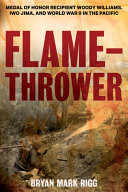
Flamethrower: Medal of Honor recipient Woody Williams, Iwo Jima, and World War II in the Pacific

Rigg, Bryan Mark
"Imagine strapping on a highly flammable 70-pound pack and entering combat as a surefire walking target-and you'd only begin to understand the job, and the horror, of Marine Corps flamethrower man. That's precisely what Hershel "Woody" Williams did in World War II, most importantly in February 1945 on Iwo Jima, one of the Pacific War's toughest battles. A few days into the battle, Marines were fighting hard for an airfield, and his captain asked Woody if he could do anything. He responded, "I'll try"-and for the next four hours, he virtually singlehandedly took on and ultimately destroyed seven enemy pillboxes and helped secure the airfield. Accomplished military historian Bryan Mark Rigg reconstructs Williams' remarkable story, from his youth in West Virginia to his experiences on Guadalcanal, Saipan, Guam, and most significantly Iwo Jima. In Rigg's telling, Williams's Medal of Honor action is not "just" a brave deed, but one of only a few strategically significant brave deeds-one that secured a strategic objective during a major campaign. Rigg tells Williams' story vividly, and objectively, and places it in the context of the broader Pacific theater of World War II."--
Stackpole Books 2020 544 pages

This is not my memoir

Gregory, André,London, Todd
The autobiography-of-sorts of André Gregory, an iconic figure in American theater and the star of My Dinner with André This Is Not My Memoir tells the life story of André Gregory, iconic theater director, writer, and actor. For the first time, André shares memories from a life lived for art, including stories from the making of My Dinner with André . Taking on the dizzying, wondrous nature of a fever dream, This Is Not My Memoir includes fantastic and fantastical stories that take the reader from wartime Paris to golden-age Hollywood, from avant-garde theaters to monasteries in India. Along the way we meet Jerzy Grotowski, Helene Weigel, Gregory Peck, Gurumayi Chidvilasananda, Wallace Shawn, and many other larger-than-life personalities. This Is Not My Memoir is a collaboration between André and Todd London, who together create a portrait of an artist confronting his later years. Here, too, are the reflections of a man who only recently learned how to love. What does it mean to create art in a world that often places little value on the process of creating it? And what does it mean to confront the process of aging when your greatest work of art may well be your own life?
Picador USA 2021-11-16 240 pages

Copland. Since 1943

Copland, Aaron
Hailed as important, entertaining, and revealing, Copland: Since 1943 is composer Aaron Copland's irresistible account of the latter half of his career--a career that brought us such pioneering works as Appalachian Spring and Lincoln Portrait, the movie scores for Of Mice and Men and Our Town, and numerous other orchestral and chamber works. It tells the story of how a self-described "brash young man from Brooklyn" went on to become one of the founding fathers of "serious" American music. Featuring cameos by luminaries such as Leonard Bernstein, Martha Graham, Agnes de Mille, Benny Goodman, and other peers of Aaron Copland during this explosively creative period, Copland: Since 1943 is an invaluable memoir that charts the crescendo of one of the most accomplished careers in the modern canon.
St. Martin's Press 1989 463 pages

The Second Oswald

Richard H. Popkin
Who killed Kennedy? Many keen minds have their doubts about the findings of the Warren Commission. Could Oswald have fired 3 shots in 5.6 seconds with the inaccurate rifle he had - and hit a moving target? Did he even kill patrolman Tippit (the bullets in the body were smaller than the barrel of his revolver)? Was the brown paper bag made only to attract attention? Was Bullet No. 399 a plant? Suppose there was a Second Oswald - a man very similar physically and an expert marksman? Such a man was seen both before and at the time of the murder. Was there a rifleman on the knoll as well as at the Book Depository window? If so this was one of the greatest - and most successful conspiracies of modern times... THE SECOND OSWALD has been called "the first plausible and significant argumentation on the Kennedy assassination." It takes into account the books by Edward J. Epstein, Mark Lane and Harold Weisberg. Too much was attempted too quickly. Professor Popkin believes that Lee Harvey Oswald may have been innocent and no more than a decoy in a plot to kill the President. His job may have been to divert suspicion and be arrested. A startling alternative to the 'Single Assassin' theory. For an author bio and photo, reviews and a reading sample, visit bosonbooks.com.
C & M Online Media, Incorporated 2008-03 152 pages

Remembering America A Voice from the Sixties

Richard N. Goodwin
From the speechwriter and top adviser to presidents Kennedy and Johnson: A behind-the-scenes history of the most momentous decade in American politics. Richard N. Goodwin entered public service in 1958 as a law clerk for Supreme Court Associate Justice Felix Frankfurter. He left politics ten years later in the aftermath of Senator Robert F. Kennedy's assassination. Over the course of one extraordinary decade, Goodwin orchestrated some of the noblest achievements in the history of the US government and bore witness to two of its greatest tragedies. His eloquent and inspirational memoir is one of the most captivating chronicles of those turbulent years ever published. From the Twenty-One quiz-show scandal to the heady days of John F. Kennedy's presidential campaign to President Lyndon Johnson's heroic vote wrangling on behalf of civil rights legislation, Remembering America brings to life the most fascinating figures and events of the era. As a member of the Kennedy administration, Goodwin charted a new course for US relations with Latin America and met in secret with Che Guevara in Uruguay. He wrote Johnson's historic civil rights speech, "We Shall Overcome," in support of the Voting Rights Act of 1965 and formulated the concept of the Great Society and its programs, which sought to eradicate poverty and racial injustice. After breaking with Johnson over the president's commitment to the Vietnam War, Goodwin played a pivotal role in bringing antiwar candidate Eugene McCarthy to within a few hundred votes of victory in the 1968 New Hampshire primary. Three months later, he was with his good friend Robert F. Kennedy in Los Angeles the night that the young senator's life--and the progressive movement that had rapidly brought about such significant change--came to a devastating end. Throughout this critical decade, Goodwin held steadfast to the passions and principles that had first led him to public service. Remembering America is a thrilling account of the breathtaking victories and heartbreaking disappointments of the 1960s, and a rousing call to action for readers committed to justice today.
Open Road Integrated Media, Incorporated 2014-09-30 828 pages

Poker Face A Girlhood Among Gamblers

Katy Lederer
“The intricacies of family and the complexities of the games they play mingle wonderfully here in a memoir quite unlike any other.”—George Plimpton, author of Truman Capote Katy Lederer grew up on the bucolic campus of an exclusive East Coast boarding school where her father taught English, her mother retreated into crosswords and scotch, and her much older siblings played “grown-up” games like gin rummy and chess. But Katy faced much more than the typical trials of childhood. Within the confines of the Lederer household an unlikely transformation was brewing, one that would turn this darkly intellectual and game-happy group into a family of professional gamblers. Poker Face is Katy Lederer’s perceptive account of her family’s lively history. From the long kitchen table where her mother played what seemed an endless game of solitaire, to the seedy New York bars where her brother first learned to play poker, to the glamorous Bellagio casino in Las Vegas, where her sister and brother wager hundreds of thousands of dollars a night at the tables, Lederer takes us on a tragicomic journey through a world where intelligence and deceit are used equally as currency. Not since Mary McCarthy’s Memories of a Catholic Girlhood has a writer cast such a witty and astringently analytic eye on the demands of growing up. An unflinching exploration of trust and betrayal, competition, suspicion, and unconventional familial love, Poker Face is a testament to the human spirit’s inventiveness when faced with unusually difficult odds.
Three River Press 2003 209 pages

Liberty's Surest Guardian Rebuilding Nations After War from the Founders to Obama

Jeremi Suri
Jeremi Suri--Nobel Fellow and leading light in the next generation of policy makers--looks to America's history to see both what it has to offer failed states around the world and what it should avoid. Far from being cold imperialists, Americans have earnestly attempted to export their invention of representative government. We have had successes (Reconstruction after the American Civil War, the Philippines, Western Europe) and failures (Vietnam), and we can learn a good deal from both. The framers of the Constitution initiated a policy of cautious nation-building, hoping not to conquer other countries, but to build a world of stable, self-governed societies that would support America's way of life--yet no other country has created more problems for itself and for others by intervening in distant lands and pursuing impractical changes. Suri has mined more than two hundred years of American policy in order to explain the five Ps of nation-building: Partners, Process, Problem-solving, Purpose, and People.--From publisher description.
Simon and Schuster 2012-07-17 368 pages

Philip Roth: stung by life

Zipperstein, Steven J.
"Philip Roth (1933-2018) is one of the most celebrated American writers of his age. Born in Newark, New Jersey -- where his short stories and thirty-one books were often set -- he wrote with immense ambition and drive, along with a keen awareness of what must be done to produce great literature. Yet despite rubbing shoulders with the Kennedys and engaging in a spate of famous and infamous romances, he viewed himself as socially withdrawn, living much like an "unchaste monk" (his words). In this original and lucid biography, Steven J. Zipperstein captures Roth's complex life and the astonishing range of his self-reflective writings-from "Goodbye, Columbus" and "Portnoy's complaint" to the Pulitzer Prize-winning "American pastoral" and "The plot against America." Employing extensive archival research and well over one hundred interviews, including conversations with Roth himself, Zipperstein provides an intimate and probing look at one of the twentieth century's most influential authors, placing his work in the context of Jewishness, freedom, and sexuality in America"-- Provided by publisher.
Yale University Press 2025-10-14 346 pages

Peter Bogdanovich: interviews

Bogdanovich, Peter
Before he was the Academy Award- nominated director of The Last Picture Show, Peter Bogdanovich (b. 1939) interviewed some of cinema's great masters: Orson Welles, Alfred Hitchcock, John Ford, and others. Since becoming an acclaimed filmmaker himself, he has given countless interviews to the press about his own career. This volume collects thirteen of his best, most comprehensive, and most insightful interviews, many long out-of print and several never before published in their entirety. They cover more than forty years of directing, with Bogdanovich talking candidly about his great triumphs, such as The Last Picture Show and What's Up, Doc?, and his overlooked gems, such as Daisy Miller and They All Laughed. Assembled by acclaimed critic Peter Tonguette, also author of a new critical biography of Bogdanovich, these interviews demonstrate that Bogdanovich is not only one of America's finest filmmakers, but also one of its most eloquent when discussing film and his own remarkable movies. Peter Tonguette, New Albany, Ohio, is a freelance writer whose work has appeared in the New York Times, Wall Street Journal, Christian Science Monitor, Weekly Standard, Sight & Sound, Film Comment, and many other publications. Also the author of Orson Welles Remembered and The Films of James Bridges, he is author of a forthcoming critical biography of Peter Bogdanovich.
University Press of Mississippi 2015 184 pages