

2180 results for "Business"

Behind the veil of economics: essays in the wordly philosophy
Professor Heilbroner shows why economics has become the reigning form of social inquiry, and how we might penetrate its mystique. He explores aspects of the "regime-like" character of capitalism and its historic position today; the meaning of work and value; and the manner in which the social visions of the "worldly philosophers" affect their economic analyses.

Work and Authority in Industry: Managerial Ideologies in the Course of Industrialization
Work and Authority in Industry analyzes how the entrepreneurial class responded to the challenge of creating, and later managing, an industrial work force in widely differing types of industrial societies: the United States, England, and Russia. Bendix's penetrating re-examination of an aspect of economic history largely taken for granted was first published in 1965. It has become a classic. His central notion, that the behavior of the capitalist class may be more important than the behavior of the working class in determining the course of events, is now widely accepted. The book explores industrialization, management, and ideological appeals; entrepreneurial ideologies in England's early phase of industrialization; entrepreneurial ideologies in eighteenth- and nineteenth-century Russia; the bureaucratization of economic enterprises; and the American experience with -industrialization. This essential text will interest those in the fields of political science, industrial relations, management studies, as well as comparative sociologists and historians.

The Frontiers of Management
The Frontiers of Management offers stimulating and profitable reading for both existing Drucker disciples and those new to his writing. This collection of thirty-five finely balanced articles and essays, plus an interview and afterword, was planned by the author from the beginning to be published eventually in one volume and as variations on one unifying theme - the challenges of tomorrow that face the executive today. What kind of tomorrow it will be depends heavily on the knowledge, insight, foresight and competence of the decision makers of today. The future is in the hands of executives who are already fully occupied with the daily crisis, and for whom the daily crisis is the one absolutely predictable event in their working day. It is to these people that this Drucker volume is addressed, to enable them to see and to understand the long-range implications and impacts of their immediate, everyday, urgent actions and decisions.

God Wants You to Be Rich
In God Wants You to Be Rich , bestselling author Paul Zane Pilzer provides an original, provocative view of how to accumulate wealth and why it is beneficial to all of humankind. A theology of economics, this book explores why God wants each of us to be rich in every way -- physically, emotionally, and financially -- and shows the way to prosperity, well-being, and peace of mind. Pilzer explains that the foundation of our economic system is based on our Judeo-Christian heritage and includes chapters on a variety of financial issues from outsourcing and unemployment to the rise of technology and real estate. Table of Contents 1. God Wants You to Be Rich 2. The Covenant 3. The Search for Camelot 4. Economic Alchemy 5. What's Happening to Our Jobs 6. The Workplace of the 21st Century 7. Money 8. Government 9. Leadership Appendix: The Principles and Six Laws of Economic Alchemy

Price Theory
Economics is sometimes divided into two parts: positive economics and normative economics. The former deals with how the economic problem is solved, while the latter deals with how the economic problem should be solved. The effects of price or rent control on the distribution of income are problems of positive economics. The desirability of these effects on income distribution is a problem of normative economics. Within economics, the major division is between monetary theory and price theory. Monetary theory deals with the level of prices in general, with cyclical and other fluctuations in total output, total employment, and the like. Price theory deals with the allocation of resources among different uses, the price of one item relative to another. Prices do three kinds of things. They transmit information, they provide an incentive to users of resources to be guided by this information, and they provide an incentive to owners of resources to follow this information. Milton Friedman's classic book provides the theoretical underpinning for and understanding of prices. Economics is not concerned solely with economic problems. It is a social science, and is therefore concerned primarily with those economic problems whose solutions involve the cooperation and interaction of different individuals. It is concerned with problems involving a single individual only insofar as the individual's behavior has implications for or effects upon other individuals. "Price Theory" is concerned not with economic problems in the abstract, but with how a particular society solves its economic problems.

Essays in positive economics
"Stimulating, provocative, often infuriating, but well worth reading."—Peter Newman, Economica "His critical blast blows like a north wind against the more pretentious erections of modern economics. It is however a healthy and invigorating blast, without malice and with a sincere regard for scientific objectivity."—K.E. Boulding, Political Science Quarterly "Certainly one of the most engrossing volumes that has appeared recently in economic theory."—William J. Baumol, Review of Economics and Statistics

Autumn of the moguls
Michael Wolff knows Rupert Murdoch, Barry Diller, Jean-Marie Messier, Steve Ross and Ted Turner. He knows what they want, what fuels their appetites and what they can and can't see when they look in the mirror (or the financial pages). And he tells us all he knows in this report.

The Gamesman
Libro usado en buenas condiciones, por su antiguedad podria contener señales normales de uso

Explosion at the poem factory
"Kilmer Watts makes his living teaching piano lessons, but when automatic pianos arrive in town, he realizes he's out of a job. He spots a "Help Wanted" sign at the poem factory and decides to investigate -- he's always been curious about how poems are made. The foreman explains that machines and assembly lines are used for poetry these days. So Kilmer learns how to operate the "meter meter" and empty the "cliché bins." He assembles a poem by picking out a rhyme scheme, sprinkling in some similes and adding alliteration. But one day the machines malfunction, and there is a dramatic explosion at the poem factory. How will poetry ever survive? Kyle Lukoff's funny story, rich in wordplay, is complemented by Mark Hoffmann's lively, quirky art. The backmatter includes definitions of poetic feet, types of poems (with illustrated examples) and a glossary of other terms."--

General Competitive Analysis

The economic role of the state
Since the Great Depression the legitimacy of the state has become closely linked to its economic performance. Recently, public choice, monetarism and the New Classical macroeconomics have all questioned the efficiency and desirability of State intervention in the economy. This book, founded on an essay by Professor Joseph E. Stiglitz aims to provide an insight into the positive and normative aspects of the evolving role of the State. Professor Stiglitz's essay is taken up and discussed by a group of economists who address the crucial question of whether there can be an optimum with respect to the size and character of the public sector.

User Interface Design for Programmers
Most programmers' fear of user interface (UI) programming comes from their fear of doing UI design. They think that UI design is like graphic design—the mysterious process by which creative, latte-drinking, all-black-wearing people produce cool-looking, artistic pieces. Most programmers see themselves as analytic, logical thinkers instead—strong at reasoning, weak on artistic judgment, and incapable of doing UI design. In this brilliantly readable book, author Joel Spolsky proposes simple, logical rules that can be applied without any artistic talent to improve any user interface, from traditional GUI applications to websites to consumer electronics. Spolsky's primary axiom, the importance of bringing the program model in line with the user model, is both rational and simple. In a fun and entertaining way, Spolky makes user interface design easy for programmers to grasp. After reading User Interface Design for Programmers , you'll know how to design interfaces with the user in mind. You'll learn the important principles that underlie all good UI design, and you'll learn how to perform usability testing that works.

The theory and practice of investment management: asset allocation, valuation, portfolio construction, and strategies
"An updated guide to the theory and practice of investment management Many books focus on the theory of investment management and leave the details of the implementation of the theory up to you. This book illustrates how theory is applied in practice while stressing the importance of the portfolio construction process. The Second Edition of The Theory and Practice of Investment Management is the ultimate guide to understanding the various aspects of investment management and investment vehicles. Tying together theoretical advances in investment management with actual practical applications, this book gives you a unique opportunity to use proven investment management techniques to protect and grow a portfolio under many different circumstances. Contains new material on the latest tools and strategies for both equity and fixed income portfolio management Includes key take-aways as well as study questions at the conclusion of each chapter A timely updated guide to an important topic in today's investment world This comprehensive investment management resource combines real-world financial knowledge with investment management theory to provide you with the practical guidance needed to succeed within the investment management arena."--Provided by publisher.

This Is Our Strength Selected Papers

Linear Programming 1 Introduction
By George B. Dantzig LINEAR PROGRAMMING The Story About How It Began: Some legends, a little about its historical sign- cance, and comments about where its many mathematical programming extensions may be headed. Industrial production, the ?ow of resources in the economy, the exertion of military e?ort in a war, the management of ?nances—all require the coordination of interrelated activities. What these complex undertakings share in common is the task of constructing a statement of actions to be performed, their timing and quantity(calledaprogramorschedule), that, ifimplemented, wouldmovethesystem from a given initial status as much as possible towards some de?ned goal. While di?erences may exist in the goals to be achieved, the particular processes, and the magnitudes of e?ort involved, when modeled in mathematical terms these seemingly disparate systems often have a remarkably similar mathematical str- ture. The computational task is then to devise for these systems an algorithm for choosing the best schedule of actions from among the possible alternatives. The observation, in particular, that a number of economic, industrial, ?nancial, and military systems can be modeled (or reasonably approximated) by mathem- ical systems of linear inequalities and equations has given rise to the development of the linear programming ?eld.

EVEolution The Eight Truths of Marketing to Women
The first book which explains why all companies need to market to women AND teaches them how to do it.

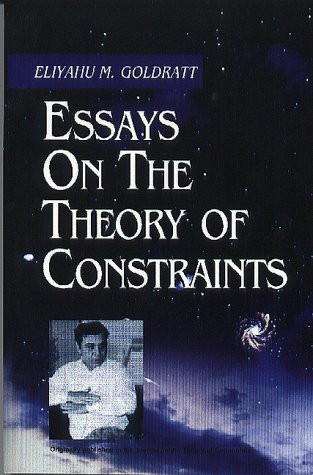
Essays on the Theory of Constraints
This collection of essays was originally published in The Journal on the Theory of Constraints.
Greedy Bastards How We Can Stop Corporate Communists, Banksters, and Other Vampires from Sucking America Dry
DYLAN RATIGAN’S mission is to uncover never-before-seen solutions to the most pressing issues of our time: government corruption, corporate communism, an ailing health care system, an age-old dependency on foreign oil, and a broken educational system. In this groundbreaking book, Ratigan makes a case that America has the opportunity to prosper, but only by setting clear goals. Ratigan believes that this country, now more than ever, needs passionate debate and smart policy, a brazen willingness to scrap what doesn’t work, and the entrepreneurial spirit to try what does. Ratigan has compiled brash and fresh solutions for building a new and better America, and with this book he has started the debate America deserves.

The Faber Report CNBC's "The Brain" Tells You How Wall Street Really Works and How You Can Make It Work for You
Already a major star on CNBC, Fabber is the host of a series of prime-time specials. The bear-market panic that crippled the sale of investment books is beginning to lift as investors realize that, especially in bad times, they need to know how to avoid loser stocks and find the rare winners.
