791 results for "Economic History"

The deepening crisis of U.S. capitalism

Magdoff, Harry
This is the third book of essays on the United States and the world economy produced by the fruitful collaboration of Monthly Review editors Paul M. Sweezy and Harry Magdoff. In these essays, written between 1977 and 1981, the authors assess the results of efforts taken to stabilize the economy after the epochal changes of the early 1970s, the end of capitalism's "golden age," by attempts to counteract the effects of inflation, debt dependence, speculation, and financial instability.
Monthly Review Press 1981 219 pages

The economic history of European Jews: late antiquity and early middle ages

Toch, Michael
"'The economic history of European jews' attempts to make sense of the economic foundations of Jewish life in the different parts of late antique and early medieval Europe. In the first part Michael Toch describes the demographic arc, decline, subsequent rise, and spatial distribution of Jewish populations. This data is then broadened to include the range of economic activities. The second part analyses the actual share of Jews in different branches of the economy. This includes the idea of their pioneer role and the notion of an intercontinental network of Jewish commerce, the phenomenon of Jews in agriculture and entrepreneurship, gender roles and the household mode of production, and the difficult subject of the significance of minority status for economic activity, among others"--provided by publisher.
Brill 2013 373 pages

History in My Life A Memoir of Three Eras

Ivan T. Berend
Ivan T. Berend is Distinguished Professor at the University of California Los Angeles, Director of the European Studies Program. He was one of the masterminds of regime change in Hungary. He made a career in Hungary as a university professor, Rector of the University of Economics (1973–79), and President of the Hungarian Academy of Sciences (1985–90). He was President of the International Committee of Historical Sciences (1995–2000), and Vice-President of the International Economic History Association (1986–1994). His research interests are the complex economic, social, ideological, and cultural history of Central and Eastern Europe in the 19th–20th century; economic modernization; problems of European backwardness; transition from state socialism to capitalism. He published and 26 books and more than 120 studies. Before he became a professor at UCLA, Ivan Berend had survived five regime changes and two revolutions in Hungary, had been in prison and German concentration camp in 1944–45. His memoir offers an interesting case study, a subjective addition to the "objective" historical works on Central and Eastern European state socialism. It describes the hard choices of intellectuals in a dictatorial state: 1. remain in isolation, concentrate on scholarly works, and exclude politics in your personal life; 2. be in opposition, criticize and unveil the regime, accept discrimination and exclusion; 3. remain within the establishment and work for reforming the country using legal possibilities to criticize the regime and to achieve changes from within. Berend’s book raises basic historical questions and debates, compares East European and American higher education systems, and presents an eyewitness’ insights on life in the United States.
Central European University Press 2023-09-15 286 pages

Imagining Zion

S. Ilan Troen
This timely book tells the fascinating story of how Zionists colonizers planned and established nearly 700 agricultural settlements, towns, and cities from the 1880s to the present. This extraordinary activity of planners, architects, social scientists, military personnel, politicians, and settlers is inextricably linked to multiple contexts: Jewish and Zionist history, the Arab/Jewish conflict, and the diffusion of European ideas to non-European worlds. S. Ilan Troen demonstrates how professionals and settlers continually innovated plans for both rural and urban frontiers in response to the competing demands of social and political ideologies and the need to achieve productivity, economic independence, and security in a hostile environment. In the 1930s, security became the primary challenge, shaping and even distorting patterns of growth. Not until the 1993 Oslo Accords, with prospects of compromise and accommodation, did planners again imagine Israel as a normal state, developing like other modern societies. Troen concludes that if Palestinian Arabs become reconciled to a Jewish state, Israel will reassign priority to the social and economic development of the country and region.
Yale University Press 2011-03-11 360 pages

Russia under Yeltsin and Putin: neo-liberal autocracy

Kagarlitsky, Boris
This passionate, pitiless analysis of post-Soviet Russia should be read by all interested in that country's present and future. Library Journal"It is a sorry tale, told with passion and competence." The IndependentRussia has undergone more seismic changes over the last 100 years than almost any other country. The 1917 Revolution, the rapid industrialisation of the 1930s, the following devastation of the Second World War, and the present return to Capitalism has seen the deep impoverishment of the entire population. The key questions which Kagarlitsky addresses are how to understand these changes, and how to characterise the complex process of reform, revolution and counter revolution. In a country with such a turbulent and violent political history, what path should development take, and what lies ahead? Looking in detail at the nature of Russian society and politics since 1990, Kagarlitsky offers an introductory political analysis of the major political and economic developments that have taken place under President Yeltsin, and the legacy he bequeathed so unexpectedly to his successor Putin. He focuses on the role of the media in post-Soviet Russia, corporate structures and their influence on social conflict, the formation of the oligarchy and the role of the left in modern Russia. This is a valuable source for anyone requiring a basic understanding of post-Soviet Russia and a clear historical guide for all students of contemporary Russian history.
Pluto Press 2002-03-20 303 pages

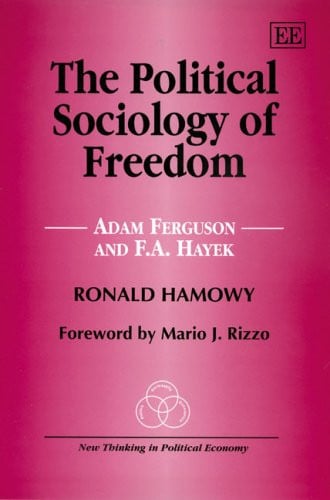
The political sociology of freedom: Adam Ferguson and F.A. Hayek

Hamowy, Ronald
Adam Ferguson and Friedrich Hayek, separated by a period of almost two hundred years, made original but similar contributions to the field of theoretical sociology. In this collection of essays, Ronald Hamowy explores the life and work of these two thinkers, giving special emphasis to their insights into the diffusion of knowledge. Ferguson, a giant of the Scottish Enlightenment, can be credited with laying the foundations of theoretical history by first proposing the idea that social institutions undergo evolutionary change. He theorized that while these institutions are formed by the actions of human beings, they are not the product of human design. Less than two centuries later, Hayek extended this insight to dealing with economic and social interaction, arguing that the knowledge requisite for structuring the social institutions under which we live is far too complex to be comprehended by any one mind or group of thinkers, and that these institutions had in fact evolved over long periods of time without deliberate design. Hayek was also the first to introduce the notion that market processes are a function of all participants contributing the limited knowledge that each possesses, out of which an orderly arrangement of enormous complexity emerges. Scholars and students of sociology, economics, history and political theory will find The Political Sociology of Freedom a unique and provocative read.
Edward Elgar 2005 265 pages

Sephardi Religious Responses to Modernity

Norman A. Stillman
First Published in 1995. Throughout the nineteenth century the entire structure of the Ashkenazi world crumbled. What remains of Ashkenazi Jewry today is split into irreconcilable religious camps on the one hand, and a large body of secularized Jews of greater or lesser ethnicity on the other. The Sephardi and Oriental Jews, who form the other great branch of world Jewry, had a very different encounter with the forces of modernity. This book examines some of their responses to its challenges. The Sephardi religious leaders, who had been historically more open to general culture, reacted with neither the anti-traditionalism of Reform Judaism nor the Ashkenazi ultra-Orthodox 's uncompromising rejection of everything new. Their response was rather one of active and creative halakhic engagement coupled with a tolerant attitude toward the growing secularized elements of their communities. Much has been written on the social, economic, and political transformation of Sephardi and Oriental Jewry in the modem era. However, this is the first book in English devoted to the religious changes taking place in this important segment of Jewry which now constitutes the majority of Jews in the Jewish state.
Taylor & Francis Group 2012-01-09 114 pages

Empire of the periphery: Russia and the world system

Kagarlitsky, Boris
Leading writer Boris Kagarlitsky offers an ambitious account of a thousand years of Russian history. Encompassing all key periods in Russia's dramatic development, the book covers everything from early settlers, through medieval decline, Ivan the Terrible-the "English Tsar", Peter the Great, the Crimean War and the rise of capitalism, the revolution, and the Soviet period, finally ending with the return of capitalism after 1991. Setting Russia within the context of the "World System", as outlined by Wallerstein, this is a major work of historical Marxist theory that is set to become a future classic.
Pluto Press 2008 364 pages

Global libidinal economy

Kapoor, Ilan,Fridell, Gavin,Sioh, Maureen Kim Lian,Vries, Pieter de
Claims unconscious desire plays a constitutive role in global political economy. This is the first book to examine global political economy from a psychoanalytic perspective. It claims that the libidinal-the site of unconscious desire-plays not a supplementary or trivial, but a constitutive role in global political economy. Consumption, for example, is not simply a way of satisfying a material or biological need but a doomed attempt at soothing our deeply held sense of loss; and capital is not just a means to material growth and prosperity but is invested with "drive" that seduces, beguiles, and manipulates in the service of unending accumulation. Thus, in contrast to political economy, which assumes a rational subject, libidinal economy is founded on the notion of a desiring subject, who obeys a logic not of good sense or self-interest but profligacy and irrationality. By applying a psychoanalytic lens, Global Libidinal Economy thereby seeks to uncover the unconscious excesses and antagonisms emergent in such key political economy categories as "production," "trade," and "ecology," while also bringing out significant contemporary themes relating to "gender" and "race."
SUNY Press 2023-11-02 220 pages

History in my life: a memoir of three eras

Berend, T. Iván
Berend's memoir offers an interesting case study, a subjective addition to the "objective" historical works on Central and Eastern European state socialism. It describes the hard choices of intellectuals in a dictatorial state: 1. remain in isolation, concentrate on scholarly works, and exclude politics in your personal life; 2. be in opposition, criticize and unveil the regime, accept discrimination and exclusion; 3. remain within the establishment and work for reforming the country using legal possibilities to criticize the regime and to achieve changes from within. Ivan T. Berend, is Distinguished Professor at the University of California Los Angeles, Director of the European Studies Program. He was one of the masterminds of regime change in Hungary. He made a career in Hungary as a university professor, Rector of the University of Economics (1973-79), and President of the Hungarian Academy of Sciences (1985-90). He was President of the International Committee of Historical Sciences (1995-2000), and Vice-President of the International Economic History Association (1986-1994). His research interests are the complex economic, social, ideological, and cultural history of Central and Eastern Europe in the 19th-20th century; economic modernization; problems of European backwardness; transition from state socialism to capitalism. He published 26 books and more than 120 studies.--Publisher's description
Central European University Press 2009 276 pages

Insiders and outsiders: the Indian working class of Durban, 1910-1990

Freund, Bill
In this social and economic history of the Indian working class of Durban, Bill Freund has woven strands of gender related, political, ethnic, and cultural issues into a complex and intriguing pattern. As "insiders and outsiders," the Indian working class presented an analytical challenge in studying economic history "from below." The result is a skillful representation of the nuances in the interplay of social forces, and the initiatives of particular classes and particular cultural formations, which simultaneously bring the larger picture into focus. The essential underlying concern of this book is to relate the history of this group to the changing nature of South African capitalism in the twentieth century. It unites an interest in people and agency with a conviction that structures are important in limiting the circumstances in which men and women pursue their destiny.
Heinemann 1995 133 pages

Bill Freund: An historian's passage to Africa ; an autobiography

Freund, Bill
'Bill Freund, the late social historian and leading analyst of African history, passed away in 2020 soon after finishing his autobiography. Often described as the academy's 'outsider insider', he was an eminent South African historian who published prodigiously in the areas of labour, capital and economic history. What influenced this American-educated academic to become such an astute and trusted observer of the political economy in Africa? We follow Bill's intellectual journey from a modest Jewish home in Chicago in the 1950s to the Universities of Chicago, Yale, Ahmadu Bello University in Nigeria and Dar-es-Salaam, Tanzania, and finally to a permanent teaching position at the University of KwaZulu-Natal in Durban, South Africa. Peppered in between the commentaries on academic life are stories of his travels, poems he wrote for loved ones, and endearing anecdotes of friendships that shaped his life. As an 'outsider', both in the United States and abroad, he is able to offer rich insights into the world of Africanists and their scholarship on different continents. His thoughtful and balanced observations on late- and post-apartheid South Africa are especially interesting and refreshing. This posthumously published autobiography will give deeper insight into this unusual man and the world that shaped him - and which he in turn influenced through a deep commitment to rigorous scholarship. It includes a select bibliography of Bill Freund's many publications as well as a foreword by Robert Morrell on the making of this autobiography."--Amazon description.
Wits University Press 2021-05-01 224 pages

Pluralism and social conflict: a social analysis of the communist world

Brucan, Silviu
This pioneering study focuses on an area of Soviet and socialist studies until now largely neglected in the literature: social change. The author contends that while most standard analyses of communist regimes purport to be about social change, they are in fact analyzing economic and political developments rather than transformation in the class structure of society. Because economic and political factors are the least stable, Brucan argues, they are therefore the least explanatory and predictive factors if we are to understand long term trends in the evolution of socialism. Brucan instead explores the social forces at work in the Soviet Union, China, and Eastern Europe--classes, professional groups, and so on--tracing the evolution of class and class policy from the time of the 1917 revolution through the present leadership of Gorbachev. Students of international affairs and sociology will find in Brucan's work important new insights into the likely future direction of the world's major communist societies. Beginning with a detailed historical analysis of class and class policy in the East, Brucan examines issues such as forced collectivization, the new working class, wage policy, the state take-over, and Khruschev's openings. Turning to a discussion of the relationship between social structure and the scientific-technological revolution, the author shows that communist regimes in the Soviet Union, Eastern Europe, and China have demonstrated a deliberate and systematic pattern of overvaluation of manual work and undervaluation of scientific and technical work--explaining their lack of preparation for rapid scientific and technical change. Brucan relates the historical analysis of social change to questions about whether reforms in the East can be achieved, arguing that no analysis of the East's economic and political history can be fully understood without considering social structure. In the final section, the author addresses the current period of perestroika, suggesting that Gorbachev's real challenge will be to dislodge the current social structure that was consolidated in the late 1970s. He concludes that a new class alignment in socialism has led to a crisis of the communist party itself.
Praeger 1990-08-28 186 pages