833 results for "Environment"

Endymion.

Disraeli, Benjamin
Title: Endymion.Publisher: British Library, Historical Print EditionsThe British Library is the national library of the United Kingdom. It is one of the world's largest research libraries holding over 150 million items in all known languages and formats: books, journals, newspapers, sound recordings, patents, maps, stamps, prints and much more. Its collections include around 14 million books, along with substantial additional collections of manuscripts and historical items dating back as far as 300 BC.The GENERAL HISTORICAL collection includes books from the British Library digitised by Microsoft. This varied collection includes material that gives readers a 19th century view of the world. Topics include health, education, economics, agriculture, environment, technology, culture, politics, labour and industry, mining, penal policy, and social order. ++++The below data was compiled from various identification fields in the bibliographic record of this title. This data is provided as an additional tool in helping to insure edition identification: ++++ British Library Disraeli, Benjamin; 1880. pp. 84. 29 cm. 12623.k.25.
British Library, Historical Print Editions 2011-03-17 132 pages

In foreign cities

Mitgutsch, Anna
"In Foreign Cities deals with an American woman who, after fifteen years of marriage to an Austrian businessman, begins an affair with a young American singer, leaves her husband and two children, and returns to her homeland in search of her lost identity as a poet and the personal artistic fulfillment that she feels has been denied to her in the foreign environment. Lillian's journey leads her through a series of internal and external confrontations with a past ideal that is not compatible with the present reality, on her way to a final resolution of the conflicts with herself and with family members who haunt her memories: a well-adjusted sister who is her social opposite; a grandmother who envisioned for her the literary success she has not realized; a father who rejected her; the husband and children whom she has left behind. The ending brings the tragic insight that she has been victimized by a false perception of her life and talent. Her problem is not the world around her but lies within herself." --Book Jacket.
Ariadne Press 1995 220 pages

Museums: In Search of a Usable Future

Wittlin, Alma
This comprehensive study offers an analysis of the museum as a public institution, provides an account of its historical roots, and gives a forecast of its future. In the Foreword, S. Dillon Ripley, Secretary of the Smithsonian Institution, states: "Museums are becoming more and more important. For one thing, as Dr. Wittlin points out, museums provide immediate encounters with authenticity, or a reasonable simulacrum of it. They provide new ways of teaching and learning, and an introduction to processes of lifelong education, now a priority for everyone." An earlier book by Dr. Wittlin, The Museum: Its History and Its Tasks in Education, was the direct predecessor of the present work. The historical chapters have been expanded, and whereas the former volume ended with the outbreak of the Second World War, this study considers the achievements that took place in all parts of the world from 1945 up to the present time. The author's earlier work, published in England, gained international acclaim as a definitive publication in the field and was praised for its philosophical depth, historical breadth, and perceptive insights into the character of a complex institution. Museological events of a scope without precedent are today in a stage of drafting and builidng. Dr. Wittlin examines all aspects of a museum's function: from the traditional functions as a depository, a center of research, and an educational agency to the newer, perhaps peripheral, functions that the author summarizes under the term "cultural center." All these purposes, though valid, must be constantly reexamined in the light of the "extending frontiers of knowledge, rising standards of general education, and of access to new techniques based on scientific advances." In a chapter on a "Twelve-Point Program for Museum Renewal" the main, broad facets of the institution are clearly and concisely discussed. Dr. Wittlin begins with a definition of the term museum established by the International Council of Museums and describes problems of institutional identity and funding, training of personnel, and determining visitor population. She also points up the fallacies in the assumption that mere exposure to exhibits results in learning and stimulation. This book is an impressive and scholarly presentation of the museum pictured through its past and examined in its present functioning as well as what it may offer in the foreseeable future. It is also entertainingly written. The "hottest" current issue, as Dr. Wittlin calls it, is ecology, the study of the interdependence of all living things not only among themselves but with the organic environment. The museum's role in this issue is postulated and discussed. The work is amply illustrated.
Mit Pr 1974-07-15 352 pages

Art in an age of civil struggle, 1848-1871

Boime, Albert
From the European revolutions of 1848 through the Italian independence movement, the American Civil War, and the French Commune, the era Albert Boime explores in this fourth volume of his epic series was, in a word, transformative. The period, which gave rise to such luminaries as Karl Marx and Charles Darwin, was also characterized by civic upheaval, quantum leaps in science and technology, and the increasing secularization of intellectual pursuits and ordinary life. In a sweeping narrative that adds critical depth to a key epoch in modern art’s history, Art in an Age of Civil Struggle shows how this turbulent social environment served as an incubator for the mid-nineteenth century’s most important artists and writers. Tracing the various movements of realism through the major metropolitan centers of Europe and America, Boime strikingly evokes the milieus that shaped the lives and works of Gustave Courbet, Edouard Manet, Émile Zola, Honoré Daumier, Walt Whitman, Abraham Lincoln, and the earliest photographers, among countless others. In doing so, he spearheads a powerful new way of reassessing how art emerges from the welter of cultural and political events and the artist’s struggle to interpret his surroundings. Boime supports this multifaceted approach with a wealth of illustrations and written sources that demonstrate the intimate links between visual culture and social change. Culminating at the transition to impressionism, Art in an Age of Civil Struggle makes historical sense of a movement that paved the way for avant-garde aesthetics and, more broadly, of how a particular style emerges at a particular moment.
University of Chicago Press 2007 884 pages

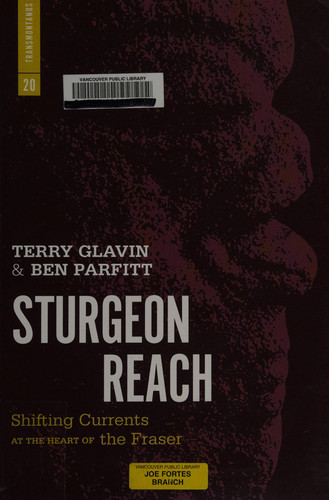
Sturgeon Reach: shifting currents at the heart of the Fraser

Glavin, Terry
Sturgeon Reach is the name some have given to a stretch of the Fraser River between Hope and Pitt Meadows, where its flow slows, and it deposits the gravel it's been carrying from the province's interior. Its story is one of rocks and stones, from its geological origins, from the mythic beginnings of human settlement, and from the arrival of Simon Fraser through to the onslaught of dykes and roads and bridges and foundations that today threaten the river's essential nature. Sturgeon Reach hosts an incredible array of life, from giant black cottonwoods to a creature that dates from the age of dinosaurs –– the remarkable white sturgeon. This stretch of river is the spawning ground for major salmon runs. And for millennia, it has also been the home of the Sto:lo Indians. How can we now live well along a river that has a ceaseless desire to overflow its banks and set its own course? How can we allow the life that the river's character fosters to persist in the face of overwhelming development? In the 20th book in the Transmontanus series, Terry Glavin and Ben Parfitt explore Sturgeon Reach — its geography, its history, its critical role in the coastal ecosystem, and the compelling story it tells about competing human needs.
New Star Books 2012-11-15 69 pages

REPORT FROM THE FRONTLINE: FROM SOUTH

United States Congress House of Represen
The BiblioGov Project is an effort to expand awareness of the public documents and records of the U.S. Government via print publications. In broadening the public understanding of government and its work, an enlightened democracy can grow and prosper. Ranging from historic Congressional Bills to the most recent Budget of the United States Government, the BiblioGov Project spans a wealth of government information. These works are now made available through an environmentally friendly, print-on-demand basis, using only what is necessary to meet the required demands of an interested public. We invite you to learn of the records of the U.S. Government, heightening the knowledge and debate that can lead from such publications.
BiblioGov 2010-12-31 102 pages

Islands and military orders, c.1291-c.1798

Emanuel Buttigieg,Simon Phillips
At the heart of this volume is a concern with exploring levels of interaction between two particular objects of study, islands on the one hand, and military orders on the other. According to Fernand Braudel, islands are, 'often brutally', caught 'between the two opposite poles of archaism and innovation.' What happened when these particular environments interacted with the Military Orders? The various contributions in this volume address this question from a variety of angles. 1291 was a significant year for the main military orders: uprooted from their foundations in the Holy Land, they took refuge on Cyprus and in the following years found themselves vulnerable to those who questioned the validity of their continued existence. The Teutonic Order negated this by successfully transferring their headquarters to Prussia; the Knights Templar, however, faced suppression. Meanwhile, the Knights Hospitaller conquest of Rhodes assured both their survival and independence. Islands are often, by definition, seen to be embodiments of 'insularity', of an effort to be separate, distinct, cut-off. Military Orders are, conversely, international in scope, nature and personnel, the 'first international orders of the Church', as they have often been described. Therein lies the crux of the matter: how did insular outposts and international institutions come together to forge distinct and often successful experiments? Hospitaller Rhodes and Malta still impress with their magnificent architectural heritage, but their success went beyond stone and mortar and the story of islands and military orders, as will be clearly shown in this volume, also goes beyond these two small islands. The interaction between the two levels - insulation and internationalisation - and the interstices therein, created spaces conducive to both dynamism and stability as military orders and islands adapted to each other's demands, limitations and opportunities.
Routledge 2024-10-14 302 pages

The modern crisis

Bookchin, Murray
Six incisive essays from the father of social ecology. Murray Bookchin's frank assessment of the disaster we are heading toward at increasing speed is as much a work of ethics as it is of environmentalism. The six essays that comprise it share the view that, as he puts it, "our ideas and our practice must be imbued with a deep sense of ethical commitment." Whether he is critiquing the market economy, the state, or the idea--common to both capitalists and certain left materialists--that human beings are motivated solely by greed and self-interest, Bookchin ever reminds us of the ineffable values of freedom, self-consciousness, and social harmony. Though first published in 1986, Bookchin's framework still applies. The moral relativism of the 1980s--the politics of lesser-evils and risk vs benefit calculations--has morphed into what we now refer to as "both-sidesism" and the risk vs benefit calculations of yesterday are the 100,000 acre burn scars seen throughout the American west today. Beyond moral relativism or moral absolutism is an ecologically based ethics--one that sees our selfhood, reason, and freedom as stemming from nature's variety and resilience. Bookchin's social ecology refuses to separate society from nature. As such one can consider it a philosophy of participation--we cannot develop ecocommunities that aren't participatory. We can't save ourselves and the planet without an ethics of freedom. This edition, with a new introduction by Bookchin scholar Andy Price, is a breath of fresh air for a left that seems to have forgotten basic truths.
AK Press 2022 155 pages

Katrina's Legacy The Black Nation, Black/latino Alliance, Indigenous Peoples Movements, the Third Reconstruction, Nations of Africa Asia and Lati

Eric Mann
* A major historical essay on white racism and Black Reconstruction from 1865 to the present-- rooted in the work of Frederick Douglass, Harriet Tubman, John Brown, W.E.B. Du Bois, Harry Haywood, Fannie Lou Hamer, Malcolm X, Student Nonviolent Coordinating Committee (SNCC), Black Panther Party, and Amiri Baraka.* A strategic intervention on demand development: The Right of Return for the 250,000-person Black New Orleans Diaspora, An Environmental Justice Plan for New Orleans, Full Democratic Rights, Land, Reparations, and Self-Determination for Black People in the U.S., Black Women in the Eye of the Storm, Immigrant and Indigenous Rights, Free the Prisoners, U.S. Out of Iraq, and Placing the Struggle on the International Stage. * A call for a Third Reconstruction--a hopeful and strategic challenge to the two-party Second Counterrevolution under which we are living today. An antiracist, anti-imperialist alternative to the Age of Reaction
Primedia E-launch LLC 2015-11-19 400 pages

Playbook for progressives: 16 qualities of the successful organizer

Mann, Eric
An organizing manifesto for the twenty-first century, Playbook for Progressives is a must-have for the activist’s tool kit. This comprehensive guide articulates pragmatically what is required in the often mystifying and rarely explained on-the-ground practice of organizing. Here, Eric Mann distills lessons he learned from over forty years as an organizer, as well as from other organizers within the civil rights, labor, LGBT, economic justice, and environmental movements.
Beacon Press 2011-08-09 207 pages

Ecologica

Gorz, André
Writing in 2007, French social philosopher André Gorz (1923-2007) was remarkably prophetic, foretelling the international economic meltdown of 2008: "The real economy is becoming an appendage of the speculative bubbles sustained by the finance industry--until that inevitable point when the bubbles burst, leading to serial bank crashes and threatening the global system of credit with collapse and the real economy with a severe, prolonged depression." This prescient article is collected in Ecologica alongside many of Gorz's final writings and interviews, which together offer practical and often path-breaking set of solutions to our current economic and political problems. In his writings Gorz condemns the speculative global economic system and anatomizes its terminal crisis. Advocating an exit from capitalism through the self-limitation of needs and the networked use of the latest technologies, he outlines a practical, democratically based solution to our current predicament. Compiled by Gorz, Ecologica is intended as a final distillation of his work and thought, a guide to the survival of our planet. It is a work of political, rather than scientific ecology--Gorz aruges that the key to planetary survival is not a surrender to environmental experts and eco-technocrats, but a switch to non-consumerist modes of living that would amount to a type of cultural revolution. Praise for André Gorz "To my mind the greatest of modern French social thinkers."--Herbert Gintis, author of Schooling in Capitalist America "Gorz's work was always within the Utopian tradition--a label he welcomed but which was used pejoratively by his opponents. . . . Many of his derided early warnings about globalization and environmental degradation have become commonplace discourses in political debates today. Ultimately, Gorz's Utopianism was expressed in a very practical sense--we never know how far along the road we are if we have no idea of the destination."-- Independent
Seagull Books 2010 185 pages

Conflict in man-made environment

Rapoport, Anatol
"How the environment causes, or contributes to, psychic and social conflict is frequently discussed. Less often considered is the theme developed in this Pelican by Professor Rapoport--that human conflict intimately affects the 'symbolic' environment, which may be a more powerful determinant of man's condition than pollution, war or urbanization. By 'symbolic' environment is meant the whole non-material body of knowledge, science, art, history, language, beliefs and ideas which human intelligence has amassed. Outlining various theories of aggression, progress, evolution and the struggle for existence, Professor Rapoport examines in detail the systemic philosophies advanced by Hobbes, Hegel, Clausewitz, Marx, Lenin and the modern 'think-tanks'. He concludes--in a book which from the start is concerned with the functioning of systems--that the 'mind' of a system, backed by power, may be disastrously different from the psychology of any of its members. In this context Professor Rapoport detects a gleam of hope in the growing scepticism about all and any concentrations of power"--Back cover.
Penguin 1974 272 pages

Goldstein's greatest hits: a book mostly about rock 'n' roll

Goldstein, Richard
Practical advice and real-life examples help teachers understand and apply the principles of classroom management in their own classroom situations. Comprehensive, based on the most current research, and supported through the examples of thousands of teachers already using these techniques, this popular resource helps K-12 teachers implement effective classroom management methods. The emphasis is on creating classrooms where students feel safe because they know they are respected and supported by their teacher and peers-and where classroom behavior standards have been developed with and agreed upon by students. Through detailed case studies, examples, and descriptions of specific strategies, the book also examines instructional methods that support high rates of student engagement and methods for responding effectively to minor as well as serious and ongoing situations where student behavior disrupts the learning environment. Included are numerous Pause and Consider questions and activities to help readers master and implement the methods presented. The Eleventh Edition expands its emphasis on data-driven, research-based approaches to classroom management, including a new focus on how brain research and trauma-sensitive classrooms can inform our understanding of student learning and behavior.
Prentice-Hall 1970 228 pages

Meg: a play in three acts

Vogel, Paula
3m, 2f / Platforms, moveable props American College Theatre Festival Winner. Base on the life of Margaret More Roper. The political and ruthless male hierarchies of Henry VIII and the Church are offstage forces imprisoning Meg, a unique woman isolated from her time and environment through the gift and curse of her developed intellect. MEG intertwines several themes and levels: It is the story of Sir Thomas More seen through his daughter's eyes, it's about a young wife and mother - and it's also
Samuel French 1977 74 pages