1524 results for "History"

A people's history of the Second World War: resistance versus empire

Gluckstein, Donny
"A People's History of the Second World War unearths the fascinating history of the war as fought "from below." Until now, the vast majority of historical accounts have focused on the regular armies of the allied powers. Donny Gluckstein shows that an important part of the fighting involved people's militias struggling against not just fascism, but also colonialism, imperialism, and capitalism itself. Gluckstein argues that despite this radical element, which was fighting on the ground, the allied governments were more interested in creating a new order to suit their interests. He shows how various anti-fascist resistance movements in Poland, Greece, Italy, and elsewhere were betrayed by the Allies despite playing a decisive part in defeating the Nazis. This book will fundamentally challenge our understanding of the Second World War - both about the people who fought it and the reasons for which it was fought."--Publisher's website
Pluto Press 2012 269 pages

Re-inventing the Jewish past: European Jewish intellectuals and the Zionist return to history

Myers, David N.
David Myers' book explores a fascinating and untold chapter in modern Jewish intellectual history: the role of the first generation of Jewish scholars at the Hebrew University in Jerusalem in establishing Jewish studies within framework of a jewish national university. committed to rewriting jewsh history according to zionst standarts, these "jerusalem scholars" richly reflect the tensions that attended their dual allegiances, to both zionism and the discipline of history
Oxford University Press 1995-11-30 278 pages

Image before my eyes: a photographic history of Jewish life in Poland before the Holocaust

Dobroszycki, Lucjan
"The Jews of Poland between the World Wars come alive in this photographic essay in all their diversities....One imagines that Polish Jewry would have wanted to be remembered thus -- looking out to the camera and the world beyond." -- Ruth R. Wisse "Reveals a vibrantly rich kaleidoscope of life using many great photographs, some known, others never seen before. A volume to read, to study, to treasure." -- Cornell Capa "Beautifully balanced to serve the fascinating truth of a civilization that vanished into the darkest folds of history....All this seems so distant and yet so familiar, for although they are gone, they are family, and it was just yesterday." -- Mark Helprin "A poignant and visually beautiful reconstitution of the varied, culturally rich, and endlessly fascinating lost world of Polish Jews. Reading it makes one glow with pride." -- Louis Begley "If you're Jewish and looking for your roots and the world of your grandfathers, this is the book for you. If you're not Jewish, but just curious, this book is for you....It can take you on a voyage into a world that vanished in the gas and smoke of the Holocaust." -- Lucy S. Dawidowicz "One of the most extraordinary photographic histories ever assembled....An entire people and culture, now gone from the face of the earth, comes forth from its pages with an animation and vitality so powerful that the tragedy of the end of Polish Jewry seems for a moment, miraculously suspended." -- Simon Schama
Schocken Books 1994-11-01 269 pages

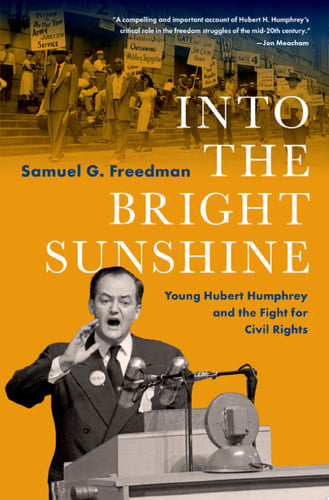
Into the bright sunshine: young Hubert Humphrey and the fight for civil rights

Freedman, Samuel G.
"Hubert Humphrey, a fallen hero and a dying man, rose on rickety legs to approach the podium of the Philadelphia Convention Hall, his pulpit for the commencement address at the University of Pennsylvania. He clutched a sheaf of paper with his speech for the occasion, typed and double-spaced by an assistant from his extemporaneous dictation, and then marked up in pencil by Humphrey himself. A note on the first page, circled to draw particular attention, read simply, "30 years ago--Here." In this place, at that time, twenty-nine years earlier to be precise, he had made history. From the dais now, Humphrey beheld five thousand impending graduates, an ebony sea of gowns and mortarboards, broken by one iconoclast in a homemade crown, two in ribboned bonnets, and another whose headgear bore the masking-tape message HI MA PA. In the horseshoe curve of the arena's double balcony loomed eight thousand parents and siblings, children, and friends. Wearing shirtsleeves and cotton shifts amid the stale heat, they looked like pale confetti from where Humphrey stood, and their flash cameras flickered away, a constellation of pinpricks"--
Oxford University Press 2023 488 pages

Raquela

Ruth Gruber
A National Jewish Book Award-winning biography: A look at the early years of Israel's statehood, experienced through the life of a pioneering nurse. During her extraordinary career, nurse Raquela Prywes was a witness to history. She delivered babies in a Holocaust refugee camp and on the Israeli frontier. She crossed minefields to aid injured soldiers in the 1948 Arab-Israeli War and organized hospitals to save the lives of those fighting the 1967 Six-Day War. Along the way, her own life was a series of triumphs and tragedies mirroring those of the newly formed Jewish state. Raquela is a moving tribute to a remarkable woman, and an unforgettable chronicle of the birth of Israel through the eyes of those who lived it.
Open Road Integrated Media, Incorporated 2014-01-21 478 pages

Flags Over the Warsaw Ghetto

Moshe Arens
The Warsaw Ghetto Uprising has become a symbol of heroism throughout the world. A short time before the uprising began, Pawel Frenkel addressed a meeting of the Jewish Military fighters: Of course we will fight with guns in our hands, and most of us will fall. But we will live on in the lives and hearts of future generations and in the pages of their history.... We will die before our time but we are not doomed. We will be alive for as long as Jewish history lives! On the eve of Passover, April 19, 1943, German forces entered the Warsaw ghetto equipped with tanks, flame throwers, and machine guns. Against them stood an army of a few hundred young Jewish men and women, armed with pistols and Molotov cocktails. Who were these Jewish fighters who dared oppose the armed might of the SS troops under the command of SS General Juergen Stroop? Who commanded them in battle? What were their goals? In this groundbreaking work, Israel s former Minister of Defense, Prof. Moshe Arens, recounts a true tale of daring, courage, and sacrifice that should be accurately told out of respect for and in homage to the fighters who rose against the German attempt to liquidate the Warsaw ghetto, and made a last-ditch fight for the honor of the Jewish people. The generally accepted account of the Warsaw Ghetto Uprising is incomplete. The truth begins with the existence of not one, but two resistance organizations in the ghetto. Two young men, Mordechai Anielewicz of the Jewish Fighting Organization (ZOB), and Pawel Frenkel of the Jewish Military Organization (ZZW), rose to lead separate resistance organizations in the ghetto, which did not unite despite the desperate battle they were facing. Included is the complete text of The Stroop Report translated into English.
Amazon Digital Services LLC - Kdp 2019-04-16 416 pages

The end of parliamentary socialism: from Benn to Blair

Panitch, Leo
Review “Leo Panitch and Colin Leys have written a book whose significance extends far beyond the specific case of the British Labour Party.”—Critical Sociology “... a brilliant refutation of New Labour’s version of history. With an impressive range of evidence, careful analysis and a theoretical framework, [Panitch and Leys] have provided a highly readable and committed book ... recommended for everyone who really wants to understand the politics and recent history of the Labour Party.”—Contemporary Politics “... a rich and immensely enjoyable narrative, full of detail about the trajectory taken by Labour over the last quarter-century.”—Times Literary Supplement Product Description This trenchant account of the last twenty-five years of the British Labour Party argues that Tony Blair’s modernizing tendency was profoundly mistaken in asserting that the only alternative to traditional social democracy and narrow parliamentarianism was an acceptance of neo-liberalism. In blaming the Labour left, rather than the social-democratic right for the party’s years in the electoral wilderness, the modernizers rejected the creativity and energy which the party’s New Left had mobilized, and without which their own professed aim of democratic renewal was unlikely to be realized. About the Author Colin Leys is Emeritus Professor of Political Studies at Queen’s University, Canada. His previous books include Politics in Britain, The Rise and Fall of Development Theory and, with Leo Panitch, The End of Parliamentary Socialism. Leo Panitch is Canada Research Chair in Comparative Political Economy and Distinguished Research Professor of Political Science at York University. Editor of The Socialist Register for 25 years, his many books include Working Class Politics in Crisis, A Different Kind of State, The End of Parliamentary Socialism, and American Empire and The Political Economy of Global Finance.
Verso 1997 341 pages

51 documents: Zionist collaboration with the Nazis

Lenni Brenner
With the Nazi era being one of the most discussed periods in history, there are still many people who are unaware of collaboration between Zionism and the fascist regimes of Hitler and Mussolini. Now in paperback and featuring an updated article on the Iron Wall' by Vladimir Jabotinsky, 51 Documents brings to light the immense disservice the Zionists did to many other Jews during this period.'
Barricade 2009 342 pages

How we forgot the Cold War: a historical journey across America

Wiener, Jon
Hours after the USSR collapsed in 1991, the U.S. Congress began making plans to establish the official memory of the Cold War. Conservatives dominated the proceedings, spending millions of dollars to portray the conflict as a clash of good vs. evil, ending in a defeat of totalitarianism equal in significance to the outcome of World War II. In this book, the author visits Cold War monuments, museums, and memorials across the United States to find out how the era is remembered today. His journey provides a history of the Cold War that turns many conventional notions on their heads
University of California Press 2012 376 pages

Race, space, and riots in Chicago, New York, and Los Angeles

Abu-Lughod, Janet L.
"This study is the first attempt to compare six major race riots that occurred in the three largest American urban areas during the course of the twentieth century: in Chicago in 1919 and 1968; in New York in 1935/1943 and 1964; and in Los Angeles in 1965 and 1992. Race, Space, and Riots in Chicago, New York, and Los Angeles weaves together detailed narratives of each riot, placing them in their changing historical contexts and showing how urban space, political regimes, and economic conditions - not simply an abstract "race conflict"--Have structured the nature and extent of urban rebellions. Building on her previous comparative history of these three cities, Janet Abu-Lughod draws upon archival research, primary sources, case studies, and personal observations to reconstruct events - especially for the 1964 Harlem-Bedford Stuyvesant uprising and Chicago's 1968 riots where no documented studies are available. By focusing on the similarities and differences in each city, identifying the unique and persisting issues, and evaluating the ways political leaders, law enforcement, and the local political culture have either defused or exacerbated urban violence, this book points the way toward alleviating long-standing ethnic and racial tensions." "Race, Space, and Riots In Chicago, New York, and Los Angeles offers a deeper understanding of past - and future - urban race relations while emphasizing that until persistent racial and economic inequalities are meaningfully resolved, the tensions leading to racial violence will continue to exist in America's cities and betray our professed democratic values"--OCLC
Oxford University Press 2007-01 344 pages

Perpetrators: The World of the Holocaust Killers

Lewy, Guenter
Zusammenfassung: "Monsters exist, but they are too few in number to be truly dangerous. More dangerous are the common men, the functionaries ready to believe and to act without asking questions." Primo Levi's words disclose a chilling truth: assigning blame to hideous political leaders, such as Hitler, Himmler, and Heydrich, is necessary but not sufficient to explain how the Holocaust could have happened. These leaders, in fact, relied on many thousands of ordinary men and women who made the Nazi machine work on a daily basis -- members of the killing squads, guards accompanying the trains to the extermination camps, civilian employees of the SS, the drivers of gas trucks, and the personnel of death factories such as Auschwitz. Why did these ordinary people collaborate and willingly become mass murderers? In Perpetrators: The World of the Holocaust Killers, Guenter Lewy tries to answer one of history's most disturbing questions. Lewy draws on a wealth of previously untapped sources, including letters and diaries of soldiers who served in Russia, the recollections of Jewish survivors, archival documents, and most importantly, the trial records of hundreds of Nazi functionaries. The result is a ghastly, extraordinarily detailed portrait of the Holocaust perpetrators, their mindset, and the motivations for their actions. Combining a rigorous historical analysis with psychological insight, the book explores the dynamics of participation in large-scale atrocities, offering a thought-provoking and timely reflection on individual responsibility for collective crimes. Lewy concludes that the perpetrators acted out of a variety of motives--a sense of duty, obedience to authority, thirst for career, and a blind faith in anti-Semitic ideology, among others. A witness to the 1938 Kristallnacht himself and the son of a concentration camp survivor, Lewy has searched for the reasons of the Holocaust out of far more than theoretical interest: it is a passionate attempt to illuminate a dismal chapter of his life -- and of human history -- that cannot be forgotten. -- Provided by publisher
Oxford University Press 2017 195 pages

Mr. and Mrs. President: from the Trumans to the Clintons

Troy, Gil
It began with Eleanor and Franklin Roosevelt. It accelerated with Jack and Jackie Kennedy. Lady Bird and Lyndon Johnson became partners in office and Nancy and Ronnie seemed joined at the hip. Without question, the presidential couple has arrived as a force in politics. Yet surprisingly, the electorate is not happy about it. The emergence of the presidential couple is one of the most important and contentious developments in America’s postwar political history. Its citizens’ reaction to the First Couple reflects the country’s changing morality, its uncertain attitude toward feminism, and the increasing power of the media. Gil Troy traces these shifts through ten presidential marriages, from the homesick tensions between Harry and Bess Truman to the very public scandals endured by Bill and Hillary Clinton. Along the way, readers learn of Mamie Eisenhower's perseverance on her husband’s campaign trail, Gerald Ford’s embarrassment over Betty’s outspoken honesty, and the amazing political success of Nancy and Ronald Reagan’s partnership in office. With a new chapter devoted to Hillary and Bill Clinton’s tainted partnership in office and to our present First Lady’s senatorial ambitions, this edition of Gil Troy’s Mr. and Mrs. President offers fresh insights into America’s paradoxical expectations for its presidential wives and husbands. “Troy argues that the rise of the First Couple is not simply a function of the women’s movement, but reflects a mixture of factors, including the weakening of parties, the rise of personality politics, the increasing power of the Presidency and the Federal Government and perhaps, most important of all, the ‘rise of the mass media and the new political culture it spawned.’”—New York Times Book Review.
University Press of Kansas 2000-05-02 440 pages

The fateful question of culture

Hartman, Geoffrey H.
Based on a series of lectures delivered at the University of California, Irvine, 1992. The essays discuss culture and the growth of cultural studies over the past 50 years. Ch. 4 (pp. 99-140), "Language and Culture after the Holocaust, " suggests that the Holocaust is a reference point in cultural history - there is a before and an after. Though some have said that after Auschwitz no narrative is possible, without narrative it is much harder to keep the event in mind. Discusses philosophers' problems with the Holocaust - especially the "nonresponse" of Heidegger and the responses of Adorno, Celan, and Derrida. After the Nazi experience, culture can no longer claim to represent a definitive triumph of the spirit; Auschwitz cannot be integrated into culture. The war against the Jews left a grim intellectual legacy.
Columbia University Press 1997 249 pages

The Far Shore

Edward Ellsberg
Edward Ellsberg's The Far Shore is the riveting first-hand account of the Allied D-Day landings in France in June 1944. A key actor in the invasion, Ellsberg describes in detail the massive preparations for the launch of the greatest armada in history, focusing on Hitler's Atlantic Wall defenses along the Normandy beaches and the ingenious creation of the Mulberry artificial floating harbor which would prove vital in securing an Allied beach-head in France. Ellsberg devotes the second half of his book to an unforgettable real-time account of the bloody D-Day landings.
CreateSpace Independent Publishing Platform 2018-07-19 256 pages

Going out: the rise and fall of public amusements

Nasaw, David
There was a time not very long ago when "going out" was only for the rich and the reckless. At the turn of the century, "going out" became part of everyday life as vaudeville halls, photograph parlors, penny arcades, nickelodeons, nightclubs, dance halls, world's fair midways, amusement parks, ballparks, and movie palaces opened their doors to the people of the city. The new amusement centers welcomed women, men, and children, native-born and immigrant, rich, poor, and middling. Only African Americans were excluded or segregated in the audience, though they were overrepresented on stage. Going Out chronicles the twentieth-century entertainment revolution that changed forever the ways we live, work, and play. In a matter of decades, a new public world of amusements was created where ethnic, class, and neighborhood differences were subordinated to the common pursuit of a good time. Clerks and bankers, sales girls and society ladies "turkey trotted" to ragtime in nightclubs and dance halls; "shot the chute" and clutched one another in "barrels of love"; visited "Darkest Africa" on the world's fair midways; and sat together in the dark watching pictures move on a screen. In Going Out, we meet the colorful characters who invented show business: Thomas Alva Edison, who was astonished when his phonograph made money playing music (he had designed it to take business dictation); Benjamin Franklin Keith, the circus grifter who opened a dime museum in Boston in the 1880s and within a decade owned the world's largest vaudeville theater circuit; Adolph Zukor and Marcus Loew, the New York furriers who made millions in the early picture-show business; and the dozens of small-time show businessmen who rode the rails with their "shows" in their trunks. And we hear the stories of the early black performers and their struggles to maintain their dignity and livelihood while audiences demanded their public humiliation. Going Out is a history of twentieth-century show business and of the new American public that assembled in the city's wondrous pleasure palaces, parks, and theaters. The book concludes with an account of the fall or relocation of this entertainment world, as central city amusement parks, movie palaces, and ballparks were uprooted and transported to the suburbs in the decades following World War II.
Harvard University Press 1999-04-15 312 pages

Animals in the Third Reich

Boria Sax
This important book explores the relationship between the Third Reich and animals -- as symbols, as myths, and as living creatures. From a review in Choice: "Rarely does a book contribute to two fields so significantly as this one. Sax, an independent scholar and consultant to various human rights organizations, has written the first book to explore thoroughly the Nazi cult of animals. In a way, this book reads like a mystery novel, as it uncovers some of the chief paradoxes of Nazi ideology. The Nazis promoted vegetarianism and passed the most progressive anti-cruelty laws the world has ever known. Yet they also developed a mystical technocracy that reduced morality to the crudest version of a biological struggle for survival...This book is a must for all collections in German history and in animal rights. It is a deep and profound reflection on the complex and perplexing ways that animals can shape human culture and politics." (S.H. Webb). This second, expanded edition includes a new essay on "Nazi Totemism."
Yogh & Thorn Press 2013-10 234 pages