4260 results for "World History"

The Principle of Relativity

Albert Einstein,H. (Hermann) Minkowski,P. C. (Prasanta Chandra) Mahalanobis
Explore the groundbreaking theories that redefined our understanding of the universe in "The Principle of Relativity," featuring seminal works by Albert Einstein and Hermann Minkowski. This essential collection delves into the revolutionary concepts of relativity, space-time, and their profound impact on the world of physics. A cornerstone of scientific thought, this volume presents Einstein's original papers alongside Minkowski's pivotal contributions, providing direct access to the genesis of these paradigm-shifting ideas. Journey through the essays that laid the foundation for modern physics and continue to inspire scientists and thinkers today. "The Principle of Relativity" offers a unique glimpse into the history of science, showcasing the intellectual journey that reshaped our comprehension of gravity, motion, and the very fabric of reality. A timeless resource for anyone interested in the profound implications of relativity and its enduring legacy. This work has been selected by scholars as being culturally important, and is part of the knowledge base of civilization as we know it. This work is in the public domain in the United States of America, and possibly other nations. Within the United States, you may freely copy and distribute this work, as no entity (individual or corporate) has a copyright on the body of the work. Scholars believe, and we concur, that this work is important enough to be preserved, reproduced, and made generally available to the public. We appreciate your support of the preservation process, and thank you for being an important part of keeping this knowledge alive and relevant.
Creative Media Partners, LLC 2025-03-29 236 pages

The Venona Secrets The Definitive Exposé of Soviet Espionage in America

Herbert Romerstein,Eric Breindel
The Venona Secrets presents one of the last great, untold stories of World War II and the Cold War. In 1995, secret Soviet cable traffic from the 1940s that the United States intercepted and eventually decrypted finally became available to American historians. Now, after spending more than five years researching all the available evidence, espionage experts Herbert Romerstein and Eric Breindel reveal the full, shocking story of the days when Soviet spies ran their fingers through America's atomic-age secrets. Included in The Venona Secrets are the details of the spying activities that reached from Harry Hopkins in Franklin Roosevelt s White House to Alger Hiss in the State Department to Harry Dexter White in the Treasury. More than that, The Venona Secrets exposes: • Information that links Albert Einstein to Soviet intelligence and conclusive evidence showing that J. Robert Oppenheimer gave Moscow our atomic secrets. • How Soviet espionage reached its height when the United States and the Soviet Union were supposedly allies in World War II. • The previously unsuspected vast network of Soviet spies in America. • How the Venona documents confirm the controversial revelations made in the 1940s by former Soviet agents Whittaker Chambers and Elizabeth Bentley. • The role of the American Communist Party in supporting and directing Soviet agents. • How Stalin s paranoia had him target Jews (code-named Rats ) and Trotskyites even after Trotsky’s death. • How the Soviets penetrated America’s own intelligence services. The Venona Secrets is a masterful compendium of spy versus spy that puts the Venona transcripts in context with secret FBI reports, congressional investigations, and documents recently uncovered in the former Soviet archives. Romerstein and Breindel cast a spotlight on one of the most shadowy episodes in recent American history - a past when by our very own government officials, whether wittingly or unwittingly, shielded treason infected Washington and Soviet agents.
Skyhorse Publishing 2014-12-08 608 pages

West and east: the war that came early

Turtledove, Harry
In 1938, two men held history in their hands. One was Adolf Hitler. The other was British prime minister Neville Chamberlain, who, determined to avoid war at any cost, came to be known as “the great appeaser.” But Harry Turtledove, the unrivaled master of alternate history, has launched a gripping saga that springboards from a different fateful act: What if Chamberlain had stood up to Hitler? What would the Nazis’ next move have been? And how would the war—which Hitler had always regretted waiting eleven months to start—have unfolded and changed our world? Here, Turtledove takes us across a panorama of conflict fueled by ideology and demagoguery. Nations are pitted against nations, alliances are forged between old enemies, ordinary men and women are hurled into extraordinary life-and-death situations. In Japanese-controlled Singapore, an American marine falls in love with a Russian dance hall hostess, while around him are heard the first explosions of Chinese guerilla resistance. On the frontlines of war-ravaged rural France, a weary soldier perfects the art of using an enormous anti-tank gun as a sniper’s tool—while from Germany a killer is sent to hunt him down. And in the icy North Atlantic, a U-boat bearing an experimental device wreaks havoc on British shipping, setting the stage for a Nazi ground invasion of Denmark. From an American woman trapped in Germany who receives safe passage from Hitler himself to a Jewish family steeped in German culture and facing the hatred rising around them, from Japanese soldiers on the remote edge of Siberia to American volunteers in Spain, West and East is the story of a world held hostage by tyrants—Stalin, Hitler, Sanjuro—each holding on to power through lies and terror even in the face of treacherous plots from within. As armies clash, and as the brave, foolish, and true believers choose sides, new weapons are added to already deadly arsenals and new strategies are plotted to break a growing stalemate. But one question looms over the conflict from West to East: What will it take to bring America into this war?
Del Rey 2010 436 pages

The Pope of Physics Enrico Fermi and the Birth of the Atomic Age

Gino Segrè,Bettina Hoerlin
A New York Times Book Review Editors’ Choice Named a Best Book of the Year by Bloomberg (Chosen by Philip Tetlock), Booklist ’s Top 10 Science Books of the Year, and Shortlisted for Physics World ’s Book of the Year A Major Biography of the Nobel Prize–Winning Physicist, Enrico Fermi, a Leading Architect of the Atomic Age Enrico Fermi is unquestionably among the greats of the world’s physicists, the most famous Italian scientist since Galileo. Called “the Pope” by his peers, he was regarded as infallible in his instincts and research. His discoveries changed our world; they led to weapons of mass destruction and conversely to life-saving medical interventions. This unassuming man struggled with issues relevant today, such as the threat of nuclear annihilation and the relationship of science to politics. Fleeing Fascism and anti-Semitism, Fermi became a leading figure in America’s most secret project: building the atomic bomb. An examination of the human dramas that touched Fermi’s life as well as a thrilling history of scientific innovation in the twentieth century, this is the comprehensive biography that Fermi deserves.
Picador 2017-10-10 384 pages

Bridge of words: Esperanto and the dream of a universal language

Schor, Esther H.
"A rich and passionate biography of a language and the dream of world harmony it sought to realizeIn 1887, Ludwig Lazarus Zamenhof, a Polish Jew, had the idea of putting an end to tribalism by creating a universal language, one that would be equally accessible to everyone in the world. The result was Esperanto, a utopian scheme full of the brilliance, craziness, and grandiosity that characterize all such messianic visions.In this first full history of a constructed language, poet and scholar Esther Schor traces the life of Esperanto. She follows the path from its invention by Zamenhof, through its turn-of-the-century golden age as the great hope of embattled cosmopolites, to its suppression by nationalist regimes and its resurgence as a bridge across the Cold War. She plunges into the mechanics of creating a language from scratch, one based on rational systems that would be easy to learn, politically neutral, and allow all to speak to all. Rooted in the dark soil of Europe, Esperanto failed to stem the continent's bloodletting, of course, but as Schor shows, the ideal continues draw a following of modern universalists dedicated to its visionary goal.Rich and subtle, Bridge of Words is at once a biography of an idea, an original history of Europe, and a spirited exploration of the only language charged with saving the world from itself"--
Metropolitan Books 2016-10-04 364 pages

The Nazis next door

Lichtblau, Eric
Read the history behind the series THE HUNTERS (starring Al Pacino) in this "captivating book rooted in first-rate research" (New York Times Book Review) that tells the true story of how America became home to thousands of Nazi war criminals. For the first time, once-secret government records and interviews tell the full story of the thousands of Nazis--from concentration camp guards to high-level officers in the Third Reich--who came to the United States after World War II and quietly settled into new lives. Many gained entry on their own as self-styled war "refugees." But some had help from the U.S. government. The CIA, the FBI, and the military all put Hitler's minions to work as spies, intelligence assets, and leading scientists and engineers, whitewashing their histories. Only years after their arrival did private sleuths and government prosecutors begin trying to identify the hidden Nazis. Now, relying on a trove of newly disclosed documents and scores of interviews, Eric Lichtblau reveals this shocking, shameful, and little-known chapter of postwar history. New York Times bestseller -- Espionage category "Disturbing." -- Salon "Engaging." -- Chicago Tribune "A gripping chronicle." -- Times of Israel "Riveting . . . An important, fascinating read." -- Jewish Book Council
Mariner Books 2015-09-19 304 pages

Aces Against Japan The American Aces Speak

Eric Hammel
ACES AGAINST JAPANThe American Aces Speak Volume IEric HammelIn this superb, originally conceived offering, noted military historian, Eric Hammel brings us first-person accounts from thirty-nine of the American fighter aces who blasted their way across the skies of the Pacific and East Asia from December 7, 1941, until the final air battles over Japan itself in August 1945.Coupled with a clear view of America's far-flung air war against Japan, Hammel's detailed interviews bring out the most thrilling in-the-cockpit experiences of the air combat that the Pacific War's best Army, Navy, and Marine pilots have chosen to tell. Meet Frank Holmes, who defied death in an outmoded P-36 while still clad in a seersucker suit he had worn to mass earlier that morning. Fly with Scott McCuskey as, single-handed at Midway, he takes out two waves of Japanese dive-bombers that are attacking his precious aircraft carrier. Sweat out the last precious drops of fuel in a defective Marine Wildcat fighter as Medal of Honor recipient Jeff DeBlanc bores ahead to his target to keep the faith with the bomber crews he has been assigned to protect. Experience the ecstasy of total victory as Ralph Hanks becomes the Navy's first Hellcat ace-in-a-day when he destroys five Japanese fighters over the Gilbert Islands in a single mission. A superb interviewer, Hammel has collected some of the very best air-combat tales from America's war with Japan. Combined with the four other volumes in The American Aces Speak series, this work will stand as an enduring testament to the brave men who fought the first and last air war in which high-performance, piston-engine fighters held sway. These are stories of bravery and survival, of men and machines pitted against one another in heart-stopping, unforgiving high-speed aerial combat. The American Aces Speak is a highly-charged emotional rendering of what men felt in the now-dim days of personal combat at the very edge of our living national history. There was never a war like it, and there never will be again. These are America's eagles, and the stories are their own, in their very own words. Eric Hammel is the author of more than thirty-five other books, including Pacifica Military History's Coral and Blood, Carrier Clash, Aces Against Germany, Aces Against Japan II, Aces at War, and Aces in Combat. He lives with his family near San Francisco. Critical Acclaim for The American Aces Speak Series The Marine Corps Aviation Association Yellow Sheet says: "The recounting of each story is done in the pilot's own words. This is a powerful technique that draws readers into the action and introduces them to the world of the fighter pilot" The American Fighter Aces Bulletin says: "Some of [the] episodes are well-known; others have never been written before. But each account delivers something intensely personal about the Pacific Air War." The Library Journal says: "No PR hype or dry-as-dust prose here. Hammel allows his flyers to tell their stories in their own way . . . Exciting stuff aviation and World War II buffs will love." Book Page says: "For those who have an interest in World War II, or those who simply like to read of drama in the skies, Eric Hammel's [Aces Against Japan] is recommended reading. It is a must for any historian's bookshelf. "WWII Aviation Booklist says: "Hammel provides a veritable feast of aviation combat narrative. As always in this series, the entries [in Aces at War] have been carefully selected to provide the most entertaining ride possible for his readers. Easily the best series available on air combat! Get them all!"
Independently Published 2020-11-24 356 pages

Jelly Roll blues: censored songs & hidden histories

Wald, Elijah
"A bestselling music historian follows Jelly Roll Morton on a journey through the hidden worlds and forbidden songs of early blues and jazz. In Jelly Roll Blues: Censored Songs and Hidden Histories, Elijah Wald takes readers on a journey into the hidden and censored world of early blues and jazz, guided by the legendary New Orleans pianist Jelly Roll Morton. Morton became nationally famous as a composer and bandleader in the 1920s, but got his start twenty years earlier, entertaining customers in the city's famous bordellos and singing rough blues in Gulf Coast honky-tonks. He recorded an oral history of that time in 1938, but the most distinctive songs were hidden away for over fifty years, because the language and themes were as wild and raunchy as anything in gangsta rap. Those songs inspired Wald to explore how much other history had been locked away and censored, and this book is the result of that quest. Full of previously unpublished lyrics and stories, it paints a new and surprising picture of the dawn of American popular music, when jazz and blues were still the private, after-hours music of the Black 'sporting world.' It gives new insight into familiar figures like Buddy Bolden and Louis Armstrong, and introduces forgotten characters like Ready Money, the New Orleans sex worker and pickpocket who ended up owning one of the largest Black hotels on the West Coast. Revelatory and fascinating, these songs and stories provide an alternate view of Black culture at the turn of the twentieth century, when a new generation was shaping lives their parents could not have imagined and art that transformed popular culture around the world--the birth of a joyous, angry, desperate, loving, and ferociously funny tradition that resurfaced in hip-hop and continues to inspire young artists in a new millennium"--
Hachette Books 2024 336 pages

While America sleeps: self-delusion, military weakness, and the threat to peace today

Kagan, Donald
In While England Slept Winston Churchill revealed in 1938 how the inadequacy of Britain's military forces to cope with worldwide responsibilities in a peaceful but tense era crippled its ability to deter or even adequately prepare for World War II. In While America Sleeps , historians Donald and Frederick W. Kagan retrace Britain's international and defense policies during the years after World War I leading up to World War II, showing how self-delusion and an unwillingness to face the inescapable responsibilities on which their security and the peace of the world depended cost the British dearly. The Kagans then turn their attention to America and argue that our nation finds itself in a position similar to that of Britain in the 1920s. For all its emergency interventions the U.S. has not yet accepted its unique responsibility to take the lead in preserving the peace. Years of military cutbacks—the "peace dividend" following the buildup and triumph over Communism of the Reagan years—have weakened our armed forces and left us with too few armed forces to cover too many possible threats. This has caused us to bank everything on high tech "smart" weapons—some of which have not yet been invented and others that we are not acquiring or deploying—as opposed to the long-term commitment of money, fighting men and women, and planning that the deterrence of a major war would require. This failure to shape a policy and to commit the resources needed to maintain peace has cost valuable time in shaping a peaceful world and has placed America's long-term security in danger. The policies of the Bush and Clinton administrations have left us in a position where we cannot avoid war and keep the peace in areas vital to our security. Neither have the post-Cold War policies sent clear signals to would-be aggressors that the U.S. can and will resist them. Tensions in the Middle East, instability in eastern Europe and the former Soviet Union, the nuclear confrontation between India and Pakistan, the development of nuclear weapons and missile by North Korea, and the menacing threats and actions of China, with its immense population, resentful sense of grievance and years of military buildup, all hint that the current peaceful era will not last forever. Can we make it last as long as possible? Are we prepared to face its collapse? While America Sleeps is a sobering work of history that poses a thoughtful challenge to policy-makers.
St. Martin's Press 2000 483 pages

Armies of the young: child soldiers in war and terrorism

Rosen, David M.
Children have been recruited for fighting throughout history - as soldiers in regular and guerilla armies, in armed revolts, and for political terrorism. However, these children cannot always be viewed as victims of remorseless and criminal leaders. In some situations, joining the fighting is the best or the only alternative for the young. Ch. 2 (pp. 19-56), "Fighting for Their Lives: Jewish Child Soldiers of World War II", discusses children's participation in the Jewish resistance during the Holocaust. Using mainly material from resistance and partisan groups in Lithuania, Poland, and Belarus, shows that joining the fighters was sometimes the Jewish children's only hope for survival. The children were motivated by necessity and a sense of honor and duty. Zionist and leftist movements, in particular Hashomer Hatzair, which headed the resistance in many ghettos, cultivated independence and militancy of the young and were especially inclined to draw children into their ranks.
Rutgers University Press 2005 199 pages

America-Lite How Imperial Academia Dismantled Our Culture (and Ushered In the Obamacrats)

David Gelernter
America-Lite (where we all live) is just like America, only turned into an amusement park or a video game or a supersized Pinkberry, where the past and future are blank and there is only a big NOW. How did we come to expect no virtue and so much cynicism from our culture, our leaders—and each other? In this refreshingly judgmental book, David Gelernter connects the historical dots to reveal a stealth revolution carried out by post-religious globalist intellectuals who, by and large, “can’t run their own universities or scholarly fields, but are very sure they can run you.” These imperial academics have deployed their students into the top echelon of professions once monopolized by staid and steady WASPs. In this simple way, they have installed themselves as the new designated drivers of American culture. Imperial academics live in a world of theory; they preach disdain for mere facts and for old-fashioned fact-based judgments like true or false. Schoolchildren are routinely taught theories about history instead of actual history—they learn, for example, that all nations are equally nice except for America, which is nearly always nasty. With academic experts to do our thinking for us, we’ve politely shut up and let second-raters take the wheel. In fact, we have handed the keys to the star pupil and teacher’s pet of the post-religious globalist intellectuals, whose election to the presidency of the United States constituted the ultimate global group hug. How do we finally face the truth and get back into the driver’s seat? America-Lite ends with a one-point plan.
Encounter Books 2013-10-14 200 pages

How Jesus Became Christian

Barrie Wilson
In How Jesus Became Christian , Barrie Wilson asks "How did a young rabbi become the god of a religion he wouldn’t recognize, one which was established through the use of calculated anti-Semitism?" Colourfully recreating the world of Jesus Christ, Wilson brings the answer to life by looking at the rivalry between the "Jesus movement," informed by the teachings of Matthew and adhering to Torah worship, and the "Christ movement," headed by Paul, which shunned Torah. Wilson suggests that Paul’s movement was not rooted in the teachings and sayings of the historical Jesus, but solely in Paul’s mystical vision of Christ, a man Paul actually never met. He then shows how Paul established the new religion through anti-Semitic propaganda, which ultimately crushed the Jesus Movement. Sure to be controversial, this is an exciting, well-written popular religious history that cuts to the heart of the differences between Christianity and Judaism, to the origins of one of the world’s great religions and, ultimately, to the question of who Jesus Christ really was – a Jew or a Christian.
National Geographic Books 2009-03-10 336 pages

The Torah For Dummies

Kurzweil, Arthur
Looking for an easy-to-follow and insightful guide to the first five books of the Hebrew bible? The Torah for Dummies walks you through the foundations of Jewish tradition, religion, and theology. Arthur Kurzweil explains the rich and ancient history of Judaism and how it's interpreted by modern Jews around the world. You'll find discussions of translations of ancient writings, as well as resources that preserve and expand on Jewish texts and archeology [sic]. You'll also discover how the Torah is structrued and understood by the Jewish community. --
John Wiley & Sons, Inc 2025 362 pages

Atoms in the Family My Life with Enrico Fermi

Laura Fermi
In this absorbing account of life with the great atomic scientist Enrico Fermi, Laura Fermi tells the story of their emigration to the United States in the 1930s-part of the widespread movement of scientists from Europe to the New World that was so important to the development of the first atomic bomb. Combining intellectual biography and social history, Laura Fermi traces her husband's career from his childhood, when he taught himself physics, through his rise in the Italian university system concurrent with the rise of fascism, to his receipt of the Nobel Prize, which offered a perfect opportunity to flee the country without arousing official suspicion, and his odyssey to the United States.
Textbook Publishers 2003 267 pages

The Phantom Public

Lippmann, Walter
Is the "Will of the People" a myth? Discover the controversial classic that shattered the romantic illusion of democracy. In a world saturated with media manipulation, fake news, and political polarization, do you ever feel like a "deaf spectator in the back row" of history? You are not alone. In 1925, legendary journalist and political critic Walter Lippmann wrote a book so prophetic it reads like a commentary on today’s headlines. The Phantom Public is a cold splash of water for anyone who believes that the average citizen is capable of governing a complex world. Lippmann argues that the "public" is an abstraction—a phantom—and that the idea of the "omnicompetent citizen" is a dangerous fiction. Why is this 20th-century masterpiece essential reading for the modern era? Understand the Machinery of Power: Learn why Lippmann believed that the average voter is too busy, distracted, and uninformed to manage public affairs, leaving the real power to insiders and experts. The Origins of "Manufacturing Consent": Before Noam Chomsky, there was Lippmann. This text lays the foundation for understanding how public opinion is shaped, controlled, and often ignored by the elite. A Realist View of Democracy: Move beyond idealistic slogans. Lippmann proposes that the true purpose of democracy is not to express a mystical "will," but simply to manage conflicts without violence. Navigate the Information Age: Written decades before the internet, Lippmann’s analysis of how limited information leads to bad policy is the key to decoding our current political philosophy and social unrest. "The private citizen today has come to feel rather like a deaf spectator in the back row... He lives in a world which he cannot see, does not understand and remains unable to direct." Whether you are a student of political science, a skeptic of the mainstream narrative, or a reader of Edward Bernays and Hannah Arendt, this book will challenge everything you think you know about your role in society. Stop watching the shadows on the wall. Scroll up and click "Buy Now" to confront the reality of The Phantom Public.
Independently published 2025-11-30 130 pages

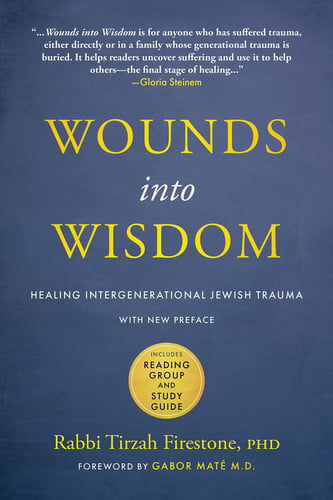
Wounds into wisdom: healing intergenerational Jewish trauma

Firestone, Tirzah
"Our past does not simply disappear. The painful history of our ancestors and their rich cultural wisdom intertwine within us to create the patterns of our future. Even when past trauma remains unspoken or has long been forgotten, it becomes part of us and our children-a legacy of both strength and woundedness that shapes our lives. In this book, Tirzah Firestone brings to life the profound impact of protracted historical trauma through the compelling narratives of those whose lives were marred by racial persecution and displacement. The tragic story of Firestone's own family lays the groundwork for these revealing testimonies of recovery, forgiveness, and moral leadership. Throughout, Firestone interweaves their voices with neuroscientific and psychological findings, as well as relevant and inspiring Jewish teachings. Seven principles emerge from these wise narratives-powerful prescriptive tools that speak to anyone dealing with the effects of past traumatic injury. At the broadest level, these principles are directives for staying morally awake in a world rife with terror"--
Monkfish Book Publishing Company 2022 258 pages

Genealogies of religion: discipline and reasons of power in Christianity and Islam

Asad, Talal
In Geneologies of Religion, Talal Asad explores how religion as a historical category emerged in the West and has come to be applied as a universal concept. The idea that religion has undergone a radical change since the Christian Reformation—from totalitarian and socially repressive to private and relatively benign—is a familiar part of the story of secularization. It is often invokved to explain and justify the liberal politics and world view of modernity. And it leads to the view that "politicized religions" threaten both reason and liberty. Asad's essays explore and question all these assumptions. He argues that "religion" is a construction of European modernity, a construction that authorizes—for Westerners and non-Westerners alike—particular forms of "history making."
The Johns Hopkins University Press 1993-08-18 335 pages

Marauders by Steve Orlando. 2

Orlando, Steve (Comic book writer)
Collects MARAUDERS (2022) #6-10. As A.X.E. makes waves, the Marauders hold on for survival! The Progenitor has risen, and - like the rest of the world - the crew will face judgment! Who among them was able to justify their existence? Who among them failed? And just how excited is Orchis for a chance to scapegoat mutants for Earth's brush with Celestial destruction? Plus- Captain Kate Pryde promised to help mutants in need, no matter where they are or when. But can the Marauders rescue an entire civilization in the past without erasing the future? Perhaps with an assist from one of the greatest X-Men of 2099?! When the Threshold Three are revealed and take their place in Krakoa, the shocking secrets of the first mutants may upend all of history! All this...and Detective Lockheed.
Marvel Worldwide, Inc 2023-08-29 144 pages

Baseball Book

Stephen Jay Gould
The late Stephen Jay Gould was a man of strong opinions--and not just about evolutionary theory and paleontology, the subjects of fine books of his such as Ever Since Darwin and Wonderful Life . Just get him going on baseball, as readers of his long-running monthly column in Natural History magazine will remember, and sparks would fly. Baseball, Gould writes in this collection of diverse essays and reviews, is an intellectual's game, but only accidentally so; plenty of smart folks like other sports. In his case, though, baseball was the game to follow, for he grew up in the New York of the 1950s, when the city had "the three greatest teams in major league baseball." Two of those teams later moved far away, but Gould nursed his passion into adulthood, all the while acquiring plenty of ammunition for sophisticated arguments about every facet of the game. In these pages, for instance, he weighs in on such eminently arguable matters as the greatest player the sport has known (Ty Cobb, maybe), the greatest single game ever played (game six of the 1975 World Series), why it is that no one hits .400 these days (it's a matter of statistics, but so much more too), and whether the current system of postseason playoffs is a good thing (no). The sport has had few more learned and literate fans than Gould, who brings his best to these pieces. Celebrating triumphs and mourning tragedies on and off the diamond, this book makes just the right companion for the new season, and for the seasons to come. --Gregory McNamee
Vintage 1999-10-07 352 pages