1322 results for "American History"

The American Newness Culture and Politics in the Age of Emerson

Irving Howe
"To confront American culture is to feel oneself encircled by a thin but strong presence. I call it Emersonian, an imprecise term but one that directs us to a dominant spirit in the national experience." Thus Irving Howe, America's distinguished social critic and a longtime reader of the Sage of Concord, begins this illuminating discussion of Emerson and his disciples and doubters. What is the Emersonian spirit? What inspired it, what propelled it? And what does it mean to us today? History gave Emerson his opportunity and then took it away. Coming to manhood during the 1830s and 1840s, the time of "the newness" when Americans beheld the world with unbounded expectations, Emerson became the spokesman for the self-reliant new man he believed had arisen, ready to thrust aside mossy traditions and launch a new revolution of freewheeling thought. But the rapid pace of the American experience overtook the Emersonian vision; in the 1850s, the rising problems of slavery, a boom-and-bust economy, the vulgarity of mass culture overwhelmed the idealist. His satellite spirits wavered and shrouded the Emersonian optimism: Hawthorne, with his stories of moral breakdown; Thoreau, rooted in nature yet inclined to the cranky and fanatical; Melville, his fathomless blackness waiting beneath archetypal fables of innocence and evil also Walt Whitman, Orestes Brownson, Twain--all were influenced by, yet reacted against, the Emersonian "newness." Howe identifies three kinds of response: the literature of work (Melville and Mark Twain), the literature of Edenic fraternity (James Fenimore Cooper, Whitman, Twain again), and the literature of loss (all the post-Civil War writers). He lays before us the intellectual and personal tragedy of the first great American man of letters, yet also shows that Emerson's belief in the untapped power of free men pervades not only the lives and works of his contemporaries but is also a permanent part of the American psyche.
Harvard University Press 2013-10 99 pages

Slave Badges and the Slave-Hire System in Charleston, South Carolina, 1783-1865

Harlan Greene,Harry S. Hutchins, Jr.,Brian E. Hutchins
The slave-hire system of Charleston, South Carolina, in the 1700s and the 1800s produced a curious object--the slave badge. The badges were intended to legislate the practice of hiring a slave from one master to another, and slaves were required by law to wear them. Slave badges have become quite collectible and have excited both scholarly and popular interest in recent years. This work documents how the slave-hire system in Charleston came about, how it worked, who was in charge of it, and who enforced the laws regarding slave badges. Numerous badge makers are identified, and photographs of badges, with commentary on what the data stamped on them mean, are included. The authors located income and expense statements for Charleston from 1783 to 1865, and deduced how many slaves were hired out in the city every year from 1800 on. The work also discusses forgeries of slave badges, now quite common. There is a section of 20 color plates.
McFarland 2008-09-08 208 pages

Warrior queen: the story of Boudica, Celtic Queen

Gold, Alan
Meticulously researched and imaginatively wrought, Warrior Queen is the sweeping epic of the infamous Boudica who challenged the vicious might of the Roman Empire. In 43 AD Boudica became the queen of a Celtic tribe and a Roman sympathiser. But after years of loyal service she finds herself brutally betrayed. The fury of her unleashed vengeance threw the Roman Empire's forces into chaos and made her a goddess to her own people. Here, Alan Gold retells the story of Boudica in a novel that embraces all the fiery passion and intrigue of this remarkable woman.
New American Library 2005 366 pages

Al Smith and his America

Handlin, Oscar
The legendary image of America as a land of opportunity was challenged in 1928 by Al Smith's race for the presidency. Could the governor from New York, a Catholic from the Lower East Side, really become president? His candidacy began a dark episode in American history as Al Smith found himself a victim of the very society that, ironically, gave him his greatest opportunity. p This sympathetic account of Smith's political career demonstrates that a changing society in the decades after World War I propelled Americans toward isolationism and a reassertion of comfortable verities about religion and ethnicity. Oscar Handlin notes that Americans were fundamentalists in 1928, and their anti-Catholicism affected the outcome of the presidential election. But religion was only one symptom of the American anxiety that prejudiced attitudes toward the city, toward foreigners, toward the League of Nations and Prohibition. Disillusioned and betrayed by an unsuccessful peace, Americans searched for external causes on which to lay blame, and Al Smith seemed to epitomize the alien forces that were undermining the nation.
Northeastern University Press 1987-10-30 207 pages

Conceived in liberty

Rothbard, Murray N.
The new single-volume edition of Conceived in Liberty is here! After so many years of having to juggle four volumes, the Mises Institute has finally put it altogether in a single, 1,616-page book. This makes it easier to read, and makes clearer just what a contribution this book is to the history of libertarian literature. There's never been a better time to remember the revolutionary and even libertarian roots of the American founding, and there's no better guide to what this means in the narrative of the Colonial period than Murray Rothbard. For anyone who thinks of Murray Rothbard as only an economic theorist or political thinker, this giant book is something of a surprise. It is probably his least known treatise. It offers a complete history of the Colonial period of American history, a period lost to students today, who are led to believe American history begins with the US Constitution. Rothbard's ambition was to shed new light on Colonial history and show that the struggle for human liberty was the heart and soul of this land from its discovery through the culminating event of the American Revolution. These volumes are a tour de force, enough to establish Rothbard as one of the great American historians. It is a detailed narrative history of the struggle between liberty and power, as we might expect, but it is more. Rothbard offers a third alternative to the conventional interpretive devices. Against those on the right who see the American Revolution as a "conservative" event, and those on the left who want to invoke it as some sort of proto-socialist uprising, Rothbard views this period as a time of accelerating libertarian radicalism. Through this prism, Rothbard illuminates events as never before. The volumes were brought out in the 1970s, but the odd timing and uneven distribution prevented any kind of large audience. They were beloved only by a few specialists, and sought after by many, thanks to their outstanding reputation. The Mises Institute is pleased to be the publisher of this integrated book. This single volume covers the discovery of the Americas and the colonies in the 17th century, the period of "salutary neglect" in the first half of the 18th century, the advance to revolution, from 1760-1775 and the political, military, and ideological history of the revolution and after.
Mises Institute 2011 1616 pages

A Shattered Peace Versailles 1919 and the Price We Pay Today

David A. Andelman
Advance Praise for A Shattered Peace "The peace settlements that followed World War I have recently come back into focus as one of the dominant factors shaping the modern world. The Balkans, the Middle East, Iraq, Turkey, and parts of Africa all owe their present-day problems, in part, to these negotiations. David Andelman brings it all back to life--the lofty ideals, the ugly compromises, the larger-than-life personalities who came to Paris in 1919. And he links that far-away diplomatic dance to present-day problems to illuminate our troubled times. A tremendous addition to this vitally important subject." --Ambassador Richard Holbrooke "The peace conference in Paris at the end of World War I was the first and last moment of pure hope for peace in the history of world affairs. Our president Woodrow Wilson was the sorcerer for this hope, and he kindled great expectations in people everywhere. David Andelman, a classic reporter and storyteller, tells this fascinating tale of hope falling finally and forever on the shoals of naivete and hard-headed cynicism." --Leslie H. Gelb, former columnist for the New York Times and President Emeritus of the Council on Foreign Relations "The failed peace settlement following the Great War of 1914-1918 has been the subject of many fine books. In many respects, David Andelman's A Shattered Peace is the best of these. It is compact and compellingly written. Moreover, it explains more clearly than any other work how the failure of peacemaking in 1919 shaped later history and, indeed, shapes our own era." --Ernest R. May, Charles Warren Professor of American History, Harvard University "It is the power and fascination of David Andelman's new book, A Shattered Peace, that he shows us--with the clarity of a first-rate reporter and the drama and detail at the command of a first-rate novelist--that we are all still enmeshed in the loose ends of the Treaty of Versailles. Andelman brings us to Korea, to Vietnam, to the Persian Gulf, and to Iraq in our own vexed era. His story is alive with color, conflict, and interesting people. We could not find a better guide to this time." --Richard Snow, Editor in Chief, American Heritage
Wiley 2007-10-19 336 pages

The Reader of Gentlemen's Mail

David Kahn
One of the most colorful and controversial figures in American intelligence, Herbert O. Yardley (1889-1958) gave America its best form of information, but his fame rests more on his indiscretions than on his achievements. In this highly readable biography, a premier historian of military intelligence tells Yardley's story and evaluates his impact on the American intelligence community. Yardley established the nation's first codebreaking agency in 1917, and his solutions helped the United States win a major diplomatic victory at the 1921 disarmament conference. But when his unit was closed in 1929 because "gentlemen do not read each other's mail," Yardley wrote a best-selling memoir that introduced-and disclosed-codemaking and codebreaking to the public. David Kahn de-scribes the vicissitudes of Yardley's career, including his work in China and Canada, offers a capsule history of American intelligence up to World War I, and gives a short course in classical codes and ciphers. He debunks the accusations that the publication of Yardley's book caused Japan to change its codes and ciphers and that Yardley traitorously sold his solutions to Japan. And he asserts that Yardley's disclosures not only did not hurt but actually helped American codebreaking during World War II.
Yale University Press 2011-03-08 368 pages

The drawings of the Florentine painters

Berenson, Bernard
This monumental work, Drawings of Florentine Painters by Bernard Berenson, was named in 2013 by Thames & Hudson one of the "books that shaped art history". Berenson was an influential American art historian of the late 19th and 20th centuries. He specialized in Renaissance Art and was a major force in building the US market for paintings by the Old Masters. American collectors of the time regarded Berenson as the ultimate Renaissance art authority. If he judged a painting authentic, its value was greatly increased. Originally published in 1938, and significantly revised and enlarged by the author in several subsequent editions, the 1970 publication by University of Chicago Press, Chicago and London, consists of three volumes. (Heavy 4tos 11 1/4" x 8 7/8". Dark blue cloth stamped in gilt. In slipcase. No dust jackets issued.) Some of the Florentine artists covered in the three volumes are: da Vinci, Michelangelo, Albertinelli, Angelico, Gozzoli, Uccello, Verrocchio, Filippo, Botticelli, Lippi, Garbo, Carli, di Cosimo, Bartolommeo, Falconi, Cungi, del Sarto, Pontormo, Rosso, Manfredi, Rosselli, and Artetino. The first volume, Text (xiv, 367 pp; 12 chapters, 15 appendices), consists of Berenson's description and analysis -- using his own critical method and assumptions -- of the work of the artists. His unique and controversial method grouped paintings according to how he considered the artist handled critical aspects, such as surface texture (labeled "tactile imagination" by Berenson) or the weight and volume of any painted figures. Volume 2, Catalogue (xii, 388 pp.), is an illustrated presentation of works by the Italian painters. Volume 3, Illustrations (400+pp., 1109 plate figures and index), includes illustrated plates of the artists' work, first published by John Murray, and in a limited edition by E. P. Dutton, in 1903. While Berenson published other works, in his lifetime, Drawings of Florentine Painters is considered his masterpiece.
University of Chicago Press 1970 420 pages

Slave law in the American South: State v. Mann in history and literature

Tushnet, Mark V.
Product Description Slavery in the American South could not have existed without the authority of law defining slaves as the property of their masters. But the fact that slaves were also human beings placed limits on this harsh reality. When the rigor of the law and the complex bonds of sentiment linking master and slave came into conflict, masters looked to the courts. In one such case, State v. Mann, North Carolina Supreme Court justice Thomas Ruffin ruled that masters could not be prosecuted for assaulting their slaves. In articulating the legal basis for his decision, Justice Ruffin also revealed his own view of the "logic of slavery," in which he sanctioned the owner's rights even as he expressed his own horror at the mistreatment of the slave. Mark Tushnet, one of the foremost living authorities on antebellum slave law, now shows how studying such a simple case can illuminate an entire society. For those who detested slavery, the case represented all that was intolerable about that institution; for those who defended it, it raised vexing and persistent issues that could not be wished away. As further testament to the importance of State v. Mann, Harriet Beecher Stowe even made it central to her second antislavery novel, Dred. Tushnet discusses the opinion's place in the novel-in which she quoted liberally from Ruffin's decision-and evaluates other historians' interpretations of both the opinion and Stowe's provocative novel. Tushnet provides a finely detailed analysis of Ruffin's opinion, portraying the judge as a man compelled by law to uphold the slaveowner's right while moved as a Christian by the slave's maltreatment and ever hopeful that communal morality and a deep-seated sense of honor would moderate the excesses of slave owners. As Tushnet shows, however, slave law was a means for maintaining the ideological hegemony of the Southern master class. Slave Law in the American South paints a broad picture of a landmark case, tying together legal, historical, social, political, and even literary strands to show how the law itself was implicated in the persistence of slavery. It sheds new light on slavery and Southern history, as it probes the conscience of a troubled jurist incapable of fully transcending his times. This book is part of the Landmark Law Cases and American Society series. From the Back Cover "While losing neither objectivity nor moral compass, Mark Tushnet skillfully navigates the murky waters of Southern judicial and legal logic. His inspired study highly deserves close and serious attention."--Bertram Wyatt-Brown, author of The Shaping of Southern Culture: Honor, Grace, and War, 1760-1880s"More than two decades ago, Tushnet ignited the field of slave law studies with his provocative and thoughtful overview of the subject, The American Law of Slavery, 1810-1860. Now he has given us the first book-length study of a classic American slave case. Comprehensive and insightful, it merits the attention of legal scholars, historians, and non-specialists alike."--Timothy S. Huebner, author of The Southern Judicial Tradition: State Judges and Section Distinctness, 1790-1890 About the Author Mark V. Tushnet is Carmack Waterhouse Professor of Constitutional Law at Georgetown University Law Center. A former law clerk to Justice Thurgood Marshall, he is the author of numerous books including Taking the Constitution Away from the Courts and Red, White, and Blue: A Critical Analysis of Constitutional Law.
University Press of Kansas 2003 150 pages

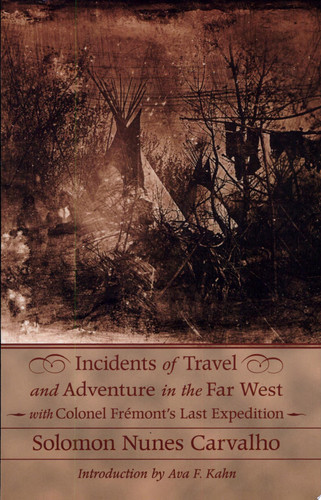
Incidents of travel and adventure in the Far West: with Colonel Fremont's last expedition across the Rocky Mountains, including three months' residence in Utah, and a perilous trip across the great American desert to the Pacific

Carvalho, Solomon Nunes
n August 1853, an American-born Sephardic Jew, Solomon Nunes Carvalho, accepted John Fremont's invitation to join his fifth expedition to find the best overland route to California. A Baltimore artist, inventor, and daguerreotypist, Carvalho was given the job of creating a photographic record of the lands and peoples along the way. Fremont's party left the Missouri on September 14, 1853, traveled up the Kansas River, overland to the Arkansas, upriver past Bent's Fort to the Huerfano, and traversed the Sandhill Pass into the Rocky Mountains. Beset by heavy snows and intense cold, they were reduced to eating their horses and mules and the occasional beaver or porcupine while making their way in midwinter across the Grand, Green, and Sevier Rivers. Suffering from frostbite, scurvy, and dysentery, Carvalho left the expedition in Utah; spent four months among the Mormons in Salt Lake City, where he observed with keen interest their system of spiritual wives; and reached California in 1854. Carvalho became the first Jewish writer to publish accounts of the Great American West and was also one of the first people to photograph the American West. Although only one of his plates is known to survive, others became the models for wood and steel engravings that broadcast the image of the West throughout the world. This Bison Books edition restores the discourses on Mormon doctrine omitted from previous twentieth-century editions. Ava F. Kahn is a visiting scholar at the California Studies Center, University of California, Berkeley. Her books include Jewish Voices of the California Gold Rush: A Documentary History, 1849-1880; Jewish Life in the American West: Perspectives on Migration, Settlement, and Community; and California Jews (coedited with Marc Dollinger).
University of Nebraska Press 2004-01-01 130 pages

Putting meat on the American table: taste, technology, transformation

Horowitz, Roger
Engagingly written and richly illustrated, Putting Meat on the American Table explains how America became a meat-eating nation -- from the colonial period to the present. It examines the relationships between consumer preference and meat processing -- looking closely at the production of beef, pork, chicken, and hot dogs. Roger Horowitz argues that a series of new technologies have transformed American meat. He draws on detailed consumption surveys that shed new light on America's eating preferences -- especially differences associated with income, rural versus urban areas, and race and ethnicity. Putting Meat on the American Table will captivate general readers and interest all students of the history of food, technology, business, and American culture.
The Johns Hopkins University Press 2006 170 pages

The American Congress: the building of democracy

Julian E. Zelizer
Congress is the heart and soul of our democracy, the place where interests are brokered, laws are established, and innovation is turned into concrete action. It is also where some of democracy's greatest virtues clash with its worst vices: idealism and compromise meet corruption and bitter partisanship. The American Congress unveils the rich and varied history of this singular institution. Julian E. Zelizer has gathered together forty essays by renowned historians to capture the full drama, landmark legislation, and most memorable personalities of Congress. Organized around four major periods of congressional history, from the signing of the Constitution to the creation of the Department of Homeland Security, this volume brings a fresh perspective to familiar watershed events: the Civil War, Watergate, the Vietnam War. It also gives a behind-the-scenes look at lesser-known legislation debated on the House and Senate floors, such as westward expansion and war powers control. Here are the stories behind the 1868 vote to impeach President Andrew Johnson; the rise of Jeannette Rankin, the first woman elected to Congress and a leading advocate for pacifism; and the controversy surrounding James Eastland of Mississippi, who carried civil rights bills in his pockets so they could not come up for a vote. Sidebars further spotlight notables including Huey Long, Sam Rayburn, and Tip O'Neill, bringing the sweeping history of our lawmaking bodies into sharp focus. If you've ever wondered how Congress worked in the past or what our elected officials do today, this book gives the engaging, often surprising, answers.
Houghton Mifflin 2004 765 pages

The journey home

Antler, Joyce
In recent decades, prominent American Jewish women like Bella Abzug and Betty Friedan have made headlines and history, challenging the constraints facing women in American public life. Few realize that these women embody a hundred-year legacy of remarkable activism. From suffrage to birth control, from trade unionism to higher education, from civil rights to feminism to every aspect of popular culture, Jewish women have been in the vanguard, leading key social movements.
Schocken 1998 410 pages

Going out: the rise and fall of public amusements

Nasaw, David
There was a time not very long ago when "going out" was only for the rich and the reckless. At the turn of the century, "going out" became part of everyday life as vaudeville halls, photograph parlors, penny arcades, nickelodeons, nightclubs, dance halls, world's fair midways, amusement parks, ballparks, and movie palaces opened their doors to the people of the city. The new amusement centers welcomed women, men, and children, native-born and immigrant, rich, poor, and middling. Only African Americans were excluded or segregated in the audience, though they were overrepresented on stage. Going Out chronicles the twentieth-century entertainment revolution that changed forever the ways we live, work, and play. In a matter of decades, a new public world of amusements was created where ethnic, class, and neighborhood differences were subordinated to the common pursuit of a good time. Clerks and bankers, sales girls and society ladies "turkey trotted" to ragtime in nightclubs and dance halls; "shot the chute" and clutched one another in "barrels of love"; visited "Darkest Africa" on the world's fair midways; and sat together in the dark watching pictures move on a screen. In Going Out, we meet the colorful characters who invented show business: Thomas Alva Edison, who was astonished when his phonograph made money playing music (he had designed it to take business dictation); Benjamin Franklin Keith, the circus grifter who opened a dime museum in Boston in the 1880s and within a decade owned the world's largest vaudeville theater circuit; Adolph Zukor and Marcus Loew, the New York furriers who made millions in the early picture-show business; and the dozens of small-time show businessmen who rode the rails with their "shows" in their trunks. And we hear the stories of the early black performers and their struggles to maintain their dignity and livelihood while audiences demanded their public humiliation. Going Out is a history of twentieth-century show business and of the new American public that assembled in the city's wondrous pleasure palaces, parks, and theaters. The book concludes with an account of the fall or relocation of this entertainment world, as central city amusement parks, movie palaces, and ballparks were uprooted and transported to the suburbs in the decades following World War II.
Harvard University Press 1999-04-15 312 pages

The Atlantic frontier of the thirteen American colonies and states: essays in eighteenth century commercial and social history

Price, Jacob M.
The external economy of British North America has attracted considerable scholarly attention in the last two generations, and the papers reprinted here, in this second collection from Jacob Price, make important contributions to quantification, conceptualisation and debate. Studies presenting and analysing new statistical material from the English and Scottish customs accounts are supplemented by a general survey of the transatlantic economy in the 18th century which is required reading for all students of the subject. Price's treatment is diversified into financial arrangements and the role of credit in the slave trade and plantation economies. In a provocative chapter "Who cared about the colonies?," concern in Britain for the 13 colonies between 1714 and 1775 is explored in terms of the ability of the colonies to involve the interests and command the attention and concern of people in Britain from the politically eminent to those in trade and to the nation at large.
Variorum 1996-01 270 pages

Hidden from history: reclaiming the gay and lesbian past

Martin Bauml Duberman,Martha Vicinus,George Chauncey
Winner of two Lambda Rising Awards This richly revealing anthology brings together for the first time the vital new scholarly studies now lifting the veil from the gay and lesbian past. Such notable researchers as John Boswell, Shari Benstock, Carroll Smith-Rosenberg, Jeffrey Weeks and John D’Emilio illuminate gay and lesbian life as it evolved in places as diverse as the Athens of Plato, Renaissance Italy, Victorian London, jazz Age Harlem, Revolutionary Russia, Nazi Germany, Castro’s Cuba, post-World War II San Francisco—and peoples as varied as South African black miners, American Indians, Chinese courtiers, Japanese samurai, English schoolboys and girls, and urban working women. Gender and sexuality, repression and resistance, deviance and acceptance, identity and community—all are given a context in this fascinating work. "A landmark of a book and a landmark of ideas that will shatter ignorance and delusion."— Catharine Stimpson, University Professor and Dean Emerita of the Graduate School of Arts and Science at New York University “Ground-breaking.”— Publishers Weekly “The juxtaposition of diverse perspectives and research crossing boundaries of race, gender, culture, and time encourages a lively dialogue. Highly recommended for history collections, and especially gay studies.”— Library Journal
New American Library 1989 579 pages

The Reform Judaism reader: North American documents

Michael A. Meyer,W. Gunther Plaut
This classic reference book chronicles the history of Reform Judaism. Historical documents and writings by renowned authors that reflect the on-going evolution of Reform Judaism are included. This book will aid the reader in understanding the changing issues that have occurred since its establishment. This timely book traces the development of Reform Judaism in light of the ideas contained in the Statement of Principles for Reform Judaism adopted at the 1999 Pittsburgh Convention of the Central Conference of American Rabbis. The book covers such areas as theology, social action, the Sabbath, and education. -- Ideal for high school and adult study -- Classic reference for every Reform Jewish home and library -- Each document preceded by an introduction by the authors -- Online study guide available at www.uahcpress.com
UAHC Press 2001 228 pages

Families, history, and social change: life course and cross-cultural perspectives

Hareven, Tamara K.
One of the prevailing myths about the American family is that there once existed a harmonious family with three generations living together, and that this "ideal" family broke down under the impact of urbanization and industralization. The essays in this volume challenge this myth and provide dramatic revisions of simplistic notions about change in the American family. Based on detailed research in a variety of sources, including extensive oral history interviews of ordinary people, these essays examine major changes in family life, dispel myths about the past, and offer new directions in research and interpretation. The essays cover a wide spectrum of issues and topics, ranging from the organization of the family and household, to the networks available to children as they grow up, to the role of the family in the process of industralization, to the division of labor in the family along gender lines, and to the relations between the generations in the later years of life. While discussing family relations in the past and revising prevailing notions of social change, these interdisciplinary essays also provide important perspectives on the present.
Westview Press 2000 374 pages