7908 results for "Science"

Essential discrete mathematics for computer science

Lewis, Harry R.,Zax, Rachel
Discrete mathematics is the basis of much of computer science, from algorithms and automata theory to combinatorics and graph theory. Essential Discrete Mathematics for Computer Science aims to teach mathematical reasoning as well as concepts and skills by stressing the art of proof. It is fully illustrated in color, and each chapter includes a concise summary as well as a set of exercises.--
Princeton University Press 2019-03-19 388 pages

The Cambridge companion to science fiction

Edward James,Farah Mendlesohn
Science fiction is at the intersection of numerous fields. It is literature which draws on popular culture, and engages in speculation about science, history, and all varieties of social relations. This volume brings together essays by scholars and practitioners of science fiction, which look at the genre from different angles. It examines science fiction from Thomas More to the present day; and introduces important critical approaches (including Marxism, postmodernism, feminism and queer theory).
Cambridge University Press 2003-11-20 295 pages

Build, baby, build: the science and ethics of housing

Caplan, Bryan Douglas
"Why are housing prices in America so unbelievably high, especially in the country's most desirable locations? The superficial answer is "supply and demand," but the deep answer-the reason supply is so low-is draconian housing regulation. In Build, Baby, Build: The Science and Ethics of Housing Regulation, economist Bryan Caplan makes the economic and philosophical case for radical deregulation of this massive market-freeing property owners to build as tall and dense as they wish. Not only would the average price of housing be cut in half, but the building boom unleashed by deregulation would simultaneously reduce inequality, increase social mobility, promote economic growth, reduce homelessness, increase birth rates, and help the environment. It's surprising then, that despite all these benefits, housing deregulation is universally unpopular with policymakers. Combining visually stunning graphics and careful interdisciplinary research, Build, Baby, Build, takes readers on a journey through what is wrong with the housing market-and what we can do about it"--
Cato Institute 2024 253 pages

Survival of the prettiest: the science of beauty

Etcoff, Nancy L.
Beauty is not a myth. According to scientist and psychologist Nancy Etcoff, the pursuit of beauty is neither a cultural construction, an invention of Madison Avenue, nor a backlash against feminism. Survival of the Prettiest, the first in-depth scientific inquiry into the nature of human beauty, posits that beauty is an essential and ineradicable part of human nature, from what makes a face beautiful to the deepest questions about the human condition. Every human civilization has revered beauty, pursued it at enormous costs, and endured both the tragic and the comic consequences of that pursuit. Provocative, witty, and insightful, Etcoff sheds light on every aspect of human beauty, including why we devour fashion magazines, check our waistlines, and gaze longingly at objects of desire. Informed by state-of-the-art theories of the human mind from cognitive science and evolutionary biology, Survival of the Prettiest tells us why gentlemen prefer blondes, why high heels have never gone out of style, why eyebrows are plucked and hair is coiffed. Etcoff also explains how sexual preference is guided by ancient rules that make us most attracted to those with whom we are most likely to reproduce. Research on why we find infant features irresistibly attractive, as well as controversial new work that suggests parents show more affection to attractive newborns, is part of a broad investigation that includes insights into how beauty influences our perceptions, attitudes, and behavior toward others. When the attainment of beauty is viewed in the context of a Darwinian struggle for survival, many of the most extreme practices surrounding our looks, such as body piercing and serial plastic surgeries, suddenly seem less outlandish. In fact, those very practices may ensure the survival of our genes. Agree or disagree, you will never think about human beauty the same way again.
Doubleday 1999 325 pages

Who we are and how we got here: ancient DNA and the new science of the human past

Reich, David (Of Harvard Medical School)
"A groundbreaking book about how technological advances in genomics and the extraction of ancient DNA have profoundly changed our understanding of human prehistory while resolving many long-standing controversies. Massive technological innovations now allow scientists to extract and analyze ancient DNA as never before, and it has become clear--in part from David Reich's own contributions to the field--that genomics is as important a means of understanding the human past as archeology, linguistics, and the written word. Now, in The New Science of the Human Past, Reich describes with unprecedented clarity just how the human genome provides not only all the information that a fertilized human egg needs to develop but also contains within it the history of our species. He delineates how the Genomic Revolution and ancient DNA are transforming our understanding of our own lineage as modern humans; how genomics deconstructs the idea that there are no biologically meaningful differences among human populations (though without adherence to pernicious racist hierarchies); and how DNA studies reveal the deep history of human inequality--among different populations, between the sexes, and among individuals within a population"--
Oxford University Press 2018 335 pages

First in Thirst How Gatorade Turned the Science of Sweat Into a Cultural Phenomenon

Darren Rovell
Gatorade is an enthralling story, brought to life in bright color and sharp detail in this book as journalist and author Darren Rovell chronicles every astonishing milestone of the company's history. With unprecedented access to the inventors, the marketers, the analysts and observers, and key company figures past and present, Rovell recounts the sweat-drenched University of Florida football practices, the first (unpalatable) prototypes, and the commercial and financial interest that quickly took hold following the drink's first on-field successes. Then came the advertising, sponsorships, product placements (many of them fortuitous), and finally the two milestones that cemented Gatorade's iconic status once and for all -- the ubiquitous Gatorade bath and the Michael Jordan "Be Like Mike" endorsement deal. With refreshing candor, First in Thirst also offers an inside look at all the aspects that went into building the brand, such as: negotiations, battles, lawsuits, mergers and acquisitions, product strategies, lucky breaks, and even the mishaps that have attended Gatorade's reign as the 800-pound gorilla of the sports-drink scene. First in Thirst identifies the nine Gatorade Rules, business principles that have helped Gatorade become one of the most dominant brands ever. By adhering to these principles, businesses in other industries may achieve greater brand recognition and market share. Long before America knew what "deep-down body thirst" was, a team of university scientists had already invented something to quench it. This book is the story of the product and the company, and of America's fascination with the one and only Gatorade.
American Management Association 2006 243 pages

Feynman lectures on computation

Feynman, Richard P.
From 1983 to 1986, the legendary physicist and teacher Richard Feynman gave a course at Caltech called “Potentialities and Limitations of Computing Machines.”Although the lectures are over ten years old, most of the material is timeless and presents a “Feynmanesque” overview of many standard and some not-so-standard topics in computer science. These include computability, Turing machines (or as Feynman said, “Mr. Turing's machines”), information theory, Shannon's Theorem, reversible computation, the thermodynamics of computation, the quantum limits to computation, and the physics of VLSI devices. Taken together, these lectures represent a unique exploration of the fundamental limitations of digital computers.Feynman's philosophy of learning and discovery comes through strongly in these lectures. He constantly points out the benefits of playing around with concepts and working out solutions to problems on your own-before looking at the back of the book for the answers. As Feynman says in the lectures: “If you keep proving stuff that others have done, getting confidence, increasing complexities of your solutions-for the fun of it-then one day you'll turn around and discovers that nobody actually did that one! And that's the way to become a computer scientist.”
Addison-Wesley 1996-09-08 303 pages

Multiverse

M a Rothman
"Fast-paced prose, fit-for-Hollywood characterizations, science with a wow factor, and accessible descriptions of complex quantum concepts and experiments... hard science meets pop-science time-travel in this entertaining thriller." - Kirkus Reviews When the future ruins your life... From a USA Today bestselling author: After particle physics professor Michael discovers how to pierce time and space, he meets a student who has memories of her future - and the research they have yet to complete together... "You won't be disappointed" (New York Times bestselling author Kevin J. Anderson). ------ When Michael Salomon woke up Tuesday morning, he did so with a smile, knowing that today would be a positive turning point in his career. With his first child on the way, he couldn't shake the feeling that something bad was about to happen. As he drives into work, he feels a sudden wave of anguish wash over him, and he sees himself alone, at the gravesite of an unborn daughter. It feels like a crystal-clear memory, a waking nightmare that nearly sends him crashing into the car in front of him. The idea of faster-than-light particles has been a part of science fiction lore for fifty years, yet Michael had made a breakthrough discovery late last night. Tachyons do exist. Going back into the office, he hasn't even had a chance to tell anyone about what he's discovered when the men from DARPA came calling. The entirety of his research has suddenly become an object of national security. But it was only when a young college student intercepts him as he gets into his car that he knows the life he's looking forward to is over. The student has memories of her future self... a future where she's worked with Michael on extending his research. She knows things that he's only thought of as possibilities, and she speaks of them as if they'd already happened. And most chilling of all, she speaks of a future where they are both in hiding from the government that sees them as the enemy. MULTIVERSE is a story about a scientist who uncovers a way to pierce the veil of time and space, and has unwittingly opened Pandora's box. Is it even possible to undo what a future version of yourself has done, or is everyone doomed to the chaos that's been loosed on the world?
Primordial Press 2022-09-05 364 pages

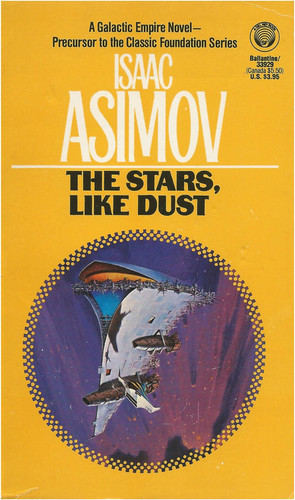
The Stars, Like Dust

Isaac Asimov
The first book in the Galactic Empire series, the spectacular precursor to the classic Foundation series, by one of history's most influential writers of science fiction, Isaac Asimov His name was Biron Farrill and he was a student at the University of Earth. A native of one of the helpless Nebular Kingdoms, he saw his home world conquered and controlled by the planet Tyrann--a ruthless, barbaric Empire that was building a dynasty of cruelty and domination among the stars. Farrill's own father had been executed for trying to resist the Tyrann dictatorship and now someone was trying to kill Biron. But why? His only hope for survival lay in fleeing Earth and joining the rebellion that was rumored to be forming somewhere in the Kingdoms. But once he cast his lot with the freedom fighters, he would find himself guarding against treachery on every side and facing the most difficult choice of all: to betray either the woman he loved or the revolution that was the last hope for the future.
Ballantine books 1986 231 pages

God's Harvard A Christian College on a Mission to Save America

Hanna Rosin
Since 2000, America s most ambitious young evangelicals have been making their way to Patrick Henry College, a small Christian school just outside the nation s capital. Most of them are homeschoolers whose idealism and discipline put the average American teenager to shame. At "God s Harvard" they are groomed to become tomorrow s elite. Diplomas in hand, they are dispatched to the front lines of politics, entertainment, and science, where they will lead the battle to take back a godless nation. Hanna Rosin spent a year and a half embedded at the college, following students from the campus to the White House, Congress, conservative think tanks, Hollywood, and other centers of influence. Her account captures this nerve center of the evangelical movement at a moment of maximum influence and also of crisis, as it struggles to avoid the temptations of modern life and still remake the world in its own image. "
HarperCollins Publishers 2008-09-08 312 pages

Gödel's proof

Nagel, Ernest
In 1931 Kurt Gödel published his fundamental paper, "On Formally Undecidable Propositions of Principia Mathematica and Related Systems." This revolutionary paper challenged certain basic assumptions underlying much research in mathematics and logic. Gödel received public recognition of his work in 1951 when he was awarded the first Albert Einstein Award for achievement in the natural sciences—perhaps the highest award of its kind in the United States. The award committee described his work in mathematical logic as "one of the greatest contributions to the sciences in recent times." However, few mathematicians of the time were equipped to understand the young scholar's complex proof. Ernest Nagel and James Newman provide a readable and accessible explanation to both scholars and non-specialists of the main ideas and broad implications of Gödel's discovery. It offers every educated person with a taste for logic and philosophy the chance to understand a previously difficult and inaccessible subject. Marking the 50th anniversary of the original publication of Gödel's Proof , New York University Press is proud to publish this special anniversary edition of one of its bestselling and most frequently translated books. With a new introduction by Douglas R. Hofstadter, this book will appeal students, scholars, and professionals in the fields of mathematics, computer science, logic and philosophy, and science.
New York University Press 2001 129 pages

The man who folded himself

Gerrold, David
This classic work of science fiction is widely considered to be the ultimate time-travel novel. When Daniel Eakins inherits a time machine, he soon realizes that he has enormous power to shape the course of history. He can foil terrorists, prevent assassinations, or just make some fast money at the racetrack. And if he doesn't like the results of the change, he can simply go back in time and talk himself out of making it! But Dan soon finds that there are limits to his powers and forces beyond his control.
BenBella Books 2003-06-10 127 pages

Heart of the Comet

Gregory Benford,David Brin
David Brin and Gregory Benford come together again to issue a new edition of their bold collaboration about our near human future in space, planting our boots . . . and staking our destiny . . . on becoming the People of the Comet. Prescient and scientifically accurate, Heart of the Comet is known as one of the great "Hard SF" novels of the 1980s. First published in 1986, it tells the story of an ambitious manned mission to visit Halley's Comet and alter its orbit, to mine it for resources. But all too soon, native cells- that might once have brought life to Earth-begin colonizing the colonists. As factions battle over the comet's future . . . and that of Earth . . . only love, courage and ingenuity can avert disaster, and possibly spark a new human destiny. Tremendously imaginative . . . a breathtaking effort from two of science fiction's brightest stars. - The San Diego Union
Lucky Bat Books 2012-06-06 513 pages

The Demolished Man

Alfred Bester
#4 in the Millennium SF Masterworks series, a library of the finest science fiction ever written. The first Hugo Award winner for best novel in 1953. “One of the all-time classics of science fiction.”—Isaac Asimov “Bester's two superb books have stood the test of time. For nearly sixty years they’ve held their place on everybody’s list of the ten greatest sf novels” —Robert Silverberg In a world policed by telepaths, Ben Reich plans to commit a crime that hasn’t been heard of in 70 years: murder. That’s the only option left for Reich, whose company is losing a 10-year death struggle with rival D’Courtney Enterprises. Terrorized in his dreams by The Man With No Face and driven to the edge after D’Courtney refuses a merger offer, Reich murders his rival and bribes a high-ranking telepath to help him cover his tracks. But while police prefect Lincoln Powell knows Reich is guilty, his telepath's knowledge is a far cry from admissible evidence. Alfred Bester was among the first important authors of contemporary science fiction. His passionate novels of worldly adventure, high intellect, and tremendous verve, The Stars My Destination and the Hugo Award winning The Demolished Man, established Bester as a s.f. grandmaster, a reputation that was ratified by the Science Fiction Writers of America shortly before his death. Bester also was an acclaimed journalist for Holiday magazine, a reviewer for the Magazine of Fantasy and Science Fiction and even a writer for Superman.
ibooks 2018-01-08 224 pages

The Metabarons

Jodorowsky, Alejandro
A grand scale space opera about family, sacrifice, and survival told within an immense universe, both in scope and originality. A must-read cult spin-off of "The Incal," by Moebius and Jodorowsky, centering around the fascinating lineage of the ultimate warrior. This collection introduces the Metabaron’s bloodline and reveals the origins of their deep-seated principles. Find out the source of the family’s vast wealth, learn why every Metabaron has cybernetic implants, and why the only way to become the next Metabaron is for him to defeat his own father in a mortal combat. Follow each successive generation as it struggles to overcome the forces amassed against it in a galaxy corrupted by greed, power, and terror. A true classic in the pantheon of graphic storytelling and Science Fiction as a whole.
Humanoids 2015-02-25 536 pages