58,196 results in 0.07 seconds

Feast Signed Edition

Nigella Lawson
Nigella Lawson, Gourmet magazine's "It Girl," New York Times "Dining In" columnist, and bestselling cookbook author, is celebrating life--and you're invited. Feast, Nigella's most festive book yet, offers savory, spicy, and delicious recipes for Thanksgiving, Christmas, Hanukah, Eid, New Year's, Passover, Easter gatherings, and any time you want to celebrate food and life. This book is filled with festive recipes, and in it, Nigella offers tips, tricks, and shortcuts that will ensure you dine with ease, style, and fun. Feast also includes some surprising gems, like Nigella's Chocolate Cake Hall of Fame, and her best cheeseburger. And like her other cookbooks, Feast is a cookbook that will be treasured all year long.
Century Hutchinson 2004-11-15

Nigella Bites

Nigella Lawson
“I am neither a chef nor a performer: this is the food I cook, the food I eat.” – Nigella Lawson Nigella Bites accompanies a forthcoming 10-part television series – a culinary and visual feast of recipes from the best and most glamorous young home-cook in Britain and a great cookery writer. Nigella Lawson’s passion for food and her refreshingly down-to-earth practicality breathe life into this beautiful cookbook, illustrated with full-colour photographs and recipes from her forthcoming television series. Like the series, Nigella Bites is a celebration of food, perfect for modern cooks, with recipes to suit many tastes, timetables and moods, and all characteristic of Nigella’s ethos: uncomplicated, original, fresh, and perfect for the way we live today. They’re easy to produce after a busy day at the office, fun to linger over at weekends or to make with the kids, delectable to read about, dreamy to look at and delicious to eat. In 10 chapters, each based on a different theme and episode of the television series – including All-Day Breakfasts, TV Dinners, Party Girl food, Rainy Day fare, Trashy food, Slow-Cook Weekends and Templefood – Nigella Lawson gives us her marvellous recipes, along with her thoughts on modern life and cooking, offering encouragement and wise advice. Nigella wants her readers to enjoy the pleasures of eating and cooking. With her, how could anyone resist?
National Geographic Books 2001-09-05 256 pages

Fools rush in: Steve Case, Jerry Levin, and the unmaking of AOL Time Warner

Munk, Nina
Every era has its merger; every era has its story. For the New Media age it was an even bigger disaster: the AOL-Time Warner deal. At the time AOL and Time Warner were considered a matchless combination of old media content and new media distribution. But very soon after the deal was announced things started to go bad—and then from bad to worse. Less than four years after the deal was announced, every significant figure in the deal -save the politically astute Richard Parsons—has left the company, along with scores of others. Nearly a $100 billion was written off and a stock that once traded at $100 now trades near $10. What happened? Where did it all go wrong? In this deeply sourced and deftly written book, Nina Munk gives us a window into the minds of two of the oddest men to ever run billion-dollar empires. Steve Case, the boy wonder who built AOL one free floppy disk at a time, was searching for a way out of the New Economy. Meanwhile Jerry Levin, who'd made his reputation as a visionary when he put HBO on satellite distribution, was searching for a monumental deal. These two men, more interested in their place in history than their personal fortunes, each thought they were out-smarting the other.
HarperCollins 2005-02-01 368 pages

Consequences of capitalism: manufacturing discontent and resistance

Chomsky, Noam
"Is there an alternative to capitalism? In this landmark text Chomsky and Waterstone chart a critical map for a more just and sustainable society. 'Covid-19 has revealed glaring failures and monstrous brutalities in the current capitalist system. It represents both a crisis and an opportunity. Everything depends on the actions that people take into their own hands.' How does politics shape our world, our lives and our perceptions? How much of 'common sense' is actually driven by the ruling classes' needs and interests? And how are we to challenge the capitalist structures that now threaten all life on the planet? Consequences of Capitalism exposes the deep, often unseen connections between neoliberal 'common sense' and structural power. In making these linkages, we see how the current hegemony keeps social justice movements divided and marginalized. And, most importantly, we see how we can fight to overcome these divisions." --Publisher's description.
Haymarket Books 2021 388 pages

Imperial ambitions: conversations with Noam Chomsky on the post-9/11 world

Chomsky, Noam
In this important new collection of interviews with the acclaimed radio journalist David Barsamian, Noam Chomsky discuses U.S. foreign policy in the post-9/11 world. Barsamian has a unique rapport with Chomsky � having conducted more interviews and radio broadcasts with him than any other journalist � and here explores topics Chomsky has never before discussed: the 2004 presidential campaign and election; the future of Social Security; the increasing threat of global warming; and new dangers presented by the United States' ever-deepening entanglement in Iraq. The result is an illuminating dialogue with one of the world's leading thinkers � and a startling picture of the turbulent world in which we live.
Penguin 2006-06 226 pages

Imperial ambitions: conversations with Noam Chomsky on the post 9/11 world

Chomsky, Noam
In this important new collection of interviews with the acclaimed radio journalist David Barsamian, Noam Chomsky discuses U.S. foreign policy in the post-9/11 world. Barsamian has a unique rapport with Chomsky - having conducted more interviews and radio broadcasts with him than any other journalist - and here explores topics Chomsky has never before discussed: the 2004 presidential campaign and election; the future of Social Security; the increasing threat of global warming; and new dangers presented by the United States' ever-deepening entanglement in Iraq. The result is an illuminating dialogue with one of the world's leading thinkers - and a startling picture of the turbulent world in which we live.
Hamish Hamilton 2005 240 pages

Syntactic Structures

Noam Chomsky
2015 Reprint of 1957 Edition. Full facsimile of the original edition. Not reproduced with Optical Recognition Software. American linguist Paul Postal wrote in 1964 that most of the "syntactic conceptions prevalent in the United States" were "versions of the theory of phrase structure grammars in the sense of Chomsky". British linguist John Lyons wrote in 1966 that "no work has had a greater influence upon the current linguistic theory than Chomsky's Syntactic Structures." Prominent historian of linguistics R. H. Robins wrote in 1967 that the publication of Chomsky's "Syntactic Structures" was "probably the most radical and important change in direction in descriptive linguistics and in linguistic theory that has taken place in recent years". Another historian of linguistics Frederick Newmeyer considers "Syntactic Structures" "revolutionary" for two reasons. Firstly, it showed that a formal yet non-empiricist theory of language was possible and more importantly, it demonstrated this possibility in a practical sense by formally treating a fragment of English grammar. Secondly, it put syntax at the center of the theory of language. Syntax was recognized as the focal point of language production, in which a finite set of rules can produce an infinite number of sentences. As a result, morphology and phonology were relegated in importance. "Syntactic Structures" also initiated an interdisciplinary dialog between philosophers of language and linguists. American philosopher John Searle wrote that "Chomsky's work is one of the most remarkable intellectual achievements of the present era, comparable in scope and coherence to the work of Keynes or Freud. It has done more than simply produce a revolution in linguistics; it has created a new discipline of generative grammar and is having a revolutionary effect on two other subjects, philosophy and psychology". With its formal and logical treatment of language, Syntactic Structures also brought linguistics and the new field of computer science closer together.
Martino Fine Books 2015-03-27 120 pages

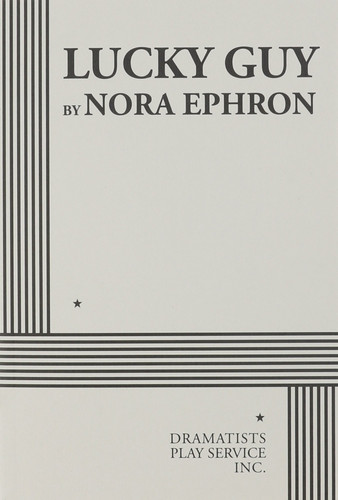
Lucky guy

Ephron, Nora
LUCKY GUY marks a return to Nora Ephron's journalistic roots. The charismatic and controversial tabloid columnist Mike McAlary covered the scandal- and graffiti-ridden New York of the 1980s. From his sensational reporting of New York's major police corruption to the libel suit that nearly ended his career, the play dramatizes the story of McAlary's meteoric rise, fall and rise again, ending with his coverage of the Abner Louima case for which he won the Pulitzer Prize, shortly before his untimely death on Christmas Day, 1998.
Dramatists Play Service, Inc 2014-06-04 75 pages

Transcendence

Rosenthal, Norman E
"Dr. Norman Rosenthal's Transcendence is the best-ever book on Transcendental Meditation: accessible and substantive, engaging and scientific, practical and profound. A very enjoyable read that can change your life, for good." —David Lynch "I have been meditating for over 10 years, and I found Transcendence to be a uniquely compelling introduction to the art and science of Transcendental Meditation. Dr. Norman Rosenthal's book will propel TM into the mainstream where it belongs." —Russell Simmons In this definitive book on the scientifically proven health and stress-relieving benefits of Transcendental Meditation, a renowned psychiatrist and researcher explores why TM works, what it can do for you, and how to use it for maximum effect. This New York Times bestselling paperback edition includes a new afterword by the author on the latest research and breakthroughs. Norman E. Rosenthal, M.D., a twenty-year researcher at the National Institute of Mental Health and the celebrated psychiatrist who pioneered the study and treatment of Season Affective Disorder (SAD), brings us the most important work on Transcendental Meditation since the Maharishi Mahesh Yogi's Science of Being and Art of Living -- and one of our generation's most significant books on achieving greater physical and mental health and wellness. Transcendence demystifies the practice and benefits of Transcendental Meditation for a general audience who may have heard about the method but do not necessarily know what it is, how it is learned, or what they stand to gain, physically and emotionally, from achieving transcendence. Dr. Rosenthal clearly and practically explains the basic ideas behind Transcendental Meditation: It is a nonreligious practice that involves sitting comfortably for twenty minutes twice a day while using a silent mantra, or nonverbal sound, to attain a profound state of aware relaxation. Alongside exclusive celebrity interviews-where figures like Paul McCartney, Ringo Starr, Martin Scorsese, Russell Brand, Laura Dern, Moby , and David Lynch openly discuss their meditation-Dr. Rosenthal draws upon experience from the lives of his patients and a wealth of clinical research amassed on TM over the past generation (340 peer-reviewed published articles). He provides the fullest and most accessible book ever on the broad range of benefits of this remarkably simple practice, from relief of anxiety, stress and depression to new hope for those experiencing addiction, attention-deficit disorder, or post-traumatic stress disorder.
Penguin Random House 2012-08-30 336 pages

Of a fire on the moon

Mailer, Norman
For many, the moon landing was the defining event of the twentieth century. So it seems only fitting that Norman Mailer—the literary provocateur who altered the landscape of American nonfiction—wrote the most wide-ranging, far-seeing chronicle of the Apollo 11 mission. A classic chronicle of America’s reach for greatness in the midst of the Cold War, Of a Fire on the Moon compiles the reportage Mailer published between 1969 and 1970 in Life magazine: gripping firsthand dispatches from inside NASA’s clandestine operations in Houston and Cape Kennedy; technical insights into the magnitude of their awe-inspiring feat; and prescient meditations that place the event in human context as only Mailer could. Praise for Of a Fire on the Moon “The gift of a genius . . . a twentieth-century American epic—a Moby Dick of space.” — New York “Mailer’s account of Apollo 11 stands as a stunning image of human energy and purposefulness. . . . It is an act of revelation—the only verbal deed to be worthy of the dream and the reality it celebrates.” — Saturday Review “A wild and dazzling book.” — The New York Times Book Review “Still the most challenging and stimulating account of [the] mission to appear in print.” — The Washington Post Praise for Norman Mailer “[Norman Mailer] loomed over American letters longer and larger than any other writer of his generation.” — The New York Times “A writer of the greatest and most reckless talent.” — The New Yorker “Mailer is indispensable, an American treasure.” — The Washington Post “A devastatingly alive and original creative mind.” — Life “Mailer is fierce, courageous, and reckless and nearly everything he writes has sections of headlong brilliance.” — The New York Review of Books “The largest mind and imagination [in modern] American literature . . . Unlike just about every American writer since Henry James, Mailer has managed to grow and become richer in wisdom with each new book.” — Chicago Tribune “Mailer is a master of his craft. His language carries you through the story like a leaf on a stream.” — The Cincinnati Post
Random House Trade Paperbacks 2014-06-03 463 pages

Crisis economics: a crash course in the future of finance

Roubini, Nouriel
In this myth-busting book Nouriel Roubini shows that everything we think about economics is wrong. Financial crises are not unpredictable 'black swans', but an inherent part of capitalism. Only by remaking our financial systems to acknowledge this, can we get out of the mess we're in. Will there be another recession, and if so what shape? When will the next bubble occur? And what can we do about it? Here Roubini gives the answers, and lists his commandments for the future.
Penguin 2011-05-05 359 pages

Seeing Voices

Oliver Sacks
Like The Man Who Mistook His Wife for a Hat , this is a fascinating voyage into a strange and wonderful land, a provocative meditation on communication, biology, adaptation, and culture. In Seeing Voices , Oliver Sacks turns his attention to the subject of deafness, and the result is a deeply felt portrait of a minority struggling for recognition and respect — a minority with its own rich, sometimes astonishing, culture and unique visual language, an extraordinary mode of communication that tells us much about the basis of language in hearing people as well. Seeing Voices is, as Studs Terkel has written, "an exquisite, as well as revelatory, work."
National Geographic Books 2008-11-13 240 pages

The Europeans Three Lives and the Making of a Cosmopolitan Culture

Orlando Figes
From the “master of historical narrative” ( Financial Times ), a dazzling, richly detailed, panoramic work—the first to document the genesis of a continent-wide European culture. The nineteenth century in Europe was a time of unprecedented artistic achievement. It was also the first age of cultural globalization—an epoch when mass communications and high-speed rail travel brought Europe together, overcoming the barriers of nationalism and facilitating the development of a truly European canon of artistic, musical, and literary works. By 1900, the same books were being read across the continent, the same paintings reproduced, the same music played in homes and heard in concert halls, the same operas performed in all the major theatres. Drawing from a wealth of documents, letters, and other archival materials, acclaimed historian Orlando Figes examines the interplay of money and art that made this unification possible. At the center of the book is a poignant love triangle: the Russian writer Ivan Turgenev; the Spanish prima donna Pauline Viardot, with whom Turgenev had a long and intimate relationship; and her husband Louis Viardot, an art critic, theater manager, and republican activist. Together, Turgenev and the Viardots acted as a kind of European cultural exchange—they either knew or crossed paths with Delacroix, Berlioz, Chopin, Brahms, Liszt, the Schumanns, Hugo, Flaubert, Dickens, and Dostoyevsky, among many other towering figures. As Figes observes, nearly all of civilization’s great advances have come during periods of heightened cosmopolitanism—when people, ideas, and artistic creations circulate freely between nations. Vivid and insightful, The Europeans shows how such cosmopolitan ferment shaped artistic traditions that came to dominate world culture.
Picador 2020-11-10 592 pages

The Cat Who'll Live Forever The Final Adventures of Norton, the Perfect Cat, and His Imperfect Human

Peter Gethers
The final, poignant chapter in a trilogy of bestselling true stories about a floppy-eared Scottish Fold named Norton Peter Gethers was a confirmed cat hater until the day he received a six-week-old kitten as a gift. Walking the streets of New York with Norton tucked into his pocket, Gethers began forming an intense attachment to his new pet. Before long Norton was flying with his owner on the Concorde to Europe, sipping milk in Parisian cafés, and eating custom-made pounce pizzas at Spago. Soon Gethers began to detail Norton’s adventures in print, and with The Cat Who Went to Paris and A Cat Abroad the duo made history as well as many, many friends around the world. The Cat Who’ll Live Forever chronicles the latest in Norton’s astonishing adventures, celebrity encounters, and worldwide excursions, culminating in his heartwarming and heartbreaking final cross-country trip. The first half of this book will have you smiling and laughing as Norton changes the lives of the Italian owners of a thirteenth-century abbey in Sicily, attends movie premiers with Sir Anthony Hopkins in the chic Hamptons, and relaxes at the dog run in Greenwich Village’s Washington Square Park. But as Norton gets older his schedule slows down and he struggles with the aches and pains and physical inconveniences that go along with age, teaching his human the essentials of loving and caring and coping with illness. Ultimately Norton passes along to his owner the most valuable lessons of all¯how to deal with death and grief, how to live life on your own terms, and how to appreciate and savor the joyful times that come along while we’re here on earth. The Cat Who’ll Live Forever is, on one level, a touching meditation on love and relationships and dealing with the pain of inevitable loss. Above all, it is a deeply moving and life-affirming tribute to a humble little animal who never let stardom go to his head and always understood the meaning of true friendship.
Crown 2002-10-08 272 pages

Babushka's doll

Polacco, Patricia
Natasha isn't really a bad girl. It's just that she wants to play on the swing now, not after the wash has been hung up to dry. And she wants her soup now, not after the goats have been fed. Looking after Natasha keeps Babushka, Natasha's grandmother, very busy. Then, after lunch, Natasha notices a doll sitting on Babushka's shelf...a doll Babushka tells Natasha she played with just once when she was a little girl. When Natasha plays with the doll while Babushka goes to the store for groceries, she discovers why once is enough with Babushka's doll...and finds out just how tiring it can be to take care of a child who wants everything now.
Simon & Schuster 1995-08-01 42 pages

I Can Hear the Sun

Patricia Polacco
From the beloved New York Times bestselling author-illustrator of Thank You, Mr. Falker and Pink and Say . Fondo's life is sad and lonely until he meets Stephanie Michele. She takes care of the geese who live on the shore of Lake Merritt, and when Fondo shows up there one day, she lets him help. But now the geese are preparing to fly south for the winter, and Fondo says that they've invited him to join them. Is hope enough to accomplish a miracle? Patricia Polacco masterfully intertwines themes of friendship, homelessness, and faith to create a beautiful modern myth.
Penguin Young Readers Group 1999-10-01 32 pages