14302 results for "History"

The Peace puzzle: America's quest for Arab-Israeli peace, 1989-2011

Kurtzer, Daniel
"Having observed earlier periods of determined, persistent, creative and wise American diplomacy on the Arab-Israeli conflict, we are left to ponder whether that kind of American leadership and diplomatic wisdom can be recaptured. We also are left to wonder whether the supportive domestic environment in which previous administrations operated will recur, or whether Congressional and public support for Israel has limited administration options and thus changed the very nature of the American role in the peace process. Our overall conclusions in this volume represent a mix of process, politics, and substantive lessons learned, offered in the hope that a better understanding of the past can inform future policy."-from The Peace Puzzle Each phase of Arab-Israeli peacemaking has been inordinately difficult in its own right, and every critical juncture and decision point in the long process has been shaped by U.S. politics and the U.S. leaders of the moment. The Peace Puzzle tracks the American determination to articulate policy, develop strategy and tactics, and see through negotiations to agreements on an issue that has been of singular importance to U.S. interests for more than forty years. In 2006, the authors of The Peace Puzzle formed the Study Group on Arab-Israeli Peacemaking, a project supported by the United States Institute of Peace, to develop a set of "best practices" for American diplomacy. The Study Group conducted in-depth interviews with more than 120 policymakers, diplomats, academics, and civil society figures and developed performance assessments of the various U.S. administrations of the post-Cold War period. This book, an objective account of the role of the United States in attempting to achieve a lasting Arab-Israeli peace, is informed by the authors' access to key individuals and official archives.
Cornell University Press 2013 336 pages

Jews, Christians and religious pluralism

Cohn-Sherbok, Dan
Provides a basis for considering the claims of a wide variety of Jewish and Christian writers in the Judeo-Christian tradition, from biblical times to the present, who have wrestled with the issues of religious pluralism. In many cases these thinkers have reflected on the merits of one another's faith; alternatively, they have considered the truth-claims of their own faith in relation to the world's religions. Profiles on some 90 thinkers, such as Augustine, Helen Fry, and Baruch Spinoza, provide the type of information most commonly sought by students and general readers, including biographical details, theological position, and samples of work. The author is a professor of Judaism at the University of Wales, and visiting professor of interfaith dialog at Middlesex University. Annotation c. Book News, Inc., Portland, OR (booknews.com)
Edwin Mellen Press 1999 336 pages

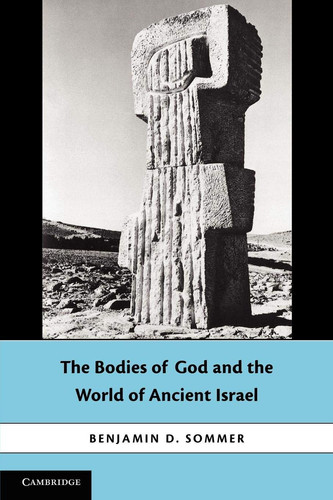
The bodies of God and the world of ancient Israel

Sommer, Benjamin D.
Sommer utilizes a lost ancient Near Eastern perception of divinity according to which a god has more than one body and fluid, unbounded selves. Though the dominant strains of biblical religion rejected it, a monotheistic version of this theological intuition is found in some biblical texts. Later Jewish and Christian thinkers inherited this ancient way of thinking; ideas such as the sefirot in Kabbalah and the trinity in Christianity represent a late version of this theology. This book forces us to rethink the distinction between monotheism and polytheism, as this notion of divine fluidity is found in both polytheistic cultures (Babylonia, Assyria, Canaan) and monotheistic ones (biblical religion, Jewish mysticism, Christianity), whereas it is absent in some polytheistic cultures (classical Greece). The Bodies of God and the World of Ancient Israel has important repercussions not only for biblical scholarship and comparative religion but for Jewish-Christian dialogue.
Cambridge University Press 2011-01-17 334 pages

The pen and the brush: how passion for art shaped nineteenth-century French novels

Muhlstein, Anka
"With the wit and penetration well known to readers of Balzac's Omelette and Monsieur Proust's Library, Anka Muhlstein's PEN AND BRUSH revisits the delights of the French novel. This time she focuses on late 19th- and 20th-century writers--Balzac, Zola, Proust, Huysmans, and Maupassant--through the lens of their passionate involvement with the fine arts. She delves into the crucial role that painters play as characters in their novels, which she pairs with an exploration of the profound influence that painting exercised on the novelists' techniques, offering an intimate view of the intertwined worlds of painters and writers at the time. Muhlstein's deftly chosen vignettes bring to life a portrait of the nineteenth century's tight-knit artistic community, where Cezanne and Zola befriended each other as boys and Balzac yearned for the approval of Delacroix. She leads the reader on a journey of spontaneous discovery as she explores how a great painting can open a mind and spark creative fire"--
Other Press 2017-01-31 228 pages

The dog with the chip in his neck: essays from NPR and elsewhere

Codrescu, Andrei
Trenchant, occasionally splenetic, and always brutally funny, Romanian-born Codrescu confronts the convulsions of our post-ideological world at a time when "the advent of cyberspace and the caffeinating of America has occurred simultaneously." With these newest essays from 1994 and 1995 - some that are straight off the NPR airwaves and some that have served as magazine pieces or speeches - Codrescu takes us on a roller-coaster tour through our own dramatically changing country. Making stops along the way to observe the shifting American landscape, our incisive guide confronts, among other curiosities: the ever-increasing illusion of democracy; the Internet and sex in the cyber age; the rise and rerise of the religious Right; the grotesquerie born out of the cooling shards of post-Communism; the transformation of the American palate; the ascendance of vampirism; and the new millennial contagion. Andrei Codrescu has been keeping his audience abreast of the absurdities of American culture for over ten years, and his trademark irony, buoyant paranoia, and mystical cynicism are once again in ample evidence in this collection. Along for the ride are all of his familiar characters, including puppets, fascists, airplanes, and Greyhound buses, but now his menagerie has expanded to include one electronically adjusted dog, Miss America, and an alligator god.
St. Martin's Press 1996 270 pages

Matilda's secret

Goldbacher, Sandra
Clementine Harper is 12 and learning to tap dance at Madame Pearl's Stage School in Finchley when war breaks out. As the air raids start to hit London, she and her two younger brothers, Ronnie and Ernie, are evacuated. Arriving in a tiny Devon village, they're sent to live with an eccentric widow who lives in a drafty mansion in the middle of wintry woods. Clementine is thrilled to meet another fi sh out of water - Giesele, a sophisticated Jewish girl, who has escaped from Nazi Germany and they become soul mates immediately. Giesele's parents are still in hiding in Berlin and her sister Klara has gone missing. If only they could help somehow. The girls are enlisted by the local Girl Guides who, they soon fi nd out, are training to do SO much more than bake cakes and tie knots. They're asked to help put on a Christmas show for the American soldiers at the military base nearby. But the show is a cover for a very secret mission, and the girls' lives are soon fi lled with mystery and adventure.
Daughters of History Ltd 2011 180 pages

Paradigm shift: from the Jewish renewal teachings of Reb Zalman Schachter-Shalomi

Schachter-Shalomi, Zalman
Rabbi Zalman Schachter-Shalomi is one of the most innovative and inspiring rabbis in the Jewish world today. Often considered the "grandfather of the Havurah movement" and the most influential advocate of the rapidly growing movement of Jewish Renewal, Reb Zalman (as he is known by his countless students and admirers) has earned a reputation as a courageous, profoundly spiritual contemporary master. Jewish Renewal, as Reb Zalman explains it, is based on Kabbalah, Hasidism, and other forms of Jewish mysticism. "Jewish Renewal does not want to abandon sacred and cherished traditions", teaches Reb Zalman. Rather, the "paradigm shift" advocates of Jewish Renewal call for asks that we recognize - as we have in the past - that there are newly emerging ways of looking at reality. Just as humankind had to adjust to the knowledge that the earth is not the center of the universe, so too do we today have to recognize that our understanding of our world has undergone significant change. Reb Zalman teaches that we must let go of the old paradigms rather than cling to these obsolete ways of thinking. In this book, Reb Zalman Schachter-Shalomi offers what he calls "the journey of my own recontextualization of Judaism as helped by Jewish mysticism". Reb Zalman points out that Judaism has undergone several "paradigm shifts" throughout its long history, such as the period after the destruction of the First and Second Temples, when, as Reb Zalman explains, "all of our practice and belief had to be reframed". Paradigm Shift: From the Jewish Renewal Teachings of Reb Zalman Schachter-Shalomi, in addition to being a record of the major teachings of Reb Zalman over the past thirty years, is a call for Jewish renewal once again. A passionate teacher of kabbalistic tradition, Reb Zalman offers a unique blend of Jewish mystical ideas as they encounter the forces and sensibilities of today. A book of great power and profundity, Paradigm Shift is one of the most creative and inspiring volumes to be published in years.
Jason Aronson 1993 322 pages

For Rulers Priming Political Leaders for Saving Humanity from Itself

Yehezkel Dror
In this striking book, Yehezkel Dror bravely goes where few authors dare, offering a big-picture view of the fateful choices facing the human species. He urges humankind to adopt unconventional survival and thriving strategies, including elevating the future of humanity above state interests, limiting the production and spread of dangerous knowledge and tools, and strengthening humanity's collective deliberative capacity. The author confronts the evolutionary trap of science and technology ensnaring unprepared humankind by providing it with awesome future-shaping power, which contemporary values and institutions are unable to handle. Dror warns that tribal and nationalist values, the inability to learn from history, and mediocre leadership will catastrophically endanger the future of human life, making radical, even painful, innovations essential. According to Dror, the prevailing form of politics is obsolete. Instead, he argues urgently for a new type of political leader - "Homo Sapiens Governors" - willing and able to fulfill the daunting mission to save humanity from itself. Recognizing that the tyrannical status quo will try to prevent essential transformations, Dror predicts new crises making what is still unthinkable clearly compelling - and that humankind will have to choose: learn rapidly to survive and thrive, or perish. YEHEZKEL DROR is professor emeritus at the Hebrew University of Jerusalem. Recognized as a founder of modern policy studies, he integrates multi-disciplinary scholarship with extensive personal experience as a global advisor into a novel paradigm on alternative evolutionary futures of humanity - as shaped by fateful choices humanity has never before faced.
Amazon Digital Services LLC - Kdp 2017-08-18 116 pages

A threat from within: a century of Jewish opposition to Zionism

Rabkin, Yakov M.
A Threat from Within presents a history of Jewish opposition to Zionism, and challenges the myths that lie at the very root of contemporary or 'new' anti-Semitism. A principled and enduring opposition to Zionism has come from spiritual leaders of Judaism and has not died away despite the State of Israel existence as an imposing military power. The violence in Israel/Palestine acquires a different meaning when seen in the context of internal opposition to Zionism. Dire warnings voiced at the birth of Zionism now sound prophetic. The anti-Zionists have claimed all along that far from 'solving the Jewish question' and offering Jews a safe haven, Zionism would only fan hatred of the Jews. A Threat from Within and its seemingly paradoxical theme - Jews opposing Zionism in the name of Judaism - will fascinate a wide range of readers from different political and religious orientations. Yakov Rabkin's book has been translated into several languages and has been nominated for the 2006 Governor General's Literary Awards, Canada's most prestigious literary prize.
Fernwood Pub 2006-03-01 261 pages

A threat from within: a century of Jewish opposition to Zionism

Rabkin, Yakov M.
There's a crack in everything, that's how the light gets in. These words by the poet Leonard Cohen could aptly describe this book, which takes history as a witness to the exceptional nature of Zionism in Jewish history. It explains many points of discord between the political ideology of Zionism and what most people consider Judaism. It also shows how Jewish traditional conscience offers a hope for the solution of the Middle East crisis. The conflicts in Israel/Palestine acquire a different meaning when seen in the context of Jewish opposition to Zionism. This book has attracted Jewish and non-Jewish readers alike who find this story inspiring in today $1 (Bs world of mobile identities.
Fernwood Pub 2006 261 pages

An introduction to the International Criminal Court

Schabas, William
"The International Criminal Court ushered in a new era in the protection of human rights. The Court prosecutes genocide, crimes against humanity, war crimes, and the crime of aggression when national justice systems are either unwilling or unable to do so themselves. This fifth edition...describes a Court which is no longer in its infancy; the Court is currently examining situations that involve more than twenty countries in every continent of the planet. This book considers the difficulties in the Court's troubled relationship with Africa, the vagaries of the position of the United States, and the challenges the Court may face as it confronts conflicts around the world. It also reviews the history of international criminal prosecution and the Rome Statute."--
Cambridge University Press 2017-01-26 598 pages

An introduction to the International Criminal Court

Schabas, William
Arguably the most significant international organization to be created since the United Nations, the International Criminal Court ushers in a new era in the protection of human rights. The direct descendant of the Nuremberg and Tokyo trials, as well as those of the more recent international criminal tribunals for the Former Yugoslavia and Rwanda, the International Criminal Court will prosecute genocide, crimes against humanity and war crimes when national justice systems are either unwilling or unable to do so themselves. This new book reviews the history of international criminal prosecution, the drafting of the Rome Statute of the International Criminal Court and the principles of its operation, including the scope of its jurisdiction and the procedural regime. Three of the Court's fundamental documents - the 1998 Rome Statute itself, the Rules of Procedure and Evidence, and the Elements of Crimes - are reproduced in the Appendix. Indispensable for students and practitioners.
Cambridge University Press 2001-07-05 406 pages

Even More Things That Nobody Knows 501 Further Mysteries of Life, the Universe and Everything

William Hartston
A fascinating exploration of the limits of human knowledge of our planet, its history and culture, and the universe beyond, from the author of The Things that Nobody Knows There are many, many more things that nobody knows. Do animals have a sense of humor? Why do we have five fingers? How long can humans live? What did Jesus do in his youth? Which speech did Lincoln deliver at Gettysburg? Does the appendix have any use? Is there an odd perfect number? In this witty and enlightening follow-up to The Things that Nobody Know s, William Hartston takes us on a guided tour of 501 further gaps in our knowledge of cosmology, mathematics, animal behavior, medical science, music, art, and literature.
Atlantic Books, Limited 2015-11-05 384 pages

East End Jewish radicals, 1875-1914

Fishman, W. J.
Professor William Fishman, son of an immigrant tailor, describes London's East End at a time of mass immigration from Eastern Europe to the shabby tenements of Stepney and Whitechapel. He describes the spread of libertarian and socialist ideals among the Jewish community culminating in the great strikes of 1889 and 1912. It was in London's East End that Rudolf Rocker taught himself Yiddish and helped politicize a generation. An extraordinary period of Jewish, immigrant and radical history, described by an inspired storyteller. "An immensely readable work, it should attract a large and enthusiastic audience." - Paul Avrich
Five leaves 2004 336 pages

Soviet realities: culture and politics from Stalin to Gorbachev

Laqueur, Walter
From Library Journal This volume contains essays and reviews about various aspects of Soviet life. Laqueur begins by concentrating on the current glasnost era under Gorbachev, which is a time of daily excitement as compared to the grim years of stagnation which preceded it. Laqueur recently published a far more detailed study of the subject in The Long Road to Freedom (LJ 4/1/89). Other essays include a discussion of Western historiography of Stalinist and post-Stalinist Russia (little here for the profession to be proud of); a 25-year-old piece on Stalin's historical reputation which stands up well; a piece on emigre politics between the wars; and reviews of spy novels of East and West. This has some interesting bits, but it is for larger collections only.- R.H. Johnston, McMaster Univ., Hamilton, OntarioCopyright 1989 Reed Business Information, Inc. Product Description In this, the third volume of collected essays by one of the most eminent students of East and West Europe, Walter Laqueur reveals a particularly deft touch at weaving the cultural and the political into a seamless whole. His familiarity with Soviet life and the Russian language gives him a unique insider's position in examining the Soviet Union and its remarkable changes in the decade of the 1980s. In chapters on glasnost and its limits to the Soviet Union in the 1990s, the reader is given a careful perspective on continuities as well as discontinuities in Soviet politics. And in studies of Nikolai Skoblin, Julian Semynov-with whom his western counterpart, John Le Carre is compared in a fine coupling-we are given a sense of the darker side of things Soviet.Soviet Realities reveals Laqueur's appreciation of the painful dialectic inherent in the grand sweet of Soviet life: underneath the faþade of an imposed monolith are the continuing struggles between Left and Right, reformers and renegades, terrorists and legalists. And in his opening chapter, the author links these disparate strands together in a modest and self-critical appraisal. This is a volume deserving of an audience far beyond "Kremlinologists" or specialists in foreign affairs. In its sense of the Soviet whole, it will be of interest to all citizens concerned with the present and future of Soviet-American relations. Review “Laqueur's essays are thoughtfully and insightfully written.” —J. S. Zacek, Choice About the Author Walter Laqueur was director of the Institute of Contemporary History in London and served as chairman of the International Research Council of the Center for Strategic and International Studies in Washington until 2000. He was founder and editor of the Journal of Contemporary History and other publications. Laqueur taught at Georgetown, Harvard, the University of Chicago, Johns Hopkins, Brandeis University, and Tel Aviv University.
Transaction Publishers 1990-01-01 231 pages