153 results for "Biography"

The Beginning of the Journey The Marriage of Diana and Lionel Trilling

Diana Trilling
It was Christmas Eve 1927 and Prohibition was at its height when Diana and Lionel Trilling, that distinguished literary pair, were introduced to each other. They met at a Manhattan speakeasy. Both were 22. Lionel was a graduate student at Columbia, taking his first tentative steps to a literary career. Diana hoped to be a singer. Soon after their marriage in 1929, the stock market crashed. Their families were in financial ruin. Not until the forties did Lionel attain literary recognition and Diana launch her career as fiction critic of the Nation. A long arduous decade had been lost to illness, financial hardship, grueling family responsibility. Also to the lure, and rejection, of Communism. The Beginning of the Journey takes its title from Lionel Trilling's famous novel, The Middle of the Journey. An uncommonly personal account of the upbringing, education, and marriage of two remarkable individuals, it is also a probing portrait of life among the group now so widely referred to as "the New York intellectuals." Mary McCarthy, Dwight Macdonald, William Phillips, Phillip Rahv, Edmund Wilson, James Agee, Sidney Hook, Randall Jarrell, Allen Ginsberg: these are but a few of the well-known figures whom we come to see through the eyes of someone who lived at the center of America's Bloomsbury. Although Mrs. Trilling chiefly deals with the intellectual culture of our century, the range of her memoir is not limited to this single section of society. The Beginning of the Journey speaks to questions of a kind which transcend social lines but which have been largely ignored by our literary biographers. What was it like, what was it really like, to be a woman in this predominantly male universe? What did it feel like to be as respected a critic as Diana Trilling but married to a man so much more celebrated than herself? What did a woman of her generation sacrifice for marriage and motherhood?
Harcourt Brace 1993 442 pages

The Art of Leaving A Memoir

Ayelet Tsabari
WINNER OF THE CANADIAN JEWISH LITERARY AWARD FOR MEMOIR FINALIST FOR THE HILARY WESTON WRITERS' TRUST PRIZE FOR NONFICTION An unforgettable memoir about a young woman who tries to outrun loss, but eventually finds a way home. Ayelet Tsabari was 21 years old the first time she left Tel Aviv with no plans to return. Restless after two turbulent mandatory years in the Israel Defense Forces, Tsabari longed to get away. It was not the never-ending conflict that drove her, but the grief that had shaken the foundations of her home. The loss of Tsabari's beloved father in years past had left her alienated and exiled within her own large Yemeni family and at odds with her Mizrahi identity. By leaving, she would be free to reinvent herself and to rewrite her own story. For nearly a decade, Tsabari travelled, through India, Europe, the US and Canada, as though her life might go stagnant without perpetual motion. She moved fast and often because--as in the Intifada--it was safer to keep going than to stand still. Soon the act of leaving--jobs, friends and relationships--came to feel most like home. But a series of dramatic events forced Tsabari to examine her choices and her feelings of longing and displacement. By periodically returning to Israel, Tsabari began to examine her Jewish-Yemeni background and the Mizrahi identity she had once rejected, as well as unearthing a family history that had been untold for years. What she found resonated deeply with her own immigrant experience and struggles with new motherhood. Beautifully written, frank and poignant, The Art of Leaving is a courageous coming-of-age story that reflects on identity and belonging and that explores themes of family and home--both inherited and chosen.
HarperCollins Publishers 2020-02-18 336 pages

In Another Place With and Without My Father, Norman Mailer

Susan Mailer
"In Another Place brings us to many remarkable new places in the Mailer universe. Written with tenderness, acuity and unadorned psychological depth, Susan Mailer's memoir is a powerful look at the literary world." -Colum McCann, National Book Award-winning author of Let the Great World Spin"Brisk, enthralling [. . .] full of dramatic family scenes, most of them heretofore unknown. I wish I had her memoir in hand when writing my biography." -J. Michael Lennon, author of Norman Mailer: A Double Life Norman Mailer, Susan Mailer's father, was among the most celebrated, talented, and controversial writers of the 20th Century. The Naked and the Dead (1948), inspired by his experience in World War II, was a bestseller and made him famous at the age of 25. Notoriously combative and egotistical, her father enjoyed a good ¿ght both physically and verbally. Whether cheered or booed, Mailer was front and center in America's cultural battles for more than 50 years. He married six times and was father to nine children. Susan, born in 1949, is the eldest.Susan's parents separated when she was a baby. She grew up shuttling between her mother's home in Mexico and New York. Later she would marry a Chilean activist, spending the majority of her adult life in Chile, where she is a practicing psychoanalyst.In Another Place tells the story of her intense and complex relationship with her father, her ¿ve stepmothers and nine siblings, and the joys and pains of being part of the large Mailer clan. It is a tale of separation, and of the rewards and struggles of living in two very di¿erent cultures. Of being someone who belongs everywhere and nowhere, always longing for a life . . . In Another Place.
Northampton House Press 2019-11-05 316 pages

Victor Hugo A Realistic Biography of the Great Romantic

Matthew Josephson
With trenchant realism and profound understanding, Matthew Josephson presents in VICTOR HUGO the realistic biography of a great romantic who wrote Les Misérables and The Hunchback of Notre Name, among others. Of tremendous sweep and scope, it is a penetrating analysis of a literary titan, who as a political pamphleteer, playwright, novelist, and romantic lover, dominated his time, influenced his peers, and moved the hearts of men. Matthew Josephson, whose Stendhal, Zola, The Robber Barons, and Rousseau defined him as a master of the art of biography, has given us in VICTOR HUGO a highly readable account of this vigorous, zestful, and fruitful career. VICTOR HUGO is the final and definitive work on "France's prince of poets and lord of language." EARLIER BOOK REVIEWS "Matthew Joseph's third full-blown biography of a great French writer.is the best. There is more color and drive in it .because the materials are so rich." New York Times Book Review (1942) "Victor Hugo's varied and colorful career offered Josephson a perfect opportunity to display again his gift for spirited narrative and keen characterization. He skillfully traces Hugo's conversion from literary great to political hero. Along the way he adds texture to his portrait by interweaving the fascinating components of Hugo's personal life -his marriage to Adèle Foucher, his fifty-year liaison with Juliette Drouet, and his friendship and betrayal by Sainte-Beuve.Victor Hugo's life was a success story without parallel, and it provided an apotheosis of Josephson's point about the duty of writers in times of social and political crisis. The critics again praised Josephson's talents as a biographer." - David E. Shi, Matthew Josephson: Bourgeois Bohemian, Yale University Press, 1981
Jorge Pinto Books Inc. 2006 528 pages

Lawrence and the Women The Intimate Life of D.H. Lawrence

Elaine Feinstein
D. H. Lawrence is recognized as one of the greatest novelists of this century. His work is taught in schools and universities all over the world. Yet, more than thirty years after the failure to ban Lady Chatterley's Lover in England fundamentally changed the moral climate of that country and of America, Lawrence remains a controversial figure. Regarded by many women during his lifetime as a sexual prophet, in recent years his supposed misogyny has drawn fierce condemnation from feminist critics. In this new biography of Lawrence, Elaine Feinstein explores his relationships with the women in his own life, many of whom have their counterparts in his novels. She traces the obsessive nature of his love for his mother, Lydia; his difficult relationship with his first sweetheart, Jessie Chambers; his pursuit of the bisexual Helen Corke; and the failure of his youthful engagement to Louisa Burrows. She gives a fascinating account of his long, battling marriage to Frieda von Richthofen; his friendships with women writers like Katherine Mansfield and Catherine Carswell; and the attachment to Lawrence of patronesses such as Lady Ottoline Morrell, Lady Cynthia Asquith and Mabel Dodge Luhan. Lawrence and the Women investigates the paradoxes of Lawrence's personality. He was considered to have a rare understanding of women's sexuality, yet his own sexual relationships were unusually difficult. He put all his faith in the energies of the body, yet his own was frail and sickly. He argued that women needed to submit to men, but he never succeeded in dominating his own wife, Frieda. With a novelist's eye for detail and uncanny intuition about character, Elaine Feinstein probes the sources of Lawrence's attitudes toward women with candor and compassion. Always responsive to the poetry and power of his writing, she offers a fresh and surprising portrait of one of the most misunderstood literary figures of our time.
HarperCollins Publishers 1994-03-30 275 pages

Off mike: a memoir of talk radio and literary life

Michael Krasny
KQED Radio's Michael Krasny is one of the country's leading interviewers of literary luminaries, a maestro for educated listeners who prefer their discourse high and civil. He is a writer's interviewer. But it didn't start out that way. In Off Mike , Krasny, host of one of public radio's most popular and intellectually compelling programs, talks of his strong desire to become a novelist in the footsteps of Bellow and Philip Roth, and then discovering his real talent as a communicator—a deft ability to draw others out as an interlocutor. In a mix of memoir and reportage, Krasny takes readers inside his world. He gives an account of the polarizing transformation of talk radio, from his early days at KGO commercial radio, through to his current role at NPR, where he manages to keep the flow of talk in his San Francisco based show animated and politically balanced. Forum fans and lovers of literature will be riveted by the insightful and amusing vignettes and behind the scenes accounts. They will get a taste of the sharp commentary from his encounters with panels of experts, and interviews with cultural and political personalities as well as writers.
Stanford General Books 2009-02 317 pages

Time Out of Mind The Diaries of Leonard Michaels, 1961-1995

Leonard Michaels
Taken from the journals of distinguished writer Leonard Michaels, Time Out of Mind chronicles the author's life as a friend, lover, husband, and father. With wrenching dramatic intensity, it captures the character and the mind of an extraordinary talent -- from his days as a struggling young writer in Greenwich Village, through the turbulent Vietnam era, to his years as a professor of English literature at Berkeley. This is an unforgettable portrait of an artist in the world -- from one of the most acclaimed authors of our time.
Penguin Publishing Group 2000-07 214 pages

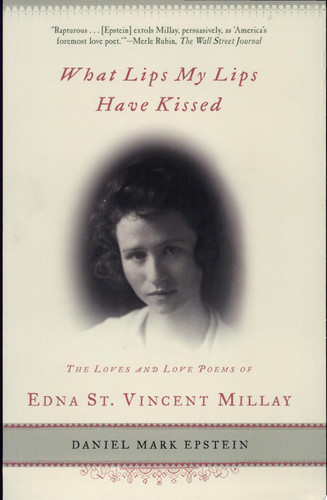
What Lips My Lips Have Kissed The Loves and Love Poems of Edna St. Vincent Millay

Daniel Mark Epstein
This is the story of a rare sort of American genius, who grew up in grinding poverty in Camden, Maine. Nothing could save the sensitive child but her talent for words, music, and drama, and an inexorable desire to be loved. When she was twenty, her poetry would make her famous; at thirty she would be loved by readers the world over. Edna St. Vincent Millay was widely considered to be the most seductive woman of her age. Few men could resist her, and many women also fell under her spell. From the publication of her first poems until the scandal over Fatal Interview twenty years later, gossip about the poet's liberated lifestyle prompted speculation about who might be the real subject of her verses. Using letters, diaries, and journals of the poet and her lovers that have only recently become available, Daniel Mark Epstein tells the astonishing story of the life, dedicated to art and love, that inspired the sublime lyrics of Edna St. Vincent Millay.
Macmillan 2002-09 300 pages

Moving Pictures, Memories of a Hollywood Prince

Budd Schulberg
Raised in the Hollywood of the 1920s as the privileged son of a pioneer studio mogul, Budd Schulberg went on to win fame as a distinguished novelist, short story writer, playwright, Oscar-winning screenwriter, and boxing historian. Moving Pictures is his fascinating remembrance of growing up amidst the glamour, swank, courage, triumphs, defeats, cabals, and double-crosses of an industry in the making. His utterly candid account includes unsparing portraits of outsized characters in all their power, venality, charm, pettiness, and vindictiveness. As a book on the early days of the movies in Hollywood, this one is hard to beat. Abundantly illustrated with rare photographs. Book jacket.
Stein and Day 1982 501 pages

Timebends A Life

Arthur Miller
The definitive memoir of Arthur Miller--the famous playwright of The Crucible , All My Sons , Death of a Salesman , A View from the Bridge , and other plays-- Timebends reveals Miller's incredible trajectory as a man and a writer. Born in 1915, Miller grew up in Harlem in the 1920s and 1930s, developed leftist political convictions during the Great Depression, achieved moral victory against McCarthyism in the 1950s, and became president of PEN International near the end of his life, fighting for writers' freedom of expression. Along the way, his prolific output established him as one of the greatest writers of the twentieth century--he wrote twenty-two plays, various screenplays, short stories, and essays, and won the Pulitzer Prize in 1949 for Death of a Salesman and the New York Drama Critics Circle Award in 1947 for All My Sons . Miller also wrote the screenplay for The Misfits, Marilyn Monroe's final film. This memoir also reveals the incredible host of notables that populated his life, including Marilyn Monroe, Elia Kazan, Clark Gable, Sir Laurence Olivier, John F. Kennedy, and Mikhail Gorbachev. Leaving behind a formidable reputation in the worlds of theater, cinema, and politics, Arthur Miller died in 2005 but his memoir continues his legacy.
Grove Atlantic 2013-07-09 656 pages

I'll Always Have Paris A Memoir

Art Buchwald
"ART BUCHWALD DOES IT AGAIN. . . . A GREAT READ." --Larry King, USA Today In 1948, an American innocent named Art Buchwald set sail for Paris, France, determined to crash Hemingway's moveable feast and make himself famous. What's more, he did it. Now he remembers those golden years--when he wrote for the Paris Herald Tribune, fell in love, spoofed Hemingway, dined with gangsters, and crashed costume balls in Venice. Everything that has made Buchwald one of the world's best-loved writers is in this funny, enchanting, poignant book. "HONEST AND MOVING . . . A CONSUMMATE STORYTELLER." --The New York Times Book Review "ROLLICKING . . . The book gallops and gambols along. . . . Buchwald is a master of the anecdote." --The Baltimore Sun
Random House Publishing Group 1997-10-15 260 pages

Irving Howe

Gerald Sorin
A New York Times “Books for Summer Reading” selection Winner of the 2003 National Jewish Book Award for History By the time he died in 1993 at the age of 73, Irving Howe was one of the twentieth century’s most important public thinkers. Deeply passionate, committed to social reform and secular Jewishness, ardently devoted to fiction and poetry, in love with baseball, music, and ballet, Howe wrote with such eloquence and lived with such conviction that his extraordinary work is now part of the canon of American social thought. In the first comprehensive biography of Howe’s life, historian Gerald Sorin brings us close to this man who rose from Jewish immigrant poverty in the 1930s to become one of the most provocative intellectuals of our time. Known most widely for his award-winning book World of Our Fathers, a rich portrayal of the East European Jewish experience in New York, Howe also won acclaim for his prodigious output of illuminating essays on American culture and as an indefatigable promoter of democratic socialism as can be seen in the pages of Dissent, the journal he edited for nearly forty years. Deeply devoted to the ideal of democratic radicalism and true equality, Howe was constantly engaged in a struggle for decency and basic fairness in the face of social injustice. In the century of Auschwitz, the Gulag, and global inter-ethnic mass murder, it was difficult to sustain political certainties and take pride in one's humanity. To have lived a life of conviction and engagement in that era was a notable achievement. Irving Howe lived such a life and Gerald Sorin has done a masterful job of guiding us through it in all its passion and complexity.
New York University Press 2002 386 pages

Getting Started A Memoir of the 1950s : with Letters from Mordecai Richler, Mavis Gallant and Brian Moore

William Weintraub
With letters from Mordecai Richler, Mavis Gallant, and Brian Moore Getting Started is a wonderful memoir, a collection of extraordinary letters, and a brilliant recreation of a time when Canadian writers were set to make their mark in the world for the first time. Writer Brian Moore emigrated from Ireland to Canada in the late 1940s and found work at the Montreal Gazette, where he also found William Weintraub embarking upon a career as a freelance journalist. When he travelled to Paris, Weintraub saw an old friend and former Gazette writer, Mavis Gallant, who filled him in on the tribulations of the expatriate writer’s life ( “My room is enormous and the radiator very small indeed” ). Gallant introduced Weintraub to another Montreal writer, Mordecai Richler, also pursuing a career as a novelist while living a gloriously Bohemian life. Weintraub joined Richler for a while in Ibiza (he later introduced him to Brian Moore), and later they kept in touch. ( “Dear Bill: I got your highly unintellectual letter yesterday and it confirmed my suspicions that you slipped a chair under your arse in the Deux Magots as soon as you arrived in Paris and probably haven’t moved since.” ) In these years, Gallant had her short stories published for the first time in the New Yorker, Moore methodically churned out money-making thrillers while working on The Lonely Passion of Judith Hearne , and Richler wrote his first acclaimed book, The Acrobats . Weintraub, meanwhile, returned to Montreal, where he saw published his brilliant comic novel, Why Rock the Boat? William Weintraub weaves together his own memories of the 1950s with letters both to and from his literary colleagues. The letters and his recollections are always fascinating, often hilarious, and provide intimate insight into the lives and work of some of Canada’s finest contemporary writers. From the Hardcover edition.
McClelland & Stewart 2001 286 pages

Portrait of my body

Lopate, Phillip
Phillip Lopate's richest and most ambitious book yet--the final volume of a trilogy that began with Bachelorhood and Against Joie de Vivre -- Portrait of My Body is a powerful memoir in the form of interconnected personal essays. One of America's foremost essayists, who helped focus attention on the form in his acclaimed anthology The Art of the Personal Essay , Lopate demonstrates here just how far a writer can go in the direction of honesty and risk taking. In thirteen essays, Lopate explores the resources and limits of the self, its many disguises, excuses, and unmaskings, with his characteristic wry humor and insight. From the title essay, a hilarious physical self-exam, to the haunting portrait of his ex-colleague Donald Barthelme, to the bittersweet account of his long-delayed surrender to marriage, "On Leaving Bachelorhood," Lopate wrestles with finding the proper balance between detachment and empathy, doubt and conviction. In other essays, he celebrates his love of film and city life, and reflects on his religious identity as a Jew. A wrenchingly vivid, unforgettable portrait of the author's eccentric, solipsistic, aged father, a self-proclaimed failure, is the centerpiece of a suite of essays about father-figures and resisted mentors. The book ends with the author's own introduction to fatherhood, as witness to the birth of his daughter. A book that will engage readers with its conversational eloquence, skeptical intelligence, candor, and mischief, Portrait of My Body is a captivating work of literary nonfiction.
Anchor Books 1996 325 pages

The Treehouse Eccentric Wisdom from My Father on How to Live, Love, and See

Naomi Wolf
Leonard Wolf, a retired professor now in his early eighties, is the kind of person who likes to use a medieval astrolabe, dress in Basque shepherd's clothing, and convince otherwise sensible people to quit their jobs and follow their passions. Leonard believes that inside everyone is an artist, and that happiness in life depends on valuing and acting upon one's creative impulse. In The Treehouse, her most personal book yet, Naomi Wolf outlines her father's lessons in creating lasting success and happiness, and offers inspiration for the artist in all of us. Drawn from Leonard's lecture notes, the chapters of The Treehouse remind us to "Be Still and Listen," "Use Your Imagination," and "Do Nothing Without Passion," and that "Your Only Wage Will Be Joy" and "Mistakes Are Part of the Draft." This is a journey of self-discovery in which the creative endeavor is paramount. The Treehouse is a stirring personal history, a meditation on fathers and daughters, an argument for honoring the creative impulse, and a unique instruction in the art of personal happiness.
Simon and Schuster 2006-05-03 288 pages

Life in Culture Selected Letters of Lionel Trilling

Lionel Trilling
A great critic’s quarrels with himself and others, as revealed in his correspondence In the mid-twentieth century, Lionel Trilling was America’s most respected literary critic. His powerful and subtle essays inspired readers to think about how literature shapes our politics, our culture, and our selves. His 1950 collection, The Liberal Imagination , sold more than 100,000 copies, epitomizing a time that has been called the age of criticism. To his New York intellectual peers, Trilling could seem reserved and circumspect. But in his selected letters, Trilling is revealed in all his variousness and complexity. We witness his ardent courtship of Diana Trilling, who would become an eminent intellectual in her own right; his alternately affectionate and contentious rapport with former students such as Allen Ginsberg and Norman Podhoretz; the complicated politics of Partisan Review and other fabled magazines of the period; and Trilling’s relationships with other leading writers of the period, including Saul Bellow, Edmund Wilson, and Norman Mailer. In Life in Culture , edited by Adam Kirsch, Trilling’s letters add up to an intimate portrait of a great critic, and of America’s intellectual journey from the political passions of the 1930s to the cultural conflicts of the 1960s and beyond.
Picador 2019-12-17 464 pages