150 results for "Business"

The Geraldo show: a memoir

Rivera, Geraldo
During my half a century in public life, my image and reputation have had more ups and downs than the Cyclone roller coaster at Coney Island. I have been called savior and sinner, fool and wise man, crusader and exploiter, hothead and dope. I am routinely scorned, admired, beloved, and belittled—which one is usually based on when the viewer tuned in. Were you around for my early days as a crusading local newsman? Did you waste an evening with me inside Al Capone's empty vault? Were you watching when the bombs dropped in Afghanistan or Iraq, or did you tune in to the raucous talk show when my nose was broken in the best television studio brawl ever caught on tape? Since the attacks of September 11, 2001, and my employment by the conservative rabble-rousers of Fox News—and, more recently, with the coming of the Age of Trump—my professional life has been even more difficult to define. How could a sincerely progressive native-born Jew-Rican New Yorker like me ever work for an outfit better suited to the vibes of Orange County, California, the Dixie, Appalachia, or the Mountain West? How could I not condemn and obstruct a wrecking ball like Donald Trump? Over five decades, I have met most of the era's good and bad guys, from Ronald Reagan to Charles Manson, Fidel Castro to Yasser Arafat, Muhammad Ali to John Lennon, and Elvis Presley to Michael Jackson. Two figure heavily in this book, both longtime friends: Roger Ailes, the disgraced yet undeniably brilliant creator of Fox News; and Donald Trump, once a flamboyant playboy, billionaire businessman, and now 45th President of the United States. At the vigorous twilight of a long and largely improvised life lived in plain sight, I have little left to prove. Faced with a series of random chances, for better and worse, what I made of my life is what I made of those chances. Time has enlightened and humbled me. Sincerely, Geraldo Rivera
BenBella Books, Inc 2018-04-03 366 pages

Adventures of a bystander

Drucker, Peter F.
"It is [a] belief in diversity and pluralism and the uniqueness of each person that underlies all my writings . . . " -from the Preface. Regarded as the most influential and widely read thinker on modern organizations and their management, Peter Drucker has also established himself as an unorthodox and independent analyst of politics, the economy, and society. A man of impressive scope and expertise, he has paved significant inroads in a number of key areas, sharing his knowledge and keen insight on everything from the plight of the employee and the effects of technology to the vicissitudes of the markets and the future of the new world order. Adventures of a Bystander is Drucker's rich collection of autobiographical stories and vignettes, in which this legendary figure paints a portrait of his remarkable life, and of the larger historical realities of his time. In a style that is both unique and engaging, Drucker conveys his life story -from his early teen years in Vienna through the interwar years in Europe, the New Deal era, World War II, and the postwar period in America-through intimate profiles of a host of fascinating people he's known through the years. Their personal histories are, as Drucker tells us, the beads for which his own life serves as the string. A colorful group, these diverse, often unpredictable, always multidimensional individuals were chosen "because each of them, in his or her own highly personal way, reflects and refracts the thirty crucial years from the end of World War I to the first post-World War II decade-the thirty years that largely formed the world in which we now live." An amazing pageant of characters, both famous and otherwise, springs from these pages, illuminating and defining one of the most tumultuous periods in world history. Along with bankers and courtesans, artists, aristocrats, prophets, and empire-builders, we meet members of Drucker's own family and close circle of friends, among them such prominent figures as Sigmund Freud, Henry Luce, Alfred Sloan, John Lewis, and Buckminster Fuller. Playing to perfection their roles as those who "reflect and refract" the customs, beliefs, and attitudes of the times, these singular personalities lend Adventures of a Bystander a striking "you-are-there" feel. A brief encounter with Freud becomes the catalyst for an absorbing, multidimensional description of the economics, politics, and social psychology of pre-World War II Europe. Drucker introduces us to Fritz Kraemer, a brilliant, monocle-wearing eccentric who became an influential mentor to the young Henry Kissinger. His personal memoir of Henry Luce documents the development of modern journalism, while in "The Indian Summer of Innocence," he rescues and preserves the very heart of the American experience during the last New Deal years before World War II. Shedding light on a turbulent and important era, Adventures of a Bystander also reflects Peter Drucker himself as a man of imaginative sympathy and enormous interest in people, ideas, and history. These enthralling stories complement and complete the groundbreaking analytical writing for which he is so revered. Luminous autobiographical stories by one of the greatest thinkers of our time "The cast of characters among whom Drucker moves is superbly rich, and the informed glimpse he provides of a vanished social and political universe is an education in itself. Adventures of a Bystander is better than a novel, more lively than an essay, and as thoughtful as both at their best." -The Harvard Business Review. "Adventures of a Bystander is a virtuoso performance in which Drucker displays a dazzling diversity of personal interests and knowledge, an awesome power of recall, and a crisp, highly readable writing style." -BusinessWeek. "Adventures of a Bystander appears in a stroke to have restored the art of the memoir and of the essay. It will doubtless be a while before its like comes round again." -The Washington Post.
Wiley 1997 344 pages

The art of being unreasonable: lessons in unconventional thinking

Broad, Eli
Eli Broad?s embrace of "unreasonable thinking" has helped him build two Fortune 500 companies, amass personal billions, and use his wealth to create a new approach to philanthropy. He has helped to fund scientific research institutes, K-12 education reform, and some of the world?s greatest contemporary art museums. By contrast, "reasonable" people come up with all the reasons something new and different can?t be done, because, after all, no one else has done it that way. This book shares the "unreasonable" principles-from negotiating to risk-taking, from investing to hiring-that have made Eli Broad such a success.
John Wiley & Sons 2012-05-08 192 pages

Inside the economist's mind: conversations with eminent economists

Paul A. Samuelson,William A. Barnett
By focusing on the human side as well as the intellectual dimensions of how economists work and think, this collection of interviews with top economists of the 20th century becomes a startling and lively introduction to the modern world of macroeconomics. A fun read! For more information, frequent updates, and to comment on the forthcoming book, visit William A. Barnett's weblog at http://economistmind.blogspot.com/. Acclaim for Inside the Economist's Mind "In candid interviews, these great economists prove to be fabulous story tellers of their lives and times. Unendingly gripping for insiders, this book should also help non-specialists understand how economists think." Professor Julio Rotemberg, Harvard University Business School, and Editor, Review of Economics and Statistics. "Economics used to be called the 'dismal science'. It will be impossible for anybody to hold that view anymore ... This is science with flesh and blood, and a lot of fascinating stories that you will find nowhere else." Dr. Jean-Pascal Bénassy, Paris-Jourdan Sciences Économiques, Paris, France "This book provides a rare and intriguing view of the personal and professional lives of leading economists ... It is like A Beautiful Mind , scaled by a factor of 16 [the number of interviews in the book]." Professor Lee Ohanian, University of California at Los Angeles " ... if you want an insider view of how economics has been developing in the last decades, this is the (only) book for you." Professor Giancarlo Gandolfo, University of Rome ‘La Sapienza,’ Rome "Here we see the HUMAN side of path-breaking research, the personalities and pitfalls, the DRAMA behind the science." Professor Francis X. Diebold, University of Pennsylvania, Philadelphia
Blackwell Pub 2007 419 pages

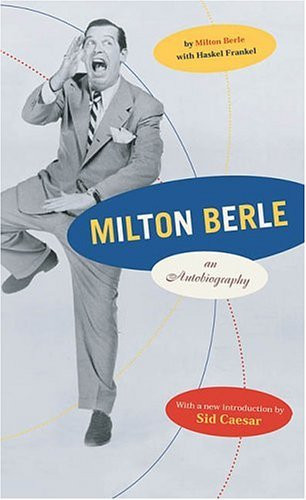
Milton Berle: an autobiography

Berle, Milton
(Applause Books). When Milton Berle died in the Spring of 2002, THE NEW YORK TIMES declared that the legendary comic "may have had a more profound influence on our way of life than some presidents or Nobel Prize winners." This landmark memoir, as startling today as it was when it was first published, reveals the life and times of the man known affectionately to millions as Uncle Miltie. Told with unflinching candor, here is one of the most fabled and influential show business careers of all time: from performing as a child in Vaudeville and making silent movies with Charlie Chaplin and Mary Pickford, to nightclub performances for Al Capone, working on radio during World War II, performing in Broadway musicals, and, finally, superstardom on television. Perhaps even more fascinating is Berle's scandal-ridden private life: his star-crossed love affair with a 1930's movie queen and the child they had out of wedlock, his numerous affairs with women ranging from evangelist Aimee Semple McPherson to Marilyn Monroe, and his stormy relationship with beautiful showgirl Joyce Mathews, whom Berle married twice. It is Berle's unsparing account of his life and his determination to show the world his real face that led Frank Sinatra, at the time, to call this "the gutsiest book I've read in years." Told with equal amounts of comedy and pathos, and featuring colorful appearancesby all the major stars of his day, MILTON BERLE is simply one of the best show business memoirs ever written.
Applause Theatre & Cinema Books 2002-09-01 337 pages

The prince of the city: Guiliani, New York, and the genius of American life

Siegel, Frederick F.
In this first post-9/11 account of the career of the man who established himself as America's Mayor in the dark days after America was attacked, Fred Siegel shows how Rudy Giuliani's successes in New York--restoring law and order, cutting taxes and radically reducing the welfare rolls--demonstrated that Gotham was indeed governable (a matter of doubt until his election) and that our major cities might again become vibrant and dynamic places to live after thirty years of middle-class flight. Someone who has worked with Giuliani as well as studied him, Siegel describes this colorful figure as an immoderate centrist, who, like the city he came to embody, evokes contradictory emotions. For some, he was a ruthless autocrat during his years at city hall; for others, he was a heroic figure who took on the vested interests that had dragged the city down. Siegel regards Guiliani as a shrewd tactician and artist of the possible who could have stepped out of the pages of Machiavelli's THE PRINCE. A self-promoting, self-absorbed man, the mayor made his own enormous ego serve the city's well-being. He promoted the virtues of duty and sacrifice, but was sometimes unable to honor these values in his personal life. He was suspicious of those outside his immediate circle, but he also placed this tribal ethos in the service of ideals that transcended New York's ethnic politics and business as usual. THE PRINCE OF THE CITY is at once a fascinating character study, a history of New York over the last forty years, and a classic inquiry into the issue of how cities thrive or die. Siegel's story culminates with a dramatic account of September 11, 2001, revealing how Giuliani's s eight years in office had prepared him and the city to rise to this tragic occasion. Siegel concludes with a look at how Guiliani's successor, Mayor Michael Bloomberg, has handled his legacy and at what the future might hold for America's Mayor.
Encounter 2007 392 pages

Legacy: one family, a cup of tea and the company that took on the world

Harding, Thomas
A panoramic new history of modern Britain, as told through the story of one extraordinary family, and one groundbreaking company. In the early 1800s, Lehmann Gluckstein and his family escaped the pogroms of Eastern Europe and made their way to Whitechapel in London's East End. There, starting with nothing, they worked tirelessly to pull themselves out of poverty, creating a small tobacco factory that grew to become the largest catering company in the world: J. Lyons. For over a century, Lyons was on every high street, in every home, in every coffee and teacup. It was an ascent from rags to riches in the face of many obstacles: poverty, hatred and anti-Semitism stood between this poor immigrant family and the British Dream. Legacy charts the rise and fall of one of the most influential dynasties in British history through the lives of five astonishing generations. Both sweeping and intimate, it is a story of sacrifice and selflessness, betrayal and personal tragedy, and Empire and its cost. It is also an illuminating new exploration of Britain and its place in the world, from the bestselling author of Hanns and Rudolf and The House by the Lake.
William Heinemann 2019 561 pages

Jacob's cane: a Jewish family's journey from the four lands of Lithuania to the ports of London and Baltimore

New, Elisa
Drawn to an image of her great-grandfather's ornately carved cane, scholar Elisa New embarked on a journey to discover the origins of her precious family heirloom. Treading back across the paths of her ancestors, she travels from Baltimore to the Baltic to London in order to find and understand an immigrant world profoundly affected by modern German culture, from the Enlightenment through the Holocaust. Deeply ambitious in its narrative sweep, Jacob's Cane captures the rich texture of life on several continents as New's family searches to establish itself in the tobacco trade. A fascinating history of one family's story of progress, innovation, and struggle, Jacob's Cane will change the way we think about the Jewish American experience.
Basic Books 2009-09-22 328 pages

Wassily Leontief and input-output economics

Wassily Leontief,Erik Dietzenbacher,Michael L. Lahr
Wassily Leontief (1905–1999) was the founding father of input-output economics, for which he received the Nobel Prize in 1973. This book offers a collection of papers in memory of Leontief by his students and close colleagues. The first part, 'Reflections on Input-Output Economics', focuses upon Leontief as a person and scholar as well as his personal contributions to economics. It includes contributions by Nobel Laureate Paul A. Samuelson who shares his memories of a young Professor Leontief at Harvard and ends with the last joint interview with Wassily and his wife, to date previously unpublished. The second part, 'Perspectives of Input-Output Economics', includes theoretical and empirical research inspired by Leontief's work and offers a wide-ranging sample of the state of interindustry economics, a field Leontief founded. This is a strong collection likely to appeal to a wide range of professionals in universities, government, industry and international organizations.
Cambridge University Press 2004-03-25 396 pages

Crusoes in Siberia

Soros, Tivadar
If you want to know where the brothers Paul and George Soros got their business skills, look no further than this little adventure story told by their father. In simple, understated style, Tivadar Soros tells how he and his companions broke out of their Siberian prisoner-of-war camp at the time of the Russian Revolution and traveled on foot through inhospitable mountains to freedom. And this was just preparation for the equally horrendous conditions that Tivadar and his family endured in World War II. -- "As a schoolboy, I used to join my father in the swimming pool after school, and after swimming he would regale me with an installment of his adventures. In this way they became an important part of my childhood." (George Soros) -- "I and my brother consider it to be our good fortune to grow up observing how our father lived and dealt with the problems of the world." (Paul Soros)
Mondial 2010 93 pages

Brothers of iron

Weider, Joe
In the depths of the Great Depression a scrawny, dirt-poor Jewish kid with a seventh-grade education picked up a barbell and got hooked on weight training. Building his muscles gave him confidence and hope for a better life. He pledged to make the great, transforming power of strength training available to everyone and to give bodybuilding all the glory it deserved.The kid, Joe Weider, enlisted his younger brother Ben in his quest, and together the Weider brothers accomplished things much bigger than Joe's boyhood dreams. The little muscle magazine Joe started, working at his family's dining room table, grew into a publishing empire. From a backyard barbell business, Joe and Ben built equipment and food supplement companies each as big as Weider Publishing. And they transformed bodybuilding into a hugely successful sport, organized under one of the largest and best-run athletic federations in the world.The Weider brothers are heroes to bodybuilders and fans all over the world. They're heroes because they're revolutionaries. The Weiders changed the way people think about exercise, health, and what makes a body beautiful. They changed the world and Brothers of Iron tells their fascinating story.
Sports Pub 2006 305 pages

The trials of Radclyffe Hall

Souhami, Diana
Radclyffe Hall was born in 1884 in Bournemouth in a house of horrors called 'Sunny Lawn'. It was an unhappy childhood, until her father's death when Radclyffe inherited £200,000. She was 18. She leased a London house, dressed in chappish clothes, called herself Peter then John & wrote her first collection of verse. She was a political reactionary, a reformed Catholic, obsessive about work, hunted with 3 packs, got her pipes from Dunhill's, wore brocade smoking jackets & had her hair cropped. She thought real women were born to be wives & disliked doing any business with them. Her 1st love was Mabel Batten, known as Ladye, who reputedly had an affair with Edward VII. Radclyffe Hall is now most famous for THE WELL OF LONELINESS, written in 1928. A novel about 'congenital inverts' - lesbian love - the book was suppressed both here & the US & caused Radclyffe to be put on trial under the Obscene Publications Act. Brilliantly written, this biography is a fresh and irreverent insight into the lives of one of the most alluring and eccentric women of this century.
Virago 1999 16 pages

Revenge of the nerd, or, ... The singular adventures of the man who would be Booger: a memoir

Armstrong, Curtis
"Risky Business. Revenge of the Nerds. Better Off Dead. Moonlighting. Supernatural. American Dad. New Girl. What do all of these movies and television shows have in common? Curtis Armstrong. A legendary comedic second banana to a litany of major stars, Curtis is forever cemented in the public imagination as Booger from Revenge of the Nerds. A classically trained actor, Curtis began his incredible 40-year career on stage but progressed rapidly to film and television. He was typecast early and it proved to be the best thing that could have happened. But there's more to Curtis' story than that. Born and bred a nerd, he spent his early years between Detroit, a city so nerdy that the word was coined there in 1951, and, improbably, Geneva, Switzerland. His adolescence and early adulthood was spent primarily between the covers of a book and indulging his nerdy obsessions. It was only when he found his true calling, as an actor and unintentional nerd icon, that he found true happiness. With whip-smart, self-effacing humor, Armstrong takes us on a most unlikely journey--one nerd's hilarious, often touching rise to the middle. He started his life as an outcast and matured into...well, an older, slightly paunchier, hopefully wiser outcast. In Hollywood, as in life, that counts as winning the game"--
Thomas Dunne Books/St. Martin's Press 2017 336 pages

The pill, pygmy chimps, and Degas' horse: the autobiography of Carl Djerassi

Djerassi, Carl
Father of the birth control pill, developer of antihistamines, founder of biomedical companies, teacher of world-class chemists, best-selling novelist.... As The Scientist notes, "Few can match Carl Djerassi's juggling act for success and longevity". Here is Djerassi's remarkable autobiography. Blending vivid descriptions of the lucrative world of drug development with controversial chapters on the politics of contraception and poignant disclosures about his personal life, this book tells the story of one of the most productive and socially conscious chemists working today. The Pill, Pygmy Chimps, and Degas' Horse tells how Djerassi, while still in his twenties and leading a small team in an obscure laboratory in Mexico City, used a locally grown yam first to synthesize cortisone and then, within twelve months, to create the first steroid effective as a birth control pill. Dubbed for this latter work "the father of the pill", a title he often shares with Gregory Pincus and John Rock, who performed the biological and clinical studies to confirm the pill's efficacy in humans, Djerassi has spent a lifetime thinking and rethinking, discussing and debating, the social, economic, and biological consequences of the changed attitudes toward contraception engendered by the pill. In two riveting chapters entitled "The Pill at Twenty" and "The Pill at Forty: What Now?" Djerassi recounts the fascinating history of the pill's journey from its first days in the laboratory to widespread public use--from being hailed as an agent of the sexual revolution to condemnation as an agent of the new promiscuity, to being accused of being an expression of the scientific community's sexism (Why was there no malebirth control pill?). And then, in a powerful consideration of where the politics of contraception have taken us, he discusses why so few innovations in contraception are being investigated today, and why even fewer are making their way to the public. The Pill, Pygmy Chimps, and Degas' Horse chronicles Djerassi's many successful careers in science, business, the academy, and the arts (he is a published poet and novelist, as well as the founder of an artists' colony). His growing appreciation for the soft side of science--its human and humane aspects--have long been reflected in the courses he teaches at Stanford, in the plot of his novel, Cantor's Dilemma, and in his decision to found one of the first environmentally aware pesticide companies. In this intellectually challenging book, the reader is let into the fertile mind and psyche of one of the few Renaissance men of twentieth-century science.
Basic Books 1992-04-26 319 pages

Name dropping: the life and lies of Alan King

King, Alan
"This is not going to be a tell-all book. My few dark secrets I'm taking to my grave", Alan King, ne Irwin Alan Kniberg, assures us. Instead, this is the story of how a son of Russian immigrants - who came to this country in steerage - grew up to live in a mansion that had been built for Oscar Hammerstein. Dropping names whenever possible, he tells terrific stories about Marlon Brando, Frank Sinatra, Charlie Chaplin, Judy Garland, Billy Crystal, the Kennedys, and dozens of other friends famous and not so famous. His life in comedy and show business takes us on a glorious journey from the Borscht Belt to early success at the Palace Theater and all the way thorough to the recent Martin Scorsese film Casino. Along the way we learn a great deal about a man who still thinks of himself as two people, Alan King and Irwin Kniberg, who wins our hearts because that kid Irwin is, as he confesses, "still inside there, desperate to do something, to be somebody".
Scribner 1996 222 pages

Julius Rosenwald: repairing the world

Diner, Hasia R.
Julius Rosenwald (1862-1932) rose from modest means as the son of a peddler to immense wealth at the helm of Sears, Roebuck. Yet his most defining legacy stands not upon his business acumen but on the pioneering changes he introduced to the practice of philanthropy. While few may recall Rosenwald's name--he refused to have it attached to the buildings, projects, or endowments he supported--his passionate support of Jewish and African American causes continues to influence lives to this day. This biography of Julius Rosenwald explores his attitudes toward his own wealth and his distinct ideas about philanthropy, positing an intimate connection between his Jewish consciousness and his involvement with African Americans. The book shines light on his belief in the importance of giving in the present to make an impact on the future, and on his encouragement of beneficiaries to become partners in community institutions and projects. Rosenwald emerges from these pages as a compassionate man whose generosity and wisdom transformed the practice of philanthropy itself.
Yale University Press 2017-10-24 237 pages