331 results for "Business"

The kid stays in the picture

Evans, Robert
Robert Evans's The Kid Stays in the Picture is universally recognized as the greatest, most outrageous, most unforgettable show business memoir ever written. The basis of a groundbreaking, award-winning documentary film, it remains the gold standard of Hollywood storytelling. The only actor ever to run a Hollywood studio, Evans emerged from near-obscurity in the mid-1960s to rescue Paramount, one of the great studios of the Golden Age, from near-bankruptcy. A self-confessed "half-assed actor," Evans proved a genius producer and studio chief, drawing on his irresistible combination of instinct, smarts, showmanship, and bravado to take Paramount from the basement to the penthouse with such films as The Odd Couple, Rosemary's Baby, Love Story, The Godfather, and Chinatown. He lived a swashbuckling life, partying with lifetime friends like Jack Nicholson, Warren Beatty, and Dustin Hoffman, consulting with power players like Henry Kissinger, and squiring a host of dazzling women including his wives Ali McGraw, Catherine Oxenberg, and Phyllis George. After a decade of triumph, he lost everything in a spectacular flameout of cocaine and bad business decisions, yet survived it all--and lived to tell the tale. An extraordinary raconteur, Evans spares no one, least of all himself. Filled with starring roles for everyone from Ava Gardner to Marlon Brando to Sharon Stone, The Kid Stays in the Picture is sharp, witty, and self-aggrandizing and self-lacerating in equal measure-- Provided by publisher.
IT Books 2013-06-04 499 pages

Hollywood vs. America: popular culture and the war on traditional values

Medved, Michael
Why does our popular culture seem so consistently hostile to the values that most Americans hold dear? Why does the entertainment industry attack religion, glorify brutality, undermine the family, and deride patriotism? In this explosive book, one of the nation's best known film critics examines how Hollywood has broken faith with its public, creating movies, television, and popular music that exacerbate every serious social problem we face, from teenage pregnancies to violence in the streets. Michael Medved powerfully argues that the entertainment business follows its own dark obsessions, rather than giving the public what it wants: In fact, the audience for feature films and network television has demonstrated its profound disillusionment in recent years, with disastrous consequences for many entertainment companies.^
HarperCollins 1992 386 pages

Exploding data: reclaiming our cybersecurity in the digital age

Chertoff, Michael
"Chertoff [posits] that our laws and policies surrounding the protection of personal information, written for an earlier time, need to be ... overhauled in the Internet era. On the one hand, the collection of data--more widespread by business than by government, and impossible to stop--should be facilitated as an ultimate protection for society. On the other, standards under which information can be inspected, analyzed, or used must be significantly tightened"--Amazon.com
Atlantic Monthly Press 2018 254 pages

Not Your All-American Girl

Wendy Wan-Long Shang,Madelyn Rosenberg
A multicultural story full of heart and hilarity about what it means to be all-American. Lauren and her best friend, Tara, have always done absolutely everything together. So when they don't have any classes together in sixth grade, it's disastrous. The solution? Trying out for the school play. Lauren, who loves to sing, wonders if maybe, just maybe, she will be the star instead of Tara this time.But when the show is cast, Lauren lands in the ensemble, while Tara scores the lead role. Their teacher explains: Lauren just doesn't look the part of the all-American girl. What audience would believe that she, half-Jewish, half-Chinese Lauren, was the everygirl star from Pleasant Valley, USA?From amidst the ensemble, Lauren tries to support her best friend. But when she can't bring herself to sing anymore, her spot in the play and her friendship are in jeopardy. With the help of a button-making business, the music of Patsy Cline, and her two bickering grandmothers, can Lauren find her voice again?Acclaimed coauthors Madelyn Rosenberg and Wendy Wan-Long Shang return to the 1980s world of Sydney Taylor Honor Book This Is Just a Test with this laugh-out-loud coming-of-age story.
Scholastic, Incorporated 2022-04-05 256 pages

Microtrends: the small forces behind tomorrow's big changes

Penn, Mark J.
Pollster Mark Penn argues that the biggest trends in America are microtrends, the smaller trends that go unnoticed or ignored. One million people can create new market for a business, spark a social movement, or effect political change. In 1996, a microtrend identified by Penn ("soccer moms") helped re-elect Clinton. Now, Penn identifies the new microtrends sweeping the world, from Extreme Commuters and Working Retired to Old New Dads, from Bourgeois And Bankrupt to Uptown Tattooed. Highlighting everything from religion to politics, from leisure pursuits to relationships, this book will take the reader deep into the worlds of polling, targeting, and psychographic analysis.--From publisher description.
Twelve 2009 454 pages

Hollywood ending: Harvey Weinstein and the culture of silence

Auletta, Ken
"A shocking account of how Harvey Weinstein rose to become one of the most iconic figures in the world of movies, how he used that position to feed his monstrous sexual appetites, and how it all came crashing down, from the author who has covered the Hollywood power game for the New Yorker for three decades. Twenty years ago, Ken Auletta wrote one of the iconic New Yorker profiles for which he is famous, of the Hollywood mogul Harvey Weinstein, then at the height of his powers. The profile created waves for exposing how volatile, even violent, Weinstein was to his employees and collaborators. But there was a much darker story that was just out of reach: rumors had long swirled that Weinstein was a sexual predator, but no one was willing to go on the record, and in the end he and the magazine concluded they couldn't close the case. But the story always nagged at him, and many years later, he was able to share his reporting notes and all that he knew with Ronan Farrow, and to cheer him along with Jodi Kantor and Megan Twohey as they broke their pioneering stories and wrote their bestselling books. But the story continued to nag at him. Farrow, Twohey, and Kantor did a brilliant job exposing the trail of assaults and their cover-up, but the larger questions remained: what explained Weinstein's monstrousness? Even more importantly, how and why was it never checked? How does a man run the day to day operations of a company with hundreds of employees and revenues in the hundreds of millions of dollars and at the same time live a shadow life of sexual predation without ever being caught, for years and years? How much is this a story about Harvey Weinstein, and how much is this a story about Hollywood and power? To answer that question fully, Ken Auletta has spent the past three years constructing a full reckoning with a career in film that has no parallel in Hollywood's history in its combination of extraordinary business and creative success and a personal brutality and viciousness that left a trail of ruined lives in its wake. How did one thing relate to the other? Hollywood Ending is an unflinching examination of Weinstein's life and career in full. Not simply a prosecutor's litany of crimes, it embeds them in the context of his overall business, his failures but also his outsized successes. To understand how he could behave as he did, we have to understand the power he wielded. Iconic film stars, Miramax employees and board members, old friends and family, even the person who knew him best, Harvey's brother Bob, all talked to Auletta at length. The result is not simply the portrait of a predator, it is a portrait of the power that allowed Weinstein to operate with such impunity for so many years, the spider web in which his victims found themselves trapped. To understand Weinstein's web is to understand how many other spider webs no doubt still remain."--
Penguin Press 2022-07-12 466 pages

Pound foolish: exposing the dark side of the personal finance industry

Olen, Helaine
If you’ve ever bought a personal finance book, watched a TV show about stock picking, listened to a radio show about getting out of debt, or attended a seminar to help you plan for your retirement, you’ve probably heard some version of these quotes: “What’s keeping you from being rich? In most cases, it is simply a lack of belief.” —SUZE ORMAN, The Courage to Be Rich “Are you latte-ing away your financial future?” —DAVID BACH, Smart Women Finish Rich “I know you’re capable of picking winning stocks and holding on to them.” —JIM CRAMER, Mad Money They’re common refrains among personal finance gurus. There’s just one problem: those and many simi­lar statements are false. For the past few decades, Americans have spent billions of dollars on personal finance products. As salaries have stagnated and companies have cut back on benefits, we’ve taken matters into our own hands, embracing the can-do attitude that if we’re smart enough, we can overcome even daunting financial obstacles. But that’s not true. In this meticulously reported and shocking book, journalist and former financial columnist Helaine Olen goes behind the curtain of the personal finance industry to expose the myths, contradictions, and outright lies it has perpetuated. She shows how an industry that started as a response to the Great Depression morphed into a behemoth that thrives by selling us products and services that offer little if any help. Olen calls out some of the biggest names in the business, revealing how even the most respected gurus have engaged in dubious, even deceitful, prac­tices—from accepting payments from banks and corporations in exchange for promoting certain prod­ucts to blaming the victims of economic catastrophe for their own financial misfortune. Pound Foolish also disproves many myths about spending and saving, including: Small pleasures can bankrupt you: Gurus popular­ized the idea that cutting out lattes and other small expenditures could make us millionaires. But reduc­ing our caffeine consumption will not offset our biggest expenses: housing, education, health care, and retirement. Disciplined investing will make you rich: Gurus also love to show how steady investing can turn modest savings into a huge nest egg at retirement. But these calculations assume a healthy market and a lifetime without any setbacks—two conditions that have no connection to the real world. Women need extra help managing money: Product pushers often target women, whose alleged financial ignorance supposedly leaves them especially at risk. In reality, women and men are both terrible at han­dling finances. Financial literacy classes will prevent future eco­nomic crises: Experts like to claim mandatory sessions on personal finance in school will cure many of our money ills. Not only is there little evidence this is true, the entire movement is largely funded and promoted by the financial services sector. Weaving together original reporting, interviews with experts, and studies from disciplines ranging from behavioral economics to retirement planning, Pound Foolish is a compassionate and compelling book that will change the way we think and talk about our money.
Portfolio/Penguin 2013-12-31 298 pages

Retail gangster: the insane, real-life story of Crazy Eddie

Weiss, Gary
"A biography of the spectacular rise and fall of Eddie Antar, better known as "Crazy Eddie," whose home electronics empire changed the world even as it turned out to be one of the biggest business scams of all time Back in the fall of 2016 we heard the news about the passing of Eddie Antar, "Crazy Eddie" as he was known to millions of people, the man behind the successful chain of electronic stores and one of the most iconic ad campaigns in history. Few things evoke the New York of a particular era the way "Crazy Eddie! His prices are insaaaaane!" does. The journalist Herb Greenberg called his death the "end of an era" and that couldn't be more true. What's insane is that his story has never been told. Before Enron, before Madoff, before The Wolf of Wall Street, Eddie Antar's corruption was second to none. The difference was that it was a street franchise, a local place that was in the blood stream of everyone's daily life in the 1970s and early '80s. And Eddie pulled it off with a certain style, an in your face blue collar chutzpah. Despite the fact that then U.S. Attorney Michael Chertoff called him "the Darth Vader of capitalism" after the extent of the fraud was revealed, one of the largest SEC frauds in American history after Crazy Eddie's stores went public in 1984, Eddie was talked about fondly by the people who worked for him. They still do--there are myriads of ex-Crazy Eddie employee web pages that still attract fans, and the Crazy Eddie fraud scheme is now taught in every business school across the United States. Many years have passed since the franchise went down in spectacular fashion but Crazy Eddie's moment has endured the way that iconic brands and characters do--one only need Google the media outpouring that accompanied his death. Maybe it's because it crystallized everything about 1970s New York almost perfectly, the merchandise and rise of consumer electronics (stereos!), the ads (cheesy!), the money (cash!). In Retail Gangster, investigative journalist Gary Weiss takes readers behind the scenes of one of the most unbelievable business scam stories of all time, a story spanning continents and generations, reaffirming the old adage that the truth is often stranger than fiction"--
Hachette Books 2022 316 pages

Human capital: a theoretical and empirical analysis, with special reference to education

Becker, Gary S.
Human Capital is Becker's classic study of how investment in an individual's education and training is similar to business investments in equipment. Recipient of the 1992 Nobel Prize in Economic Science, Gary S. Becker is a pioneer of applying economic analysis to human behavior in such areas as discrimination, marriage, family relations, and education. Becker's research on human capital was considered by the Nobel committee to be his most noteworthy contribution to economics. This expanded edition includes four new chapters, covering recent ideas about human capital, fertility and economic growth, the division of labor, economic considerations within the family, and inequality in earnings. "Critics have charged that Mr. Becker's style of thinking reduces humans to economic entities. Nothing could be further from the truth. Mr. Becker gives people credit for having the power to reason and seek out their own best destiny."— Wall Street Journal
The University of Chicago Press 1993-01 390 pages

My anecdotal life : a memoir

Reiner, Carl
More than once, Carl Reiner has had friends say, “Hey, Reiner, you ought to write those things down.” And at eighty, he finally has. In this funny and engaging memoir, one of the best raconteurs on the planet recalls his life in show business in short comic takes. Reiner tells of how, after answering an ad for free acting classes on his brother Charlie’s advice, he forsakes a budding career as a machinist for an acting career. In “Sidney Bechet and His Jazz Band Meet Franz Kafka,” he captivates the legendary jazz man and his band with an unusual reading of The Metamorphosis , during a thunderstorm at a Catskills resort in 1942. Reiner also recalls the highlights of the succeeding decades: his first sweaty audition, impersonating a dog impersonating movie stars; his forays into the theater; his work on Your Show of Shows and The Dick Van Dyke Show during TV’s golden days; and his long friendship and collaboration with Mel Brooks which gave birth to the Two Thousand Year Old Man. In “A Recipe to Remember,” he recites a recipe for cream cheese cookies to a star-studded audience that includes Paul Newman, Leonard Bernstein, and Barbra Streisand. In “The Gourmet Eating Club,” he gives an insider’s take on the now-legendary group that included Mario Puzo, Joseph Heller, Zero Mostel, and other luminaries. Mary Tyler Moore, Sid Caesar, Mickey Rooney, Johnny Carson, Cary Grant, Dinah Shore, Ann Bancroft, Jean Renoir – the list goes on and on – also appear in what Reiner calls the “literary variety show” that captures the highs and lows of his extraordinary life. Through it all, Reiner displays the wit and warmth that have made him one of the most beloved figures in the entertainment business. This charming memoir will delight anyone who wants a behind-the-scenes look at five decades of Hollywood and television history.
St. Martin's Press 2003-05-16 236 pages

Even this I get to experience

Lear, Norman
“Flat out, one of the best Hollywood memoirs ever written . . . an absolute treasure.” — Booklist (starred review) In my ninety-plus years I’ve lived a multitude of lives. In the course of all these lives, I had a front-row seat at the birth of television; wrote, produced, created, or developed more than a hundred shows; had nine on the air at the same time; founded the 300,000-member liberal advocacy group People For the American Way; was labeled the “no. 1 enemy of the American family” by Jerry Falwell; made it onto Richard Nixon’s “Enemies List”; was presented with the National Medal of Arts by President Clinton; purchased an original copy of the Declaration of Independence and toured it for ten years in all fifty states; blew a fortune in a series of bad investments in failing businesses; and reached a point where I was informed we might even have to sell our home. Having heard that we’d fallen into such dire straits, my son-in-law phoned me and asked how I was feeling. My answer was, “Terrible, of course,” but then I added, “But I must be crazy, because despite all that’s happened, I keep hearing this inner voice saying, ‘Even this I get to experience.’” Norman Lear’s work is legendary. The renowned creator of such iconic television programs as All in the Family ; Maude ; Good Times ; The Jeffersons ; and Mary Hartman, Mary Hartman , Lear remade our television culture from the ground up. At their peak, his programs were viewed by 120 million people a week, with stories that dealt with the most serious issues of the day—racism, poverty, abortion—yet still left audiences howling with laughter. In Even This I Get to Experience , Lear opens up with all the candor, humor, and wisdom to be expected from one of America’s greatest living storytellers. But TV and politics are only a fraction of the tale. Lear’s early years were grounded in the harshness of the Great Depression and further complicated by his parents’ vivid personalities. The imprisonment of Lear’s father, a believer in the get-rich-quick scheme, colored his son’s childhood. During this absence, Lear’s mother left her son to live with relatives. Lear’s comic gifts were put to good use during this hard time, as they would be decades later during World War II, when Lear produced and staged a variety show for his fellow airmen in addition to flying fifty bombing missions. After the war, Lear tried his hand at publicity in New York before setting out for Los Angeles in 1949. A lucky break had a powerful agent in the audience the night Danny Thomas performed a nightclub routine written by Lear, and within days his career in television began. Before long, his work with Dean Martin and Jerry Lewis (and later Martha Raye and George Gobel) made him the highest-paid comedy writer in the country, and he was spending his summers with the likes of Carl Reiner and Mel Brooks. Movies followed, and soon he was making films starring Frank Sinatra, Dick Van Dyke, and Jason Robards. Then came the ’70s and Lear’s unprecedented string of TV hits. Married three times and the father of six children ranging in age from nineteen to sixty-eight, Lear’s penetrating look at family life, parenthood, and marriage is a volume in itself. A memoir as touching, funny, and remarkable as any of Lear’s countless artistic creations, Even This I Get to Experience is nothing less than a profound gift, endlessly readable and characteristically unforgettable.
Penguin Books 2015-10-27 480 pages

Pain Killer

Meier, Barry
Between 1999 and 2017, an estimated 250,000 Americans died from overdoses involving prescription painkillers, a plague ignited by Purdue Pharma's aggressive marketing of OxyContin. Families, working class and wealthy, have been torn apart, businesses destroyed, and public officials pushed to the brink. Meanwhile, the drugmaker's owners, Raymond and Mortimer Sackler, whose names adorn museums worldwide, made enormous fortunes from the commercial success of OxyContin. In Pain Killer, Barry Meier tells the story of how Purdue turned OxyContin into a billion-dollar blockbuster. Powerful narcotic painkillers, or opioids, were once used as drugs of last resort for pain sufferers. But Purdue launched an unprecedented marketing campaign claiming that the drug's long-acting formulation made it safer to use than traditional painkillers for many types of pain. That illusion was quickly shattered as drug abusers learned that crushing an Oxy could release its narcotic payload all at once. Even in its prescribed form, Oxy proved fiercely addictive. As OxyContin's use and abuse grew, Purdue concealed what it knew from regulators, doctors, and patients. Here are the people who profited from the crisis and those who paid the price, those who plotted in boardrooms and those who tried to sound alarm bells. A country doctor in rural Virginia, Art Van Zee, took on Purdue and warned officials about OxyContin abuse. An ebullient high school cheerleader, Lindsey Myers, was reduced to stealing from her parents to feed her escalating Oxy habit. A hard-charging DEA official, Laura Nagel, tried to hold Purdue executives to account. In Pain Killer, Barry Meier breaks new ground in his decades-long investigation into the opioid epidemic. He takes readers inside Purdue to show how long the company withheld information about the abuse of OxyContin and gives a shocking account of the Justice Department's failure to alter the trajectory of the opioid epidemic and protect thousands of[Bokinfo]
Random House US 2023 240 pages

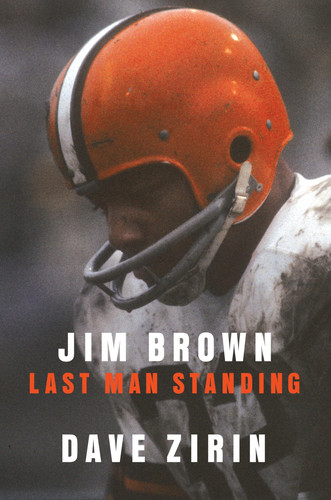
Jim Brown: last man standing

Zirin, Dave
A unique biography of Jim Brown—football legend, Hollywood star, and controversial activist—written by acclaimed sports journalist Dave Zirin. Jim Brown is recognized as perhaps the greatest football player to ever live. But his phenomenal nine-year career with the Cleveland Browns is only part of his remarkable story, the opening salvo to a much more sprawling epic. Brown parlayed his athletic fame into stardom in Hollywood, where it was thought that he could become “the black John Wayne.” He was an outspoken Black Power icon in the 1960s, and he formed Black Economic Unions to challenge racism in the business world. For this and for his decades of work as a truce negotiator with street gangs, Brown—along with such figures as Muhammad Ali, Bill Russell, and Billie Jean King—is revered as a socially conscious athlete. On the most hypermasculine cultural canvases of the United States—NFL football, the Black Power movement, Hollywood's blaxploitation films, gang intervention both inside and outside prison walls—Jim Brown has made his mark. Yet in the landscape of the most toxic expression of “what makes a man”—numerous accusations of violence against women—he has left a jagged mark as well. Dave Zirin's book redefines an American icon, and not always in a flattering light. At eighty-one years old, Brown continues to speak out and look for fights. His recent public support of Donald Trump and criticism of Colin Kaepernick are just the latest examples of someone who seems restless if he is not in conflict. Jim Brown is a raw and thrilling account of Brown's remarkable life and a must-read for sports fans and students of the black freedom struggle.
Blue Rider Press 2018-05-15 320 pages

The system: who rigged it, how we fix it

Reich, Robert B.
"Millions of Americans have lost confidence in our political and economic system. After years of stagnant wages, volatile job markets, and an unwillingness to deal with profound threats such as climate change, there is a mounting sense that the system is fixed, serving only those select few with enough money to secure a controlling stake. With the characteristic clarity and passion that has made him a central civil voice, Robert B. Reich shows how wealth and power have interacted to install an elite oligarchy, eviscerate the middle class, and undermine democracy. Using Jamie Dimon, the chairman and CEO of JPMorgan Chase as an example, Reich exposes how those at the top propagate myths about meritocracy, national competitiveness, corporate social responsibility, and the "free market," to distract most Americans from their accumulation of extraordinary wealth, and power over the system. Instead of answering the call to civic duty, they have chosen to uphold self-serving policies that line their own pockets and benefit their bottom line. Reich's objective is not to foster cynicism, but rather to demystify the system so that we might instill fundamental change and demand that democracy works for the majority once again"--
Alfred A. Knopf 2020-03-24 206 pages

Federal jurisdiction

Chemerinsky, Erwin
A student treatise, by one of the nation's leading authorities in Federal Jurisdiction, intended for use alongside any federal jurisdiction casebook. Features: Comprehensive coverage , with clear descriptions and analyses of the doctrines and policies that determine the jurisdiction of the federal courts Chemerinsky's straightforward approach , in which he clearly states the current law; identifies unresolved issues; and examines underlying, competing policy considerations An even-handed treatment of the material, with multiple viewpoints presented Has been used as the required text in lieu of a traditional casebook, with professors bringing in their own cases New to the Sixth Edition: Updates to include discussions of important developments that occurred after the current edition was published in 2007, among them: Military Commissions Act and Boumediene v. Bush Medellin v. Texas Massachusetts v. EPA, Hein v. Freedom from Religion Foundation, Sprint Communications v. APPC Services, and DaimlerChrysler v. Cuno MedImmune v. Genentech Habeas corpus developments Ashcroft v. Iqbal Stoneridge Investment Partner v. Scientific-Atlanta (implied rights of action)
Wolters Kluwer Law & Business 2012 1132 pages

Roll over Beethoven: the return of cultural strife

Aronowitz, Stanley
Product Description The question of culture has become central for a new generation of scholars raised in a world of television and mass production. At the same time debates about culture have become a point of reference for criticism of current trends in academia and society, variously defended or derided on the grounds of "multiculturalism," "canonicity," and political correctness." In his re-examination off these debates, Stanley Aronowitz traces the history of the cultural issue - in both its British and American manifestations - and relates it to the contemporary rethinking of the nature of knowledge and culture. Roll Over Beethoven analyzes topics as diverse as the history of American radicalism, the sociology if science, the impact of the Library of Congress on the organization of knowledge, and the institutionalization of film studies. Aronowitz's account of recent controversies over "political correctness" reveals that the current culture wars reflect profound differences among scholars over the proper role of the university and the character of legitimate intellectual knowledge. Within this broad reappraisal of the cultural question, which is embedded in the intellectual history of the 20th century, Aronowitz offers an "interpretive genealogy" of cultural studies that describes both the evolution of the field and the political and social contexts in which it developed. He argues that cultural studies exhibit a tendency toward transgression that is rarely explicit but always present and, at its best, not merely interdisciplinary but anti-disciplinary. From Publishers Weekly In this "interpretive genealogy of cultural studies," sociologist Aronowitz ( The Politics of Identity ) offers a history of this field with an eye toward examining how the nature of intellectual knowledge is defined. Though the book meanders from present-day politics to the historical debate over "high" and "low" culture to the role of the New Left in popular culture, Aronowitz's style is fairly accessible. Some arguments are undeveloped, as when he urges the Left to vigorously support the First Amendment but then suggests that "any community has a right to set limits on what it considers acceptable speech." In a chapter on the cultural politics of the Popular Front, Aronowitz offers an engaging memoir of his Bronx boyhood, recalling his rich encounters with classical and popular music and his study of political economy at a Communist Party school; he then analyzes novels and plays of the era, defending them against charges of populist oversimplification. After addressing current debates over the idea of an academic "canon," he notes that "virtually any significant educational innovation already has a history somewhere in the annals of the American academic system." Copyright 1993 Reed Business Information, Inc. From Library Journal Through his books on the labor movement, social theory, education theory, and the politics of science, Aronowitz has become one of the most interesting intellectuals on the contemporary scene. His latest work traces the emergence of "Cultural Studies" and emphasizes its invigorating impact on the humanities and social sciences. Written in an entertaining and informative style, Roll Over Beethoven could become the book that helps introduce large numbers of readers to the exciting new field of cultural interpretation. Individual chapters explore such topics as "high" versus "low" culture, culture and politics in the 1930s, the state of popular culture in contemporary America, and the relationship of cultural studies to the literary and philosophical canon. Along the way, Aronowitz offers a sophisticated critique of the revanchist critics of the modern university (Allan Bloom, William Bennett, et al.). This is a first-rate text that deserves the widest possible readership. - Kent Worcester, Social Science Research Council, New York Copyright 1993 Reed Business Information, Inc.
Wesleyan University Press 1993 277 pages

Siren song: my life in music

Stein, Seymour
Seymour Stein is America's greatest living record man. Not only has he signed and nurtured more important artists than anyone alive, now sixty years in the game, he's still the hippest label head, travelling the globe in search of the next big thing. Since the late fifties, he's been wherever it's happening: Billboard, Tin Pan Alley, The British Invasion, CBGB, Studio 54, Danceteria, the Rock n Roll Hall of Fame, the CD crash. Along that winding path, he discovered and broke out a skyline full of stars: Madonna, The Ramones, Talking Heads, Depeche Mode, The Smiths, The Cure, Ice-T, Lou Reed, Seal, and many others. Brimming with hilarious scenes and character portraits, Siren Song's wider narrative is about modernity in motion, and the slow acceptance of diversity in America - thanks largely to daring pop music. Including both the high and low points in his life, Siren Song touches on everything from his discovery of Madonna to his wife Linda Stein's violent death. Ask anyone in the music business, Seymour Stein is a legend. Sung from the heart, Siren Song will etch his story in stone
St. Martin's Press 2018-06-12 342 pages

Direct from Dell: strategies that revolutionized an industry

Dell, Michael
In 1983, Michael S. Dell, then an incoming freshman at the University of Texas at Austin, drove away from his parents' Houston home in a white BMW he'd bought selling subscriptions to his hometown newspaper. In the backseat were three personal computers. Today, he is the Chairman and Chief Executive Officer of Dell Computer Corporation, an $18 billion company, the second-largest manufacturer and marketer of computers in the world. Founded on a deceptively simple premise--to deliver high-performance computer systems directly to the end user--Dell Computer is the envy of its competition, constantly growing at five times the industry rate, and a perennial darling of Wall Street: its stock is up more than 36,000 percent this decade, and more than 200 percent in the last year. In Direct From Dell, Michael Dell himself tells the incredible story of Dell Computer's successful rise, beginning in his college dorm room with $1,000 in capital. In these pages, you'll see the formation of a great visionary--and a great company. You'll meet the young Dell who, at the tender age of eight, had already begun looking "to eliminate unnecessary steps" and who, as a numbers-loving adolescent, was inspired by a newfound fascination with computers to save his money to buy a coveted Apple II--only to promptly take it apart. You'll encounter a young visionary who, upon witnessing the inefficiencies of an exploding industry, challenged conventional wisdom and set out to do nothing less than beat IBM at its own game. In so doing, Dell forever changed the way things "had always been done" in the computer industry. You'll also see the birth of a Dell hallmark--the direct model--which, in its ability to reach the customer directly, eliminated not only a substantial middleman markup but also the possibility of costly excess inventory, setting the stage for other extraordinary achievements. In an industry notorious for its unreliable service, Dell utilized its direct customer relationships to pioneer the concept of customer "support"--and didn't rest until the caliber of its service was rivaled only by the quality of its products and its speed of delivery. But the story of Dell Computer is no fairy tale. Marked by uncharacteristically rapid growth, the company was faced with challenges that could have threatened its very existence. From forays into retail to under- (and over-) developed product lines, Dell learned some hard lessons along the way--and emerged stronger as a result. The strategies born of those times--unrivaled speed to market; superior customer service; a fierce commitment to producing constantly high-quality custom-made systems--heralded what has perhaps been the company's crowning achievement: an early exploitation of the Internet. One of the first companies to actually make money online, Dell is now selling more than $12 million worth of systems per day over www.dell.com. Not just for CEOs or those in high tech, the strategies revealed in Direct From Dell are invaluable to managers in a broad cross section of industries. From starting a successful business to pioneering computer sales and service over the Internet, Dell shares his perspectives on: Why it's infinitely better for any business starting out to have too little capital, rather than too much How studying your customers--not your competition--will give you a greater competitive edge Why it can be life-threatening to your company to pursue too many good ideas--or to grow too fast Why it's essential to run a P&L on every area of your business Why your people prose a greater threat to the health of your business than your competition does How you can exploit your competition's weakness by exposing its greatest strength How integrating your business virtually can make the difference between being quick--and being dead Revealing nothing less than a new model for doing business in the information age, Direct From Dell is both an extraordinary business success story and a manifesto for revolutionizing any industry.
HarperBusiness 1999-02-17 236 pages

The great risk shift: the new economic insecurity and the decline of the American dream

Hacker, Jacob S.
"On the eve of the financial crisis, Jacob S. Hacker wrote "the policy book of the year" (E.J. Dionne, Jr., Washington Post), demonstrating and explaining the hidden story of growing economic insecurity. In this fully revised and updated second edition, he brings his powerful exposé of "The Great Risk Shift" up to date with startling new evidence and compelling new ideas. Hacker shows that the safety net was unraveling long before the late-2000s, as more and more economic risk shifted from the broad shoulders of government and business onto the fragile backs of American families. Whether the problem is risky jobs brought on by corporate restructuring and the "gig economy" of contingent work, risky families created by the rising costs and instabilities of parenthood, risky retirement caused by the collapse of traditional guaranteed pensions, or risky health care fueled by skyrocketing costs and unstable coverage-Hacker shows what has changed and why, the ways in which ordinary Americans have been affected, and how we can fight back. Behind the risk shift, he contends, is the "Personal Responsibility Crusade" eagerly embraced by corporate leaders and conservative politicians who speak of an economic nirvana in which Americans are free to choose. But the result, Hacker reveals, has been very different: a harsh new world of economic insecurity in which far too many Americans are allowed to fall behind. Blending powerful human stories, big-picture analysis, and compelling ideas for reform, this remarkable volume has become a rallying point in the struggle for economic security in an increasingly uncertain world."--
Oxford University Press 2019 241 pages

All in: how our work-first culture fails Dads, families, and businesses--and how we can fix it together

Levs, Josh
When journalist Josh Levs was denied fair parental leave by his employer after his child was born, he fought back--and won. Since then, he's become an advocate for modern families and working fathers. In All In, he explores the changing face of fatherhood and what it means for our individual lives, families, workplaces, and society. Fatherhood today is far different from previous generations. Stay-at-home dads are increasingly common, and growing numbers of men are working part-time or flextime schedules to spend more time with their children. Even the traditional breadwinner-dad is being transformed. Dads today are more emotionally and physically involved on the home front. They are "all in" and--like mothers--they are struggling with work-life balance and doing it all. Journalist and "dad columnist" Josh Levs explains that despite these unprecedented changes, our laws, corporate policies, and gender-based expectations in the workplace remain rigid. They are preventing both women and men from living out the equality we believe in--and hurting businesses in the process. Women have done a great job of speaking out about this, Levs--whose fight for parental leave made front page news across the country--argues. It's now time for men to join in. Combining Levs' personal experiences with investigative reporting and frank conversations with fathers about everything from work life to money to sex, All In busts popular myths, lays out facts, uncovers the forces holding all of us back, and shows how we can all join together to change them.
HarperOne 2015 261 pages