129 results for "Business History"

The fall of the house of Roosevelt: brokers of ideas and power from FDR to LBJ

Janeway, Michael
In the 1930s a band of smart and able young men, some still in their twenties, helped Franklin D. Roosevelt transform an American nation in crisis. They were the junior officers of the New Deal. Thomas G. Corcoran, Benjamin V. Cohen, William O. Douglas, Abe Fortas, and James Rowe helped FDR build the modern Democratic Party into a progressive coalition whose command over power and ideas during the next three decades seemed politically invincible. This is the first book about this group of Rooseveltians and their linkage to Lyndon Johnson's Great Society and the Vietnam War debacle. Michael Janeway grew up inside this world. His father, Eliot Janeway, business editor of Time and a star writer for Fortune and Life magazines, was part of this circle, strategizing and practicing politics as well as reporting on these men. Drawing on his intimate knowledge of events and previously unavailable private letters and other documents, Janeway crafts a riveting account of the exercise of power during the New Deal and its aftermath. He shows how these men were at the nexus of reform impulses at the electoral level with reform thinking in the social sciences and the law and explains how this potent fusion helped build the contemporary American state. Since that time efforts to reinvent government by "brains trust" have largely failed in the U.S. In the last quarter of the twentieth century American politics ceased to function as a blend of broad coalition building and reform agenda setting, rooted in a consensus of belief in the efficacy of modern government. Can a progressive coalition of ideas and power come together again? The Fall of the House of Roosevelt makes such a prospect both alluring and daunting.
Columbia University Press 2004 284 pages

Movies and money

Puttnam, David
"A fascinating history."-- Time Out New York The acclaimed producer of such classic films as Chariots of Fire and The Killing Fields , and the only European ever to head a major Hollywood studio, former Columbia Pictures chief David Puttnam has written a fascinating behind-the-scenes history of the movie business and of the unique and frequently unholy alliance between commerce and art that underpins it. Puttnam's story moves from the early days of cinema and the rivalry between Edison and the Lumiere brothers, through the rise of the studio system, and up to the present day, with European filmmakers and politicians struggling to protect their industry and even their cultural identity from a triumphant and all-devouring Hollywood. In the process he introduces a host of colorful characters: from Goldwyn and Zanuck to Eisner and Ovitz. Movies and Money is a groundbreaking book that will change our understanding of the movie business. "Excellent.... A book so well written that it can easily be read at a single sitting."-- San Francisco Chronicle and Examiner "Puttnam has a dry sense of humor, and most of his book is jammed with astonishing anecdotes and seething portraits of the personalities of film history."-- Newsday
Knopf 1998 337 pages

The JFK ASSASSINATION DIARY My Search For Answers to the Mystery of the Century

Edward Jay Epstein
One of the most important original documents about the assassination of President John F. Kennedy to be published on the 50th anniversary of the event. The never before published diary of Edward Jay Epstein's investigation into the assassination reveals startling new details. Epstein, one of America's most acclaimed investigative journalists and widely acknowledged as the premier expert on the assassination, while still an undergraduate at Cornell, interviewed the members of the Warren Commission and its staff of investigators, and obtained their key files. He was the only journalist, ever, to have gained this access. His full findings are disclosed here for the first time. In his investigation, Epstein also interviewed the top officials of the CIA, including at length the legendary chief of counter-intelligence James Jesus Angleton. He was the only journalist to interview Yuri Nosenko, the KGB officer who claimed to be Oswald's KGB case officer. Jim Garrison, the New Orleans district attorney, who attempted to reopen the case, confided his methods and sources in Epstein. Epstein was, moreover, the last person to see George De Mohrenschildt, Oswald's mysterious White Russian friend, who he interviewed for hours until the moment when he took his secrets with him in death. The JFK Assassination Diary is the true story at last of the incredible answers Epstein unearthed in pursuit of the greatest crime of the 20th century. Praise for Edward Jay Epstein "A grand figure of modern journalism...Show Epstein a juicy crime and he will show you how it has been subverted by unseen powers for their own agenda, by the inevitable incompetence of investigative authorities and by the media because it likes a simple story line." -Michael Wolff, USA Today "Epstein believes that conspiracies are more common than most journalists credit; for much of his career, he has reveled in the kind of tantalizing clues that could lead somewhere, or nowhere." -Joe Nocera, The New York Times "Epstein is a bulldog researcher." -Jonathan Yardley, The Washington Post "A brilliant investigator." - Lou Dobbs Praise For Agency of Fear "Epstein tells all." -John Leonard, New York Times " Part detective story, part farce, part exposé, and part textbook on investigative reporting. It is ingenious, perverse, hilarious, and shocking." -Victor Navasky "Exciting research, impressive thesis." -Norman Mailer Praise For Legend: The Secret World of Lee Harvey Oswald A fascinating, alarming, and enormously significant book on the mystery of Lee Harvey Oswald-- The New York Times Book Review ABOUT THE AUTHOR Edward Jay Epstein is the author of fifteen books. He studied government at Cornell and Harvard and received a Ph.D from Harvard in 1973. His thesis on the search for political truth became a best-selling book, Inquest: The Warren Commission and the Establishment of Truth. His doctoral dissertation on television news was published as News From Nowhere. He is the recipient of numerous foundation grants and awards, including the prestigious Financial Times/Booz Allen & Hamilton Global Business Book Award for both best biography and best business book for Dossier: The Secret History of Armand Hammer. He has written for Vanity Fair, The New Yorker, The Atlantic, The New York Times Magazine, and the Wall Street Journal. He lives in New York City.
CreateSpace Independent Publishing Platform 2013-09-26 110 pages

The Art of Diplomacy How American Negotiators Reached Historic Agreements that Changed the World

Stuart E. Eizenstat
A riveting retelling of diplomatic history with praise from Bill Clinton, Hillary Clinton, Bertie Ahern (Ireland), Tony Blair (UK), Ehud Olmert (Israel), and more. “A magisterial tome on the international negotiations that shaped modern American history.... Grand in scope and grounded in decades of experience, The Art of Diplomacy is a compelling work of political history aimed at the diplomatic negotiators of tomorrow.” -Foreword Reviews Commended by Kirkus Reviews , which says Eizenstat writes with "authority and clarity of experience." Inside the greatest diplomatic negotiations of the past 50 years In one readable volume, diplomat and negotiator Stuart E. Eizenstat covers every major contemporary international agreement, from the treaty to end the Vietnam War to the Kyoto Protocols and the Iranian Nuclear Accord. Written from the perspective that only a participant in top level negotiations can bring, Eizenstat recounts the events that led up to the negotiation, the drama that took place around the table, and draws lessons from successful and unsuccessful strategies and tactics. Based on interviews with over 60 key figures in American diplomacy, including former presidents and secretaries of state, and major political figures abroad, Eizenstat provides an intimate view of diplomacy as today's history. The Art of Diplomacy will be an indispensable volume to understand American foreign policy and provide invaluable insights on the art of negotiation for anyone involved in government or business negotiations. The paperback edition adds a substantive afterword that presents the challenges and opportunities for the second Trump administration.
Bloomsbury Academic 2026-01-22 544 pages

The audacity of Inez Burns

Bloom, Stephen G.
THE VIVID, SCANDAL-FILLED STORY OF A SHREWD, RAGS-TO-RICHES MILLIONAIRESS AND THE RUTHLESS POLITICIAN WHO PURSUED HER, TOLD AGAINST THE EFFERVESCENT BACKDROP OF AMERICA’S GOLDEN CITY—SAN FRANCISCO. San Francisco, until the mid-1940s, was a city that lived by its own rules, fast and loose. Formed by the gold rush and destroyed by the 1906 earthquake, it served as a pleasure palace for the legions of men who sought their fortunes in the California foothills. For the women who followed, their only choice was to support, serve, or submit. Inez Burns was different. She put everyone to shame with her dazzling, calculated, stone-cold ambition. Born in the slums of San Francisco to a cigar-rolling alcoholic, Inez transformed herself into one of California’s richest women, becoming a notorious powerbroker, grand dame, and iconoclast. A stunning beauty with perfumed charm, she rose from manicurist to murderess to millionaire, seducing one man after another, bearing children out of wedlock, and bribing politicians and cops along the way to secure her place in the San Francisco firmament. Inez ruled with incandescent flair. She owned five hundred hats and a closet full of furs, had two small toes surgically removed to fit into stylish high heels, and had two ribs excised to accentuate her hourglass figure. Her presence was defined by couture dresses from Paris, red-carpet strutting at the San Francisco Opera, and a black Pierce-Arrow that delivered her everywhere. She threw outrageous parties on her sprawling, eight-hundred-acre horse ranch, a compound with servants, cooks, horse groomers, and trainers, where politicians, judges, attorneys, Hollywood moguls, and entertainers gamboled over silver fizzes. Inez was adored by the desperate women who sought her out—and loathed by the power-hungry men who plotted to destroy her. During a time when women risked their lives with predatory practitioners lurking in back alleys, Inez and her team of women, clad in crisp, white nurse’s uniforms, worked night and day in her elegantly appointed clinic, performing fifty thousand of the safest, most hygienic abortions available during a time when even the richest wives, Hollywood stars, and mistresses had few options when they found themselves with an unwanted pregnancy. Inez’s illegal business bestowed upon her power and influence—until a determined politician by the name of Edmund G. (Pat) Brown—the father of current California Governor Jerry Brown—used Inez to catapult his nascent career to national prominence. In The Audacity of Inez Burns , Stephen G. Bloom, the author of the bestselling Postville, reveals a jagged slice of lost American history. From Inez’s riveting tale of glamour and tragedy, he has created a brilliant, compulsively readable portrait of an unforgettable woman during a moment when America’s pendulum swung from compassion to criminality by punishing those who permitted women to control their own destinies.
Regan Arts 2018-02-06 428 pages

Boom Town

Sonia Levitin
Cat Bowman Smith and Sonia Levitin have teamed up again to bring the history of America's westward expansion to life in this fun, colorful picture book. Bored by cabin life in the sparse settlement, Amanada figures out how to bake a gooseberry pie in the family's crude wood stove. Soon prospectors are paying for her pies, and her business success spills over to the other folks who've decided to settle there.
Scholastic 2004-02 40 pages

The pill, pygmy chimps, and Degas' horse: the autobiography of Carl Djerassi

Djerassi, Carl
Father of the birth control pill, developer of antihistamines, founder of biomedical companies, teacher of world-class chemists, best-selling novelist.... As The Scientist notes, "Few can match Carl Djerassi's juggling act for success and longevity". Here is Djerassi's remarkable autobiography. Blending vivid descriptions of the lucrative world of drug development with controversial chapters on the politics of contraception and poignant disclosures about his personal life, this book tells the story of one of the most productive and socially conscious chemists working today. The Pill, Pygmy Chimps, and Degas' Horse tells how Djerassi, while still in his twenties and leading a small team in an obscure laboratory in Mexico City, used a locally grown yam first to synthesize cortisone and then, within twelve months, to create the first steroid effective as a birth control pill. Dubbed for this latter work "the father of the pill", a title he often shares with Gregory Pincus and John Rock, who performed the biological and clinical studies to confirm the pill's efficacy in humans, Djerassi has spent a lifetime thinking and rethinking, discussing and debating, the social, economic, and biological consequences of the changed attitudes toward contraception engendered by the pill. In two riveting chapters entitled "The Pill at Twenty" and "The Pill at Forty: What Now?" Djerassi recounts the fascinating history of the pill's journey from its first days in the laboratory to widespread public use--from being hailed as an agent of the sexual revolution to condemnation as an agent of the new promiscuity, to being accused of being an expression of the scientific community's sexism (Why was there no malebirth control pill?). And then, in a powerful consideration of where the politics of contraception have taken us, he discusses why so few innovations in contraception are being investigated today, and why even fewer are making their way to the public. The Pill, Pygmy Chimps, and Degas' Horse chronicles Djerassi's many successful careers in science, business, the academy, and the arts (he is a published poet and novelist, as well as the founder of an artists' colony). His growing appreciation for the soft side of science--its human and humane aspects--have long been reflected in the courses he teaches at Stanford, in the plot of his novel, Cantor's Dilemma, and in his decision to found one of the first environmentally aware pesticide companies. In this intellectually challenging book, the reader is let into the fertile mind and psyche of one of the few Renaissance men of twentieth-century science.
Basic Books 1992-04-26 319 pages

Affairs of State Public Life in Late Nineteenth-Century America

Morton Keller
This first modern history of American public life after the Civil War is a work of magisterial sweep and sophisticated insight. It will be the standard work on the era for many years to come. Integrating political, legal, and administrative history on a scale not previously attempted, Morton Keller examines crosscurrents in American institutions during a key transitional period in American history—a period that began with the end of a bloody civil war and ended with the beginning of massive industrialization. At the same time, he vividly captures the energy and optimism of a young country about to burst into the twentieth century. Keller begins by reviewing the twin legacies of the Civil War: a strengthened belief in an active national government and a vigorous drive toward civil equality. He moves on to the postwar years when centralizing and reformist tendencies were evident everywhere, not only in the Reconstructed South but also in a renewed North. After the 1880s, however, the pendulum began to swing back, and Americans faced the social and economic upheavals of the last decades of the nineteenth century with deeply divided views—an uncertainty that persists in our own day.
Harvard University Press 1977 640 pages

A Living Wage American Workers and the Making of Consumer Society

Lawrence B. Glickman
The fight for a "living wage" has a long and revealing history as documented here by Lawrence B. Glickman. The labor movement's response to wages shows how American workers negotiated the transition from artisan to consumer, opening up new political possibilities for organized workers and creating contradictions that continue to haunt the labor movement today. Nineteenth-century workers hoped to become self-employed artisans, rather than permanent "wage slaves." After the Civil War, however, unions redefined working-class identity in consumerist terms, and demanded a wage that would reward workers commensurate with their needs as consumers. This consumerist turn in labor ideology also led workers to struggle for shorter hours and union labels. First articulated in the 1870s, the demand for a living wage was voiced increasingly by labor leaders and reformers at the turn of the century. Glickman explores the racial, ethnic, and gender implications, as white male workers defined themselves in contrast to African Americans, women, Asians, and recent European immigrants. He shows how a historical perspective on the concept of a living wage can inform our understanding of current controversies.
Cornell University Press 1999-03-11 240 pages

Trapped The 1909 Cherry Mine Disaster

Karen Tintori
A gripping account of the worst coal mine fire in US history—the 1909 Cherry Mine Disaster that claimed the lives of 259 men. "Drawing on diaries, letters, written accounts of survivors and testimony from the coroner's inquest...Tintori's engaging prose keeps readers on the edge" ( Publishers Weekly ). Inspired by a refrain of her girlhood—"Your grandfather survived the Cherry Mine disaster"—Karen Tintori began a search for her family's role in the harrowing tragedy of 1909. She uncovered the stories of victims, survivors, widows, orphans, townspeople, firefighters, reporters, and mine owners, and wove them together to pen Trapped, a riveting account of the tragic day that would inspire America's first worker's compensation laws and hasten much-needed child labor reform. On a Saturday morning in November of 1909, four hundred and eighty men went down into the mines as they had countless times before. But a fire erupted in the mineshaft that day and soon burned out of control. By nightfall, more than half the men would either be dead or trapped as officials sealed the mine in an attempt to contain the blaze. Miraculously, twenty men would emerge one week later, but not before the Cherry Mine disaster went down in history as the worst ever coal mine fire in the US—and not before all the treachery and heroism of mankind were revealed.
Simon and Schuster 2003-09-17 288 pages

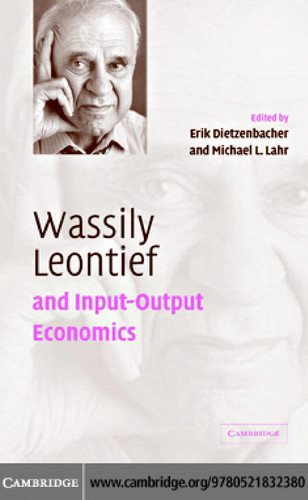
Wassily Leontief and input-output economics

Wassily Leontief,Erik Dietzenbacher,Michael L. Lahr
Wassily Leontief (1905–1999) was the founding father of input-output economics, for which he received the Nobel Prize in 1973. This book offers a collection of papers in memory of Leontief by his students and close colleagues. The first part, 'Reflections on Input-Output Economics', focuses upon Leontief as a person and scholar as well as his personal contributions to economics. It includes contributions by Nobel Laureate Paul A. Samuelson who shares his memories of a young Professor Leontief at Harvard and ends with the last joint interview with Wassily and his wife, to date previously unpublished. The second part, 'Perspectives of Input-Output Economics', includes theoretical and empirical research inspired by Leontief's work and offers a wide-ranging sample of the state of interindustry economics, a field Leontief founded. This is a strong collection likely to appeal to a wide range of professionals in universities, government, industry and international organizations.
Cambridge University Press 2004-03-25 396 pages

Financial innovations and market volatility

Miller, Merton H.
In this book, Nobel Laureate Merton Miller presents a sustained attack on the popular view that modern financial innovations have created excessive market volatility to the detriment of individual savers and business investors, and that regulation is essential in such forms as higher margin requirements, taxes on trading, and perhaps even closing down the future market.
Blackwell 1991-01 288 pages

Makin' toons: inside the most popular animated TV shows and movies

Neuwirth, Allan
From the first drawing board sketch to wriggling TV character, Makin’ Toons illustrates the thrills and challenges of making animated cartoon movies as told by the industry’s most successful creators. Cartoon lovers everywhere will be treated to 47 personal interviews with animation artists and industry leaders ranging from Shrek director Andrew Adamson to Rugrats producer Gabor Csupo. These and dozens of other fascinating firsthand accounts chronicle the behind-the-scene antics and commercial dynamics behind such blockbusters as The Simpsons, South Park, Beauty and the Beast, and Dragon Tales, to name just a few. Author Allan Neuwirth—an accomplished animation artist and writer himself—spices the book with insightful comments, hilarious anecdotes, and a true “toon artist’s” sense of humor. He also includes 75 never-before-published concept drawings, character designs, storyboards, and much more. Allworth Press, an imprint of Skyhorse Publishing, publishes a broad range of books on the visual and performing arts, with emphasis on the business of art. Our titles cover subjects such as graphic design, theater, branding, fine art, photography, interior design, writing, acting, film, how to start careers, business and legal forms, business practices, and more. While we don't aspire to publish a New York Times bestseller or a national bestseller, we are deeply committed to quality books that help creative professionals succeed and thrive. We often publish in areas overlooked by other publishers and welcome the author whose expertise can help our audience of readers.
Allworth Press 2003-04-01 272 pages

The Making of Global Capitalism The Political Economy of American Empire

Sam Gindin,Leo Panitch
The all-encompassing embrace of world capitalism at the beginning of the twenty-first century was generally attributed to the superiority of competitive markets. Globalization had appeared to be the natural outcome of this unstoppable process. But today, with global markets roiling and increasingly reliant on state intervention to stay afloat, it has become clear that markets and states aren’t straightforwardly opposing forces. In this groundbreaking work, Leo Panitch and Sam Gindin demonstrate the intimate relationship between modern capitalism and the American state, including its role as an “informal empire” promoting free trade and capital movements. Through a powerful historical survey, they show how the US has superintended the restructuring of other states in favor of competitive markets and coordinated the management of increasingly frequent financial crises. The Making of Global Capitalism , through its highly original analysis of the first great economic crisis of the twenty-first century, identifies the centrality of the social conflicts that occur within states rather than between them. These emerging fault lines hold out the possibility of new political movements transforming nation states and transcending global markets.
Verso Books 2025-08-05 480 pages

Missing man: the American spy who vanished in Iran

Meier, Barry
A real-life thriller about a CIA contractor who vanished in Iran and the international manhunt to find him In late 2013, Americans were shocked to learn that a former FBI agent turned private investigator who disappeared in Iran in 2007 was there on a mission for the CIA. The missing man, Robert Levinson, appeared in pictures dressed like a Guantánamo prisoner and pleaded in a video for help from the United States. Barry Meier, an award-winning investigative reporter for The New York Times , draws on years of interviews and never-before-disclosed CIA files to weave together a riveting narrative of the ex-agent’s journey to Iran and the hunt to rescue him. The result is an extraordinary tale about the shadowlands between crime, business, espionage, and the law, where secrets are currency and betrayal is commonplace. Its colorful cast includes CIA operatives, Russian oligarchs, arms dealers, White House officials, gangsters, private eyes, FBI agents, journalists, and a fugitive American terrorist and assassin. Missing Man is a fast-paced story that moves through exotic locales and is set against the backdrop of the twilight war between the United States and Iran, one in which hostages are used as political pawns. Filled with stunning revelations, it chronicles a family’s ongoing search for answers and one man’s desperate struggle to keep his hand in the game.
Farrar, Straus and Giroux 2018-02-20 279 pages

Capital and credit in British overseas trade: the view from the Chesapeake, 1700-1776

Price, Jacob M.
In a model study Jacob Price illuminates the dynamic growth of Britain’s foreign trade in the eighteenth century through an investigation of the investment patterns and credit institutions that financed that expansion. Concentrating on the trade between Britain and the Chesapeake tobacco colonies of Virginia and Maryland, for which a unique set of records exists, Price surveys the ways in which commerce developed and working capital was mobilized in Britain to support expanding overseas trade. Price develops the clearest picture ever of the financial environment within Britain as it affected Southern colonies in the preindustrial age. He does so by determining the kind of capital resources merchants in foreign trade actually commanded and measuring how much of their own wealth merchants brought to trade. In great and absorbing detail he discusses also the development of merchant-oriented banks in London and other ports, reinvestment of profits, long-term borrowing on bond, and the long-term credit provided to export merchants by wholesalers in textiles, ironmongery, and other industries. The relationship of debt to the coming of the American Revolution is also treated. Tobacco growers suffered more than others from a psychological unease caused by immense debt and were more revolutionary than farmers with less intensive capital needs and, hence, with lighter debt. This history will enlighten Anglo-American historians, economic historians, and historians of the American revolutionary era.
Harvard University Press 1980-12-02 233 pages

Republic of denial: press, politics, and public life

Janeway, Michael
This thought-provoking book offers the most insightful critique of the relationship among the press, politics, and public life in decades. Disdain for politics today in the United States is almost universal. Condemnation of the press is rampant as well. Until we understand the modern condition of politics and journalism--and the cultural context in which they interact--says Michael Janeway, there's small hope of either recovering its standing. Drawing on years of experience at the top levels of the news business and in politics and government, Janeway provides an integrated, insider's critique of the profound changes in each of these professional worlds, showing how trends in each have contributed to deepening public alienation. From its confident post-World War Two era of world leadership, the United States entered a difficult period of turbulence and reversals in the 1960s and 1970s. With wit, clarity, and an eye for offbeat cultural indicators, Janeway examines the full complex of forces that have corroded our press, politics, and public life since then. The result, he argues, is a loss of substance and structure in public life as well as citizen connection to it, a vacuum all too easily filled by political entertainers, shallow coverage of "character," and--engulfing the nation in convulsive crisis for a year of its history--the politics of scandal. None of today's proposed remedies for the failings of our press or politcal system is adequate, Janeway argues, for none take full account of the integral relationship between the two spheres. In the absence of recognition of its buried democratic crisis, Janeway concludes, the United States has become a "republic of denial."
Yale University Press 2001 192 pages