328 results for "Classics"

Imaginary Magnitude

Stanisław Lem
These wickedly authentic introductions to twenty-first-century books preface tomes on teaching English to bacteria, using animated X-rays to create "pornograms," and analyzing computer-generated literature through the science of "bitistics." "Lem, a science fiction Bach, plays in this book a googleplex of variations on his basic themes" (New York Times Book Review). Translated by Marc E. Heine. A Helen and Kurt Wolff Book
Harcourt Brace Jovanovich 1985 264 pages

Battle Cry

Leon Uris
Battle Cry is the riveting Marine epic by the bestselling author of such classics as Trinity and Exodus Originally published in 1953, Leon Uris's Battle Cry is the raw and exciting story of men at war from a legendary American author. This is the story of enlisted men--Marines at the beginning of World War II. They are a rough-and-ready tangle of guys from America's cities and farms and reservations. Led by a tough veteran sergeant, these soldiers band together to emerge as part of one of the most elite fighting forces in the world. With staggering realism and detail we follow them into intense battles--Guadalcanal and Tarawa--and through exceptional moments of camaraderie and bravery, Battle Cry does not extol the glories of war, but proves itself to be one of the greatest war stories of all time.
Blackstone Publishing 2022-11-22 712 pages

Miss Lonelyhearts

NATHANAEL. WEST
Miss Lonelyhearts is Nathanael West's second novel. He began writing it early in 1930 and completed the manuscript in November of 1932. Published in 1933, it is an Expressionist black comedy set in New York City during the Great Depression. In the story, Miss Lonelyhearts is an unnamed male newspaper columnist writing an advice column for the lovelorn and lonesome, a duty that the other newspaper staff considers a joke. As Miss Lonelyhearts reads letters from desperate New Yorkers, he feels terribly burdened and falls into a cycle of deep depression, accompanied by heavy drinking and occasional bar fights. He is also the victim of the pranks and cynical advice of Shrike, his feature editor at the newspaper. Miss Lonelyhearts tries several approaches to escape the terribly painful letters he has to read: religion, trips to the countryside with his fiancée Betty, and affairs with Shrike's wife and Mrs. Doyle, a reader of his column. However, Miss Lonelyheart's efforts do not seem to ameliorate his situation. After his sexual encounter with Mrs. Doyle, he meets her husband, a poor crippled man. The Doyles invite Miss Lonelyhearts to have dinner with them. When he arrives, Mrs. Doyle tries to seduce him again, but he responds by beating her. Mrs. Doyle tells her husband that Miss Lonelyhearts tried to rape her. In the last scene, Mr. Doyle hides a gun inside a rolled newspaper and decides to take revenge on Miss Lonelyhearts. Lonelyhearts, who has just experienced a religious enlightenment after three days of sickness, runs toward Mr. Doyle to embrace him. The gun "explodes", and the two men roll down a flight of stairs together. The general tone of the novel is one of extreme disillusionment with Depression-era American society, a consistent theme throughout West's novels. However, the novel is a black comedy, characterized by a dark sense of humor and irony. Justus Neiland, among others, has pointed out the use of Bergsonian laughter, in which "the attitudes, gestures, and movements of the human body are laughable in exact proportion as that body reminds us of a machine." The novel can be read through a Marxist lens as a condemnation of alienation and the colonization of social life by commodification, foreshadowing the stance of the Situationists and Guy Debord in particular. Miss Lonelyhearts is unable to fulfill his role as advice giver in a world in which both people and advice (in the form of newspaper ads, for example) are mass-produced. People are machines for the sole purpose of laboring as far as the rest of society is concerned (thus Miss Lonelyhearts' name), and any advice for them is as mass-produced as a manual for a machine. Lonelyhearts is unable to find a personal solution to his problems because they have systemic causes. West, who worked in the newspaper business before writing Miss Lonelyhearts, is also an advice giver of a sort as a novelist. Miss Lonelyhearts is similar to a détournement because it uses a form to critique the same form. The novel also condemns itself by condemning art, which is repeatedly derided by Shrike and compared to religion as an opiate of the masses. Many of the problems described in Miss Lonelyhearts describe actual economic conditions in New York City during the Great Depression, although the novel carefully avoids questions of national politics. Moreover, the novel is particularly important due to its existential import. The characters seem to be living in an amoral world. Hence, they resort to heavy drinking, sex, and parties. Miss Lonelyhearts has a "Christ complex", which stands for his belief in religion as a solution to a world devoid of values. (wikipedia.org)
Bibliotech Press 2025-03-08 94 pages

The war of the roses

Adler, Warren
"Jonathan and Barbara Rose are the perfect couple, living the dream in their beautiful house, filled with their precious antiques, their darling children, and their prized Ferrari in the garage. It's all any red-blooded American could possibly want. But when Jonathan experiences a sudden heart attack (or so he thinks) Barbara realizes that she wants a new life, without him. There's just one problem: they both want the house. For husband and wife, it's not just a residence: it's a passion, one that will escalate an ugly divorce into a full-blown battlefield, complete with weapons and casualties. In this viciously black comedy, the Roses will each do whatever they can to destroy their better half--no matter the cost to themselves..." -- Provided by publisher.
Zando 2025-07-22 245 pages

Seize the Day

Saul Bellow
Fading charmer Tommy Wilhelm has reached his day of reckoning and is scared. In his forties, he still retains a boyish impetuousness that has brought him to the brink of chaos: He is separated from his wife and children, at odds with his vain, successful father, failed in his acting career (a Hollywood agent once cast him as the "type that loses the girl"), and in a financial mess. In the course of one climactic day he reviews his past mistakes and spiritual malaise, until a mysterious, philosophizing con man grants him a glorious, illuminating moment of truth and understanding, and offers him one last hope... Book jacket.
Viking Press 1956-11-15 118 pages

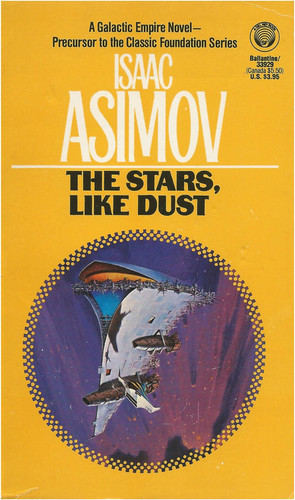
The Stars, Like Dust

Isaac Asimov
The first book in the Galactic Empire series, the spectacular precursor to the classic Foundation series, by one of history's most influential writers of science fiction, Isaac Asimov His name was Biron Farrill and he was a student at the University of Earth. A native of one of the helpless Nebular Kingdoms, he saw his home world conquered and controlled by the planet Tyrann--a ruthless, barbaric Empire that was building a dynasty of cruelty and domination among the stars. Farrill's own father had been executed for trying to resist the Tyrann dictatorship and now someone was trying to kill Biron. But why? His only hope for survival lay in fleeing Earth and joining the rebellion that was rumored to be forming somewhere in the Kingdoms. But once he cast his lot with the freedom fighters, he would find himself guarding against treachery on every side and facing the most difficult choice of all: to betray either the woman he loved or the revolution that was the last hope for the future.
Ballantine books 1986 231 pages

A Hunger Artist

Kafka, Franz
Written during Kafka's final years as he battled tuberculosis, A Hunger Artist was the last work he personally prepared for publication before his death in 1924. The story appeared first in Die Neue Rundschau before being published as part of a collection by Verlag Die Schmiede. Max Brod recounted that Kafka revised the text extensively while staying at the Kierling sanatorium near Vienna, perhaps seeing parallels between the artist's physical withering and his own condition. The story chronicles the decline of a professional faster whose art form - public starvation displays - falls out of fashion with changing times. Set against the backdrop of Europe's post-war transformation, the text captures the death of old cultural forms and the public's shifting appetites for entertainment. The hunger artist's insistence on fasting beyond forty days - the maximum his impresario allows - points to the gap between artistic purity and commercial demands. His body becomes a battlefield where artistic integrity clashes with market forces, while his cage in the circus suggests how art gets relegated to sideshows in an age of mass entertainment. The hunger artist's final confession - that he fasted simply because he could never find food he liked - strips away the spiritual and artistic pretensions surrounding his performance. This revelation transforms the story from allegory about artistic sacrifice into something more ambiguous and personally haunting. The text resonates with Kafka's own complicated relationship to food, his sense of alienation from Prague's literary culture, and his struggles with tuberculosis that made eating difficult in his final years. When circus workers clear away the hunger artist's body like so much straw, replacing him with a young panther full of vital energy, the story delivers its sharpest bite - showing how quickly culture discards what it once celebrated, how thoroughly new forms devour the old. This modern translation from the original German is a fresh, accessible and beautifully rendered text that brings to life Kafka's great literary work. This edition contains extra amplifying material including an illuminating afterword, a timeline of Kafka's life and works alongside of the historical events which shaped his art, and a short biography, to place this work in its socio-historical context.
Independently published 2025-01-20 103 pages

The Collected Novels of Franz Kafka

Franz Kafka
The Collected Novels of Franz Kafka: (The Trial; The Castle; America)638 pp. Epilogue by Max Brod. "In his novels Kafka evokes a nightmare world of enigmatic realities and intangible truths. The hero, or anti-hero, of both The Trial and The Castle is a man named K.--a lonely, perplexed individual, riddled with inexplicable guilt. In The Trial K. is arrested. He doesn't know why. Yet he is pulled, slowly and desperately, into the wayward processes of the law. The same (or a different?) K. in The Castle is a land surveyor, uncannily attracted to yet repelled by a strange, forbidding castle-like structure. America lies within a more traditional novelistic framework; however, a similar atmosphere pervades this work, and reality assumes a certain menace, both alient yet terrifyingly recognizable."Keyword: FRANZ KAFKA NOVELS LITERATURE TRIAL CASTLE AMERICA
Penguin 1988 638 pages

A Country Doctor

Franz Kafka
About the Book "A Country Doctor" (German: "Ein Landarzt") is a short story written in 1919 by Franz Kafka. It was first published in the collection of short stories of the same title. The plot follows a country doctor's hapless struggle to attend a sick young boy on a cold winter's night. A series of surreal events occur in the process, including the appearance of a mysterious groom in a pig shed. -Wikipedia For more eBooks visit www.kartindo.com
CreateSpace Independent Publishing Platform 2013-12-17 26 pages

Armageddon: a novel of Berlin

Uris, Leon
Meticulously researched, this New York Times bestselling novel gives a historically accurate account of the early days of the Cold War and the fight for German redemption. At the end of World War II, American army officer Captain Sean O'Sullivan is commissioned with rebuilding Berlin. Reeling from the death of his brothers at German hands and faced with the direct horrors of the Holocaust, O'Sullivan struggles against his animosity toward the nation he is helping restore. Meanwhile, Soviet forces blockade Germany in a bid for power, and the Western Allies must unite to prevent a communist takeover. When the airlift begins, the Allies find their deepest convictions tested as they fight against a threat even more dangerous than Hitler.
Blackstone Publishing 2022-10-25 898 pages

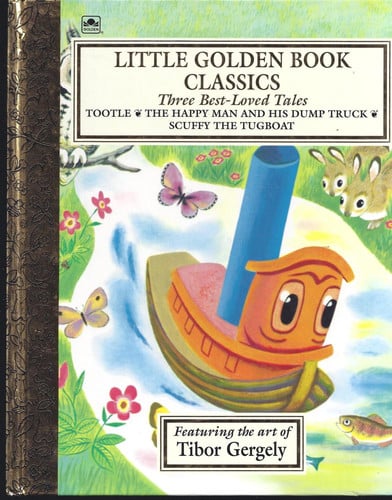
Three Best-Loved Tales Tootle; The Happy Man and His Dump Truck; Scuffy the Tugboat

Gergely, Tibor
Tootle, the baby locomotive, goes to the village of Lower Trainswitch to learn how to become a working locomotive. A man with a dump truck takes all of his friends for a ride and lets them use his dumper for a slide. Tuffy sails down a stream, into the river, and finally into the ocean, where he is rescued by the man with polka-dot tie.
Random House Children's Books 1992-07 80 pages

Swann in Love

Marcel Proust
Swann in Love , a book within a book contained within the first volume, Swann's Way , of Marcel Proust's In Search of Lost Time , is an excellent entry point into the author's work and a compelling standalone novel. In its pages, the portrait of a stormy love affair between the courtesan Odette de Crécy and upper-class socialite Charles Swann serves as a springboard for the author's meditations on love and jealousy Swann's Way : https://www.amazon.com/dp/1520135157 We once dreamt of possessing the heart of our beloved; later, the feeling that we already possess a certain woman's heart could be all we need so that we fall in love. So at an age where it would seem that a woman's beauty and how it aligns with our tastes would play a larger role than ever, a love can be born, a love of the most physical kind even, without there having been any initial foundation of desire. At this stage in our life, we have already been touched by love more than once, it no longer evolves on its own, following its unknown, fatal laws before our passive and astonished hearts. We come to its aid; calling on our memories, yielding to suggestion, we act it out. In recognizing one of its symptoms, we recall, we recreate the others. As we possess its song, engraved on our heart in its entirety, we need only for a woman to provide the opening strands, filled with the admiration we feel at recognizing another's beauty, and we know what comes next. And if she starts in the middle, at the part where our two hearts come together, where we talk of existing each only for the other, we know this tune well enough that we can at once join our partner in the passage where she awaits us.
Independently Published 2017-04-03 190 pages

The Angry Hills

Leon Uris
From the #1 New York Times bestselling author of Trinity, Topaz, and Exodus, comes a classic World War II thriller of Greek resistance during the German infiltration of Athens--based on the diaries of Leon Uris's uncle. Just as World War II threatens to break out, Mike Morrison arrives in Greece to collect his late wife's inheritance. Hoping to quickly finish his business and leave before German troops invade, Morrison's plans are derailed when he receives a letter listing the names of Greek patriots pretending to be German collaborators, a list Nazi strategists desperately need. With the outcome of the war hinging on Morrison's ability to protect the letter, he embarks on an adventure across Greece in an effort to evade Nazi troops and keep the letter from falling into enemy hands.
Blackstone Publishing 2022-10-25 376 pages