833 results for "Environment"

The age of sustainable development

Sachs, Jeffrey
"Jeffrey D. Sachs is one of the world's most perceptive and original analysts of global development. In this major new work he presents a compelling and practical framework for how global citizens can use a holistic way forward to address the seemingly intractable worldwide problems of persistent extreme poverty, environmental degradation, and political-economic injustice: sustainable development. Sachs offers readers, students, activists, environmentalists, and policy makers the tools, metrics, and practical pathways they need to achieve Sustainable Development Goals. Far more than a rhetorical exercise, this book is designed to inform, inspire, and spur action. Based on Sachs's twelve years as director of the Earth Institute at Columbia University, his thirteen years advising the United Nations secretary-general on the Millennium Development Goals, and his recent presentation of these ideas in a popular online course, The Age of Sustainable Development is a landmark publication and clarion call for all who care about our planet and global justice"--Provided by publisher.
Columbia University Press 2015-03-10 543 pages

Earth: evolution of a habitable world

Lunine, Jonathan Irving
Fully updated throughout, including revised illustrations and new images from NASA missions, this new edition provides an overview of Earth's history from a planetary science perspective for Earth science undergraduates. Earth's evolution is described in the context of what we know about other planets and the cosmos at large, from the origin of the cosmos to the processes that shape planetary environments and from the origins of life to the inner workings of cells. Astronomy, earth science, planetary science and astrobiology are integrated to give students the whole picture of how the Earth has come to its present state and an understanding of the relationship between key ideas in different fields. The book presents concepts in nontechnical language and mathematical treatments are avoided where possible. New end-of-chapter summaries and questions allow students to check their understanding and critical thinking is emphasized to encourage students to explore ideas scientifically for themselves.
Cambridge University Press 2013-04-08 318 pages

Unfathomable city, a New Orleans atlas

Solnit, Rebecca,Snedeker, Rebecca
"Like the bestselling Infinite City: A San Francisco Atlas, this book is a brilliant reinvention of the traditional atlas, one that provides a vivid, complex look at the multi-faceted nature of New Orleans, a city replete with contradictions. More than twenty essays assemble a chorus of vibrant voices, including geographers, scholars of sugar and bananas, the city's remarkable musicians, prison activists, environmentalists, Arab and Native voices, and local experts, as well as the coauthors' compelling contributions. Featuring 22 full-color two-page-spread maps, Unfathomable City plumbs the depths of this major tourist destination, pivotal scene of American history and culture and, most recently, site of monumental disasters such as Hurricane Katrina and the BP oil spill. The innovative maps' precision and specificity shift our notions of the Mississippi, the Caribbean, Mardi Gras, jazz, soils and trees, generational roots, and many other subjects, and expand our ideas of how any city is imagined and experienced. Together with the inspired texts, they show New Orleans as both an imperiled city-by erosion, crime, corruption, and sea level rise-and an ageless city that lives in music as a form of cultural resistance. Compact, lively, and completely original, Unfathomable City takes readers on a tour that will forever change the way they think about place. "--
University of California Press 2013 166 pages

Moral compass: a novel

Steel, Danielle
"Saint Ambrose Prep is a place where the wealthy send their children for the best possible education, with teachers and administrators from the Ivy League, and graduates who become future lawyers, politicians, filmmakers, and CEOs. Traditionally a boys-only school, Saint Ambrose has just enrolled one hundred and forty female students for the first time. Even though most of the kids on the campus have all the privilege in the world, some are struggling, wounded by their parents' bitter divorces, dealing with insecurity and loneliness. In such a heightened environment, even the smallest spark can become a raging fire. One day after the school's annual Halloween event, a student lies in the hospital, her system poisoned by dangerous levels of alcohol. Everyone in this sheltered community--parents, teachers, students, police, and the media--are left trying to figure out what actually happened. Only the handful of students who were there when she was attacked truly know the answers and they have vowed to keep one another's secrets. As details from the evening emerge, powerful families are forced to hire attorneys and less powerful families watch helplessly. Parents' marriages are jeopardized, and students' futures are impacted. No one at Saint Ambrose can escape the fallout of a life-altering event. In this compelling novel, Danielle Steel illuminates the dark side of one drunken night, with its tragic consequences, from every possible point of view. As the drama unfolds, the characters will reach a crossroads where they must choose between truth and lies, between what is easy and what is right, and find the moral compass they will need for the rest of their lives"--
Delacorte Press 2020 275 pages

Equoid A Laundry Files Novella

Charles Stross
For Bob Howard, a working day tends to alternate between desperately trying not to fall asleep in committee meetings and being menaced by tentacular horrors from beyond spacetime. That's because Bob works for the Laundry, the secret British government agency tasked with protecting the realm from occult nightmares. So when his manager Iris sends him off to the countryside to liaise with a veterinary inspector from the Department of the Environment, Fisheries, and rural Affairs, at first he takes it as a pleasant vacation. But why is Edgebaston Farm's livery stable buying a hundred kilos of raw meat per day? Why does his briefing file contain the death-bed confession of that old fraud, H. P. Lovecraft? And why is his contact from DEFRA so deathly afraid of unicorns
Subterranean Press 2014 109 pages

Recognition and treatment of psychiatric disorders: a psychopharmacology handbook for primary care

Nemeroff, Charles B.
Mental health is an important public health issue. National survey data indicate that 48% of the U.S. adult population have reported a psychiatric disorder at some point in their lives and 30% have reported one in the past 12 months. With the changing healthcare environment, 60% of these patients are identified and receive treatment in the primary care setting. Recognition and Treatment of Psychiatric Disorders: A Psychopharmacology Handbook for Primary Care • developed to provide the busy primary care physician with practical and timely strategies for screening and treating patients who have psychiatric disorders. It covers• The continually growing number of drugs available for treatment of mental disorders.• An overview of the epidemiology, pathophysiology, presentation, diagnostic criteria, and screening tests for common psychiatric disorders including anxiety disorders, mood disorders, insomnia, somatization disorder, substance use disorder, eating disorders, dementia, and schizophrenia• Treatment algorithms and other step-by-step approaches to direct the physician who is treating patients with mental disorders including drug dosages, schedules, and routes of administration• Basic pharmacology, pharmacokinetics, drug interaction and safety concerns, and practical dosing issues for all classes of drugs used to treat mental disorders• Guidelines for primary care physicians on when to refer patients to psychiatrist colleagues This handbook is the quintessential resource for primary care physicians needing to screen and treat patients with mental disorders. Brief, but informative, this resource includes a glossary, a listing of printed and electronic mental health resources, a bibliography, and an appendix containing selected diagnostic rating scales.
American Psychiatric Press 1999 269 pages

Building the New American Economy Smart, Fair, and Sustainable

Jeffrey D. Sachs
In this passionate and powerful book--part manifesto, part plan of action--the renowned economist Jeffrey D. Sachs offers a practical strategy to move America, seemingly more divided than ever, toward a new consensus: sustainable development. Sustainable development is a holistic approach that emphasizes economic, social, and environmental objectives in shaping policy. In focusing too much on economic growth, the United States has neglected rising economic inequality and dire environmental threats. Now, even growth is imperiled. Sachs explores issues that have captivated the nation and political debate, including infrastructure, trade deals, energy policy, the proper size and role of government, the national debt, and income inequality. Not only does he provide illuminating and accessible explanations of the forces at work in each case, but he also presents specific policy solutions. His argument rises above the pessimism born of political paralysis, economic stagnation, and partisanship to devise a brighter way forward, achievable both individually and collectively. In Building the New American Economy , Sachs shows how the United States can find a path to renewed economic progress that is fair and environmentally sustainable.
Columbia University Press 2018-03-20 130 pages

How class works: power and social movement

Aronowitz, Stanley
Americans like to believe that they live in a classless society. Most Americans defiantly identify themselves as middle class, although economic inequality is greater in the United States than in most advanced Western nations. Offering an important revision of conventional wisdom, Stanley Aronowitz demonstrates that class remains a potent force in the United States. Aronowitz shows that class need not be understood simply in terms of socioeconomic stratification, but rather as the power of social groups to make a difference. Aronowitz explains that social groups from different economic and political positions become ruling classes when they make demands that change the course of history. For instance, labor movements, environmental activists, and feminists have engaged in class struggles as their demands for power reconfigured the social order. The emerging global justice movements--comprised of activists from heterogeneous social and political backgrounds--also show potential for class formation. Written by a prominent scholar and social activist, this book offers a stunning reconceptualization of the meaning and significance of class in modern America.
Yale University Press 2003 263 pages

Lyndon B. Johnson Portrait of a President

Robert Dallek
Robert Dallek's brilliant two-volume biography of Lyndon Johnson has received an avalanche of praise. Michael Beschloss, in The Los Angeles Times, said that it "succeeds brilliantly." The New York Times called it "rock solid" and The Washington Post hailed it as "invaluable." And Sidney Blumenthal in The Boston Globe wrote that it was "dense with astonishing incidents." Now Dallek has condensed his two-volume masterpiece into what is surely the finest one-volume biography of Johnson available. Based on years of research in over 450 manuscript collections and oral histories, as well as numerous personal interviews, this biography follows Johnson, the "human dynamo," from the Texas hill country to the White House. We see LBJ, in the House and the Senate, whirl his way through sixteen- and eighteen-hour days, talking, urging, demanding, reaching for influence and power, in an uncommonly successful congressional career. Then, in the White House, we see Johnson as the visionary leader who worked his will on Congress like no president before or since, enacting a range of crucial legislation, from Medicare and environmental protection to the most significant advances in civil rights for black Americans ever achieved. And we see the depth of Johnson's private anguish as he became increasingly ensnared in Vietnam. In these pages Johnson emerges as a man of towering intensity and anguished insecurity, of grandiose ambition and grave self-doubt, a man who was brilliant, crude, intimidating, compassionate, overbearing, driven: "A tornado in pants." Gracefully written and delicately balanced, this singular biography reveals both the greatness and the tangled complexities of one of the most extravagant characters ever to step onto the presidential stage.
Oxford University Press 2005 396 pages

The beginning comes after the end: notes on a world of change

Solnit, Rebecca
"Rebecca Solnit offers a thrilling account of the sheer breadth and scale of social, political, scientific, and cultural change over the past three quarters of a century. In this sequel to her enduring bestseller Hope in the Dark, Solnit surveys a world that has changed dramatically since the year 1960. Despite the forces seeking to turn back the clock on history, change is not a possibility; it is an inevitability. The changes amount to nothing less than dismantling an old civilization and building a new one, whose newness is often the return of the old ways and wisdoms. In this rising worldview, interconnection is a core idea and value. But because the transformation is obscured within a longer arc of history, its scale is seldom recognized. While the white nationalist and authoritarian backlash drives individualism and isolation, this new world embraces antiracism, feminism, a more expansive understanding of gender, environmental thinking, scientific breakthroughs, and Indigenous and non-Western ideas, pointing toward a more interconnected, relational world." -- Provided by publisher
Haymarket Books 2026-04-21 147 pages

Survival of the richest: escape fantasies of the tech billionaires

Rushkoff, Douglas
"The tech elite have a plan to survive the apocalypse: they want to leave us all behind. Five mysterious billionaires summoned theorist Douglas Rushkoff to a desert resort for a private talk. The topic? How to survive the "Event": the societal catastrophe they know is coming. Rushkoff came to understand that these men were under the influence of The Mindset, a Silicon Valley-style certainty that they and their cohort can break the laws of physics, economics, and morality to escape a disaster of their own making-as long as they have enough money and the right technology. In Survival of the Richest, Rushkoff traces the origins of The Mindset in science and technology through its current expression in missions to Mars, island bunkers, AI futurism, and the metaverse. In a dozen urgent, electrifying chapters, he confronts tech utopianism, the datafication of all human interaction, and the exploitation of that data by corporations. Through fascinating characters-master programmers who want to remake the world from scratch as if redesigning a video game and bankers who return from Burning Man convinced that incentivized capitalism is the solution to environmental disasters-Rushkoff explains why those with the most power to change our current trajectory have no interest in doing so. And he shows how recent forms of anti-mainstream rebellion-QAnon, for example, or meme stocks-reinforce the same destructive order. This mind-blowing work of social analysis shows us how to transcend the landscape The Mindset created-a world alive with algorithms and intelligences actively rewarding our most selfish tendencies-and rediscover community, mutual aid, and human interdependency. In a thundering conclusion, Survival of the Richest argues that the only way to survive the coming catastrophe is to ensure it doesn't happen in the first place"--
W.W. Norton & Company, Inc 2022-09-06 212 pages

The face on your plate: the truth about food

Masson, J. Moussaieff
This revelatory work brings together author Masson's intellectual, psychological, and emotional expertise over the last twenty years into the pivotal book of the food revolution. Masson shows how food affects our moral selves, our health, and the environment. He raises questions to make us conscious of the decisions behind every bite we take: What effect does eating animals have on our land, waters, even global warming? What are the results of farming practices--such as debeaking chickens and separating calves from their mothers--on animals and humans? How does the health of animals affect the health of our planet and our bodies? And uniquely, as a psychoanalyst, Masson investigates how denial keeps us from recognizing the animal at the end of our fork--think pig, not bacon--and how each culture distinguishes which animals are food and which are forbidden.--From publisher description.
W.W. Norton & Co 2009 288 pages

When smoke ran like water: tales of environmental deception and the battle against pollution

Davis, Devra Lee
This text shows that we have the scientific tools to reveal the connection between environment and disease in a way never before possible, and even to predict which chemicals pose the greatest risk. We no longer need to wait for actual human harm as the only proof of harmfulness. Davis describes how the science of environmental epidemiology arose and how environmental toxins affect a broad spectrum of human health, including breast cancer, the health and development of the lungs and even male reproductive capacity. The book shows readers the full picture of how the environment is affecting their health, what they can do about it and why standard approaches to public health need to change.
Perseus 2002-12-05 256 pages

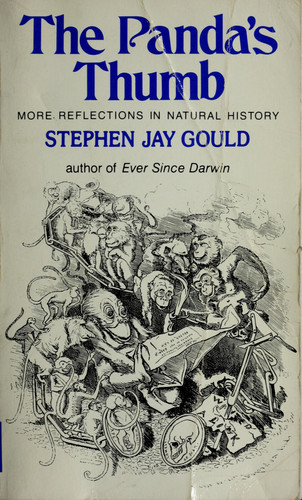
The panda's thumb: more reflections in natural history

Gould, Stephen Jay
A collection of essays by reknown scientist Jay Stephen Gould drawn from his columns in Natural History. The essays deal with topics such as: evolutionary opportunism (nature is a tinkerer, making the most of what's available in the course of adapting to the environment); new information on Darwin and his contemporaries; racism and cultural relativism; the evolutionary pattern of sudden rapid change; the origin of birds or the warm-bloodedness of dinosaurs; and, Teilhard de Chardin as a co-conspirator in the Piltdown hoax.
Norton 1980 343 pages

The distance learning playbook for parents: how to support your child's academic, social, and emotional development in any setting

Wiseman, Rosalind,Fisher, Douglas,Frey, Nancy,Hattie, John
"Parents are, and will always be, their child's best teacher. Helping your child get the best possible education is every parent's goal. While parent involvement has always been a vital part of a child's education, the pandemic and resulting remote instruction call for parents and educators to partner at an even deeper level. Following the success of Douglas Fisher, Nancy Frey, and John Hattie's The Distance Learning Playbook for Grades K-12, these renowned educators teamed up with New York Times bestselling author and parenting expert Rosalind Wiseman to bring you the consummate guide to supporting your child's academic, social, and emotional development in any learning environment - while not overwhelming you in the process"--
Corwin 2020

The minds of boys: saving our sons from falling behind in school and life

Gurian, Michael
Michael Gurian's blockbuster bestseller The Wonder of Boys is the bible for mothers, fathers, and educators on how to understand and raise boys. It has sold over 400,000 copies, been translated into 17 languages, and sells over 25,000 every year, which is more than any other book on boys in history. To follow up on this first book, which launched the boy's movement, he has now written this revolutionary new book which confronts what he and a lot of other parents and teachers in this country truly believe to be a "boy's crisis". Here are the facts: Boys today are simply not learning as well as girls Boys receive 70% of the Ds and Fs given all students Boys cause 90% of classroom discipline problems 80% of all high school dropouts are boys Millions of American boys are on Ritalin and other mind-bending control drugs Only 40% of college students are boys And three out of four learning disabled students are boys So what can we do? Gurian has the answer in this enormously fascinating and practical book which shows parents and teachers how to help boys overcome their current classroom obstacles by helping to create the proper learning environment, understand how to help boys work with their unique natural gifts, nurture and expand every bit of their potential, and enabling them to succeed in life the way they ought to. Gurian presents a whole new way of solving the problem based on the success of his program in schools across the country, the latest research and application of neuro-biological research on how boys' brains actually work and how they can learn very well if they're properly taught. Anyone who cares about the future of our boys must read this book.
Jossey-Bass 2005-08-15 351 pages

Tales of a shaman's apprentice: an ethnobotanist searches for new medicines in the Amazon rain forest

Plotkin, Mark J.
"For thousands of years, healers have used plants to cure illness. Aspirin, the world's most widely used drug, is based on compounds originally extracted from the bark of a willow tree, and more than a quarter of medicines found on pharmacy shelves contain plant compounds. Now Western medicine, faced with health crises such as AIDS, Alzheimer's disease, and cancer, has begun to look to the healing plants used by indigenous peoples to develop powerful new medicines. Nowhere is the search more promising than in the Amazon, the world's largest tropical forest, home to a quarter of all botanical species on this planet - as well as hundreds of Indian tribes whose medicinal plants have never been studied by Western scientists. In Tales of a Shaman's Apprentice, ethnobotanist Mark J. Plotkin recounts his travels and studies with some of the most powerful Amazonian shamans, who taught him the plant lore their tribes have spent thousands of years gleaning from the rain forest. For more than a decade, Dr. Plotkin has raced against time to harvest and record new plants before the rain forests' fragile ecosystems succumb to overdevelopment - and before the Indians abandon their own culture and learning for the seductive appeal of Western material culture. Tales of a Shaman's Apprentice relates nine of the author's quests, taking the reader along on a wild odyssey as he participates in healing rituals; discovers the secret of curare, the lethal arrow poison that kills in minutes; tries the hallucinogenic snuff epena that enables the Indians to speak with their spirit world; and earns the respect and fellowship of the mysterious shamans as he proves that he shares both their endurance and their reverence for the rain forest. Mark Plotkin combines the Darwinian spirit of the great writer-explorers of the nineteenth century - curious, discursive, and rigorously scientific - with a very modern concern for the erosion of our environment and the vanishing culture of native peoples."--Publisher description.
Viking 1993 318 pages

Unwanted advances: sexual paranoia comes to campus

Kipnis, Laura
Feminism is broken, argues Laura Kipnis, if anyone thinks the sexual hysteria overtaking American campuses is a sign of gender progress. A committed feminist, Kipnis was surprised to find herself the object of a protest march by student activists at her university for writing an essay about sexual paranoia on campus. Next she was brought up on Title IX complaints for creating a 'hostile environment.' Defying confidentiality strictures, she wrote a whistleblowing essay about the ensuing seventy-two-day investigation, which propelled her to the center of national debates over free speech, 'safe spaces,' and the vast federal overreach of Title IX. In the process she uncovered an astonishing netherworld of accused professors and students, campus witch hunts, rigged investigations, and Title IX officers run amuck. Drawing on interviews and internal documents, Unwanted Advances demonstrates the chilling effect of this new sexual McCarthyism on intellectual freedom. Without minimizing the seriousness of campus assault, Kipnis argues for more honesty about the sexual realities and ambivalences hidden behind the notion of 'rape culture.' Instead, regulation is replacing education, and women's hard-won right to be treated as consenting adults is being repealed by well-meaning bureaucrats. Unwanted Advances is a risk-taking, often darkly funny interrogation of feminist paternalism, the covert sexual conservatism of hook-up culture, and the institutionalized backlash of holding men alone responsible for mutually drunken sex. It's not just compulsively readable, it will change the national conversation.
Verso 2018-08-14 272 pages