122 results for "Environment"

With the Weathermen: the personal journal of a revolutionary woman

Stern, Susan
Drugs. Sex. Revolutionary violence. From its first pages, Susan Stern's memoir With the Weathermen provides a candid, first-hand look at the radical politics and the social and cultural environment of the New Left during the late 1960s. The Weathermen--a U.S.-based, revolutionary splinter group of Students for a Democratic Society--advocated the overthrow of the government and capitalism, and toward that end, carried out a campaign of bombings, jailbreaks, and riots throughout the United States. In With the Weathermen Stern traces her involvement with this group, and her transformation from a shy, married graduate student into a go-go dancing, street-fighting "macho mama." In vivid and emotional language, she describes the attractions and difficulties of joining a collective radical group and in maintaining a position within it. Stern's memoir offers a rich description of the raw and rough social dynamics of this community, from its strict demands to "smash monogamy," to its sometimes enforced orgies, and to the demeaning character assassination that was led by the group's top members. She provides a distinctly personal and female perspective on the destructive social functionality and frequently contradictory attitudes toward gender roles and women's rights within the New Left. Laura Browder's masterful introduction situates Stern's memoir in its historical context, examines the circumstances of its writing and publication, and describes the book's somewhat controversial reception by the public and critics alike.
Rutgers University Press 2007 387 pages

The impact of the presidency of Donald Trump on American Jewry and Israel: the Jewish role in American life

Windmueller, Steven F.
"The Trump presidency has resulted in a fundamentally disruptive moment in this nation's political culture. Not only were there different policy options and directions, but the cultural artifacts of politics changed because of how this president dramatically challenged the existing norms of political behavior and action. As we have shifted from a period of American liberalism to a time of political populism, deep fissures are dividing Americans in general and Jews in particular. The Impact of the Presidency of Donald Trump on American Jewry and Israel unpacks President Donald Trump's distinctive and unique relationship with the American Jewish community and the State of Israel. Addressing the various dimensions of his personal and political connections with Jews and Israel, this publication is designed to provide an assessment of how the Trump presidency has influenced and altered American Jewish political behavior. Writers from different backgrounds and political orientations bring a broad range of perspectives designed to examine various aspects of this presidency, including Trump's particular impact on Israel-US relations, his special connection with Orthodox Jews, and his complex and uneven relationship with Jewish Republicans. For liberal American Jews, these four years represented a fundamental revolution, overturning and challenging much that a generation of activists had fought to achieve and protect. For Trump's supporters, it afforded them an opportunity to advance their priorities, while joining the forty-fifth president in changing the American political landscape. The "Trump effect" will extend well beyond his four-year tenure, creating an environment that has fomented the politics of hate and exposed a deeply embedded presence of anti-Semitism. How Americans understand this moment in time and the ways society will adapt can be reflected through the prism of the Jewish encounter with Trumpism that this volume seeks to explore"--
Purdue University Press 2021 286 pages

The pre-emptive empire: a guide to Bush's kingdom

Landau, Saul
Saul Landau is an internationally known scholar, author, journalist, poet and activist. An Emmy-award-winning film maker, he does frequent radio and TV shows, and his work on human rights and Latin America have won him acclaim the world over. This, his latest book, is a scathing account of George W. Bush's world before and after the 9/11 terrorist attacks that will appeal to anyone who is disenchanted with the cynicism of Bush's government, and the blatant imperialism U.S. international policy -- or those who just want to learn about what's happening in US politics. Landau covers the topical and controversial issues -- from terrorism and US foreign policy to Bush's wondrous election victory; from Enron, Chile and Pinochet to Cuba, the Middle East, the IMF, the environment and sexual and cultural politics. He delves into the erosion of civil liberties and the proliferation of empire under the guise of pre-empting the scourge of terrorism. Landau reveals how Bush protects "his" terrorists -- those who perpetrate violence against Castro’s Cuba, and to whom he owes his presidency. He also examines how Bush has appointed former officials to high level posts in his cabinet despite their membership in a conspiracy to sell weapons of mass destruction to Iran in the 1980s. In "declassifying" Bush’s Empire, Landau dissects a post-9/11 world where deference to patriotism obliterates debate in Congress and the media. How can the notion of empire happily co-exist with the notion of a republic? In times like these, as dissenting voices are stifled and the public are denied access to the facts about their own security, Landau shows how democracy itself is under threat. He asks whether the already fragile world economy can survive in the new "security" culture of the post-9/11 world. This is an entertaining read from one of America's foremost cultural and political commentators. Above all, Landau makes a convincing case for the necessity of activism -- the book is not only funny but is also a ringing call for citizens to participate in making their own history.
Pluto Press 2003 182 pages

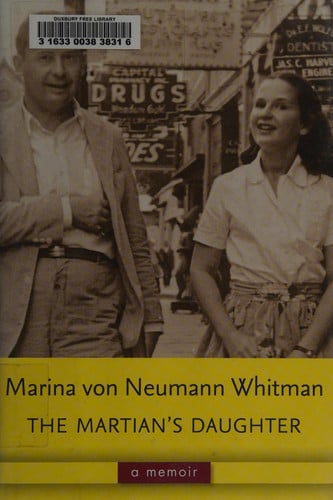
The Martian's daughter: a memoir

Whitman, Marina von Neumann
One of the five Hungarian scientific geniuses dubbed "the Martians" by their colleagues, John von Neumann is often hailed as the greatest mathematician of the twentieth century and even as the greatest scientist after Einstein. He was a key figure in the Manhattan Project; the inventor of game theory; the pioneer developer of the modern stored-program electronic computer; and an adviser to the top echelons of the American military establishment. In The Martian's Daughter , Marina von Neumann Whitman reveals intimate details about the famed scientist and explores how the cosmopolitan environment in which she was immersed, the demanding expectations of her parents, and her own struggles to emerge from the shadow of a larger-than-life parent shaped her life and work. Unfortunately, von Neumann did not live to see his daughter rise to become the first or highest-ranking woman in a variety of arenas. Whitman became a noted academic during the 1960s and '70s, casting her teaching and writing in the framework of globalization before the word had been invented; became the first woman ever to serve on the President's Council of Economic Advisers and participated actively in U.S. efforts to reshape the international monetary and financial system during the early 1970s; pioneered the role of women on the boards of leading multinational corporations; and became the highest-ranking female executive in the American auto industry in the 1980s. In her memoir, Whitman quotes from personal letters from her father and describes her interactions with such figures as Roger Smith of GM and President Nixon. She also details the difficulties she encountered as an early entrant into a world dominated by men and how she overcame the obstacles to, in her words, "have it all."
University of Michigan Press 2012-08-31 308 pages

California Jews

Ava F. Kahn,Marc Dollinger
The nation's thirty-first state emerged early as one of its most diverse as people immigrated to the west. California's indigenous tribes were forced off their lands first by Spanish settlers, then by the arrival of gold miners from every corner of the world. Because of its Catholic missionary history, Gold Rush California did not experience a more exclusive eastern-style Protestantism. This permitted more rapid and inclusive acculturation. California Jews, unlike their eastern counterparts whose arrival often followed that of European Protestants, were often among the first settlers to establish a west coast community. Jewish immigrants to California took advantage of its physical environment, ethnic diversity, and cultural distinctiveness to fashion a form of Judaism unique in the American experience. California Jews enjoyed unprecedented access to political power a generation earlier than their New York counterparts. They thrived in the multicultural mix, redefining the classic black-white racial binary by forging relations with a variety of religious and ethnic groups in both San Francisco and Los Angeles.
Brandeis University Press 2012 196 pages

The presidency of Barack Obama: a first historical assessment

Julian E. Zelizer
"Barack Obama's election as the first African American president seemed to usher in a new era, and he took office in 2009 with great expectations. But by his second term, Republicans controlled Congress, and, after the 2016 presidential election, Obama's legacy and the health of the Democratic Party itself appeared in doubt. In The Presidency of Barack Obama, Julian Zelizer gathers leading American historians to put President Obama and his administration into political and historical context. These writers offer strikingly original assessments of the big issues that shaped the Obama years, including the conservative backlash, race, the financial crisis, health care, crime, drugs, counterterrorism, Iraq and Afghanistan, the environment, immigration, education, gay rights, and urban policy. Together, these essays suggest that Obama's central paradox is that, despite effective policymaking, he failed to receive credit for his many achievements and wasn't a party builder. Provocatively, they ask why Obama didn't unite Democrats and progressive activists to fight the conservative counter-tide as it grew stronger." -- Publisher's description
Princeton University Press 2018-03-13 346 pages

Nobody left to hate: teaching compassion after Columbine

Aronson, Elliot
In the wake of the Columbine High School massacre, Nobody Left to Hate, offers concise, practical and easy-to-apply strategies for creating a more supportive, stimulating and compassionate environment in schools. Based on decades of scientific research and classroom testing, these strategies explain how students can be taught to control their own impulses, how to respect others, and how to resolve conflict amicably. In addition they show teachers how to structure classes to promote cooperation, rather than competition.
W.H. Freeman 2000 194 pages

Fooling some of the people all of the time: a long short story

Einhorn, David
In 2002, Einhorn spoke publicly about Allied Capital--a leader in the private finance industry--presenting it as an excellent short opportunity. Einhorn describes the incredible events that followed his speech and how Allied and the investment community attacked him to protect the company--and its stock price. Informative and intriguing, "Fooling Some of the People All of the Time" details how the current environment on Wall Street--and the world of hedge funds in particular-- not only allows for such behavior, but how it protects the companies and attacks those who attempt to uncover them.--From publisher's description.
J. Wiley 2008-05-02 379 pages

One billion Americans: the case for thinking bigger

Yglesias, Matthew
"A bold case for massive population growth in the name of national greatness--from Vox co-founder and host of "The Weeds" podcast Matt Yglesias. America is in decline. Fewer children are born each year due to financial pressure. Thousands flee our iconic cities with their housing shortages and broken infrastructure. While we tie ourselves into knots trying to stop the flow of immigrants, our exhausted economy deflates the heartland's already shrinking population. To survive China's impending global takeover (not to mention Russia), we can't afford to be weak. We need to get bigger, much bigger. We need one billion Americans. In this timely and provocative book, Matthew Yglesias makes the case for massive population growth through humane family and immigration policy. Of course, more people requires more housing, not to mention better transportation, improved education, a revitalized welfare system, and climate change mitigation. Why not do it all, and stay on top forever? Written with Yglesias's signature humor and analytic rigor, One Billion Americans challenges readers across the political spectrum to take decline seriously. Drawing on economic theory and research from leading policy experts, he offers ideas from around the globe--from Singapore's approach to traffic jams to Canada's town planning--that move us beyond left-right divides, to explore the practical and creative solutions our times call for"--
Portfolio / Penguin, an imprint of Penguin Random House LLC 2020-09-15 267 pages

The harrows of spring: a World made by hand novel

Kunstler, James Howard
In Union Grove, early spring is a challenging season, known as the "six weeks want," a time when fresh food is scarce and the winter stores are dwindling. The town is struggling in particular this year as the Hudson River trade route to Albany has been halted by the local plantation tycoon Stephen Bullock, who has deemed it too resource-intensive and is now striving for self-sufficiency. Meanwhile, after returning from his travels around what is left of the United States, Daniel Earle is intent on resurrecting a newspaper for the community, and finds an interesting story to cover when representatives of a group of anti-establishment, hyper-liberals known as the Berkshire People's Republic arrive in the town.
Atlantic Monthly Press 2016 317 pages

The pill, pygmy chimps, and Degas' horse: the autobiography of Carl Djerassi

Djerassi, Carl
Father of the birth control pill, developer of antihistamines, founder of biomedical companies, teacher of world-class chemists, best-selling novelist.... As The Scientist notes, "Few can match Carl Djerassi's juggling act for success and longevity". Here is Djerassi's remarkable autobiography. Blending vivid descriptions of the lucrative world of drug development with controversial chapters on the politics of contraception and poignant disclosures about his personal life, this book tells the story of one of the most productive and socially conscious chemists working today. The Pill, Pygmy Chimps, and Degas' Horse tells how Djerassi, while still in his twenties and leading a small team in an obscure laboratory in Mexico City, used a locally grown yam first to synthesize cortisone and then, within twelve months, to create the first steroid effective as a birth control pill. Dubbed for this latter work "the father of the pill", a title he often shares with Gregory Pincus and John Rock, who performed the biological and clinical studies to confirm the pill's efficacy in humans, Djerassi has spent a lifetime thinking and rethinking, discussing and debating, the social, economic, and biological consequences of the changed attitudes toward contraception engendered by the pill. In two riveting chapters entitled "The Pill at Twenty" and "The Pill at Forty: What Now?" Djerassi recounts the fascinating history of the pill's journey from its first days in the laboratory to widespread public use--from being hailed as an agent of the sexual revolution to condemnation as an agent of the new promiscuity, to being accused of being an expression of the scientific community's sexism (Why was there no malebirth control pill?). And then, in a powerful consideration of where the politics of contraception have taken us, he discusses why so few innovations in contraception are being investigated today, and why even fewer are making their way to the public. The Pill, Pygmy Chimps, and Degas' Horse chronicles Djerassi's many successful careers in science, business, the academy, and the arts (he is a published poet and novelist, as well as the founder of an artists' colony). His growing appreciation for the soft side of science--its human and humane aspects--have long been reflected in the courses he teaches at Stanford, in the plot of his novel, Cantor's Dilemma, and in his decision to found one of the first environmentally aware pesticide companies. In this intellectually challenging book, the reader is let into the fertile mind and psyche of one of the few Renaissance men of twentieth-century science.
Basic Books 1992-04-26 319 pages

Living with the dragon: how the American public views the rise of China

Page, Benjamin I.
It is widely believed that most Americans not only distrust but also despise China. Considering the country's violent political history, unprecedented economic rise, and growing military capabilities, China has become America's strongest market competitor and arguably the most challenging global threat to the United States.Nevertheless, a full consideration of American opinion proves the opposite to be true. Carefully analyzing all available polls and surveys, Benjamin I. Page and Tao Xie find most Americans favor peaceful engagement with China. The public view has been surprisingly coherent and consistent, changing only in response to major events and new information.While a majority of Americans are not happy that China's economy is projected to become as large as that of the United States, they are prepared to live with it. "Unfair" Chinese trade practices and their impact on American jobs and wages are a concern, along with the quality and safety of Chinese-made goods. However, Americans favor free trade with China, provided it is tempered with environmental and workplace protections. They also believe that the United States should "balance" Chinese power through alliances with neighboring countries, such as Japan. Yet they oppose military action to defend Taiwan. Page and Xie examine these opinions in relation to facts about China and in light of current U.S. debates on diplomacy and policy
Columbia University Press 2010 212 pages

Return of the primitive: the anti-industrial revolution

Rand, Ayn
In the tumultuous late 60s and early 70s, a social movement known as the "New Left" emerged as a major cultural influence, especially on the youth of America. It was a movement that embraced "flower-power" and psychedelic "consciousness-expansion," that lionized Ho Chi Minh and Fidel Castro and launched the Black Panthers and the Theater of the Absurd. In Return Of The Primitive (originally published in 1971 as The New Left), Ayn Rand, bestselling novelist and originator of the theory of Objectivism, identified the intellectual roots of this movement. She urged people to repudiate its mindless nihilism and to uphold, instead, a philosophy of reason, individualism, capitalism, and technological progress. Editor Peter Schwartz, in this new, expanded version of The New Left, has reorganized Rand's essays and added some of his own in order to underscore the continuing relevance of her analysis of that period. He examines such current ideologies as feminism, environmentalism and multiculturalism and argues that the same primitive, tribalist, "anti-industrial" mentality which animated the New Left a generation ago is shaping society today. --
Meridian 1999-01-01 290 pages

Does American democracy still work?

Wolfe, Alan
The past few decades have brought a shift in the nature of American democracy--an alarming shift that threatens such liberal democratic values as respect for pluralism, acceptance of the separation of powers, and recognition of the rights of opposition parties. In this insightful book, political scientist Alan Wolfe identifies the current political conditions that endanger the quality of our democracy. He describes how politics has changed, and he calls for a democracy protection movement designed to preserve our political traditions not unlike the environmental protection movement’s efforts to safeguard the natural world. Voters who know little about issues, leaders who bend rules with little fear of reprisal, and political parties that are losing the ability to mobilize citizens have all contributed to a worrisome new politics of democracy, Wolfe argues. He offers a brilliant analysis of how religion and morality have replaced political and economic self-interest as guiding principles, and how a dangerous populism promotes a radical form of elitism. Without laying blame on one party or ideology and without claiming that matters will improve with one party or the other in office, Wolfe instead suggests that Americans need to understand the danger their own indifference poses and take political matters more seriously.
Yale University Press 2006 216 pages

Crop chemophobia: will precaution kill the green revolution?

Jon Entine
The Green Revolution of 1960s introduced herbicides, pesticides, and advanced agricultural technologies to third world countries-rescuing hundreds of millions of people from malnutrition and starvation and transforming low-yield, labor-intensive farming into the high-tech, immensely productive industry it is today. Despite these stunning gains, critics of chemical farming remain vocal. Recently, the European Union passed a ban on twenty-two chemicals-about 15 percent of the EU pesticides market-to begin in 2011. In Crop Chemophobia, Jon Entine and his coauthors examine the "precautionary principle" that underlies the EU's decision and explore the ban's potential consequences-including environmental degradation, decreased food safety, impaired disease-control efforts, and a hungrier world.
AEI Press 2011 158 pages

Capital and credit in British overseas trade: the view from the Chesapeake, 1700-1776

Price, Jacob M.
In a model study Jacob Price illuminates the dynamic growth of Britain’s foreign trade in the eighteenth century through an investigation of the investment patterns and credit institutions that financed that expansion. Concentrating on the trade between Britain and the Chesapeake tobacco colonies of Virginia and Maryland, for which a unique set of records exists, Price surveys the ways in which commerce developed and working capital was mobilized in Britain to support expanding overseas trade. Price develops the clearest picture ever of the financial environment within Britain as it affected Southern colonies in the preindustrial age. He does so by determining the kind of capital resources merchants in foreign trade actually commanded and measuring how much of their own wealth merchants brought to trade. In great and absorbing detail he discusses also the development of merchant-oriented banks in London and other ports, reinvestment of profits, long-term borrowing on bond, and the long-term credit provided to export merchants by wholesalers in textiles, ironmongery, and other industries. The relationship of debt to the coming of the American Revolution is also treated. Tobacco growers suffered more than others from a psychological unease caused by immense debt and were more revolutionary than farmers with less intensive capital needs and, hence, with lighter debt. This history will enlighten Anglo-American historians, economic historians, and historians of the American revolutionary era.
Harvard University Press 1980-12-02 233 pages

Diario de Oaxaca

Kuper, Peter
Painting a vivid, personal portrait of social and political upheaval in Oaxaca, Mexico, this unique memoir employs comics, bilingual essays, photos, and sketches to chronicle the events that unfolded around a teachers' strike and led to a seven-month siege. When award-winning cartoonist Peter Kuper and his wife and daughter moved to the beautiful, 15th-century colonial town of Oaxaca in 2006, they planned to spend a quiet year or two enjoying a different culture and taking a break from the U.S. political climate under the Bush administration. What they hadn't counted on was landing in the epicenter of Mexico's biggest political struggle in recent years. Timely and compelling, this extraordinary firsthand account presents a distinct artistic vision of Oaxacan life, from explorations of the beauty of the environment to graphic portrayals of the fight between strikers and government troops that left more than 20 people dead, including American journalist Brad Will.
PM Press 2009 208 pages

The golden door: international migration, Mexico, and the United States

Ehrlich, Paul R.
"Our most potentially disastrous national problem, along with the danger of nuclear war and threats to the environment, is the pressing catastrophe of massive illegal immigration. The 2,000 mile United States-Mexican border is the only place in the world where a wealthy, heavily industrialized stable country is confronted directly by a struggling, preindustrial nation. United States prosperity relies on a stable population, and Mexico, with her burgeoning population, increasing poverty, and massive unemployment is threatening the traditional U.S. life-style. Stereotyped thinking, based on racism or fear, will not solve these problems. The Golden Door is a sensitive exploration of a difficult situation, and this edition includes new material on the Cuban, Salvadoran, and Haitian migration to the United States"--P. [4] of cover.
Wideview Books 1981 402 pages

Living in the long emergency: global crisis, the failure of the futurists, and the early adapters who are showing us the way forward

Kunstler, James Howard
"James Howard Kunstler, author of The Long Emergency, which sold approximately 36K copies, returns with a new book exploring the looming collapse of the techno-industrial economy, featuring profiles of individuals who have drastically altered their lives due to financial difficulties"--
BenBella Books 2020 277 pages