162 results for "Future Technology"

Infotopia: how many minds produce knowledge

Sunstein, Cass R.
As the dire history of planned economies highlights, small well-informed groups of people will often make far worse decisions than large numbers of people, acting independently, would make. In Infotopia, Cass Sunstein looks at the "wisdom of the many"--particularly as seen on today's Internet--illuminating many new ways of collecting and evaluating information and making effective decisions. Sunstein shows how the on-line efforts of many people coming together help companies, schools, governments, and individuals to amass ever-growing bodies of accurate knowledge. He describes for instance how Wikipedia, through an endless flurry of self-correcting exchanges, collects information on everything from politics and business to science fiction. Open-source software--which licenses programmers to use, change, and improve the software--taps the power of large numbers of people to spur technological development. And prediction markets--such as the famous Iowa Electronic Market, where people bet real money on the outcome of local and national elections--collect information in a way that allows companies, ranging from computer makers to Hollywood studios, to make better decisions about the future. Sunstein reveals why these revolutionary new methods are so astoundingly accurate and he also shows how people can take advantage of "the wisdom of the many" without succumbing to the dangers of herd mentality. "Sunstein, one of the biggest of America's internet big thinkers, has written an intriguing new book in which he argues that Hayek's insights about the genius of markets are equally true of the internet." --Patti Waldmeir, Financial Times "This extraordinary work synthesizes the latest in how we know, with the latest in what the web has become, to map more compellingly than any other book the promise and risk of the information society." --Lawrence Lessig, author of Free Culture and The Future of Ideas "Vivid, readable, and informativea show-me-the-money guide to what soars and what stumbles from the stable of Internet dreams." --Jedediah Purdy, American Prospect "Sunstein, one of the biggest of America's internet big thinkers, has written an intriguing new book in which he argues that Hayek's insights about the genius of markets are equally true of the internet. Sunstein argues, for example, that sharing scientific information online would cure some of the worst problems of the US patent system and foster innovation much more efficiently than costly patent litigation. Sunstein recognizes all the potential flaws of such collaborative projects. Groupthink can be dangerous. But, says Sunstein, the wisdom of the many is a great thing, and sharing knowledge online can lead to remarkable advances for companies, for governments and for the rest of us."--Patti Waldmeir, Financial Times "A survey of the evidence on how information technology affects political debate and institutional decision making. The result is a vivid, readable, and informative work of empiricist skepticism--a show-me-the-money guide to what soars and what stumbles from the stable of Internet dreams."--Jedediah Purdy, merican Prospect, Duke University "This extraordinary work synthesizes the latest in how we know, with the latest in what the web has become, to map more compellingly than any other book the promise and risk of the information society. As with everything Sunstein writes, this beautiful and clear book has something to teach the experts, and lots to teach the rest of us."-Lawrence Lessig, author of Free Culture and The Future of Ideas "Infotopia is a persuasive and sophisticated meditation on the ways in which the Web is not just living up to its early hype, but transcending it. Cass Sunstein has given us a brilliant integrative view of how the distributed users of the Internet can band together to produce extraordinary work--along with the circumstances that best give rise to deliberation r
Oxford University Press 2008 273 pages

Build for change: revolutionizing customer engagement through continuous digital innovation

Trefler, Alan
Customers have radically changed the ways they interact with businesses, and today's organizations need to adapt Is your company prepared for the Gen D future, or is it heading toward life support? A lot of companies across the globe are going to die over the next few years, not because of macroeconomic stress, but because there is an emerging generation that is radically changing the rules of customer engagement. In Build For Change , Pegasystems CEO Alan Trefler shows exactly what companies can do to turn the coming "customerpocalypse" into one of the biggest business opportunities of the decade. The newest generation of consumers is turning customer relationship management on its head. Build For Change highlights the revolutionary changes to business, marketing, and technology practices that are needed to survive and thrive in these unforgiving times. Readers will learn how businesses are increasingly relying on new forms of customer engagement, and how one customer's experience—whether good or bad—can alter a company's reputation with the click of a mouse. With practical insight from a leader in customer engagement, this book serves as a timely wakeup call to companies that have not yet embraced the digital future. Traditional marketing is becoming increasingly irrelevant, and businesses must become more customer-centric while taking a completely different approach to adopting and using technology. Build For Change outlines exactly what can—and must—be done to ensure sustainable success in the new digital era: Relate to the new generation of consumers, and understand their preferences and demands Stop obsessing about mountains of data, and instead apply business-driven continuous improvement to customer processes Learn how to overcome the fatal flaws of current technology fads Rethink organizational roles to drive adaptive and transformative innovation Consumers have more options than ever before, and ensuring customer loyalty in the modern market means knowing exactly what the customer wants and how to deliver it brilliantly. Build For Change provides actionable guidance for engaging this new connected consumer.
Wiley 2014-06-03 175 pages

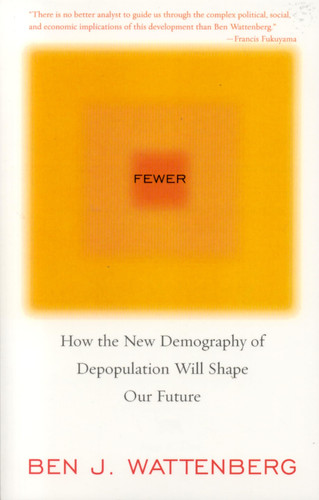
Fewer How the New Demography of Depopulation Will Shape Our Future

Ben J. Wattenberg
For at least 650 years, since the time of the Black Plague, the world's population has headed in only one direction: up. But within a few decades the number of people on earth will level off and then will likely decline over an extended period of time. In Fewer, the author explains how and why birthrates and fertility rates are now falling at an alarming rate in countries throughout the world--both modern and less developed. And he explores the major implications--for world politics, the environment, and the international economy--of this momentous shift. Illustrated with 23 clarifying charts.
Bloomsbury Academic 2004 241 pages

Do we still need doctors?

Lantos, John D.
Do We Still Need Doctors? is a personal account from the front lines of the moral and political battles that are reshaping America's health care system. Using compelling firsthand experiences, clinical vignettes, and moral arguments, John D. Lantos, a pediatrician, asks whether, as we proceed with the redesign of our health care system, doctors will - or should - continue to fulfill the roles and responsibilities that they have in the past. Interspersing moving personal stories of his young patients suffering from AIDS, cancer, and other chronic or terminal illnesses with his own stirring dilemmas of truth telling, creative navigation of HMO bureaucracy, and reflections on the identity crisis of medical education, Dr. Lantos reveals how changes in our health care system and new technologies are fostering new ways of understanding and responding to illness. He taps into the public's sense of wanting doctors and hospitals to do something other than what they do now and the frustrating disagreement about what they should do in the future. Do We Still Need Doctors? neither demonizes nor idealizes managed care or for-profit medicine. Instead, Dr. Lantos argues that managed care continues a trend toward rationalizing disease and streamlining treatment that doctors themselves have initiated and sustained over the last fifty years. Illness and death will always resist rationalizing, and in order to respond to them, doctors and patients alike need to re-imagine what healing is or ought to be.
Routledge 1999 214 pages

China 1945: Mao's revolution and America's fateful choice

Bernstein, Richard
Examines the first episode in which American power and good intentions came face-to-face with a powerful Asian revolutionary movement, and challenges familiar assumptions about the origins of modern Sino-American relations. As 1945 opened, America was on surprisingly congenial terms with China's Communist rebels--their soldiers treated their American counterparts as heroes, rescuing airmen shot down over enemy territory. Chinese leaders talked of a future in which American money and technology would help lift China out of poverty. Mao Zedong himself held friendly meetings with U.S. emissaries, vowing to them his intention of establishing an American-style democracy in China. By year's end, however, cordiality had been replaced by chilly hostility and distrust. Chinese Communist soldiers were setting ambushes for American marines in north China; Communist newspapers were portraying the United States as an implacable imperialist enemy; civil war in China was erupting. The pattern was set for a quarter century of almost total Sino-American mistrust, with the devastating wars in Korea and Vietnam among the consequences. Richard Bernstein here tells the incredible story of that year's sea change, brilliantly analyzing its many components, from ferocious infighting among U.S. diplomats, military leaders, and opinion makers to the complex relations between Mao and his patron, Stalin.--From publisher description
Alfred A. Knopf 2014 445 pages

Adventures of a bystander

Drucker, Peter F.
"It is [a] belief in diversity and pluralism and the uniqueness of each person that underlies all my writings . . . " -from the Preface. Regarded as the most influential and widely read thinker on modern organizations and their management, Peter Drucker has also established himself as an unorthodox and independent analyst of politics, the economy, and society. A man of impressive scope and expertise, he has paved significant inroads in a number of key areas, sharing his knowledge and keen insight on everything from the plight of the employee and the effects of technology to the vicissitudes of the markets and the future of the new world order. Adventures of a Bystander is Drucker's rich collection of autobiographical stories and vignettes, in which this legendary figure paints a portrait of his remarkable life, and of the larger historical realities of his time. In a style that is both unique and engaging, Drucker conveys his life story -from his early teen years in Vienna through the interwar years in Europe, the New Deal era, World War II, and the postwar period in America-through intimate profiles of a host of fascinating people he's known through the years. Their personal histories are, as Drucker tells us, the beads for which his own life serves as the string. A colorful group, these diverse, often unpredictable, always multidimensional individuals were chosen "because each of them, in his or her own highly personal way, reflects and refracts the thirty crucial years from the end of World War I to the first post-World War II decade-the thirty years that largely formed the world in which we now live." An amazing pageant of characters, both famous and otherwise, springs from these pages, illuminating and defining one of the most tumultuous periods in world history. Along with bankers and courtesans, artists, aristocrats, prophets, and empire-builders, we meet members of Drucker's own family and close circle of friends, among them such prominent figures as Sigmund Freud, Henry Luce, Alfred Sloan, John Lewis, and Buckminster Fuller. Playing to perfection their roles as those who "reflect and refract" the customs, beliefs, and attitudes of the times, these singular personalities lend Adventures of a Bystander a striking "you-are-there" feel. A brief encounter with Freud becomes the catalyst for an absorbing, multidimensional description of the economics, politics, and social psychology of pre-World War II Europe. Drucker introduces us to Fritz Kraemer, a brilliant, monocle-wearing eccentric who became an influential mentor to the young Henry Kissinger. His personal memoir of Henry Luce documents the development of modern journalism, while in "The Indian Summer of Innocence," he rescues and preserves the very heart of the American experience during the last New Deal years before World War II. Shedding light on a turbulent and important era, Adventures of a Bystander also reflects Peter Drucker himself as a man of imaginative sympathy and enormous interest in people, ideas, and history. These enthralling stories complement and complete the groundbreaking analytical writing for which he is so revered. Luminous autobiographical stories by one of the greatest thinkers of our time "The cast of characters among whom Drucker moves is superbly rich, and the informed glimpse he provides of a vanished social and political universe is an education in itself. Adventures of a Bystander is better than a novel, more lively than an essay, and as thoughtful as both at their best." -The Harvard Business Review. "Adventures of a Bystander is a virtuoso performance in which Drucker displays a dazzling diversity of personal interests and knowledge, an awesome power of recall, and a crisp, highly readable writing style." -BusinessWeek. "Adventures of a Bystander appears in a stroke to have restored the art of the memoir and of the essay. It will doubtless be a while before its like comes round again." -The Washington Post.
Wiley 1997 344 pages

The best that money can't buy: beyond politics, poverty, & war

Fresco, Jacque
Jacque Fresco envisions a global civilization in which science and technology are applied with human and environmental concern to secure, protect, and encourage a more humane world for all people. This book offers a possible way out of our recurring cycles of boom and recession, famine, poverty, a declining environment, and territorial conflicts where peace is merely the interval between wars. It outlines an attainable, humane social design of the near future where human rights are no longer paper proclamations but a way of life. The Best That Money Can't Buy is a challenge to all people to work toward a society in which all of the world's resources become the common heritage of all of the earth's people. It is accompanied by 70 color photos of Fresco's original designs, which illuminate the fulfilling lifestyle of a global, resource-based economy.
Global Cyber-Visions 2002 168 pages

Strategic intelligence: conceptual tools for leading change

Maccoby, Michael
Changes in technology, customer demands, competition, and the social character challenge organizations to innovate and change. How they change depends on their leaders, and their knowledge, and philosophy. To create a better future for organizations and to improve the wellbeing of customers, collaborators and communities, leaders need to be strategic thinkers. This book describes the qualities of strategic intelligence and provides the conceptual tools that equip leaders to improve and transform organizations in the age of knowledge work. These qualities include foresight, visioning, partnering both within and outside the organization, and engaging and motivating collaborators. To develop these qualities, it is necessary to articulate a leadership philosophy and to gain knowledge of systems, variation, personality psychology, and the theory of knowledge. This book uniquely integrates leadership, personality and organization. Michael Maccoby has almost unparalleled experience of working with organizations in a wide variety of contexts.0He draws his insights from several disciplines - organization theory, psychoanalysis, anthropology; and from working with distinguished and pioneer thinkers. These include the psychoanalyst Erich Fromm; the systems theorist Russell Ackoff; and management pioneer W. Edwards Deming. A major challenge for leadership today is the transformation of traditional bureaucracies into learning organizations. It can't be done by following formulas or roadmaps. Leaders need the qualities and conceptual tools of strategic intelligence and this book shows them what they must do and provides exercises to develop them.
Oxford United Press 2015-01 189 pages

Genocide

Kuper, Leo
A valuable study of what the term "genocide" means - and what the concept should include. To solve the problem of precision, UCLA emeritus professor Kuper starts with the UN Convention on Genocide (1948). There, genocide was defined as any of the following acts "committed with intent to destroy, in whole or in part, a national, ethnical, racial or religious group, as such": killing members of the group, or causing them serious physical or mental harm; prevention of birth within the group, or transfer of children out of the group; infliction of conditions calculated to bring death or destruction to the group. By tracing the path of this document through the UN, Kuper shows the political processes that helped narrow the concept of genocide. For example, the West wanted a provision labeling the destruction of political groups as genocide, but the Soviets blocked it; conversely, the Soviets wanted cultural genocide included, and the West blocked that. Kuper concludes that nations don't want to block their own possible future actions - and argues that political groups should be included in the definition. Then, accepting the UN definition as a starting point, he turns his attention (via historical instances of genocide) to the 20th century and the nature of genocide. It is a feature of plural societies, he contends - of societies that contain "persistent and pervasive cleavages" between the racial, ethnic, and/or religious groups that compose them. In cases of extreme pluralism, the divisions between these groups are overlaid with divisions between power, and genocide is one possible means by which an elite can maintain itself. The classic case of this is the Turkish massacre of its subject Armenians, the first of two cases Kuper explores in some depth. The second, the German extermination of Europe's Jews, differed in degree; it knew no national boundary, employed more sophisticated technology, had a more developed
Penguin 1981 255 pages

Everything is miscellaneous: the power of the new digital disorder

Weinberger, David
From A to Z, Everything Is Miscellaneous will completely reshape the way you think - and what you know - about the world. Includes information on alphabetical order, Amaxon.com, animals, Aristotle, authority, Bettmann Archive, blogs (weblogs), books, broadcasting, British Broadcasting Corporation (BBC), business, card catalog, categories and categorization, clusters, companies, Colon Classification, conversation, Melvil Dewey, Dewey Decimal Classification system, Encyclopaedia Britannica, encyclopedia, essentialism, experts, faceted classification system, first order of order, Flickr.com, Google, Great Books of the Western World, ancient Greeks, health and medical information, identifiers, index, inventory tracking, knowledge, labels, leaf and leaves, libraries, Library of Congress, links, Carolus Linnaeus, lumping and splitting, maps and mapping, marketing, meaning, metadata, multiple listing services (MLS), names of people, neutrality or neutral point of view, New York Public Library, Online Computer Library Center (OCLC), order and organization, people, physical space, everything having place, Plato, race, S.R. Ranganathan, Eleanor Rosch, Joshua Schacter, science, second order of order, simplicity, social constructivism, social knowledge, social networks, sorting, species, standardization, tags, taxonomies, third order of roder, topical categorization, tree, Uniform Product Code (UPC), users, Jimmy Wales, web, Wikipedia, etc. Philosopher Weinberger shows how the digital revolution is radically changing the way we make sense of our lives. Human beings constantly collect, label, and organize data--but today, the shift from the physical to the digital is mixing, burning, and ripping our lives apart. In the past, everything had its one place--the physical world demanded it--but now everything has its places: multiple categories, multiple shelves. Everything is suddenly miscellaneous. Weinberger charts the new principles of digital order that are remaking business, education, politics, science, and culture. He examines how Rand McNally decides what information not to include in a physical map (and why Google Earth is winning that battle), how Staples stores emulate online shopping to increase sales, why your children's teachers will stop having them memorize facts, and how the shift to digital music stands as the model for the future. --
Holt 2008-04-29 277 pages

Imagining the future: science and American democracy

Levin, Yuval
From stem cell research to global warming, human cloning, evolution, and beyond, political debates about science have raged in recent years - and, to the chagrin of most observers, have increasingly fallen into the familiar categories of America's culture wars. In Imagining the Future: Science and American Democracy, Yuval Levin explores the complicated meanings of science and technology in American politics and finds that the science debates have a lot to teach us about our political life. These debates, Levin argues, reveal some serious challenges to American self-government, and put on stark display the deepest strengths and greatest weaknesses of both the left and the right. American life has been profoundly shaped by science and technology, and will be all the more so in the coming decades, making it crucial that we understand how to think and speak about science in politics. Yuval Levin's smart and eminently well-reasoned book makes the important point that the purpose of science is a moral one -- to improve human life -- and that judging what that involves is sometimes a job for more than science alone in a democratic society. Levin's insights speak directly to today's political debates and make his book a must-read for policymakers and all those who care about science and society. --Newt Gingrich, former Speaker of the House Imagining the Future goes far beyond the contemporary polarized debates over science to unpack the moral premises of the modern scientific project and its consequences for American democracy. In the process, Yuval Levin provides us with a deep understanding of policy issues from genetic engineering to global warming. --Francis Fukuyama, Johns Hopkins University This book is important to the thinking of both progressives and conservatives. Clearly and incisively, it shows how science and technology are shaping humanity's future and world views. Levin alerts democratic societies that human dignity and equality are imperiled unless we provide political and moral guidance to prevent the submergence of humanity in its own ingenuity. --Edmund Pellegrino, Chairman, President's Council on Bioethics
Encounter Books 2008 145 pages

Mirror worlds, or the day software puts the universe in a shoebox-: how it will happen and what it will mean

Gelernter, David Hillel
Technology doesn't flow smoothly; it's the big surprises that matter, and Yale computer expert David Gelernter sees one such giant leap right on the horizon. Today's small scale software programs are about to be joined by vast public software works that will revolutionize computing and transform society as a whole. One such vast program is the "Mirror World." Imagine looking at your computer screen and seeing reality--an image of your city, for instance, complete with moving traffic patterns, or a picture that sketches the state of an entire far-flung corporation at this second. These representations are called Mirror Worlds, and according to Gelernter they will soon be available to everyone. Mirror Worlds are high-tech voodoo dolls: by interacting with the images, you interact with reality. Indeed, Mirror Worlds will revolutionize the use of computers, transforming them from (mere) handy tools to crystal balls which will allow us to see the world more vividly and see into it more deeply. Reality will be replaced gradually, piece-by-piece, by a software imitation; we will live inside the imitation; and the surprising thing is--this will be a great humanistic advance. We gain control over our world, plus a huge new measure of insight and vision. In this fascinating book--part speculation, part explanation--Gelernter takes us on a tour of the computer technology of the near future. Mirror Worlds, he contends, will allow us to explore the world in unprecedented depth and detail without ever changing out of our pajamas. A hospital administrator might wander through an entire medical complex via a desktop computer. Any citizen might explore the performance of the local schools, chat electronically with teachers and other Mirror World visitors, plant software agents to report back on interesting topics; decide to run for the local school board, hire a campaign manager, and conduct the better part of the campaign itself--all by interacting with the Mirror World. Gelernter doesn't just speculate about how this amazing new software will be used--he shows us how it will be made, explaining carefully and in detail how to build a Mirror World using technology already available. We learn about "disembodied machines," "trellises," "ensembles," and other computer components which sound obscure, but which Gelernter explains using familiar metaphors and terms. (He tells us that a Mirror World is a microcosm just like a Japanese garden or a Gothic cathedral, and that a computer program is translated by the computer in the same way a symphony is translated by a violinist into music.) Mirror Worlds offers a lucid and humanistic account of the coming software revolution, told by a computer scientist at the cutting edge of his field.
Oxford University Press 1991 237 pages

"A beautiful mind"

Goldsman, Akiva
La 4ème de couverture indique : Ce scénario retrace la vie du mathématicien John Nash. Etudiant atypique et ombrageux à l'université de Princeton, brillant, il étonne son professeur en lui proposant une théorie économique révolutionnaire. Ceci lui ouvrira les portes du prestigieux Massachusetts Institute of Technology (où il rencontrera sa future épouse) puis du Pentagone. Diagnostiqué schizophrène grave, il fait la rencontre d'un mystérieux agent des services secrets qui va l'entraîner dans une incroyable aventure. Quand, bien des années plus tard, il sort de sa maladie, il se voit attribuer le prix Nobel d'économie.
Pocket 2012-06-28 223 pages

The coming conflict with China

Bernstein, Richard
In eye-opening detail, Richard Bernstein and Ross H. Munro, both of whom have been correspondents in China and bureau chiefs in Asia, examine China's continuing portrayal of America as the enemy; the shifts in Beijing's perception of American might; the enormous boon to China that the takeover of Hong Kong represents; China's increase in military strength; its challenging positions on Taiwan and the South China Sea; its sale of weapons to U.S. adversaries; its concerted efforts to hijack technology; its rigorous attempts - often through American corporations profiting in China - to influence U.S. policy. We discover how our military strategists are revising their scenarios for future conflicts, and how China is conducting its espionage. We are brought face-to-face with the startling implications of the trade imbalance between the United States and China (our deficit is $40 billion and growing). We learn of the struggles within the Chinese leadership and how assertive Chinese nationalism augurs a turbulent period ahead. This book is an informed and illuminating examination of a high-stakes clash of competing ideologies and economic interests.
A.A. Knopf 1997 245 pages

A view from the year 3000: a ranking of the 100 most influential persons of all time

Hart, Michael H.
This book speculates about the important inventions, scientific discoveries, and political and social developments, which may occur during the coming millennium. It does this by presenting -- through the eyes of a fictitious author living in the year 3000 -- a list of the 100 men and women who have had the greatest impact on world history and on the everyday lives of individuals. The hundred persons are ranked in order of their influence. The main section of the book consists of short biographies of those 100 persons, describing what each person accomplished, and why that person is so important. Forty-five of the entries are actual historical personages. These include such well known figures as Jesus Christ, Confucius, Charles Darwin, Christopher Columbus, Albert Einstein, and George Washington. Among the fifty-five entries from the third millennium are: Sue Ellen Green (who develops a cancer vaccine); Miguel Carranza (chief founder of the United World Federation); Stella Ricardo Garcia (architect and formscaper); Mika Kivikoski (who develops the technology to control the weather); and Shu Gungwu (who finds the solution to the baffling "mind-body problem"). Other topics treated include: space travel and space colonies; medical advances (such as artificial organs, and reversible sex-change operations); arts and entertainment (including music, literature, the visual arts, and sports and games); solar power; philosophy (including political theory, epistemology, semantics, and ethics); mathematics, pollution control, robots, brainwashing; nuclear warfare; robots; and artificial intelligence. The book includes a historical chart (listing the main events of both the actual past and the projected future), a list of honorable mentions (and their accomplishments); a glossary, and an extensive index.
Poseidon Press 1999 430 pages

The Suicidal Planet How to Prevent Global Climate Catastrophe

Mayer Hillman
"An outstanding overview on global warming--and what we can do about it--from a distinguished world-class authority" Climate change is the single biggest problem that humankind has ever had to face, as we continue with lifestyles that are way beyond the planet's limits. Mayer Hillman explains the real issues: what role technology can play, how you and your community can make changes, and what governments must do now to protect our planet for future generations. In "The Suicidal Planet, "he proposes: - A ceiling on greenhouse gas emissions by the world's governments- Global carbon rationing to reduce our individal carbon outputs to a fair and ecologically safe level- Helpful guidelines for the home, travel, and leisure- And much, much more. Featuring the very latest information on global warming completely revised to include U.S. facts and figures, "The Suicidal Planet" takes us out of the problem and into the solution of our international crisis.
Thorndike Press 2007 413 pages

Radical happiness: moments of collective joy

Segal, Lynne
A passionate call to rediscover the political and emotional joy that emerges when we share our lives In an era of increasing individualism, we have never been more isolated and dispirited. A paradox confronts us. While research and technology find new ways to measure contentment and popular culture encourages us to think of happiness as a human right, misery is abundant. Segal believes we have lost the art of “radical happiness”—the liberation that comes with transformative, collective joy. She argues that instead of obsessing about our own well-being we should seek fulfilment in the lives of others. Examining her own experience in the women’s movement, Segal looks at the relationship between love and sex, and the scope for utopian thinking as a means to a better future. She also shows how the gaps in care that come from the diminishing role of the welfare state must be replaced by alternative ways of living together and looking after one another. In this brilliant and provocative book, Segal proposes that the power of true happiness can only be discovered collectively.
Verso 2018-11-13 336 pages

Tradition

Shils, Edward
Tradition, by esteemed sociologist Edward Shils, was the first book to fully explore the history, significance, and future of tradition as a whole. Intent on questioning the meaning of the antitraditionalist impulse in today's society, Shils argues here that the tendency to distrust and rebel against tradition is at the heart of tradition itself; only through suspicion and defiance does tradition actually move forward. Revealing the importance of tradition to social and political institutions, technology, science, literature, religion, and scholarship, Tradition remains the definitive work on this vital element of our society.--provided by publisher
University of Chicago Press 1981 334 pages