132 results for "History"

Mr. & Mrs. Hollywood Edie and Lew Wasserman and Their Entertainment Empire

Kathleen Sharp
Ever wonder why so many B actors wind up as A-grade politicians? Or how the casting couch worked? Acclaimed author Kathleen Sharp traces the influence of show business through the lives of its first power couple. Edie and Lew Wasserman built the world's largest talent agency, MCA, created the multibillion-dollar Universal Studios, and helped shape Washington, DC. Starting from MCA's birth in gangland Chicago, Lew represented stars such as Jimmy Stewart and Marilyn Monroe; pioneered TV with Leave It to Beaver and Miami Vice ; spawned the blockbuster movie model with Psycho and Jaws ; and developed a mega-theme park. His savvy wife, Edie, was the daughter of a mob attorney, the queen of A-list parties, and Lew's secret agent who boosted their status. Yet, the couple was attacked by rivals, federal prosecutors, and their own protégés. Even so, over the course of seven decades they managed to vanquish their enemies and parlay their influence far beyond Sunset Strip into governors' mansions, Senate chambers, and the White House. At the end, Edie and Lew became diplomats, kingmakers, and philanthropists, who elevated the fortunes of middle-class workers and California itself. Based on some four hundred interviews, this book features Janet Leigh, Clark Gable, Grace Kelly, John Belushi, Jean Stein, and Steven Spielberg along with the Kennedys, the Johnsons, the Reagans, and the Clintons. It's a fascinating read about how two kids from Cleveland created the largest entertainment conglomerate in the world and wound up ruling twentieth-century America.
Blackstone Publishing 2017-12-05 538 pages

Sailing the wine-dark sea: International trade and the late bronze age aegean

Cline, Eric H.
A reissue of Eric H. Cline's highly regarded study of trade in the Late Bronze Age Aegean, first published in 1994 and out-of-print since 2000. The monograph is composed of three principal parts: 1) an analytical section discussing the trade and contacts which occurred between the Aegean, Italy, Egypt, and the Near East during the latter half of the second millennium BC, and the social, economic and cultural implications of such contacts; 2) first, a catalogue of literary and pictorial references to the LBA Aegean found in outside areas - primarily Egypt and the Near East - with transliterations and translations of the appropriate texts, and second, a compilation of the references to, and loanwords from, other areas of the Mediterranean found in the Linear B texts in the Aegean; and 3) a catalogue, by object type, of all the Orientalia and Occidentalia found in LBA contexts within the Aegean area. The monograph utilizes the catalogues in combination with previously published works by a variety of scholars to provide a detailed analysis of the trade and contacts between the LBA Aegean, Italy, Egypt and the Near East. The work is divided into six sections, each consisting of a series of interlinked essays. Section One provides an introduction to the topic, a brief overview of the previous scholarship in this area, and a discussion of the chronological problems involved. Section Two consists of an initial chapter discussing LBA trade and contact between the Aegean, Italy, Egypt and the Near East by centuries, followed by chapters discussing trade between the LBA Aegean and individual Mediterranean countries. Section Three contains discussions of the trade mechanisms involved, the trade routes, merchant nationalities, goods, motivations, and partnerships, plus a brief look at the Ulu Burun (Kas) and Cape Gelidonya shipwrecks. Section Four presents an overview of the conclusions reached by this study and reiterates that the current work presents much raw data and some preliminary observations but is only the tip of the iceberg in terms of tapping the wealth of information which may be extracted from the accompanying catalogues.
British Archaeological Reports 2009 348 pages

Branson

Tom Bower
'Bower's book is a devastating indictment' Sunday Times 'Explosive ... Bower reveals a remarkable and sinister picture of the man who likes to appear as the ever-smiling hero' Daily Mail A sensational critical biography of the man and his business practices. No British tycoon is better known, few claim to be richer and none has masterminded a more recognisable brand than Richard Branson. What is behind the success of the buccaneering balloonist, the tabloids' favourite celebrity nude, the 'grinning jumper' and the scourge of corporate goliaths? Tom Bower has a uncovered a different tale to the one so eagerly promoted by Virgin's publicists. Here is the full story of Branson: his businesses, his friendships, his ambition, his law-breaking, his drug-taking, his bullying. Offering an intimate scrutiny of exactly how Richard Branson created and sold himself, this biography reveals Branson to be a single-minded profiteer who, while occasionally generous to others, has a fixed purpose to enhance his family's wealth in secret off-shore trust funds. Instead of a glittering saint, Branson emerges as a devious actor, proud of plucking for his own profit the good ideas of others.
Fourth Estate 2001 393 pages

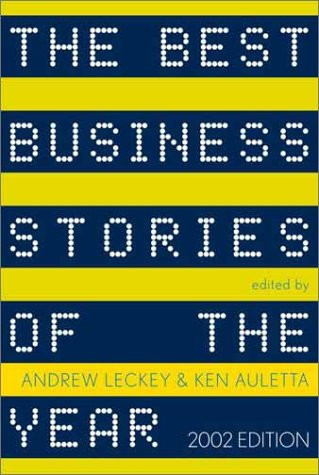
The Best Business Stories of the Year

Andrew Leckey,Ken Auletta
"[The editors] cast their net wide, picking up some excellent stories from nontraditional sources that even avid readers of the business press may have missed."-"USA Today," on the 2001 edition Series editor Andrew Leckey and guest editor Ken Auletta have scoured the print media, consulted with the editors of major business and general interest publications, and surveyed journalism school deans to find the best business stories from the last twelve months. Among those selected: Michael Lewis on teenage stock trader Jonathan Lebed, from "The New York Times Magazine"; James B. Stewart on the irrepressible Michael Milken, from "The New Yorker"; and many others from the pages of "The Wall Street Journal, Rolling Stone, Fortune, Rocky Mountain News, "and" Wired. " The second annual edition continues the excellence and comprehensive range of this fascinating anthology series.
Pantheon Books 2002 470 pages

Vanity Fair's Hollywood

Christopher Hitchens
On the motion-picture front, no other publication of our age has achieved the stature, vitality, or magic of Vanity Fair. In its coverage of the film industry, the magazine prides itself on assigning the world's top photographers, writers, and illustrators to explore the brightest stars in the Hollywood firmament. Now, for the first time, the most memorable renderings of this illustrious pantheon have been assembled in one volume: Garbo and Swanson, Fairbanks and Pickford, Gable and Grant, Tracy and Hepburn, Taylor and Burton -- along with today's cinematic giants, including Cruise and Kidman, Nicholson and Streep, De Niro and DiCaprio, Tom Hanks and Julia Roberts, and scores more. As this sweeping, lavish book makes clear, Vanity Fair's stable of photographers (Cecil Beaton, Annie Leibovitz, Helmut Newton, Herb Ritts, Edward Steichen, Mario Testino, Bruce Weber, and many others represented here) have helped define modern portraiture. Likewise, Vanity Fair's Hollywood includes Vanity Fair contributors of the past (D.H. Lawrence, Clare Boothe Luce, Dorothy Parker, Carl Sandburg, Walter Winchell, and P.G. Wodehouse) and of the present.
Viking Studio 2001 318 pages

Changing the Rules Adventures of a Wall Street Maverick

Muriel Siebert
When Mickie Siebert arrived in New York in the mid-1950s, she had $500 in her wallet and drove a used Studebaker. Almost fifty years later she is known as the "First Woman of Finance," the only woman to head a publicly traded national brokerage firm. Pithy, vastly entertaining, and full of behind-the-scenes anecdotes, Changing the Rules reveals how Siebert forged her phenomenal success in the chaotic and cutthroat world of Wall Street. Three four-letter words are behind Siebert's career success: One is work -- she learned everything there was to know about a company before recommending its stock. The second is luck -- as an analyst in training, she had the good fortune to follow a fledgling industry that nobody else wanted. (The "dog" industry was airlines.) The third word is risk -- she knew how to assess liability and make a decision. Siebert recounts the resistance of the good gray Stock Exchange when she dared to infiltrate the boys' club, threatening to have a Port-O-San delivered to the NYSE luncheon club if they didn't add a women's bathroom. She reveals the backstage stories about saving Lockheed and selling Conrail (at the time, the largest stock offering in Wall Street history), as well as the changes on the Street that led to May Day, 1975, when she was first in line as a discount broker (and considered a pariah by industry standards). She tells of her memorable encounters with such legendary figures as Captain Eddie Rickenbacker, the World War I flying ace who ran Eastern Airlines, and Robert Brimberg, the iconoclastic "Scarsdale Fats" whose investing acumen was the envy of the Street. Writing with equal candor about the politics of finance and the finance of politics, Siebert recalls her five years as Superintendent of Banking for New York State -- when she helped to prevent a national fiscal crisis during the Iran hostage situation -- and her experiences as a pro-choice Republican senatorial candidate. Siebert's reputation for rocking the boat is legendary, and Changing the Rules is both a fascinating biography of a true pioneer, and a valuable strategic and informational tool for anyone who deals with or dabbles in the money game.
Free Press 2007-08-22 240 pages

Better, Stronger, Faster The Myth of American Decline . . . and the Rise of a New Economy

Daniel Gross
Daniel Gross, Yahoo! financial columnist and author of Dumb Money , offers a refreshingly optimistic take on our nation’s economic prospects, examining the positive trends that point to a better, stronger future. Financial meltdown, a deep recession, and political polarization—combined with strong growth outside the U.S.—have led to a global bubble of pessimism surrounding the U.S. and its economic prospects. Bloated with debt, outpaced by China, India, and other emerging markets, the U.S. has been left for dead as an economic force. But, Daniel Gross, widely respected for his Newsweek and Slate coverage of the crash and the recovery, shows that much of the talk about decline is misplaced. In the wake of the crash, rather than accept the inevitability of a Japan-style lost decade, America’s businesses and institutions tapped into the very strengths that built the nation’s economy into the global powerhouse in the first place: speed, ingenuity, adaptability, pragmatism, entrepreneurship, and, most significantly, an ability to engage with the world. As the U.S. wallowed in self-pity, the world continued to see promise in what America has to offer—buying exports, investing in the U.S., and adapting American companies and business models as their own. Global growth, it turns out, is not a zero-sum game. These same attributes can propel the world’s largest economy forward through the significant headwinds it faces. Better, Stronger, Faster is a narrative of the remarkable reconstruction and reorientation that started in March 2009, a period that Gross compares to March 1933. Both marked the start of unexpected recoveries and monumental shifts in our nation’s history. As Gross explains, through stories of innovative solutions devised by policymakers, businesses, investors, and consumers, America has the potential to emerge from this period, not as the unrivaled ruler of the global economy, but as a leader and enabler of growth.
Free Press 2014-10-18 272 pages

Engines of Enterprise An Economic History of New England

Peter Temin
New England's economy has a history as dramatic as any in the world. From an inauspicious beginning--as immigration ground to a halt in the eighteenth century--New England went on to lead the United States in its transformation from an agrarian to an industrial economy. And when the rest of the country caught up in the mid-twentieth century, New England reinvented itself as a leader in the complex economy of the information society. Engines of Enterprise tells this dramatic story in a sequence of narrative essays written by preeminent historians and economists. These essays chart the changing fortunes of entrepreneurs and venturers, businessmen and inventors, and common folk toiling in fields, in factories, and in air-conditioned offices. The authors describe how, short of staple crops, colonial New Englanders turned to the sea and built an empire; and how the region became the earliest home of the textile industry as commercial fortunes underwrote new industries in the nineteenth century. They show us the region as it grew ahead of the rest of the country and as the rest of the United States caught up. And they trace the transformation of New England's products and exports from cotton textiles and machine tools to such intangible goods as education and software. Concluding short essays also put forward surprising but persuasive arguments--for instance, that slavery, while not prominent in colonial New England, was a critical part of the economy; and that the federal government played a crucial role in the development of the region's industrial skills.
Harvard University Press 2000 328 pages

The Accumulation of Capital

Rosa Luxemburg
2015 Reprint of 1951 Edition. Full facsimile of the original edition. Not reproduced with Optical Recognition Software. First published in 1913 and generally held to be her finest achievement, this volume reveals Luxemburg as a Marxist critical of Karl Marx. It offers a theory of the dynamic development of capitalism which is of continued relevance to contemporary scholarship. Taking Marx as her starting point, she offers an independent and fiercely critical explanation of the economic and political consequences of capitalism in the context of the turbulent times in which she lived, reinterpreting events in the United States, Europe, China, Russia and the British Empire. Most today believe there is no alternative to global capitalism. This book is a timely and forceful statement of an opposing view. Rosa Luxemburg was born in 1870 in Russian Poland. She was murdered in Germany while on way to prison. Contains an introduction by Joan Robinson.
Martino Fine Books 2015-02-25 476 pages

Tropicana Nights The Life and Times of the Legendary Cuban Nightclub

Rosa Lowinger,Ofelia Fox
Tropicana is to Cuba what the Bolshoi is to Russia, the Moulin Rouge to Paris, or the Blue Note to New York--an enduring cultural mecca. This definitive biography of the place that was known as Paradise Under the Stars, vividly describes the 1950s nightclub that was part casino, part cabaret and was the only club owned and run by Cubans rather than the American mob. Nat "King" Cole, Liberace, and Carmen Miranda performed there before audiences that included Joan Crawford, Marlon Brando, and Ernest Hemingway. The book portrays the cultural richness and roiling social problems of pre-Revolutionary Cuba and takes the reader on a tour of one of the world's most glamorous venues at its most brilliant moment.
Coralstone Press 2016-07 438 pages

The Anti-capitalistic Mentality

Ludwig Von Mises
2009 Reprint of original 1956 edition. Paperback, 114pp. Mises wrote and lectured extensively on behalf of classical liberalism and is seen as one of the leaders of the Austrian School of economics. Mises introduced praxeology as a more general conceptual foundation of the social sciences and established that economic laws were only arrived at through the means of methodological individualism firmly rejecting positivism and materialism as a foundation for the social sciences. Many of his works were on two related economic themes:1. Monetary economics and inflation; 2. The differences between government controlled economies and free trade.
Martino Publishing 2009 124 pages

The Income Tax

Frank Chodorov
Frank Chodorov was an extraordinary thinker and writer, and hugely influential in the 1950s. This is his American classic that argues that the income tax, more than any other legislative change in American history, made it possible to violate individual rights that were at the core of the founding. He argues that income taxes are different from other forms because they deny the right of private property and presume government control over all things. The introduction is by former IRS commissioner J. Bracken Lee.
Ludwig von Mises Institute 2007 116 pages

Anatomy of the State

Murray Rothbard
2016 Reprint of Undated Original Edition [Circa 1965]. Full facsimile of the original edition, not reproduced with Optical Recognition Software. This gives a succinct account of Rothbard's view of the state. Following Franz Oppenheimer and Albert Jay Nock, Rothbard regards the state as a predatory entity. It does not produce anything but rather steals resources from those engaged in production. In applying this view to American history, Rothbard makes use of the work of John C. Calhoun How can an organization of this type sustain itself? It must engage in propaganda to induce popular support for its policies. Court intellectuals play a key role here, and Rothbard cites as an example of ideological mystification the work of the influential legal theorist Charles Black, Jr., on the way the Supreme Court has become a revered institution. A wealth of citations and references supports the basic premise.
Martino Fine Books 2016-07-11 30 pages

The Economic Point of View

Israel M. Kirzner
Israel Kirzner is an outstanding student of Mises's, and here is his sweeping defense of the Misesian definition of the scope and meaning of economic science. He compares the Misesian view of human action with the neoclassical and classical school, and contrasts their views on rationality, human choice, scarcity, and scientific method. The book came out in 1960, before Rothbard's treatise and before the growth of the Austrian movement. It therefore exercised an important influence on the rising generation. Its contribution is to place the Misesian perspective within the context of the history of thought, demonstrating its unique contribution.
Ludwig von Mises Institute 2007 228 pages

Power and Market

Murray N. Rothbard
What can government do to enhance social and economic well being? Nothing, says Murray N. Rothbard. Power and Market contains the proof. It will inoculate the reader against the even the slightest temptation to invoke the state as a solution to any social or economic problem. It is ultimate manual for completely de-mystifying the myth of the state. This beautiful new edition is the first to truly do it justice. The Rothbardian claim is perhaps the most radical made in the history of political economy. But how can it be convincing? What must an author do to back up this claim? Here is what Rothbard did. He systematically classified every form of intervention into three types: autistic, binary, and triangular. Within each category, he discusses their ill effects, and does so with precision and insight. Free market scholars have been using and expanding on his insights for years. But in this book we have the source. He is like an expert house inspector examining the edifice of the state. Brick by brick, nail by nail, he shows that it is fundamentally unsound. The seeming edifice is really a house of cards. This book is the ideal answer to the person who says: "I favor free markets but…." and then proceeds to advocate some intervention they believe to be helpful. Rothbard shows that it is not helpful, no matter what it is. And he provides the logic for understanding how all forms of government aggression make society worse off. Softcover, 328 pages including index.
Ludwig von Mises ,Institute 2006 348 pages

Banking And Finance Among Jews In Renaissance Italy

Yehiel Nissim Da Pisa
Banking and Finance Among Jews in Renaissance Italy is a historical book written by Yehiel Nissim Da Pisa. The book explores the role of Jews in the banking and finance industry during the Renaissance period in Italy. It examines the economic, social, and political conditions that led to the emergence of Jewish bankers and financiers in Italy and their impact on the economy of the region. The book provides a detailed account of the Jewish banking families and their business practices, including their involvement in international trade and the creation of credit networks. It also discusses the challenges faced by Jewish bankers, including anti-Semitic attitudes and discriminatory laws. Through extensive research and analysis of primary sources, Da Pisa offers a comprehensive understanding of the Jewish banking and finance industry in Renaissance Italy. The book is an essential read for anyone interested in the history of banking and finance, Jewish history, and the Renaissance period.Text Language Is English And Hebrew.This scarce antiquarian book is a facsimile reprint of the old original and may contain some imperfections such as library marks and notations. Because we believe this work is culturally important, we have made it available as part of our commitment for protecting, preserving, and promoting the world's literature in affordable, high quality, modern editions, that are true to their original work.
Literary Licensing, LLC 2011-05 290 pages

The Rule Of Law And Economic Reform In Russia

Sachs, Jeffrey,Pistor, Katharina
What impact has Russia's chosen path of reform had on the development of law after the collapse of the communist regime? This collection of essays examines how Russia's distinctive traditions of law?and lawlessness?are shaping the current struggle for economic reform in the country. Nine renowned scholars, chosen from specialties in history, politi
Taylor & Francis Limited (Sales) 2019-09-13 228 pages

Formative Writings (Routledge Revivals)

Simone Weil
This volume, first published in English in 1987 makes available an important part of Weil’s early writings. Although primarily known as a religious thinker, she devoted enormous energy in her formative years to her work as a political activist and as a philosopher/teacher. This book reveals these other sides of Weil and demonstrates the lines of continuity underlying her whole thought. Written between 1929 and 1941 the book covers a crucial and transitional period in Weil’s life. Taken together they represent invaluable primary source material on the evolution of Weil’s life and on her chosen method of abstracting elements from her personal experience and transmuting that experience into considered thought. Even when highly theoretical, her writing was always concerned with the application of her intelligence to concrete problems of human existence.
Routledge 2009-12-17 294 pages

Highway and Byways Studies on Reform and Postcommunist Transition

Janos Kornai
The metaphor that frames this collection of recent studies reflects a broad perspective and understanding of the complexities of transition: every highway and byway leads eventually to capitalism, Kornai observes, but to what kind, how fast, and at what cost? Who wins and who loses? Hungarian economist János Kornai first used the metaphor of a single path to postsocialist transition in his earlier book, The Road to a Free Economy . The new metaphor that frames this collection of recent studies reflects a broader perspective and understanding of the complexities of transition: every highway and byway leads eventually to capitalism, Kornai observes, but to what kind, how fast, and at what cost? Who wins and who loses? Kornai draws from his experiences of Hungarian reform as well as from countries of the former Soviet Union to make several major points. The first three studies describe what went wrong in countries that tried to mix elements of planned and market economies. Efforts made by communist countries to introduce market socialism (the "middle road") contained an inherent contradiction between the logic of socialism and the logic of a free enterprise system, and were doomed to failure. In the studies that follow, Kornai analyzes the ongoing dilemmas. The transition from communism to free enterprise is filled with daunting hurdles; it requires no less than redefining ownership, changing values concerning the distribution of wealth, transferring the control of political power, creating financial institutions and enforcing financial discipline, and making deep economic sacrifice. Kornai closes with an overall survey of postsocialist transition, describing the stages that countries tend to go through, that will be particuarly useful to scholars of comparative economic systems.
MIT Press 1994-11-22 258 pages