75 results for "History"

The paradox of American democracy: elites, special interests, and the betrayal of the public trust

Judis, John B.
John B. Judis, one of our most insightful political commentators, most rational and careful thinkers, and most engaged witnesses in Washington, has taken on a challenge that even the most concerned American citizens shrink from: forecasting the American political climate at the turn of the century. The Paradox of American Democracy is a penetrating examination of our democracy that illuminates the forces and institutions that once enlivened it and now threaten to undermine it. It is the well-reasoned discussion we need in this era of unrestrained expert opinions and ideologically biased testimony. The disenchantment with our political system can be seen in decreasing voter turnout, political parties co-opted by consultants and large contributors, the corrupting influence of "soft money," and concern for national welfare subverted by lobbying organizations and special-interest groups. Judis revisits particular moments -- the Progressive Era, the New Deal, the 1960s -- to discover what makes democracy the most efficacious and, consequently, most inefficacious. What has worked in the past is a balancing act between groups of elites --- trade commissions, labor relations boards, policy groups -- whose mandates are to act in the national interest and whose actions are governed by a disinterested pursuit of the common good. Judis explains how the displacment of such elites by a new lobbying community in Whashington has given rise to the cynicism that corrodes the current political system. The Paradox of American Democracy goes straight to the heart of every political debate in this country.
Pantheon Books 2000-02-15 305 pages

Enraged citizens, European peace and democratic deficits: or, Why the democracy given to us must become one we fight for

Menasse, Robert
"In 2010, Robert Menasse journeyed to Brussels to begin work on a novel centered on the European Union. His extended stay resulted in a completely different book - Enraged Citizens, European Peace and Democratic Deficits, a work of nonfiction examining the history of the European project and the evolving politics of nation-states. Spanning from the beginning of the transnational idea with 1951's Montanunion - the European Coal and Steel Community - to the current financial crisis, Menasse focuses on the institutional structures and forces both advancing and obstructing the European project. Given the internal tensions among the European Commission, Parliament, and Council, Menasse argues that current problems that are frequently misunderstood as resulting from the financial crisis are, in fact, political. Along the way, he makes the bold claim that either the Europe of nation-states will perish - or the project of transcending the nation-states will ... [this work] analyzes the financial and bureaucratic structures of the European Union and sheds light on the state of the debt crisis. Menasse unravels the real state of the Union, along the way weaving a tale of one continent's efforts to become a truly postnational democracy."--Provided by publisher.
Seagull Books 2016 134 pages

Democratization in America: a comparative-historical analysis

Desmond King,Robert C. Lieberman,Gretchen Ritter,Laurence Whitehead
The essays in this volume examine democracy’s development in the United States, demonstrating how that process has shaped—and continues to shape—the American political system. Scholars of American politics commonly describe the political development of the United States as exceptional and distinct from that of other advanced industrial democracies. They point to the United States as the longest-lived and most stable liberal democracy in history. What they often fail to mention, though, is that it took considerable time to extend democracy throughout the country. The contributors to this volume suggest that it is intellectually fruitful to consider the U.S. case in comparison to other countries. They argue that the development of democracy is ongoing in America; that even with a written constitution grounded in liberal democracy, the meaning and significance of U.S. democracy are still evolving. This volume shows that democratization and the pursuit of democracy are processes affected by multiple and continuing challenges—including such issues as citizenship, race, institution building, and political movements—as patterns and practices of politics and governance continue to change. This innovative approach contributes significantly to comparative democratization studies, a field normally confined to Latin America and former communist countries. The U.S. case is a unique reference point for students of American political development and comparative democratization.
Johns Hopkins University Press 2009-08-05 337 pages

Judaism and the American idea

Konvitz, Milton R.
This book is A thoughtful meditation on the values of Judaism and the ideals of the Declaration of Independence. As he makes clear, there is such a thing as the American-Hebraic idea, which is manifested in the ideals of human dignity, the Rule of Law, the democratic ideal, the rights of conscience, and the pursuit of happiness. It is certain to appeal to American Jews who are seeking identity as Americans and as Jews, and to any reader interesting in understanding why Jews feel rooted in modern America -- from AbeBooks website.
Cornell University Press 1978-11 223 pages

Unnecessary suffering: managing markets utopia

Glasman, Maurice
They have a dream—a dream of a world where everything and everybody can be bought and sold, a world run efficiently by managers, a world where “freedom” means the free market. Maurice Glasman argues that this dream is an unrealizable utopia—or a nightmare if put into practice. He takes the tired old clichés of management-speak of the New Right and New Left alike and turns them on their heads: managers are not efficient, they are barriers to work and production. “Liberal democracy”—which now means the free market and the strong state—should be turned upside down, with democracy at the level of the economy and liberalism at the level of the state. Drawing on the work of Karl Polanyi, Glasman argues that there is no need to surrender solidarity and human rights to the march of the managers and the market. There is another tradition, represented by the labour movement and Catholic Church in postwar West Germany, and Solidarity in Poland before 1989, when statist communitarianism and the New Right took over. Unnecessary Suffering examines this tradition and issues a call that human beings and the environment cannot, should not, and will not be treated like commodities. For all workers drowning in a sea of dogma and management.memos, Unnecesary Suffering is necessary reading.
Verso 1996-11-17 167 pages

Pluralism and democracy in India: debating the Hindu right

Wendy Doniger,Martha Craven Nussbaum
Wendy Doniger and Martha Nussbaum bring together leading scholars from a wide array of disciplines to address a crucial question: How does the world's most populous democracy survive repeated assaults on its pluralistic values? India's stunning linguistic, cultural, and religious diversity has been supported since Independence by a political structure that emphasizes equal rights for all, and protects liberties of religion and speech. But a decent Constitution does not implement itself, and challenges to these core values repeatedly arise-most recently in the form of the Hindu Right movements of the twenty-first century that threatened to destabilize the nation and upend its core values, in the wake of a notorious pogrom in the state of Gujarat in which approximately 2000 Muslim civilians were killed. Focusing on this time of tension and threat, the essays in this volume consider how a pluralistic democracy managed to survive. They examine the role of political parties and movements, including the women's movement, as well as the role of the arts, the press, the media, and a historical legacy of pluralistic thought and critical argument. Featuring essays from eminent scholars in history, religious studies, political science, economics, women's studies, and media studies, Pluralism and Democracy in India offers an urgently needed case study in democratic survival. As Nehru said of India on the eve of Independence: ''These dreams are for India, but they are also for the world.'' The analysis this volume offers illuminates not only the past and future of one nation, but the prospects of democracy for all.
Oxford University Press 2015 384 pages

Stability and crisis in the Athenian democracy

Gabriel Herman
Was the Athenian democracy anarchic, given to domestic violence and hence unstable, as claimed by some scholars, or was it a stable, well-ordered, social system, provided with in-built mechanisms to overcome crisis? Various aspects of this question, central to the understanding of the Athenian democracy, are investigated in this volume by a team of distinguished experts. The often surprising answers they provide should be of interest to specialists as well as laymen. The volume is dedicated to the memory of the late Professor Alexander Fuks.
Franz Steiner Verlag 2011 164 pages

State of crisis

Bauman, Zygmunt
"Today we hear much talk of crisis and comparisons are often made with the Great Depression of the 1930s, but there is a crucial difference that sets our current malaise apart from the 1930s: today we no longer trust in the capacity of the state to resolve the crisis and to chart a new way forward. In our increasingly globalized world, states have been stripped of much of their power to shape the course of events. Many of our problems are globally produced but the volume of power at the disposal of individual nation-states is simply not sufficient to cope with the problems they face. This divorce between power and politics produces a new kind of paralysis. It undermines the political agency that is needed to tackle the crisis and it saps citizens' belief that governments can deliver on their promises. The impotence of governments goes hand in hand with the growing cynicism and distrust of citizens. Hence the current crisis is at once a crisis of agency, a crisis of representative democracy and a crisis of the sovereignty of the state. In this book Zygmunt Bauman and Carlo Bordoni explore the social and political dimensions of the current malaise. While this problems have been greatly exacerbated by the turmoil following the financial collapse of 2007-8, Bauman and Bordoni argue that the crisis facing Western societies is rooted in a much more profound series of transformations that stretch back further in time and are producing long-lasting effects. This highly original analysis of our current predicament by two of the world's leading social thinkers will be of interest to a wide readership."--Page 4 of cover.
Polity Press 2014-07-08 164 pages

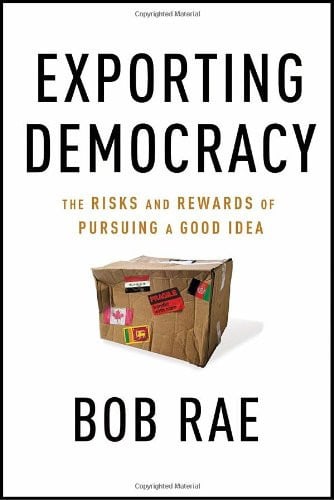
Exporting democracy: the risks and rewards of pursuing a good idea

Rae, Bob
The way most Western politicians talk, democracy is the pinnacle of civilization, the best political system there is. Many think it's the system the rest of the world ought to adopt. Bob Rae is not one of them. He is too well informed about the difficulties and dangers of implanting democracy in foreign lands. Exporting Democracy is an eloquently argued book in which Rae brings his lively, nuanced understanding to bear on the history and current fortunes of this powerful idea. He shows how it and the related ideas of freedom, human rights, and federalism have been pushed to centre stage by the collapse of Soviet communism and by ongoing wars to topple secular and religious dictatorships in the Middle East. He's also witnessed attempts to implant democracy in three countries riven by tribal and ethnic divisions, Iraq, Afghanistan, and Sri Lanka, and offers readers a cool appraisal of the effort.
McClelland & Stewart 2010 275 pages

The democratic ideal and the Shoah: the unthought in political modernity

Trigano, Shmuel
Is the Shoah a unique event or just one of the many genocides that have occurred (and continue to occur) in modern history? In The Democratic Ideal and the Shoah, Shmuel Trigano begins with the hypothesis that the Shoah must be understood in both universal and singular terms: insofar as it addresses the meaning and value of modernity, it is solely because the singular experience of the Jews is at its center. Drawing on history, political philosophy, hermeneutics, and psychoanalysis, Trigano argues that the attitude of democracy towards the Jews is key to understanding the very nature of democracy and the democratic ideal, and he postulates that the anti-Semitism that has haunted modern times is the same spectre that has haunted democracy throughout history in the form of nationalism, totalitarianism, and now multiculturalism. Can democratic theory rid itself of the dilemma between universality and particularity, between collectivity and individuality? This is the ultimate question addressed by this book.
SUNY Press 2009 329 pages

The Naked God The Writer and the Communist Party

Howard Fast
2020 Reprint of the 1957 Edition. Full facsimile of the original edition and not reproduced with Optical Recognition Software. Howard Fast (1914-2003) was one of the most prolific American writers of the twentieth century. He was a bestselling author of more than eighty works of fiction, nonfiction, poetry, and screenplays. The son of immigrants, Fast grew up in New York City and published his first novel upon finishing high school in 1933. In 1950, his refusal to provide the United States Congress with a list of possible Communist associates earned him a three-month prison sentence. During his incarceration, Fast wrote one of his best-known novels, Spartacus (1951). Throughout his long career, Fast matched his commitment to championing social justice in his writing with a deft, lively storytelling style. In The Naked God the well-known author tells of his disillusionment with Communism and his subsequent break with the Party. The book is Howard Fast's public repudiation of the Communist Party, of which he was a devoted member for thirteen years until reading about the full scope of atrocities committed by the Soviet Union under Stalin. As the bestselling author of Spartacus and Citizen Tom Paine, Howard Fast lent his writing talents and celebrity to the communist cause as a steadfast advocate and public figure. However, he felt increasingly ill at ease with the superior manner Party leaders took with rank-and-file members and with rumors of Soviet anti-Semitism. In The Naked God, his first book after officially leaving the Party in 1956, Howard Fast explores the reasons he joined and his long inner struggle with a political movement in which he never felt he truly belonged.
Martino Fine Books 2020-11-03 206 pages

The German Social Democratic Party, 1875-1933: From Ghetto to Government

Guttsman, W. L.
Originally published in 1981, this book covers the development of the Social Democratic Party (SPD) from its inception to the end of the Weimar republic. Within a historical framework it analyses the role and operation of the SPD in the changing social and political climate of Germany and describes the party's internal struggles throughout the period. The party continually debated its aims and the means to achieve them. Conducted by people such as Kautsky, Bernsteina dn Rosa Luxemburg, with close links to Marx, Engels and other leaders of the international socialist movement, this debate within the party was one of the most fundamental socialist controversies, whose relevance remains today.
Routledge 2019-07-10 370 pages