601 results for "History"

Leo Strauss on political philosophy: responding to the challenge of positivism and historicism

Strauss, Leo
"Leo Strauss is known primarily for reviving classical political philosophy through careful analyses of works by ancient thinkers. As with his published writings, Strauss’s seminars devoted to specific philosophers were notoriously dense, accessible only to graduate students and scholars with a good command of the subject. In 1965, however, Strauss offered an introductory course on political philosophy at the University of Chicago. Using a conversational style, he sought to make political philosophy, as well as his own ideas and methods, understandable to those with little background on the subject. Leo Strauss on Political Philosophy brings together the lectures that comprise Strauss’s “Introduction to Political Philosophy.” Strauss begins by emphasizing the importance of political philosophy in determining the common good of society and critically examining the two most powerful contemporary challenges to the possibility of using political theory to learn about and develop the best political order: positivism and historicism. In seeking the common good, classical political philosophers like Plato and Aristotle did not distinguish between political philosophy and political science. Today, however, political philosophy must contend with the contemporary belief that it is impossible to know what the good society really is. Strauss emphasizes the need to study the history of political philosophy to see whether the changes in the understanding of nature and conceptions of justice that gradually led people to believe that it is not possible to determine what the best political society is are either necessary or valid. In doing so, he ranges across the entire history of political philosophy, providing a valuable, thematically coherent foundation, including explications of many canonical thinkers, such as Auguste Comte and Immanuel Kant, about whom Strauss did not write extensively in his published writings." -- Jacket.
The University of Chicago Press 2018-07-23 232 pages

Reflections on gender and science

Keller, Evelyn Fox
Why are objectivity and reason characterized as male and subjectively and feeling as female? How does this characterization affect the goals and methods of scientific enquiry? This groundbreaking work explores the possibilities of a gender-free science and the conditions that could make such a possibility a reality. "Keller’s book opens up a whole new range of ideas for anyone who cares to think about the history of science, that is, the history of the modern world. . . Let us be glad to be in times when such a sparkling, innovative. . . book can be produced, a book to start all of us thinking in new directions.”--Ian Hacking, New Republic "A brilliant and sensitive undertaking that does credit not only to feminist scholarship but, in the end, to science as well.”--Barbara Ehrenreich, Mother Jones "This book represents the expression of a particular feminist perspective made all the more compelling by Keller’s evident commitment to and understanding of science. As a lively and important contribution to the scholarship of science, it will undoubtedly stimulate argument and controversy.”--Helen Longino, Texas Humanist "Provocative arguments, presented with authority.”-- Kirkus Reviews "Consistently thoughtful, provocative, and interconnected. . . A well-made book that will be useful in upper-level undergraduate and graduate women’s studies, philosophy, and history of science.”--E.C. Patterson, Choice "Written with grace and clarity, [this book] will stand as an important contribution to feminist theory, to the sociology of knowledge and to the continuing critique of the established scientific method.”--Lillian B. Rubin "A powerful book.”--Jessie Bernard
Yale University Press 1985 193 pages

Debating Darwin's Doubt A Scientific Controversy that Can No Longer be Denied

David Klinghoffer
In 2013 Stephen Meyer's book Darwin's Doubt: The Explosive Origin of Animal Life and the Case for Intelligent Design became a national bestseller, provoking a wide-ranging debate about the adequacy of Darwinian theory to explain life's history. In Debating Darwin's Doubt: A Scientific Controversy that Can No Longer Be Denied , leading scholars in the intelligent design community respond to critiques of Meyer's book and show that the core challenge posed by Meyer remains unanswered: Where did the influx of information essential to the creation of new body plans come from? In addition to ten chapters by Stephen Meyer, Debating Darwin's Doubt also includes contributions from biologists Richard Sternberg, Douglas Axe, and Ann Gauger; philosopher of biology Paul Nelson; mathematicians William Dembski and David Berlinski; and Center for Science and Culture research coordinator Casey Luskin. In forty-four chapters, these contributing authors explore topics such as orphan genes, cladistics, small shelly fossils, protein evolution, the length of the Cambrian explosion, the God-of-the-Gaps objection to intelligent design, and criticisms raised by proponents of theistic evolution. Anyone who wants to understand the cutting-edge of current scientific debates over modern Darwinian theory needs to read this book.
Discovery Institute Press 2015 350 pages

A Preface to Politics

Walter Lippmann
Walter Lippmann (September 23, 1889 - December 14, 1974) was an American writer, reporter, and political commentator famous for being among the first to introduce the concept of Cold War, coining the term "stereotype" in the modern psychological meaning, and critiquing media and democracy in his newspaper column and several books, most notably his 1922 book Public Opinion.
CreateSpace Independent Publishing Platform 2016-03-07 120 pages

Black-body theory and the quantum discontinuity, 1894-1912

Kuhn, Thomas S.
"A masterly assessment of the way the idea of quanta of radiation became part of 20th-century physics. . . . The book not only deals with a topic of importance and interest to all scientists, but is also a polished literary work, described (accurately) by one of its original reviewers as a scientific detective story."—John Gribbin, New Scientist "Every scientist should have this book."—Paul Davies, New Scientist
University of Chicago Press 1987-01-15 378 pages

The Story of the Jews Volume Two Belonging: 1492-1900

Simon Schama
In the second of two volumes of this magnificently illustrated cultural history--the tie-in to the PBS and BBC series The Story of the Jews--Simon Schama details the story of the Jewish people, spanning from their expulsion from Spain in the Inquisition across six hundred years to the present day. It is a story like no other: an epic of endurance against destruction, of creativity in the face of oppression, joy amidst grief, the affirmation of life against the steepest of odds. It spans the centuries and the continents--from the Iberian Peninsula and the collapse of "the golden age" to the shtetls of Russia to the dusty streets of infant Hollywood. Its voices ring loud and clear, from the philosophical musings of Spinoza to the poetry written on slips of paper in concentraion camps. Within these pages, the Enlightenment unfolds, a great diaspora transforms a country, a Viennese psychaiatrist forever changes the conception of the human mind. And a great story unfolds. Not--as often imagined--of a culture apart, but of a Jewish world immersed in and imprinted by the peoples among whom they have dwelled, from the Egyptians to the Greeks, from the Arabs to the Christians, from the Soviets to America. Which makes the story of the Jews everyone's story, too.
HarperCollins Publishers 2020-07-28 800 pages

All life is problem solving

Popper, Karl R.
'Never before has there been so many and such dreadful weapons in so many irresponsible hands.' - Karl Popper, from the Preface All Life is Problem Solving is a stimulating and provocative selection of Popper's writings on his main preoccupations during the last twenty-five years of his life. This collection illuminates Popper's process of working out key formulations in his theory of science, and indicates his view of the state of the world at the end of the Cold War and after the collapse of communism.
Routledge 1999 171 pages

Jean-Paul Sartre and the Jewish Question Anti-Antisemitism & the Politics of the French Intellectual

Jonathan Judaken
Jean-Paul Sartre and the Jewish Question examines the image of "the Jew" in Sartre's work to rethink not only his oeuvre but also the role of the intellectual in France and the politics and ethics of existentialism. It explores more broadly how French identity is defined through the abstraction and allegorization of "the Jew" and examines the role anti-antisemitic intellectuals play in this process. Jonathan Judaken reconsiders the origins of the intellectual in France in the context of the Dreyfus affair and Sartre's interventions in the parallel Franco-French conflicts in the 1930s and during the Vichy regime. He considers what it was possible to say on behalf of Jews and Judaism during the German occupation, Sartre's contribution after the war to the Vichy syndrome, his positions on the Arab-Israeli conflict, and the ways Sartre's reflections on the Jewish Question served as a template for his shift toward Marxism, his resistance to colonialism, and for the defining of debates about Jews and Judaism in postwar France by both Jewish and non-Jewish intellectuals. Judaken analyzes the texts that Sartre devoted to these issues and argues that "the Jew" constituted a foil Sartre consistently referenced in reflecting on politics in general and on the role of the intellectual in particular.
University of Nebraska Press 2009-04-17 408 pages

Science And Human Values

Jacob Bronowski
Science and Human Values is a thought-provoking book by Jacob Bronowski that explores the relationship between science and human values. The author argues that science is not just a collection of facts and theories, but a way of thinking that shapes our understanding of the world and our place in it. He contends that science and human values are intimately connected, and that science has the power to transform our understanding of ourselves and the world around us.The book is divided into five chapters, each of which explores a different aspect of the relationship between science and human values. The first chapter discusses the nature of scientific inquiry and the role of imagination in scientific discovery. The second chapter examines the relationship between science and art, arguing that both are essential to our understanding of the world. The third chapter explores the ethical implications of scientific research, particularly in the areas of genetics and nuclear physics.The fourth chapter examines the role of science in shaping our understanding of human nature, while the final chapter discusses the implications of scientific progress for our future as a species. Throughout the book, Bronowski emphasizes the importance of human values in shaping scientific research and the need for scientists to be mindful of the ethical implications of their work.Overall, Science and Human Values is a thought-provoking and insightful book that challenges readers to think deeply about the relationship between science and human values. It is a must-read for anyone interested in the role of science in our lives and the ethical implications of scientific research.The Impact Of Science On Ethics And Human Values.This scarce antiquarian book is a facsimile reprint of the old original and may contain some imperfections such as library marks and notations. Because we believe this work is culturally important, we have made it available as part of our commitment for protecting, preserving, and promoting the world's literature in affordable, high quality, modern editions, that are true to their original work.
Literary Licensing, LLC 2011-09 98 pages

Time and Free Will

Henri Bergson
"Time and Free Will" is Henri Bergson's doctoral thesis, which was first published in French in 1889. In the work French philosopher Bergson introduces us to his theory of duration, a response to Immanuel Kant's ideas regarding free will as something only possible outside of time and space. Bergson argues that the traditional concept of free will is merely confusion among philosophers caused by an illegitimate translation of the unextended into the extended and a lack of understanding of mechanics. He contends instead that free will is bound to causality and could only be understood in reference to first-person experience and perception. Duration was a way of understanding free will as it referred to each individual person's experience of time, not as a linear mathematical progression, but as something that slows down or speeds up as the person experiences and reflects upon life events. Bergson was one of the most influential philosophers of his day and his ideas, beginning with the publication of "Time and Free Will", profoundly changed the direction of modern European philosophy in the late nineteenth and early twentieth century. This edition is printed on premium acid-free paper and follows the translation of F. L. Pogson.
Digireads.com Publishing 2021-11-28 122 pages

After the end of art: contemporary art and the pale of history

Danto, Arthur C.
"Originally delivered as the prestigious A.W. Mellon Lectures in the Fine Arts in 1995, After the End of Art remains a classic of art criticism and philosophy, and continues to generate heated debate for contending that art ended in the 1960s. Arthur Danto, one of the best-known art critics of his time, presents radical insights into art's irrevocable deviation from its previous course and the decline of traditional aesthetics. He demonstrates the necessity for a new type of criticism in the face of contemporary art's wide-open possibilities"--Page 4 of cover.
Princeton University Press 2014 239 pages

Specters of Marx - The State of the Debt, the Work of Mourning and the New International

Jacques Derrida
Published shortly after the fall of Communism in Eastern Europe and the dissolution of the Soviet regime, Specters of Marx is one of Derrida's most interesting and prophetic books. Whilst many in the West heralded the triumph of liberal democracy and "the end of history", Derrida takes several steps back to argue that whilst Communism may have disappeared in much of the world, the questions posed by Marx continue to haunt us. In his customary provocative style, he asks some uncomfortable questions: after the fall of Communism, can we preserve Marx's legacy of radicalism? How do we continue his philosophy of responsibility? Uncannily anticipating many of the challenges facing us today, Derrida argues that the capitalist system is plagued by a multitude of ills, including aggression, trade wars, debt, the exploitation of migrant labour and ethnic conflict. This Routledge Classics edition is a translation of the revised French edition and includes a debate between Derrida and Étienne Balibar on Marx and Marxism, published here in English for the first time. It also includes new corrections and additions to the text and footnotes made by Derrida after the book's initial publication in French. Translated by Peggy Kamuf and with a new Foreword by Peter Salmon, this Routledge Classics edition retains the original Editors' Introduction by Bernd Magnus and Stephen Cullenberg.
Routledge, Chapman & Hall, Incorporated 2026-02-16 320 pages

Lectures on Kant's political philosophy

Arendt, Hannah
Hannah Arendt's last philosophical work was an intended three-part project entitled The Life of the Mind. Unfortunately, Arendt lived to complete only the first two parts, Thinking and Willing. Of the third, Judging, only the title page, with epigraphs from Cato and Goethe, was found after her death. As the titles suggest, Arendt conceived of her work as roughly parallel to the three Critiques of Immanuel Kant. In fact, while she began work on The Life of the Mind, Arendt lectured on "Kant's Political Philosophy," using the Critique of Judgment as her main text. The present volume brings Arendt's notes for these lectures together with other of her texts on the topic of judging and provides important clues to the likely direction of Arendt's thinking in this area.--Publisher's description
The Encyclopaedia 1992 174 pages

Fernhurst, Q.E.D., and other early writings

Stein, Gertrude
Gertrude Stein began the creative work that was to earn her the reputation as one of the most original writers of this century with the three pieces in this volume. Fernhurst, a fictional episode based on a Bryn Mawr scandal of the early 1900s, explores the labyrinth of love between man and woman and between woman and woman; Q.E.D. fictionalizes an early Stein romance (doomed finally by a rival); and the third selection is an early draft of The Making of Americans, which records Stein's struggle toward maturity as woman and artist. Essential works of a significant twentieth-century literary voice.
Liveright Publishing Corporation 1983

Introduction to Objectivist Epistemology

Ayn Rand
Today man's mind is under attack by all the leading schools of philosophy. We are told that we cannot trust our senses, that logic is arbitrary, that concepts have no basis in reality. Ayn Rand opposes that torrent of nihilism, and she provides the alternative in this eloquent presentation of the essential nature--and power--of man's conceptual faculty. She offers a startlingly original solution to the problem that brought about the collapse of modern philosophy: the problem of universals. This brilliantly argued, superbly written work, together with an essay by philosophy professor Leonard Peikoff, is vital reading for all those who seek to discover that human beings can and should live by the guidance of reason.
Penguin Publishing Group 1979-04 1 pages

The Chomsky-Foucault debate: on human nature

Chomsky, Noam
In this historic 1971 debate, two of the twentieth century’s most influential thinkers discuss whether there is such a thing as innate human nature. In 1971, at the height of the Vietnam War and at a time of great political and social instability, two of the world’s leading intellectuals, Noam Chomsky and Michel Foucault, were invited by Dutch philosopher Fons Elders to debate an age-old question: Is there such a thing as “innate” human nature independent of our experiences and external influences? The resulting dialogue is one of the most original, provocative, and spontaneous exchanges to have occurred between contemporary philosophers. Above all, their discussion serves as a concise introduction to their two opposing theories. What begins as a philosophical argument rooted in linguistics (Chomsky) and the theory of knowledge (Foucault), soon evolves into a broader discussion encompassing a wide range of topics, from science, history, and behaviorism to creativity, freedom, and the struggle for justice in the realm of politics. In addition to the debate itself, this volume features a newly written introduction by noted Foucault scholar John Rajchman and includes substantial additional texts by Chomsky and Foucault. “[Chomsky is] arguably the most important intellectual alive.” ―The New York Times “Foucault . . . leaves no reader untouched or unchanged.” ―Edward Said
New Press 2006-09-18 213 pages

Beyond the university: why liberal education matters

Roth, Michael S.
From the president of Wesleyan University, an eloquent defense of liberal education, seen against the backdrop of its contested history in America Winner of the 2016 Frederic W. Ness Book Award sponsored by the Association of American Colleges and Universities Contentious debates over the benefits--or drawbacks--of a liberal education are as old as America itself. From Benjamin Franklin to the Internet pundits, critics of higher education have attacked its irrelevance and elitism, often calling for more vocational instruction. Thomas Jefferson, by contrast, believed that nurturing a student's capacity for lifelong learning was useful for science and commerce while also being essential for democracy. In this provocative contribution to the disputes, university president Michael S. Roth focuses on important moments and seminal thinkers in America's long-running argument over vocational vs. liberal education. Conflicting streams of thought flow through American intellectual history: W. E. B. Du Bois's humanistic principles of pedagogy for newly emancipated slaves developed in opposition to Booker T. Washington's educational utilitarianism, for example. Jane Addams's emphasis on the cultivation of empathy and John Dewey's calls for education as civic engagement were rejected as impractical by those who aimed to train students for particular economic tasks. Roth explores these arguments (and more), considers the state of higher education today, and concludes with a stirring plea for the kind of education that has, since the founding of the nation, cultivated individual freedom, promulgated civic virtue, and instilled hope for the future.
Yale University Press 2015 228 pages

Crisis and Covenant Jewish Thought After the Holocaust

Jonathan Sacks
In this pioneering study of Jewish thought, Rabbi Lord Jonathan Sacks addresses a crucial dilemma for Jews and Judaism today. The Holocaust and the birth of the State of Israel have combined to create a strong contemporary awareness of peoplehood - of Jews as sharing a common history, destiny and responsibility. But can there be peoplehood across the deep religious and cultural divisions that are the heritage of the Jewish encounter with modernity? Crisis and Covenant, first published in 1992, is essential reading, not only for students of Jewish thought and modern Jewish history, but for all those concerned with the fate of religious traditions in a secular age.
Maggid 2024-03-15 294 pages

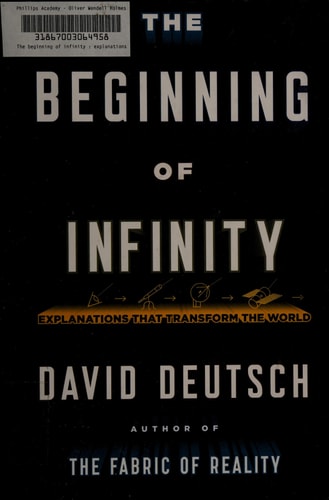
The beginning of infinity: explanations that transform the world

Deutsch, David
"A bold and all-embracing exploration of the nature and progress of knowledge from one of today's great thinkers. Throughout history, mankind has struggled to understand life's mysteries, from the mundane to the seemingly miraculous. In this important new book, David Deutsch, an award-winning pioneer in the field of quantum computation, argues that explanations have a fundamental place in the universe. They have unlimited scope and power to cause change, and the quest to improve them is the basic regulating principle not only of science but of all successful human endeavor. This stream of ever improving explanations has infinite reach, according to Deutsch: we are subject only to the laws of physics, and they impose no upper boundary to what we can eventually understand, control, and achieve. In his previous book, The Fabric of Reality, Deutsch describe the four deepest strands of existing knowledge-the theories of evolution, quantum physics, knowledge, and computation-arguing jointly they reveal a unified fabric of reality. In this new book, he applies that worldview to a wide range of issues and unsolved problems, from creativity and free will to the origin and future of the human species. Filled with startling new conclusions about human choice, optimism, scientific explanation, and the evolution of culture, The Beginning of Infinity is a groundbreaking book that will become a classic of its kind"--
Viking 2011 487 pages