211 results for "History"

Japan's Holocaust. History of Imperial Japan's Mass Murder and Rape During World War II

Rigg, Bryan Mark
Japan's Holocaust is a comprehensive exploration of Japan's mass murder and sexual crimes during the Pacific and Asian Wars from 1927 to 1945. Japan's Holocaust combines research conducted in over eighteen research facilities in five nations to explore Imperial Japan's atrocities from 1927 to 1945 during its military expansions and reckless campaigns throughout Asia and the Pacific. This book brings together the most recent scholarship and new primary research to ascertain that Japan claimed a minimum of thirty million lives, slaughtering far more than Hitler's Nazi Germany. Japan's Holocaust shows that Emperor Hirohito not only knew about the atrocities his legions committed, but actually ordered them. He did nothing to stop them when they exceeded even the most depraved person's imagination, as illustrated during the Rape of Nanking as well as many other events. Japan's Holocaust will document in painful detail that the Rape of Nanking was not an isolated event during the Asian War but rather representative of how Japan behaved for all its campaigns throughout Asia and the Pacific from 1927 to 1945. Mass murder, rape, and economic exploitation was Japan's modus operandi during this time period, and whereas Hitler's SS Death's Head outfits attempted to hide their atrocities, Hirohito's legions committed their atrocities out in the open with fanfare and enthusiasm. Moreover, whereas Germany has done much since World War II to atone for its crimes and to document them, Japan has been not with its reparations for its crimes and in its efforts to educate its population about its wartime past. Japan continues, in general, to glorify is criminals and its wartime past. --
Post Hill Press 2024 446 pages

The Polish officer

Furst, Alan
"September, 1939. The opening days of World War II. The invading German Wehrmacht blazes a trail of destruction across Poland. Warsaw is surrounded. France and Britain declare war, but do nothing to help. And a Polish resistance movement takes shape under the shadow of occupation, enlisting those willing to risk death in a David-and-Goliath struggle for a nation's survival. Among them is Captain Alexander de Milja, an officer in the Polish military intelligence service, a cartographer who now must learn a dangerous new role; spymaster in the anti-Nazi underground. Beginning with a daring operation to smuggle the Polish National Gold Reserve to the government in exile, he slips into the shadowy and treacherous front lines of espionage that span occupied Europe; he moves through Poland, France, and the Ukraine, changing identities and staying one step ahead of capture. In Warsaw, he engineers a subversive campaign to strengthen the people's will to resist. In Paris, he poses as a Russian poet, then as a Slovakian coal merchant, drinking champagne in black-market bistros with Nazis while uncovering information about German battle plans. And a love affair with a woman of the French Resistance leads him to make the greatest decision of his life. In the Polish Officer, Alan Furst returns to the shadowy, clandestine arena of World War II spycraft, and the result is a gripping, panoramic espionage novel in the tradition of Graham Greene and John le Carré. The Polish Officer, like Furst's acclaimed Night Soldiers and Dark Star, has a haunting authenticity that brings the era to vital life. His story, brilliantly and colorfully cast, is written with a keen awareness of the nuances of national character, individual psychology, and the weight of history. It evokes the turmoil of a world gone mad, and the courageous heroism of ordinary men and women during the darkest hours of our time. Literate, sophisticated, and utterly convincing, it is by far Furst's best work to date."--
Random House 1995 325 pages

Prague in danger: the years of German occupation, 1939-45 : memories and history, terror and resistance, theater and jazz, film and poetry, politics and war

Demetz, Peter
A dramatic account of life in Czechoslovakia's great capital during the Nazi Protectorate With this successor book to Prague in Black and Gold, his account of more than a thousand years of Central European history, the great scholar Peter Demetz focuses on just six short years--a tormented, tragic, and unforgettable time. He was living in Prague then--a "first-degree half-Jew," according to the Nazis' terrible categories--and here he joins his objective chronicle of the city under German occupation with his personal memories of that period: from the bitter morning of March 15, 1939, when Hitler arrived from Berlin to set his seal on the Nazi takeover of the Czechoslovak government, until the liberation of Bohemia in April 1945, after long seasons of unimaginable suffering and pain. Demetz expertly interweaves a superb account of the German authorities' diplomatic, financial, and military machinations with a brilliant description of Prague's evolving resistance and underground opposition. Along with his private experiences, he offers the heretofore untold history of an effervescent, unstoppable Prague whose urbane heart went on beating despite the deportations, murders, cruelties, and violence: a Prague that kept its German- and Czech-language theaters open, its fabled film studios functioning, its young people in school and at work, and its newspapers on press. This complex, continually surprising book is filled with rare human detail and warmth, the gripping story of a great city meeting the dual challenge of occupation and of war.
Farrar, Straus and Giroux 2008-04-15 274 pages

Prague in danger: the years of German occupation, 1939-45 : memories and history, terror and resistance, theater and jazz, film and poetry, politics and war

Demetz, Peter
A dramatic account of life in Czechoslovakia's great capital during the Nazi Protectorate With this successor book to Prague in Black and Gold , his account of more than a thousand years of history in the great Central European capital, Peter Demetz focuses on the six years that Prague was under German occupation in World War II: from the bitter morning of March 15, 1939, when Hitler arrived from Berlin to set his seal on the Nazi takeover of the Czechoslovak government, until the liberation of Bohemia in April 1945. Demetz was a boy living in Prague then, and here he joins his objective chronicle of the city under Nazi control with his personal memories of that period, expertly interweaving a superb account of the German authorities' diplomatic, financial, and military machinations with a brilliant description of Prague's evolving resistance and underground opposition. The result is a complex, continually surprising book filled with rare human detail and warmth, the gripping story of a great city meeting the dual challenge of occupation and of war.
Farrar, Straus and Giroux 2008 274 pages

Among the righteous: lost stories from the Holocaust's long reach into Arab lands

Satloff, Robert B.
In the face of almost universal Holocaust denial among Arabs, presents evidence of Arab involvement in all aspects of the Holocaust (e.g. persecution, confiscation of property, and forced labor). Describes cases of active collaboration (e.g. sadistic torturers and camp guards) and indifference to the fate of the Jews. In the European context, shows how Vichy France implemented the Holocaust in North Africa. Demonstrates how the Holocaust has largely been ignored, forgotten, or denied in the postwar Arab world. Provides information about the Holocaust as it affected Jews in Morocco, Algeria, and Tunisia, including about labor camps whose existence had been lost to history. The second half of the book relates cases of "righteous" Arabs who saved Jews. Among the latter are Khaled Abdelwahhab and Si Ali Sakkat of Tunisia; Si Kaddour Benghabrit, the rector of the Great Mosque in Paris; the ruler of Tunisia, Moncef Bey, and his prime minister Mohamed Chenik; and Sultan Muhammad V of Morocco. In conclusion, relates how some Arabs are beginning to question Holocaust denial. Pp. 197-198 present a list of sites of 104 French, German, and Italian labor camps in Algeria, Morocco, and Tunisia.
PublicAffairs 2006-10-30 251 pages

Athene Palace

Waldeck, R. G.
As European capitals fell during 1940 and 1941, there swarmed to the Athene Palace, Bucharest’s Grand Hotel, diplomats, generals, Gestapo spies, and demi-mondaines from all over Europe. Arriving at the crowded Athene Palace on the day Paris fell in June 1940, American female journalist Rosa Goldschmidt Waldeck observed for the next seven months all the events that unfolded and the international figures that made Romania Europe’s last sensational hotbed of intrigue and color. Hitler’s beautiful feminine agents held court in the Athene Palace lobby within eyeshot of British diplomats, while around them moved fifth columnists, German economists, and generals, American and English diplomats and newspapermen, all who made the Athene Palace the most glamorous spot on the continent. The dramatic events of this turbulent period are described here chiefly in terms of personalities: Carol and Lupescu, Antonescu and Dr. Clodius, Nazi Gauleiters, British Quislings, Romanian appeasers, and all the types who dominated the scene of World War II Europe... On the surface, this is a fast-moving, dramatic book, as readable as a novel, but it is also a most effective dissection of the Nazi New Order. This penetrating insight into the German administration of Europe reveals the reasons underlying the failure of the Nazi regime. Originally published during the Second World War, this new edition of Athene Palace is enhanced by a thorough introductory study on the author’s life and work by Ernest H. Latham, Jr., former cultural attaché at the American Embassy in Bucharest. Dr. Latham is a well-known specialist in Romanian history and has done extensive research on American and British journalists in Romania during World War II.
Histria, The Center for Romanian Studies 2018 378 pages

The bomb

Zinn, Howard
As an active WWII bombardier returning from the end of the war in Europe and preparing for combat in Japan, Howard Zinn read the headline "Atomic Bomb Dropped on Japan" and was glad—the war would be over. "Like other Americans," writes Zinn, "I had no idea what was going on at the higher levels, and had no idea what that 'atomic bomb' had done to men, women, children in Hiroshima, any more than I ever really understood what the bombs I dropped on European cities were doing to human flesh and blood." During the war, Zinn had taken part in the aerial bombing of Royan, France, and in 1966, he went to Hiroshima, where he was invited to a "house of rest" where survivors of the bombing gathered. In this short and powerful book, the backstory of the making and use of the bomb, Zinn offers his deep personal reflections and political analysis of these events, and the profound influence they had in transforming him from an order-taking combat soldier to one of our greatest anti-authoritarian, anti-war historians. Simultaneous publication this August in the U.S. and Japan commemorates the 65th anniversary of the USA's two atomic bombings of Japan by calling for the abolition of all nuclear weapons and an end to war as an acceptable solution to human conflict. "It's my favorite. . . . He wrote the book to remind himself and to remind us that anybody can throw the wrench in the machinery, and we often should." -- Bill Moyers "Part history, part memoir, part sermon, The Bomb is meant to wake up citizens, to rouse them to reject 'the abstractions of duty and obedience' and to refuse to heed the call of war." —Jonah Raskin, The Rag Blog
City Lights Books 2010-08-01 91 pages

Jewish reactions to the Holocaust

Bauer, Yehuda
A revised version of two courses of lectures delivered as part of the Broadcast University series of Israel Army Radio. Discusses the struggle of Jews for survival under Nazi rule, and attempts at aid and rescue by Jews in the Western democracies and Palestine, by foreign governments, and by "Righteous Gentiles". Emphasizes that the Nazis decided to murder all the Jews only in autumn 1940; until then no one could have foreseen the Holocaust to come. When the first reports of mass murder were received, they met with disbelief on the part of most Jews as well as non-Jews. This lack of awareness explains why the potential victims were slow to escape or resist; and, in conjunction with the prevalence of antisemitism and the political impotence of world and Palestinian Jewry, it also explains the failure of the outside world to come to their rescue. Among the topics covered are the search for countries of asylum; the Transfer Agreement; illegal immigration to Palestine; the ghettos and the Judenräte; the resistance groups and armed uprisings in the ghettos; Jewish partisans; underground rescue groups; negotiations with SS functionaries for Jewish lives; and the British Foreign Office's blocking of rescue proposals.
MOD Books 1989 226 pages

Imperfect justice: looted assets, slave labor, and the unfinished business of World War II

Eizenstat, Stuart
A personal memoir by Eizenstat, who served under President Carter in several capacities, including secretary of state on Holocaust issues, relating his experiences in negotiations with governments of and/or business representatives from Switzerland, Austria, France, and Germany to pay compensation to Holocaust victims or their heirs for looted property and for suffering (slave labor) under the Nazis. Swiss gold, stolen art, and other stolen property of individuals and communities were finally repaid through agreements reached or encouraged by U.S. class-action suits. In addition to the "imperfect justice" of financial recompense, notes the moral success of furthering the truth and inspiring international efforts at Holocaust education. also discusses the author's role in helping establish the U.S. Holocaust Memorial Museum.
Public Affairs 2003 401 pages

GI Jews: how World War II changed a generation

Moore, Deborah Dash
Whether they came from Sioux Falls or the Bronx, over half a million Jews entered the U.S. armed forces during the Second World War. Uprooted from their working- and middle-class neighborhoods, they joined every branch of the military and saw action on all fronts. Deborah Dash Moore offers an unprecedented view of the struggles these GI Jews faced, having to battle not only the enemy but also the prejudices of their fellow soldiers. Through memoirs, oral histories, and letters, Moore charts the lives of fifteen young Jewish men as they faced military service and tried to make sense of its demands. From confronting pork chops to enduring front-line combat, from the temporary solace of Jewish worship to harrowing encounters with death camp survivors, we come to understand how these soldiers wrestled with what it meant to be an American and a Jew. Moore shows how military service in World War II transformed this generation of Jews, reshaping Jewish life in America and abroad. These men challenged perceptions of Jews as simply victims of the war, and encouraged Jews throughout the diaspora to fight for what was right. At the same time, service strengthened Jews' identification with American democratic ideals, even as it confirmed the importance of their Jewish identity. GI Jews is a powerful, intimate portrayal of the costs of a conflict that was at once physical, emotional, and spiritual, as well as its profound consequences for these hitherto overlooked members of the "greatest generation."
Belknap 2006-04 368 pages

Hitler's spies: German military intelligence in World War II

Kahn, David
A German patrol wiggles through Russian lines to return with details of Soviet defenses. An expert Luftwaffe interrogator teases secret information from downed Allied airmen. Two spies steal ashore in Maine and make their way into New York City. Filled with episodes of intrigue and adventure, Hitler's Spies reveals the workings of German intelligence-the famed Abwehr, the dreaded SD, the codebreakers, the spies, and the intelligence gatherers of the Foreign Office-and explains its failure to best the Allies. Draws on original documents and extensive interviews.
Macmillan 1978 671 pages

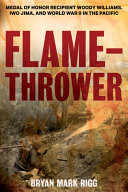
Flamethrower: Medal of Honor recipient Woody Williams, Iwo Jima, and World War II in the Pacific

Rigg, Bryan Mark
"Imagine strapping on a highly flammable 70-pound pack and entering combat as a surefire walking target-and you'd only begin to understand the job, and the horror, of Marine Corps flamethrower man. That's precisely what Hershel "Woody" Williams did in World War II, most importantly in February 1945 on Iwo Jima, one of the Pacific War's toughest battles. A few days into the battle, Marines were fighting hard for an airfield, and his captain asked Woody if he could do anything. He responded, "I'll try"-and for the next four hours, he virtually singlehandedly took on and ultimately destroyed seven enemy pillboxes and helped secure the airfield. Accomplished military historian Bryan Mark Rigg reconstructs Williams' remarkable story, from his youth in West Virginia to his experiences on Guadalcanal, Saipan, Guam, and most significantly Iwo Jima. In Rigg's telling, Williams's Medal of Honor action is not "just" a brave deed, but one of only a few strategically significant brave deeds-one that secured a strategic objective during a major campaign. Rigg tells Williams' story vividly, and objectively, and places it in the context of the broader Pacific theater of World War II."--
Stackpole Books 2020 544 pages

The Routledge history of the Second World War

Paul R. Bartrop
The Routledge History of the Second World War sums up the latest trends in the scholarship of that conflict, covering a range of major themes and issues. The book delivers a thematic analysis of the many ways in which study of the Second World War can take place, considering international, transnational, and global approaches, and serves as a major jumping off point for further research into the specific fields covered by each of the expert authors. It demonstrates the global and total nature of the Second World War, giving due coverage to the conflict in all major theatres and through the lens of the key combatants and neutrals, examines issues of race, gender, ideology, and society during the war, and functions as a textbook to educate students as to the trends that have taken place in how the conflict has been (and can be) interpreted in the modern world. Divided into twelve parts that cover central themes of the conflict, including theatres of war, leadership, societies, occupation, secrecy and legacies, it enables those with no memory of war to approach it with a view to comprehending what it was all about and places the history of this conflict into a context that is international, transnational, and institutional. This is a comprehensive and accessible reference volume for anyone interested in the most up to date scholarship on this major conflict.
Routledge, Taylor & Francis Group 2022 789 pages

Five days in London, May 1940

Lukacs, John
The days from May 24 to May 28, 1940 altered the course of the history of this century, as the members of the British War Cabinet debated whether to negotiate with Hitler or to continue the war. The decisive importance of these five days is the focus of John Lukacs's magisterial new book. Lukacs takes us hour by hour into the critical unfolding of events at 10 Downing Street, where Churchill and the members of his cabinet were painfully considering their war responsibilities. We see how the military disasters taking place on the Continent-particularly the plight of the nearly 400,000 British soldiers bottled up in Dunkirk-affected Churchill's fragile political situation, for he had been prime minister only a fortnight and was regarded as impetuous and hotheaded even by many of his own party. Lukacs also investigates the mood of the British people, drawing on newspaper and Mass-Observation reports that show how the citizenry, though only partly informed about the dangers that faced them, nevertheless began to support Churchill's determination to stand fast. Other historians have dealt with Churchill's difficulties during this period, using the partial revelations of certain memoirs and private and public papers. But Lukacs is the first to convey the drama and importance of these days, and he does so in a compelling narrative that combines deep knowledge with high literary style.
Yale University Press 1999-09-10 236 pages

SMERSH: Stalin's secret weapon

Birstein, Vadim J.
"Why is a book about SMERSH relevant today? As Mr. Birstein takes pains to point out, 'the present Russian government seems intent on whitewashing Stalin's atrocities and the history of the Soviet security services.'"-- The Washington Times SMERSH is primarily known to readers in English as James Bond's sinister opponent. Yet SMERSH was a real organization and was just as diabolical as its fictional counterpart. Based on Russian documents and memoirs, a critical missing piece of the history of World War II and the Soviet secret services is finally exposed to the light of day. Vadim J. Birstein, PhD , is a historian, activist, and molecular geneticist. He lives in New York.
Biteback Publishing 2013 512 pages

I escaped from Auschwitz

Vrba, Rudolf
"At 6 P.M. on April 7th, 1944 sirens shrieked continuously as two prisoners escaped from Auschwitz. Once free, Rudolf Vrba and Alfred Wetzler wrote a report that detailed -- for the first time -- the mechanics of the Nazi Death Factory. The report -- known now as the Vrba-Wetzler Report on the Auschwitz Protocols -- warned the world that the Nazis were preparing to kill nearly 800,000 Hungarian Jews. The report was smuggled to Switzerland and eventually reached the U.S. State Department, the Vatican, and the British Embassy in Berlin. I Escaped from Auschwitz is the first-hand account of his daring escape. It also includes the full text of the Auschwitz Protocols which is considered by many to be one of the most important documents of the twentieth century. The subsequent handling and mishandling of the report contained in this book has marred history forever." --
Barricade Books 2002 447 pages