100 results for "Human Biology"

The politics of women's biology

Hubbard, Ruth
For a range of historical and contemporary issues in eugenics, human evolution, and procreative technology, Ruth Hubbard explains why scientific descriptions and choices should not generalize human, or female, attributes without acknowledging the realities of people's lives. Sophisticated in its analysis, yet not at all technical in its exposition, this book will find a wide readership among feminists, the general public, and the scientific community.
Rutgers University Press 1990 229 pages

Essays on the anthropology of reason

Rabinow, Paul
This collection of essays explains and encourages new reflection on Paul Rabinows pioneering project to anthropologize the West. His goal is to exoticize the Western constitution of reality, emphasize those domains most taken for granted as universal, and show how their claims to truth are linked to particular social practices, hence becoming effective social forces. He has recently begun to focus on the core of Western rationality, in particular the practices of molecular biology as they apply to our understanding of human nature. This book moves in new directions by posing questions about how scientific practice can be understood in terms of ethics as well as in terms of power.The topics include how French socialist urban planning in the 1930s engineered the transition from city planning to life planning; how the discursive and nondiscursive practices of the Human Genome Project and biotechnology have refigured life, labor, and language; and how a debate over patenting cell lines and over the dignity of life required secular courts to invoke medieval notions of the sacred. Building on an ethnographic study of the invention of the polymerase chain reaction--which enables the rapid production of specific sequences of DNA in millions of copies Rabinow, in the final essay, reflects in dialogue with biochemist Tom White on the place of science in modernity, on science as a vocation, and on the differences between the human and natural sciences.
Princeton University Press 1996 190 pages

Philosophical Darwinism: On the Origin of Knowledge by Means of Natural Selection

Münz, Peter
Philosophers have not taken the evolution of human beings seriously enough. If they did, argues Peter Munz, many long standing philosophical problems would be resolved. One of philosophical concequences of biology is that all the knowledge produced in evolution is a priori , i.e., established hypothetically by chance mutation and selective retention, not by observation and intelligent induction. For organisms as embodied theories, selection is natural and for theories as disembodied organisms, it is artificial. Following Popper, the growth of knowledge is seen to be continuous from the amoeba to Einstein'. Philosophical Darwinism throws a whole new light on many contemporary debates. It has damaging implications for cognitive science and artificial intelligence, and questions attempts from within biology to reduce mental events to neural processes. More importantly, it provides a rational postmodern alternative to what the author argues are the unreasonable postmodern fashions of Kuhn, Lyotard and Rorty.
Routledge 2014-05-16 264 pages

Handbook of Nuclear Receptors: Part I: Receptor Families - Part II: Receptor Concepts

John Schwabe,Laszlo Nagy
Timely and unrivalled, this first work to categorize and systematically cover all recently identified receptors in the human genome is all set to become the gold standard in the field of receptor genetics and physiology. In three handy volumes, this comprehensive guide adopts an innovative approach, where, in the first part, each receptor family is discussed individually, based on the latest evidence. In the second part, the knowledge is integrated into concepts and overviews of common themes in present-day receptor research.While serving as a central resource for many disciplines, including biochemistry, molecular genetics and physiology, this reference will be equally welcomed by drug developers and cancer researchers.
Wiley-VCH 2010-07-20 1200 pages

The philosophy of biology: an episodic history

Grene, Marjorie
"Is life different from the non-living? If so, how? And how, in that case, does biology, as the study of living things, differ from other sciences? These questions lie at the heart of The Philosophy of Biology, and are traced through an exploration of episodes in the history of biology and philosophy. The book begins with Aristotle, then moves on to Descartes, comparing his position with that of Harvey. From the eighteenth century, the authors consider Buffon and Kant. From the nineteenth century, the authors examine the Cuvier-Geoffroy debate, pre-Darwinian geology and natural theology, Darwin, and the transition from Darwin to the revival of Mendelism. Two chapters on the twentieth century deal with the Modern Evolutionary Synthesis and such questions as the species problem, the reducibility or otherwise of biology to physics and chemistry, and the problem of biological explanation in terms of function and teleology. The final chapters reflect on the question of human nature and the implications of the philosophy of biology for the philosophy of science in general."--Jacket
Cambridge University Press 2004-08-02 416 pages

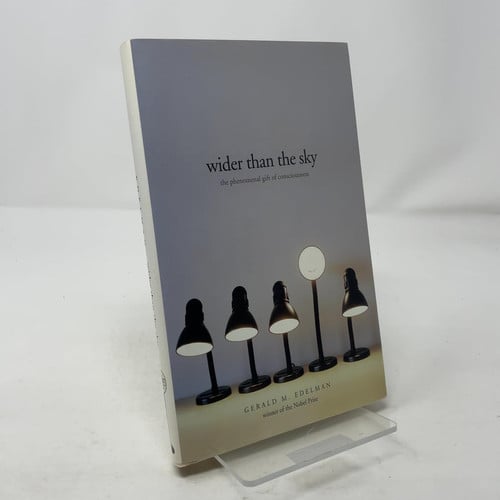
Wider than the sky: the phenomenal gift of consciousness

Edelman, Gerald M.
A neuroscientist demystifies the subject of consciousness in this up-to-date discussion of mind-body connections. How does the firing of neurons give rise to subjective sensations, thoughts, and emotions? How can the disparate domains of mind and body be reconciled? The quest for a scientifically based understanding of consciousness has attracted study and speculation across the ages. In this direct and non-technical discussion of consciousness, Dr. Gerald M. Edelman draws on a lifetime of scientific inquiry into the workings of the brain to formulate answers to the mind-body questions that intrigue every thinking person. Concise and understandable, the book explains pertinent findings of modern neuroscience and describes how consciousness arises in complex brains. Edelman explores the relation of consciousness to causation, to evolution, to the development of the self, and to the origins of feelings, learning, and memory. His analysis of the brain activities underlying consciousness is based on recent remarkable advances in biochemistry, immunology, medical imaging, neuroscience, and evolutionary biology, yet the implications of his book extend farther--beyond the worlds of science and medicine into virtually every area of human inquiry.
Yale University Press 2004-01-01 201 pages

Dear Mr Darwin: letters on the evolution of life and human nature

Dover, G. A.
"Stimulated by Darwin's relatively uninformed but obviously intelligent questions, Dover takes the father of evolution on an exhilarating roller-coaster ride through recent genetic discoveries. In recounting stories from the treasure trove of modern biology, Dover exposes the naively deterministic view of selfish genes and their supposed lonely pursuits of self-replication and self-immortalization. He reveals a world of evolution far more intricate and subtle than can be expected from the notion of natural selection acting alone - a world in which genes are born to cooperate, as a consequences of newly discovered genetic processes."--BOOK JACKET.Title Summary field provided by Blackwell North America, Inc. All Rights Reserved
Weidenfeld & Nicolson 2000 268 pages

The faith of biology & the biology of faith: order, meaning, and free will in modern medical science

Pollack, Robert
Are there parallels between the "moment of insight" in science and the emergence of the "unknowable" in religious faith? Where does scientific insight come from? Award-winning biologist Robert Pollack argues that an alliance between religious faith and science is not necessarily an argument in favor of irrationality: the two can inform each other's visions of the world. Pollack begins by reflecting on the large questions of meaning and purpose--and the difficulty of finding either in the orderly world described by the data of science. He considers the obligation to find meaning and purpose despite natural selection's claim to be a complete explanation of our presence as a species--a claim that calls upon neither natural intention, nor design, nor Designer. Next, the book focuses on matters of free will, from the choice of a scientist to accept evidence, to the choice of a religious person to accept a revelation, to a patient's loss of free will in medical treatment. Here Pollack addresses questions of ethics and offers a provocative comparison of two difficult texts whose contents remain incompletely understood: the DNA "text" of the human genome and the Hebrew record of Jewish written and oral law. In closing, Pollack considers the promise of genetic medicine in enabling us to glimpse our own future and offers a reconsideration of the possible utility of the so-called placebo effect in curing illness. Whether refuting a DNA-based biological model of Judaism or discussing the Darwinian concept of the species, Pollack, under the banner of free inquiry, presents a genuine, vital, and well-argued assay of the intersection of science and religion.
Columbia University Press 2000 125 pages

Human ecology, human economy

Mark Diesendorf,Clive Hamilton
'A brilliant synthesis of ecology and economics that provides a sure guide to a sustainable future. It is a must for all environmentalists and economists.' Charles Birch 'Written by an impressive list of experts across a number of disciplines, this readable text provides not only analysis but vigorous criticism-and answers.' Robyn Williams 'This book is such a useful guide to responsible decision-making that it should be supplied in bulk to senior government officials and managers in the private sector.' Ian Lowe 'This is a fine contribution to ecological economics coming from Australia, and of interest worldwide.' Herman E Daly Human well-being is wholly dependent upon the continued good health of the Earth s ecosystems. Human behaviour as it interacts with the biophysical environment is enormously complex, as governments (and individuals) who must make decisions about resource use are becoming increasingly aware. Human Ecology, Human Economy provides the basic concepts and tools for understanding how to analyse that interaction. The book is designed to be used as a text for undergraduate and graduate students in environmental studies, human and social ecology, ecological economics, futures studies, and science and technology studies. It is also intended for interested members of the public and for policy-makers working on environmental issues, especially where these intersect with economic policy. Human Ecology, Human Economy not only covers the basic concepts, but also moves to some of the frontiers of thinking in several case studies. It uses a problem and solution oriented approach which crosses disciplinary boundaries, drawing together elements from biology, economics, philosophy and political science. Professor Mark Diesendorf is Director of the Institute for Sustainable Futures at the University of Technology, Sydney and Vice President of the Sustainable Energy Industries Council of Australia. Among the books he has edited are The Magic Bullet and Energy And People. Dr Clive Hamilton is Executive Director of the Australia Institute, Canberra and teaches in the Public Policy Program at the Australian National University. His books include Capitalist Industrialisation In Korea, The Mystic Economist and The Economic Dynamics Of Australian Industry.
Routledge 2021-03-31 400 pages

The Meaning of Dreams

Isador H. Coriat
THE new psychology of dreams, as elaborated by Freud, represents one of the greatest advances ever made in our knowledge pf the human mind and of human motives. For abnormal psychology, dream-analysis can be compared only in importance with the discovery of the origin of species and of the factors of organic evolution in the field of biology. The analysis of dreams is not only of great theoretical value in the understanding of the unconscious but has its practical side as well, in giving medicine the most potent instrument which it has ever possessed in the treatment of certain functional nervous disturbances.This volume is written along purely psycho-analytic lines, and every dream therein has been personally analyzed by the author. Its aim is to give the general reader an outline of the meaning of dreams as elaborated by the psycho-analytic school, with its applications to medical science, in particular to that method of psychotherapy known as psycho-analysis. Because of the great difficulties inherent in the subject of dream-analysis, only the basic principles have been given, the details being left for the special treatises and journals on the subject.ISADOR H. CORIAT.Boston, February, 1915.
CreateSpace Independent Publishing Platform 2017-09-06 78 pages

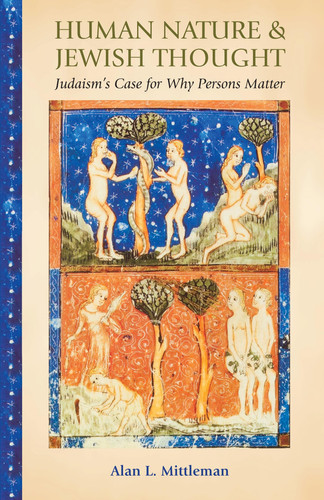
Human nature & Jewish thought: Judaism's case for why persons matter

Mittleman, Alan
This book explores one of the great questions of our time: How can we preserve our sense of what it means to be a person while at the same time accepting what science tells us to be true-namely, that human nature is continuous with the rest of nature? What, in other words, does it mean to be a person in a world of things? Alan Mittleman shows how the Jewish tradition provides rich ways of understanding human nature and personhood that preserve human dignity and distinction in a world of neuroscience, evolutionary biology, biotechnology, and pervasive scientism. These ancient resources can speak to Jewish, non-Jewish, and secular readers alike. Science may tell us what we are, Mittleman says, but it cannot tell us who we are, how we should live, or why we matter. Traditional Jewish thought, in open-minded dialogue with contemporary scientific perspectives, can help us answer these questions. Mittleman shows how, using sources ranging across the Jewish tradition, from the Hebrew Bible and the Talmud to more than a millennium of Jewish philosophy. Among the many subjects the book addresses are sexuality, birth and death, violence and evil, moral agency, and politics and economics. Throughout, Mittleman demonstrates how Jewish tradition brings new perspectives to-and challenges many current assumptions about-these central aspects of human nature. A study of human nature in Jewish thought and an original contribution to Jewish philosophy, this is a book for anyone interested in what it means to be human in a scientific age.
Princeton University Press 2015 215 pages

The organism

Goldstein, Kurt
In this remarkable book by one of the great psychologists and neurologists of the early twentieth century, Kurt Goldstein presents a summation of his “holistic” theory of the human organism. In the course of his studies on brain-damaged soldiers during the First World War, Goldstein became aware of the failure of contemporary biology and medicine to genuinely understand both the impact of such injuries and the astonishing adjustments that patients made to them. He challenged reductivist approaches that dealt with “localized” symptoms, insisting instead that an organism be analyzed in terms of the totality of its behavior and interaction with its surrounding milieu. He was especially concerned with the breakdown of organization and the failure of central cerebral controls that take place in catastrophic responses to situations such as physical or mental illness. But Goldstein was equally attuned to the amazing powers of the organism to readjust to such devastating losses, if only by withdrawal to a more limited range of activity that it could manage by a redistribution of its reduced energies, thus reclaiming as much wholeness as new circumstances allowed. Goldstein’s concepts in The Organism have had a major impact on philosophical and psychological thought throughout this century, as can be seen in the work of Maurice Merleau-Ponty, Georges Canguilhem, Ernst Cassirer, Ludwig Binswanger, and Roman Jakobson, not to mention the wide-ranging field of Gestalt psychology.
Zone 2000-04-04 424 pages

The accompaniment: assembling the contemporary

Rabinow, Paul
In this culmination of his search for anthropological concepts and practices appropriate to the twenty-first century, Paul Rabinow contends that to make sense of the contemporary anthropologists must invent new forms of inquiry. He begins with an extended rumination on what he gained from two of his formative mentors: Michel Foucault and Clifford Geertz. Reflecting on their lives as teachers and thinkers, as well as human beings, he poses questions about their critical limitations, unfulfilled hopes, and the lessons he learned from and with them. This spirit of collaboration animates The Accompaniment , as Rabinow assesses the last ten years of his career, largely spent engaging in a series of intensive experiments in collaborative research and often focused on cutting-edge work in synthetic biology. He candidly details the successes and failures of shifting his teaching practice away from individual projects, placing greater emphasis on participation over observation in research, and designing and using websites as a venue for collaboration. Analyzing these endeavors alongside his efforts to apply an anthropological lens to the natural sciences, Rabinow lays the foundation for an ethically grounded anthropology ready and able to face the challenges of our contemporary world.
University of Chicago Press 2011-11-15 238 pages

Life: the leading edge of evolutionary biology, genetics, anthropology, and environmental science

John Brockman
"The newest addition to John Brockman's Edge.org series explores life itself, bringing together the world's leading biologists, geneticists, and evolutionary theorists -- including Richard Dawkins, Edward O. Wilson, J. Craig Venter, and Freeman Dyson. Scientists' understanding of life is progressing more rapidly than at any point in human history, from the extraordinary decoding of DNA to the controversial emergence of biotechnology. Featuring pioneering biologists, geneticists, physicists, and science writers, Life explains just how far we've come -- and takes a brilliantly educated guess at where we're heading. Richard Dawkins and J. Craig Venter compare genes to digital information, and sketch the frontiers of genomic research. Edward O. Wilson reveals what ants can teach us about building a superorganism -- and, in turn, about how cells build an organism. Elsewhere, David Haig reports new findings on how mothers and fathers individually influence the human genome, while Kary Mullis covers cutting edge treatments for dangerous viruses. And there's much more in this fascinating volume. We may never have all the answers. But the thinkers collected in Life are asking questions that will keep us dreaming for generations."--provided by Amazon.com.
Harper Perennial 2016-04-19 367 pages

A World of Wounds:Ecologists and the Human Dilemma: 8 (Excellence in Ecology)

Paul R Ehrlich
Recipient of the ECI Prize in 1993 for terrestrial ecology. Reviews and analyses the essential aspects of modern ecological research and its bearing on society and on related sciences. The author deplores that many ecologists are not doing enough to motivate society into counteracting the increasing degradation of our environment. Hence, he outlines and discusses what, in his opinion, research ecologists should do to avoid the world's plunge towards ecocatastrophe.
International Ecology Institute 1997-12-31 210 pages