

85 results for "Investing"

Ugly Americans Proof

The basics of investing
This book and the other three books in Making the Most of Your Money series provide readers with practical and usable information about money. The Basics of Investing offers a clear road map for readers to follow when handling money and making decisions about what to do with it. It answers these fundamental questions: Why is saving not enough? When is the right time to begin investing? What are the goals of investing, and how do they change over the investor's lifetime? What investment alternatives are right for each type of investor? How can a new investor build a solid portfolio? Should investors manage their own porfolios? The Basics of Investing is written for consumers who are confused about their finances and need a well-written, easy-to-understand guide to making safe, sound investments.

Changing the Rules Adventures of a Wall Street Maverick
When Mickie Siebert arrived in New York in the mid-1950s, she had $500 in her wallet and drove a used Studebaker. Almost fifty years later she is known as the "First Woman of Finance," the only woman to head a publicly traded national brokerage firm. Pithy, vastly entertaining, and full of behind-the-scenes anecdotes, Changing the Rules reveals how Siebert forged her phenomenal success in the chaotic and cutthroat world of Wall Street. Three four-letter words are behind Siebert's career success: One is work -- she learned everything there was to know about a company before recommending its stock. The second is luck -- as an analyst in training, she had the good fortune to follow a fledgling industry that nobody else wanted. (The "dog" industry was airlines.) The third word is risk -- she knew how to assess liability and make a decision. Siebert recounts the resistance of the good gray Stock Exchange when she dared to infiltrate the boys' club, threatening to have a Port-O-San delivered to the NYSE luncheon club if they didn't add a women's bathroom. She reveals the backstage stories about saving Lockheed and selling Conrail (at the time, the largest stock offering in Wall Street history), as well as the changes on the Street that led to May Day, 1975, when she was first in line as a discount broker (and considered a pariah by industry standards). She tells of her memorable encounters with such legendary figures as Captain Eddie Rickenbacker, the World War I flying ace who ran Eastern Airlines, and Robert Brimberg, the iconoclastic "Scarsdale Fats" whose investing acumen was the envy of the Street. Writing with equal candor about the politics of finance and the finance of politics, Siebert recalls her five years as Superintendent of Banking for New York State -- when she helped to prevent a national fiscal crisis during the Iran hostage situation -- and her experiences as a pro-choice Republican senatorial candidate. Siebert's reputation for rocking the boat is legendary, and Changing the Rules is both a fascinating biography of a true pioneer, and a valuable strategic and informational tool for anyone who deals with or dabbles in the money game.

Better, Stronger, Faster The Myth of American Decline . . . and the Rise of a New Economy
Daniel Gross, Yahoo! financial columnist and author of Dumb Money , offers a refreshingly optimistic take on our nation’s economic prospects, examining the positive trends that point to a better, stronger future. Financial meltdown, a deep recession, and political polarization—combined with strong growth outside the U.S.—have led to a global bubble of pessimism surrounding the U.S. and its economic prospects. Bloated with debt, outpaced by China, India, and other emerging markets, the U.S. has been left for dead as an economic force. But, Daniel Gross, widely respected for his Newsweek and Slate coverage of the crash and the recovery, shows that much of the talk about decline is misplaced. In the wake of the crash, rather than accept the inevitability of a Japan-style lost decade, America’s businesses and institutions tapped into the very strengths that built the nation’s economy into the global powerhouse in the first place: speed, ingenuity, adaptability, pragmatism, entrepreneurship, and, most significantly, an ability to engage with the world. As the U.S. wallowed in self-pity, the world continued to see promise in what America has to offer—buying exports, investing in the U.S., and adapting American companies and business models as their own. Global growth, it turns out, is not a zero-sum game. These same attributes can propel the world’s largest economy forward through the significant headwinds it faces. Better, Stronger, Faster is a narrative of the remarkable reconstruction and reorientation that started in March 2009, a period that Gross compares to March 1933. Both marked the start of unexpected recoveries and monumental shifts in our nation’s history. As Gross explains, through stories of innovative solutions devised by policymakers, businesses, investors, and consumers, America has the potential to emerge from this period, not as the unrivaled ruler of the global economy, but as a leader and enabler of growth.

Never Going Home A Tale of Extraordinary People in Today's Formidable Times
Never Going Home is a wake-up tale of passionate love, intrigue, despair, and tragedy. The players in Never Going Home are alone. They find their way to one another and create a family of super-intellects. Betty, a wise eighty-five-year-old retired librarian, leads the family. Other accomplished family members include Harold, a lawyer; Bailey, a widow and mother with an MSF degree in finance; Will, a sociologist; Bob, a bank president; Gloria, with an MBA degree; and Lenny, a Vietnam veteran who studied psychotherapy to understand his PTSD in which he relives his combat experiences. Ruby, a Las Vegas showgirl, and voted best of Vegas five years running, hearing of Lenny's thesis in psychotherapy, surmises Lenny could be the key to unlocking her very private dysfunction. Betty reveals the enormous wealth Harold and she accumulated investing in the military-industrial complex off a tip from an aircraft-manufacturing lobbyist Harold defended in court prior to the Vietnam War. They made millions as crony capitalists. There seems to be no challenge the family can't rise to. Author Jerry Lewis exposes through his "can-do" characters a wide variety of issues facing Americans today: war, deplorable treatment of veterans, religious intolerance, racial issues, corruption and deception, cultural evolution, mismatch disease, health-care hoaxes, diet, and exercise. This book will earn a front-and-center position on your bookshelf.

Safety net: the strategy for de-risking your investments in a time of turbulence
Glassman shows how to develop an investing strategy that enables readers to make money and sleep at night with the investing idea everyone is searching for: reasonable returns from one's portfolio and protection against devastating declines.

Heat of Passion
Win Liberte has it all. He prides himself on never having worked a day in his life. He has everything he wants-fast cars, beautiful women, a racing yacht, a penthouse in Manhattan. Orphaned at eleven, Win inherited an international diamond business that is managed by his uncle. Then Win loses it all when his uncle commits suicide after investing all of Win's money in a scheme that fails. His single remaining asset is a bankrupt diamond mine in Angola, a steaming, war-ravaged country in equatorial Africa. In the blood and muck of central Africa, Win experiences the "Diamond Curse" first hand. Battles over Angola's vast wealth in gems occur daily, and fights for control of the diamond industry have wiped out generations. Thriving on the challenge, Win founds an international diamond business that challenges a powerful cartel's stranglehold on the market. Loved by two women-a movie goddess who sears men's souls and a dedicated UN worker who risks her life in Africa-Win doesn't find anything worth living for until he loses love. From the tunnels of the diamond mine to the stage at the Academy Awards, from the beds of beautiful women to a battle with warlords, Win has to fight to get back everything he ever wanted.

Investing in dynamic markets: venture capital in the digital age
"Without venture capital, many of the companies whose technical innovations sparked the digital revolution would not exist. Venture investments funded these firms to develop their bright ideas into commercial products that created new business models and established whole new markets. In Profiting from Innovation, Henry Kressel, a partner at multi-billion-dollar global investing company Warburg Pincus, takes you behind the scenes of the private equity process. He draws on his extensive experience to show how venture capital works, why venture capitalists fund certain companies and not others, and what factors influence the success or failure of their high-risk, high-reward investments. He also discusses venture capital's future, now that the commercialization of technology requires larger investments and global market access. Written in clear, non-technical language, the book features informative case studies of venture capital funding in a wide range of industries, including telecommunications, software and services, semiconductors, and the internet"--

George Cukor: interviews
For investing movies with an image of style and glamour George Cukor (1899--1983) is considered one of the founding fathers of the Golden Age of Hollywood. The roll call of the great films he made and the stars he directed validates his rank as one of cinema's greatest moviemakers. "The only really important thing I have to say about George Cukor," Katharine Hepburn proclaimed, "is that all the other directors I have worked with starred themselves. But George 'starred' the actor. He didn't want people to say, 'this great director.' He wanted them to say 'this great actor.' " Along with introducing Hepburn and Greta Garbo to American audiences, he worked with many of the most acclaimed movie actresses of his day, including Vivien Leigh, Olivia de Havilland, Jean Harlow, Elizabeth Taylor, Joan Crawford, Ingrid Bergman, Ava Gardner, Claudette Colbert, Angela Lansbury, Judy Holliday, Audrey Hepburn, and Marilyn Monroe. These interviews are a pleasure to read because Cukor is so immersed in his subject and so forthright in his observations. He comes to life immediately with disarming candor and infectious enthusiasm for cinema and the people who make it. In addition to discussing his romantic comedies, Cukor talks about his famous screen adaptations of classic novels and plays, including Little Women (1933) and David Copperfield (1935). His experience of being fired by producer David O. Selznick partway through the shooting of Gone With the Wind (1939) surfaces in nearly every interview. Instead of having his career derailed by this dismissal, however, he continued his rise as one of America's premier directors. In his cornucopia of films are Holiday (1938), The Philadelphia Story (1940), Adam's Rib (1949), Born Yesterday (1950), A Star Is Born (1954), Let's Make Love (1960), and My Fair Lady (1964). Cukor was a man of myriad dimensions. In his last years he opened up about his private life and his previously undisclosed homosexuality. He was ardent in his friendships and single-minded in his devotion to making quality movies for a popular audience. Robert Emmet Long, a literature and film scholar and writer living in Fulton, New York, is the author or editor of more than forty books, including John Huston: Interviews (University Press of Mississippi).

Modern security analysis: understanding Wall Street fundamentals
A legendary value investor on security analysis for a modern era This book outlines Whitman's approach to business and security analysis that departs from most conventional security analysts. This approach has more in common with corporate finance than it does with the conventional approach. The key factors in appraising a company and its securities: 1) Credit worthiness, 2) Flows—both cash and earnings, 3) Long-term outlook, 4) Salable assets which can be disposed of without compromising the going concern, dynamics, 5) Resource conversions such as changes in control, mergers and acquisitions, going private, and major changes in assets or in liabilities, and 6) Access to capital. Offers the security analysis value approach Martin Whitman has used successfully since 1986 Details Whitman's unconventional approach to security analysis and offers information on the six key factors for appraising a company Contains the three most overemphasized factors used in conventional securities investing Written by Martin J. Whitman and Fernando Diz, Modern Security Analysis meets the challenge of today's marketplace by taking into account changes to regulation, market structures, instruments, and the speed and volume of trading.

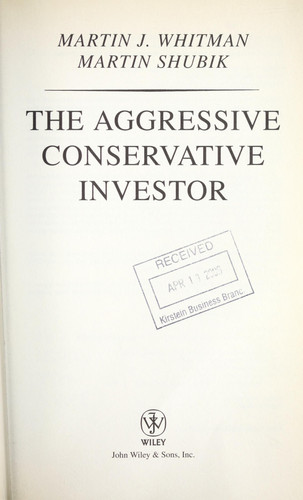
The aggressive conservative investor
One of the best books ever written on value investing and distressed securities The Aggressive Conservative Investor is a no-holds-barred presentation of one of the most successful investment strategies of all time-value investing in distressed securities/companies. With painful honesty and terrific storytelling, the authors show investors how to analyze and evaluate stocks just like controlling owners-based on the assumption that stock price rarely reflects real value. Using numerous case studies, Whitman and Shubik present risk-minimizing methods that also provide high rewards. Still relevant today, this classic work includes a new introduction discussing the dramatic changes that have taken place in the value investing world since the book was first published in 1979.
Value investing: a balanced approach
The author explains value investing and compares it to other investment disciplines.

The Secret Code of the Superior Investor How to Be a Long-Term Winner in a Short-Term World
What should your investment strategy be now that the steady, upward trend of the U.S. stock market seems like history? The years ahead promise to be volatile, full of ups and downs, so is this the time for investors to hunker down and scale back? Not at all, is Jim Glassman’s advice. Sure, there were some people who bailed out of the market early and came out ahead, but that was luck—the kind of luck that wins the lottery once in a blue moon: it’s not a strategy. And if there is one clear lesson to be learned from all of the recent market drama, it’s that you need a point of view and a coherent investment strategy. And that’s just what Glassman provides in The Secret Code of the Superior Investor. If you believe that the long-term outlook for the American economy is positive (as Glassman and most experts do), then the best strategy is the tried-and-true approach that has worked well for more than a hundred years: acquiring a diversified portfolio of stocks in great companies and then holding on to them forever. Jim Glassman’s investing principles provide the ballast to help you keep your investing balance no matter how the markets bubble or bobble. His rigorous, practical, straightforward way of thinking and taking action enables you to build a portfolio that performs well no matter what the economic climate. Here is invaluable advice on what stocks and mutual funds to buy—and when to sell them. (Hint: Almost never.)

Serpent on the Rock
It was the summer of '81 and the brokers at the shabby offices of Bache & Co. couldn't have been happier: After years of their business being tainted by one scandal after another, the beleaguered firm was being purchased by one of America's most respected institutions, Prudential Insurance. Soon rechristened as Prudential-Bache Securities, the brokerage firm would continued the trust needed to attract thousands of new investors eager to put their savings into rock-solid investments. Yet as billions of dollars began pouring in from around the country, Pru-Bache executives and their outside sponsors of investment deals were secretly eating into the very cash Pru-Bache was supposed to be protecting - and indeed growing - for their customers. As their brokers were touting financially shaky limited partnership deals as safe and solid investments, everyone from elderly retirees to sophisticated investors was being duped, with hundreds of thousands of them losing their homes, their retirement funds, or massive chunks of their savings. Meanwhile, executives at Pru-Bache and their colleagues were enjoying lavish party vacations, exorbitant personal gifts, and business trips aboard ships like the QE2 - all paid for by the investor capital with which they were entrusted. By the time regulators could pin anything on Pru-Bache, what began as the comeback story of the '80s had become the most destructive scandal Wall Street had ever known. In Serpent on the Rock, award-winning reporter Kurt Eichenwald, who investigated the scandal for the New York Times, tells the whole devastating story of the rot behind the dignified facade of Wall Street. With intricate detail of the crimes and lies behind the "rock-solid" image, Eichenwald re-creates the colorful characters who were the primary enablers of the massive scandal the company is still reeling from today.

An Essay On The Influence Of A Low Price Of Corn On The Profits Of Stock (1815)
""An Essay On The Influence Of A Low Price Of Corn On The Profits Of Stock"" is a book written by David Ricardo in 1815. The book discusses the relationship between the price of corn and the profits of stock, focusing on the impact of a low price of corn on the economy. Ricardo argues that a low price of corn can lead to higher profits for stockholders, as it reduces the cost of labor and increases the demand for manufactured goods. He also discusses the potential negative effects of a low price of corn, such as the impact on farmers and the potential for social unrest. The book is considered a classic work in the field of economics and is still widely studied and referenced today.This scarce antiquarian book is a facsimile reprint of the old original and may contain some imperfections such as library marks and notations. Because we believe this work is culturally important, we have made it available as part of our commitment for protecting, preserving, and promoting the world's literature in affordable, high quality, modern editions, that are true to their original work.

Distress investing: principles and technique

The Advanced Sleuth Investor Access Your Brain's Hidden Info, to Take Other People's Money
Some information cannot be contained in ink and blips and must always remain physical. This has been found in science, but also applies to investing, where it provides big advantage to investors who investigate companies physically ("sleuthing.") In this book (a follow up on his first), seasoned investing expert Avner Mandelman, relying on recent findings in AI and the latest Nobel Prize winning research, presents case-studies and sleuthing techniques to help the reader take the money of those who haven't read the book. In these studies, written in an engaging style, you will learn from: Chess-playing computers, how a chess-inspired formula picks the best stocks to sleuth Top intel operatives, how to get informers to open up Top Generals, how to discern winner CEOs from mediocre ones Quantum physicists, how to go beyond public data and create your own Brain and AI scientists, how to access the "dark info" inside your own brain Top athletes and top-gun pilots, how to train to win.

SuperCash: the new hedge fund capitalism
"James Altucher is scary smart, and also a font of great and original ideas. So it's no surprise that SuperCa$h is so much fun to read and so devilishly informative. It is equally full of 'holy cow!' moments and 'why-didn't-I-think-of-that?' moments. A true keeper." —Stephen J. Dubner, coauthor of Freakonomics "Altucher describes in easy-to-understand terms the strategies used by the smartest managers in the world—those who are running the hottest hedge funds—to show how they are making money today. SuperCa$h is a great primer for those who are looking to trade like the pros. And it helps that Altucher writes in a clear and fun style!" —John Mauldin, President of Millennium Wave Advisors, LLC, and author of Bull's Eye Investing As hedge funds have become more mainstream, some of their strategies are less capable of producing extraordinary returns. In response, hedge fund managers and other sophisticated investors have found new ways to turn cash into supercash. Examine these new ways with hedge fund manager James Altucher and supersize your returns.

Honky-Tonk Parade The New Yorker Profiles
The latest adventure of the classic Enterprise crewcontinues here! When the Enterprise crew embarks on amission of planetary First Contact, Captain Kirk finds apeaceful, idyllic society, one happily linked together by aglobal thought network-or so it appeared. When he discoversa bitter rebellion simmering beneath the surface, will he beable to follow the Prime Directive, or find himselfcompelled to get involved? Star Trek Burden of KnowledgeVolume 2 is the next exciting and intriguing part of the newOriginal Series-era miniseries from the creative team behindSpock: Reflections! The Star Trek adventure continues!
