401 results for "Jewish Children"

Shores beyond shores: from Holocaust to hope : my true story

Butter, Irene H.,Bidwell, John,Holloway, Kris
As Irene's Pappi fights to save his family during the Holocaust, Irene's childhood is lost. Play is restricted. Family and friends disappear. Finally, with the Dutch police at their door comes the reality that Irene's father has not moved his family far enough from Hitler's Germany. By January 1945, the family is struggling to survive a death camp. Irene tends her ailing parents, cares for starving kids, and even helps bring clothes to her Amsterdam neighbor Anne Frank, before her family is offered a singular chance for freedom...providing the Nazi doctor says they are healthy enough. After two weeks of heart-lifting miracles and heart-breaking tragedies, Irene arrives in the Algerian desert to journey into redemption and womanhood, without her parents or brother. Irene's first person memoir, Shores Beyond Shores, is an account of how the heart keeps its common humanity in the most inhumane and turbulent of times. Irene's hard-earned lessons are a timeless inspiration. ______________________________________________________________________________________________________________________ Following publication of an article on the Holocaust on April 13, 2018, Irene wrote a letter to the Editor which was published April 17, 2018 in The New York Times: Holocaust Survivors 'Have Voices That Matter' April 17, 2018 Re "Getting Facts Wrong on the Holocaust" (news article, April 13): More than four decades passed before I could break the silence about my traumatic experiences during the Holocaust. It is a formidable challenge for survivors to speak and for others to listen. The number of survivors is dwindling; they are getting quite old and their memories are fading. Yet it is ever more important that the signs of authoritarian regimes and how they evolved are brought into the consciousness of youths and adults, as warning signals of what must be prevented from happening again. Survivors, when able, have the responsibility to bear witness and provide evidence so that the six million Jews who were murdered are not forgotten, so that perpetrators are not pardoned for their crimes, and so that deniers don't have a leg to stand on. While the voices of the victims have been silenced forever, we the survivors have voices that matter. After four decades of not speaking, I realized that silence was no longer an option. I told my stories to my children and grandchildren as well as to many students in many schools over a 30-year period. Schools and other organizations should take advantage of every opportunity to engage survivors to tell their stories. IRENE BUTTER, ANN ARBOR, MICH. The writer survived two concentration camps, Westerbork and Bergen-Belsen. She recently published her memoir, "Shores Beyond Shores: From Holocaust to Hope."
White River Press 2018 273 pages

The Warsaw Anagrams

Richard Zimler
With his international bestseller The Last Kabbalist of Lisbon, Richard Zimler first made a name as a master of historical thrillers. in this chilling mystery, winner of the Marques de Ouro Prize, Zimler has woven a gripping tale in the tradition of The Shadow of the Wind. It is autumn, 1940, and the Nazis have sealed 400,000 Jews into the Warsaw Ghetto. Erik Cohen, an elderly psychiatrist, moves into a tiny apartment with his last remaining relatives. then his beloved great-nephew Adam goes missing and his body is discovered tangled in the barbed wire, strangely mutilated. soon afterward, another body turns up, this time a young girl. could there be a Jewish traitor luring children to their deaths? With an unlikely hero and hair-raising suspense, The Warsaw Anagrams is a profoundly moving and darkly atmospheric thriller.
Harry N. Abrams 2012-04-24 336 pages

The last million: Europe's displaced persons from World War to Cold War

Nasaw, David
"In May of 1945, German forces surrendered to the Allied powers, effectively putting an end to World War II in Europe. But the aftershocks of this global military conflict did not cease with the signing of truces and peace treaties. Millions of lost and homeless POWs, slave laborers, political prisoners, and concentration camp survivors overwhelmed Germany, a country in complete disarray. British and American soldiers gathered the malnourished and desperate foreigners, and attempted to repatriate them to Poland, Estonia, Latvia, Lithuania, Ukraine, and the USSR. But after exhaustive efforts, there remained over a million displaced persons who either refused to go home or, in the case of many, had no home to which to return. They would spend the next three to five years in displaced persons camps, divided by nationalities, temporary homelands in exile, with their own police forces, churches, schools, newspapers, and medical facilities. The international community couldn't agree on the fate of the Last Million, and after a year of fruitless debate and inaction, an International Refugee Organization was created to resettle them in lands suffering from labor shortages. But no nations were willing to accept the 200,000 to 250,000 Jewish men, women, and children who remained trapped in Germany. In 1948, the United States, among the last countries to accept anyone for resettlement, finally passed a Displaced Persons Bill - but as Cold War fears supplanted memories of WWII atrocities, the bill only granted visas to those who were reliably anti-communist, including thousands of former Nazi collaborators, Waffen-SS members, and war criminals, while barring the Jews who were suspected of being Communist sympathizers or agents because they had been recent residents of Soviet-dominated Poland. Only after the passage of the controversial UN resolution for the partition of Palestine and Israel's declaration of independence were the remaining Jewish survivors finally able to leave their displaced persons camps in Germany."--
Penguin Press 2020-09-15 654 pages

The last million: Europe's displaced persons from World War to Cold War

Nasaw, David
"In May of 1945, German forces surrendered to the Allied powers, effectively putting an end to World War II in Europe. But the aftershocks of this global military conflict did not cease with the signing of truces and peace treaties. Millions of lost and homeless POWs, slave laborers, political prisoners, and concentration camp survivors overwhelmed Germany, a country in complete disarray. British and American soldiers gathered the malnourished and desperate foreigners, and attempted to repatriate them to Poland, Estonia, Latvia, Lithuania, Ukraine, and the USSR. But after exhaustive efforts, there remained over a million displaced persons who either refused to go home or, in the case of many, had no home to which to return. They would spend the next three to five years in displaced persons camps, divided by nationalities, temporary homelands in exile, with their own police forces, churches, schools, newspapers, and medical facilities. The international community couldn't agree on the fate of the Last Million, and after a year of fruitless debate and inaction, an International Refugee Organization was created to resettle them in lands suffering from labor shortages. But no nations were willing to accept the 200,000 to 250,000 Jewish men, women, and children who remained trapped in Germany. In 1948, the United States, among the last countries to accept anyone for resettlement, finally passed a Displaced Persons Bill - but as Cold War fears supplanted memories of WWII atrocities, the bill only granted visas to those who were reliably anti-communist, including thousands of former Nazi collaborators, Waffen-SS members, and war criminals, while barring the Jews who were suspected of being Communist sympathizers or agents because they had been recent residents of Soviet-dominated Poland. Only after the passage of the controversial UN resolution for the partition of Palestine and Israel's declaration of independence were the remaining Jewish survivors finally able to leave their displaced persons camps in Germany."--
Penguin Press 2020 654 pages

Armies of the young: child soldiers in war and terrorism

Rosen, David M.
Children have been recruited for fighting throughout history - as soldiers in regular and guerilla armies, in armed revolts, and for political terrorism. However, these children cannot always be viewed as victims of remorseless and criminal leaders. In some situations, joining the fighting is the best or the only alternative for the young. Ch. 2 (pp. 19-56), "Fighting for Their Lives: Jewish Child Soldiers of World War II", discusses children's participation in the Jewish resistance during the Holocaust. Using mainly material from resistance and partisan groups in Lithuania, Poland, and Belarus, shows that joining the fighters was sometimes the Jewish children's only hope for survival. The children were motivated by necessity and a sense of honor and duty. Zionist and leftist movements, in particular Hashomer Hatzair, which headed the resistance in many ghettos, cultivated independence and militancy of the young and were especially inclined to draw children into their ranks.
Rutgers University Press 2005 199 pages

In God's Name

Sandy Eisenberg Sasso
Multicultural, Nonsectarian, Nondenominational Endorsed by Protestant, Catholic, and Jewish Religious Leaders Finalist, Children's Books of Distinction Award--Hungry Mind Review A Children's Book Council Not Just for Children Anymore! Selection Recommended by Parent Council Everyone and everything in the world has a name. What is God's name? In poetic text and vibrant illustrations, this modern fable celebrates the diversity and, at the same time, the unity of all people. "God must have a single name this greater and more powerful than all other names." All the people of the world set out to find God's name ... and each of the many seekers is sure that he or she alone has found the right name, the only name, for God. Finally, they come together--and at last learn what God's name really is. In God's Name is a spiritual celebration of all people of the world and their belief in one God.
LongHill Partners, Incorporated 2004-09 32 pages

The Book of Separation A Memoir

Tova Mirvis
The memoir of a woman who leaves her faith and her marriage and sets out to navigate the terrifying, liberating terrain of a newly mapless world Born and raised in a tight-knit Orthodox Jewish family, Tova Mirvis committed herself to observing the rules and rituals prescribed by this way of life. After all, to observe was to be accepted and to be accepted was to be loved. She married a man from within the fold and quickly began a family. But over the years, her doubts became noisier than her faith, and at age forty she could no longer breathe in what had become a suffocating existence. Even though it would mean the loss of her friends, her community, and possibly even her family, Tova decides to leave her husband and her faith. After years of trying to silence the voice inside her that said she did not agree, did not fit in, did not believe, she strikes out on her own to discover what she does believe and who she really is. This will mean forging a new way of life not just for herself, but for her children, who are struggling with what the divorce and her new status as "not Orthodox" mean for them. This is a memoir about what it means to decide to heed your inner compass at long last. To free the part of yourself that has been suppressed, even if it means walking away from the only life you've ever known. Honest and courageous, Tova takes us through her first year outside her marriage and community as she learns to silence her fears and seek adventure on her own path to happiness.
HarperCollins Publishers 2018-09-18 336 pages

If all the seas were ink: a memoir

Kurshan, Ilana
At the age of 27, alone in Jerusalem in the wake of a painful divorce, Ilana Kurshan joined the world s largest book club, learning daf yomi, Hebrew for daily page" of the Talmud, a book of rabbinic teachings spanning about 600 years and the basis for all codes of Jewish law. A runner, a reader and a romantic, Kurshan adapted to its pace, attuned her ear to its poetry, and discovered her passions in its pages. She brought the Talmud with her wherever she went, studying in airplanes, supermarket lines, and over a plate of pasta at home, careful not to drip tomato sauce upon discussions about the sprinkling of blood on the Temple altar. By the time she completed the Talmud after seven and a half years, Kurshan was remarried with three young children. With each pregnancy, her Talmud sat perched atop her growing belly. This memoir is a tale of heartache and humor, of love and loss, of marriage and motherhood, and of learning to put one foot in front of the other by turning page after page. Kurshan takes us on a deeply accessible and personal guided tour of the Talmud, shedding new light on its stories and offering insights into its arguments both for those already familiar with the text and for those who have never encountered it. For people of the book both Jewish and non-Jewish If All the Seas Were Ink is a celebration of learning through literature how to fall in love once again.
St. Martin's Press 2017-09 299 pages

Holocaust Forgotten - Five Million Non-Jewish Victims

Terese Schwartz
Eleven million people were killed in the Holocaust. Six million of these were Jewish - Hitler's most recognized victims. But, five million were not Jewish. Who were these other victims? The author, a Jewish convert of Polish Catholic descent, whose uncle was murdered by the Nazis, discovered that there are many non-Jewish survivors and children of survivors, who have been searching for a voice and an opportunity to finally be counted. This book sheds light on some of the non-Jewish victims with interviews and individual stories. Foreword by Danusha V. Goska, PhD
CreateSpace Independent Publishing Platform 2012-07-18 74 pages

Other people's houses

Segal, Lore Groszmann
Originally published in 1964 and hailed by critics including Cynthia Ozick and Elie Wiesel, Other People's Houses is Lore Segal's internationally acclaimed semi-autobiographical first novel. Nine months after Hitler takes Austria, a ten-year-old girl leaves Vienna aboard a children's transport that is to take her and several hundred children to safety in England. For the next seven years she lives in "other people's houses," the homes of the wealthy Orthodox Jewish Levines, the working-class Hoopers, and two elderly sisters in their formal Victorian household. An insightful and witty depiction of the ways of life of those who gave her refuge, Other People's Houses is a wonderfully memorable novel of the immigrant experience.
Ballantine Books 1986-08-12 309 pages

Kaddish

Wieseltier, Leon
Children have obligations to their parents: the Talmud says "one must honor him in life and one must honor him in death." Beside his father’s grave, a diligent but doubting son begins the mourner’s kaddish and realizes he needs to know more about the prayer issuing from his lips. So begins Leon Wieseltier’s National Jewish Book Award–winning autobiography, Kaddish, the spiritual journal of a man commanded by Jewish law to recite a prayer three times daily for a year and driven, by ardor of inquiry, to explore its origins. Here is one man’s urgent exploration of Jewish liturgy and law, from the 10th-century legend of a wayward ghost to the speculations of medieval scholars on the grief of God to the perplexities of a modern rabbi in the Kovno ghetto. Here too is a mourner’s unmannered response to the questions of fate, freedom, and faith stirred in death’s wake. Lyric, learned, and deeply moving, Wieseltier’s Kaddish is a narrative suffused with love: a son’s embracing the tradition bequeathed to him by his father, a scholar’s savoring they beauty he was taught to uncover, and a writer’s revealing it, proudly, unadorned, to the reader.
Alfred A. Knopf 1999 588 pages

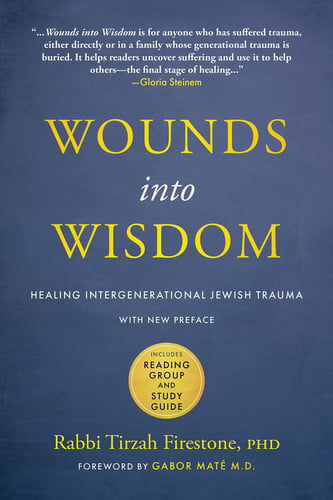
Wounds into wisdom: healing intergenerational Jewish trauma

Firestone, Tirzah
"Our past does not simply disappear. The painful history of our ancestors and their rich cultural wisdom intertwine within us to create the patterns of our future. Even when past trauma remains unspoken or has long been forgotten, it becomes part of us and our children-a legacy of both strength and woundedness that shapes our lives. In this book, Tirzah Firestone brings to life the profound impact of protracted historical trauma through the compelling narratives of those whose lives were marred by racial persecution and displacement. The tragic story of Firestone's own family lays the groundwork for these revealing testimonies of recovery, forgiveness, and moral leadership. Throughout, Firestone interweaves their voices with neuroscientific and psychological findings, as well as relevant and inspiring Jewish teachings. Seven principles emerge from these wise narratives-powerful prescriptive tools that speak to anyone dealing with the effects of past traumatic injury. At the broadest level, these principles are directives for staying morally awake in a world rife with terror"--
Monkfish Book Publishing Company 2022 258 pages

Between worlds: the autobiography of Leo Lionni

Lionni, Leo
Born in Holland, half Jewish, raised in Amsterdam, Brussels, Genoa, Philadelphia - Lionni is a man of many languages and cultures but no real home. His story is one of a constant search, a search that takes him from an ideal early childhood to a strict education in Italy that proved largely irrelevant to his future, and then to exile from Fascist Italy in America; from being a highly political aspiring artist to becoming a highly successful advertising director (he invented the famous "Never underestimate the power of a woman" campaign) and a powerful force in the world of graphics as the art director of Fortune magazine; from life in the affluent commuter world of Connecticut to a return to Italy and the life of an artist. After all this - a full life by any account - he finds yet another successful vocation as the author and illustrator of children's books that have sold millions of copies throughout the world.
Knopf 1997 295 pages

God, faith & identity from the ashes: reflections of children and grandchildren of Holocaust survivors

Menachem Z. Rosensaft
Almost ninety children and grandchildren of Holocaust survivors--theologians, scholars, spiritual leaders, authors, artists, political and community leaders and media personalities--from sixteen countries on six continents reflect on how the memories transmitted to them have affected their lives.--Publisher information.
Jewish Lights Publishing, a division of LongHill Partners, Inc 2014-11-04 309 pages

My friend Anne Frank: the inspiring and heartbreaking true story of best friends torn apart and reunited against all odds

Pick-Goslar, Hannah,Kraft, Dina
"In 1933, Hannah Pick-Goslar and her family fled Nazi Germany to live in Amsterdam, where she struck up a close friendship with her next-door neighbor, an outspoken and fun-loving young girl named Anne Frank. For several years, the inseparable pair enjoyed a carefree childhood of games, sleepovers, and treats with the other children in their neighborhood of Rivierenbuurt. But in 1942, Hannah and Anne's lives abruptly changed forever. As the Nazi occupation of Amsterdam progressed, Anne and the Frank family seemingly vanished, leaving behind unmade beds and dishes in the sink--but no trace of Anne's precious diary. Torn from her dear friend without warning, Hannah spent the next two years tormented by questions about Anne's fate, wondering if she had, by some miracle, managed to escape danger. In this long-awaited memoir, Hannah shares the story of her childhood during the Holocaust, from the introduction of anti-Jewish laws in Amsterdam to the gradual disappearance of classmates and, eventually, the Frank family, to Hannah and her family's imprisonment in the Bergen-Belsen concentration camp. As Hannah chronicles the experiences of her own life during and after the war, she provides a searing look at what countless children endured at the hands of the Nazi regime, as well as an intimate, never-before-seen portrait of the most recognizable victim of the Holocaust. Culminating in an astonishing fateful reunion, My Friend Anne Frank is the profoundly moving story of childhood and friendship during one of the darkest periods in the world's history"--Dust jacket flap.
Little, Brown Spark 2023 313 pages

The diary of Dawid Sierakowiak: five notebooks from the Łódź ghetto

Sierakowiak, Dawid
"In the evening I had to prepare food and cook supper, which exhausted me totally. In politics there's absolutely nothing new. Again, out of impatience I feel myself beginning to fall into melancholy. There is really no way out of this for us." This is Dawid Sierakowiak's final diary entry. Soon after writing it, the young author died of tuberculosis, exhaustion, and starvation--the Holocaust syndrome known as "ghetto disease." After the liberation of the Lodz Ghetto, his notebooks were found stacked on a cookstove, ready to be burned for heat. Young Sierakowiak was one of more than 60,000 Jews who perished in that notorious urban slave camp, a man-made hell which was the longest surviving concentration of Jews in Nazi Europe.The diary comprises a remarkable legacy left to humanity by its teenage author. It is one of the most fastidiously detailed accounts ever rendered of modern life in human bondage. Off mountain climbing and studying in southern Poland during the summer of 1939, Dawid begins his diary with a heady enthusiasm to experience life, learn languages, and read great literature. He returns home under the quickly gathering clouds of war. Abruptly Lodz is occupied by the Nazis, and the Sierakowiak family is among the city's 200,000 Jews who are soon forced into a sealed ghetto, completely cut off from the outside world. With intimate, undefended prose, the diary's young author begins to describe the relentless horror of their predicament: his daily struggle to obtain food to survive; trying to make reason out of a world gone mad; coping with the plagues of death and deportation. Repeatedly he rallies himself against fear and pessimism, fighting the cold, disease, and exhaustion which finally consume him. Physical pain and emotional woe hold him constantly at the edge of endurance. Hunger tears Dawid's family apart, turning his father into a thief who steals bread from his wife and children.The wonder of the diary is that every bit of hardship yields wisdom from Dawid's remarkable intellect. Reading it, you become a prisoner with him in the ghetto, and with discomfiting intimacy you begin to experience the incredible process by which the vast majority of the Jews of Europe were annihilated in World War II. Significantly, the youth has no doubt about the consequence of deportation out of the ghetto: "Deportation into lard," he calls it. A committed communist and the unit leader of an underground organization, he crusades for more food for the ghetto's school children. But when invited to pledge his life to a suicide resistance squad, he writes that he cannot become a "professional revolutionary." He owes his strength and life to the care of his family.
Oxford University Press 1996-11-07 271 pages

The thieves of Ostia

Lawrence, Caroline
Flavia Gemina is brilliant at finding things, so it's natural for her to solve mysteries. The daughter of a ship's captain living in Ostia, the port of Rome, in AD79, she acquires a gang of three friends who help her. There is Jonathan, the Jewish boy (and secretly a Christian) who has just moved in next door; Nubia, the African slave girl Flavia's father buys to save her from a terrible fate; and Lupus, a ragged homeless boy who is mysteriously mute. Together they work out who severed the heads of the watchdogs that guard people's homes, and why he did it. Caroline Lawrence, a first-time writer, is a terrific storyteller who creates a wonderfully vivid picture of daily life in the colourful, bustling port of Ostia while never labouring the historical detail. THE THIEVES OF OSTIA is first and foremost a whodunnit, with lots of excitement and plot twists.
Orion Children's 2001 195 pages

When we flew away: a novel of Anne Frank, before the diary

Hoffman, Alice
A beautiful novel exploring the little-known story of Anne Frank's life before she went into hiding - from bestselling, award-winning author Alice Hoffman and published in cooperation with the Anne Frank House. In soaring prose, bestselling author Alice Hoffman brings Anne Frank to life on the page, drawing from her extensive research in Europe and the United States, to depict her experiences from the moment the Nazis invade the Netherlands until her family is forced into hiding in the annex of her father's office building at 263 Prinsengracht, in Amsterdam. As state-sponsored discrimination turns ordinary people into monsters, the Jews of the Netherlands are caught in an inescapable swell of violence and hate, and Anne is shaped as both a young woman and as a writer who will change the world. WHEN WE FLEW AWAYfeatures archival content provided by the Anne Frank House, as well as information about Otto Frank's desperate bids to get his family to safety in America gathered from correspondence between Otto Frank and Nathan Straus, Jr., from the Straus Historical Society's Archives. A heart-wrenching exploration of Anne's life before the annex By New York Times bestselling author of The World We Knew, Alice Hoffman Featuring archival content provided by the Anne Frank House
Scholastic 2024-09-17 320 pages