715 results for "Jewish History"

A short history of the Jews

Brenner, Michael
From the Publisher: A Short History of the Jews is the story of the Jewish people told in a sweeping and powerful historical narrative. Michael Brenner chronicles the Jewish experience from Biblical times to today, tracing what is at heart a drama of migration and change, yet one that is also deeply rooted in tradition. He surveys the latest scholarly perspectives in Jewish history, making this short history the most learned yet broadly accessible book available on the subject. Brenner takes readers from the mythic wanderings of Moses to the unspeakable atrocities of the Holocaust; from the Babylonian exile to the founding of the modern state of Israel; and from the Sephardic communities under medieval Islam to the shtetls of eastern Europe and the Hasidic enclaves of modern-day Brooklyn. This richly illustrated book is full of fascinating and often personal stories of exodus and return, from that told about Abraham, who brought his newfound faith into the land of Canaan, to that of Holocaust survivor Esther Barkai, who lived on a kibbutz established on a German estate seized from the Nazi Julius Streicher as she awaited resettlement in Israel. Brenner traces the major events, developments, and personalities that have shaped Jewish history down through the centuries, and highlights the important contributions Jews have made to the arts, politics, religion, and science. Breathtaking in scope, A Short History of the Jews is a compelling blend of storytelling and scholarship that brings the history of the Jewish people marvelously to life.
Princeton University Press 2010-06-13 421 pages

The Jewish writings

Arendt, Hannah
Although Hannah Arendt is not primarily known as a Jewish thinker, she probably wrote more on Jewish issues than on any other topic. As a young adult in Germany, she wrote about German Jewish history. After moving to France in 1933, she helped Jewish youth immigrate to Palestine. During her years in Paris, her principle concern was the transformation of antisemitism from prejudice to policy, which would culminate in the Nazi "final solution." After France fell, Arendt escaped from an internment camp and made her way to America. There she wrote articles calling for a Jewish army to fight the Nazis. After the war, she supported the creation of a Jewish homeland in a binational (Arab-Jewish) state of Israel .Arendt's original conception of political freedom cannot be fully grasped apart from her experience as a Jew. In 1961 she attended Adolf Eichmann's trial in Jerusalem. Her report, Eichmann in Jerusalem, provoked an immense controversy, which culminated in her virtual excommunication from the worldwide Jewish community. Today that controversy is the subject of serious re-evaluation, especially among younger people in the United States, Europe, and Israel. The publication of The Jewish Writings–much of which has never appeared before–traces Arendt’s life and thought as a Jew. It will put an end to any doubts about the centrality, from beginning to end, of Arendt’s Jewish experience.
Schocken Books 2007 559 pages

Stars of David: Prominent Jews talk about being Jewish

Pogrebin, Abigail
Sixty-two of the most accomplished Jews in America speak intimately—most for the first time—about how they feel about being Jewish. In unusually candid interviews conducted by former 60 Minutes producer Abigail Pogrebin, celebrities ranging from Sarah Jessica Parker to Supreme Court Justice Ruth Bader Ginsburg, from Larry King to Mike Nichols, reveal how resonant, crucial or incidental being Jewish is in their lives. The connections they have to their Jewish heritage range from hours in synagogue to bagels and lox; but every person speaks to the weight and pride of their Jewish history, the burdens and pleasures of observance, the moments they’ve felt most Jewish (or not). This book of vivid, personal conversations uncovers how being Jewish fits into a public life, and also how the author’s evolving religious identity was changed by what she heard.
Broadway books 2005 385 pages

Jews and the American slave trade

Friedman, Saul S.
The Nation of Islam's Secret Relationship between Blacks and Jews has been called one of the most serious anti-Semitic manuscripts published in years. This work of so-called scholars received great celebrity from individuals like Louis Farrakhan, Leonard Jeffries, and Khalid Abdul Muhammed who used the document to claim that Jews dominated both transatlantic and antebellum South slave trades. As Saul Friedman definitively documents in Jews and the American Slave Trade, historical evidence suggests that Jews played a minimal role in the transatlantic, South American, Caribbean, and antebellum slave trades.Jews and the American Slave Trade dissects the questionable historical technique employed in Secret Relationship, offers a detailed response to Farrakhan's charges, and analyzes the impetus behind these charges. He begins with in-depth discussion of the attitudes of ancient peoples, Africans, Arabs, and Jews toward slavery and explores the Jewish role hi colonial European economic life from the Age of Discovery tp Napoleon. His state-by-state analyses describe in detail the institution of slavery in North America from colonial New England to Louisiana. Friedman elucidates the role of American Jews toward the great nineteenth-century moral debate, the positions they took, and explains what shattered the alliance between these two vulnerable minority groups in America.Rooted in incontrovertible historical evidence, provocative without being incendiary, Jews and the American Slave Trade demonstrates that the anti-slavery tradition rooted in the Old Testament translated into powerful prohibitions with respect to any involvement in the slave trade. This brilliant exploration will be of interest to scholars of modern Jewish history, African-American studies, American Jewish history, U.S. history, and minority studies.
Transaction Publishers 1998 326 pages

Being Jewish after the destruction of Gaza

Beinart, Peter
"In Peter Beinart's view, one story dominates Jewish communal life: that of persecution and victimhood. It is a story that erases much of the nuance of Jewish religious tradition and warps our understanding of Israel and Palestine. After Gaza, where Jewish texts, history and language have been deployed to justify mass slaughter and starvation, Beinart argues, Jews must tell a new story. After this war, whose horror will echo for generations, they must do nothing less than offer a new answer to the question: What does it mean to be a Jew?Beinart imagines an alternate narrative, which would draw on other nations' efforts at moral reconstruction and a different reading of Jewish tradition. A story in which Israeli Jews have the right to equality, not supremacy, and in which Jewish and Palestinian safety are not mutually exclusive but intertwined. One that recognizes the danger of venerating states at the expense of human life." --
Atlantic Books 2025 172 pages

Why are Jews liberals?

Podhoretz, Norman
"In his brilliant and provocative examination of why Jews are liberals, Podhoretz reviews the history of Jewish political attitudes and thoroughly examines the available evidence, demonstrating that all the usual explanations--such as a passion for justice allegedly deriving from the prophets of the Hebrew Bible--are either inadequate or flat-out false. Finally he proposes his own answer to the great puzzle of why most Jews remain as committed to liberalism as ever"--OCLC
Doubleday 2009 337 pages

The dictionary of Jewish biography

Cohn-Sherbok, Dan
From Abraham to Saul Bellow, from Moses Maimonides to Woody Allen, from the Baal Shem Tov to Albert Einstein, this comprehensive dictionary of Jewish biographies provides a first point of entry into the fascinating richness of the Jewish heritage. Modelled on the highly acclaimed Dictionary of Christian Biography (Continuum 2001) and with the advice of leading Jewish scholars, the Dictionary of Jewish Biography provides a rapid reference to those Jewish men and women who have, over the last four thousand years, contributed to the life of the Jewish people and the history of the Jewish religion. This dictionary will prove essential for general readers interested in the evolution of Judaism from ancient times to the present day, a perfect study aid for students and teachers.
Continuum 2005-06-30 308 pages

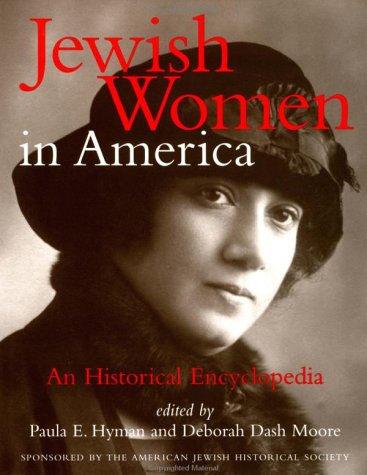
Jewish women in America: an historical encyclopedia

Paula Hyman,Deborah Dash Moore,Phyllis Holman Weisbard,American Jewish Historical Society
This encyclopedia provides the first standard reference work on the lives, history and activities of Jewish women in the United States. Covering a period which extends from the arrival of the first Jewish women in North America in 1654 to the present, this two-volume set presents the most comprehensive and detailed portrait of American Jewish women ever published, and brings together for the first time the wealth of recent scholarship on this subject. Includes: * Biographical entries on over 800 individual women. * 128 topical articles on organizations such as Hadassah, the National Council of Jewish Women, Mizrachi, and the Ladies' Garment Workers' Union. * Major essays on Jewish women's participation in the movement for women's suffrage, social reform, civil rights, and the recent women's movement. * The activities of Jewish women in politics, business, education, the arts, and religion. * A readable, inviting format with over 500 large photographs. * Bibliographies at the end of each entry which include overviews of major scholarship in the field, complete citations of more general works and citations of additional bibliographical and reference sources. * The comprehensive index includes citations to every substantive discussion in the entries as well as all proper names appearing in the text, such as organizations, book, song and film titles, schools, and individuals. The "Encyclopedia" provides information on American Jewish women in all fields of endeavor, and pays special attention to the work of women in the arts, academics, law, the labor movement, education, science, medicine, journalism and publishing, and on the lives of ordinary Jewish women during all time periods and in all regions of the United States.
Routledge 1997 1770 pages

The pity of it all: a history of the Jews in Germany, 1743-1933

Elon, Amos
Presents a cultural history of German Jewry from Moses Mendelssohn's arrival in Berlin until the end of the Weimar Republic. Refers to antisemitism in a number of contexts: Mendelssohn is hailed by German intellectuals as an exception among the Jews; acceptance of the Jew was sometimes soon followed by rejection; despite or because of disproportionate Jewish contributions to culture and society, Jews are viewed as foreigners; rights are granted only to rich and useful Jews; despite Jewish patriotism, Jews are often portrayed as traitors and subversives. Among the prominent Jews discussed are Heinrich Heine, whose ambivalence toward Germans reflected their ambivalence toward him, and Walther Rathenau who was assassinated by radical nationalists whose activities the Weimar Republic was unable to curb. The section devoted to the latter reveals how Weimar's weaknesses opened the door of power to the Nazis.
Metropolitan Books 2002-11 446 pages

Ruth Maier's diary: a young girl's life under Nazism

Maier, Ruth
Ruth Maier was born into a middle-class Jewish family in interwar Vienna. Following the Anschluss of Austria in March 1938, the world of the substantial Viennese Jewish community crumbled. In early 1939, her sister having left for England, Ruth emigrated to Norway and lived with a family in Lillestrom, about thirty miles from Oslo. Although she loved many things about her new country and its people, Ruth's relationship with her hosts soon turned stale, then sour. Ruth became increasingly isolated in Norway until she met a soul mate, Gunvor Hofmo, who was to become a celebrated poet. Norway itself became a Nazi conquest in April 1940, and Ruth's attempts to join the rest of her family - now in Britain - became ever more urgent. She never left Norway, and in November 1942 she was deported to Auschwitz where she was exterminated on arrival. She had just turned twenty-two. Ruth Maier kept a diary from 1934 until just before she was murdered. Despite being only in her teens she shows a sophisticated understanding of the political forces shaping central Europe as well as extraordinary prescience. The book is much more than just historical documentation, however. In a lucid yet highly lyrical style, with an incisive talent for narrative and a sharp wit, Ruth explores universal themes of isolation, identity, friendship, love, sexuality, desire, morality, justice and sacrifice. Most of all, however, she seeks what it means to be a human being. Published only recently for the first time in Norway, Ruth Maier's Diary is one of the most moving testimonies to emerge from this dark period of European history
Harvill Secker 2009 413 pages

Assimilated Jews in the Warsaw Ghetto, 1940-1943

Person, Katarzyna
Jews in Nazi-occupied Warsaw during the 1940s were under increasing threat as they were stripped of their rights and forced to live in a guarded ghetto away from the non-Jewish Polish population. Within the ghettos, a small but distinct group existed: the assimilated, acculturated, and baptized Jews. Unwilling to integrate into the Jewish community and unable to merge with the Polish one, they formed a group of their own, remaining in a state of suspension throughout the interwar period. In 1940, with the closure of the Jewish residential quarter in Warsaw, their identity was chosen for them. Person looks at what it meant for assimilated Jews to leave their prewar neighborhoods, understood as both a physical environment and a mixed Polish Jewish cultural community, and to enter a new, Jewish neighborhood. She reveals the diversity of this group and how its members’ identity shaped their involvement in and contribution to ghetto life. In the first English-language study of this small but influential group, Person illuminates the important role of the acculturated and assimilated Jews in the history and memory of the Warsaw Ghetto.
Syracuse University Press 2014-06-30 239 pages

Good-bye Marianne

Watts, Irene N.
A heartbreaking story of loss and love. As autumn turns toward winter in 1938 Berlin, life for Marianne Kohn, a young Jewish girl, begins to crumble. First there was the burning of the neighbourhood shops. Then her father, a mild-mannered bookseller, must leave the family and go into hiding. No longer allowed to go to school or even sit in a caf�, Marianne's only comfort is her beloved mother. Things are bad, but could they get even worse? Based on true events, this fictional account of hatred and racism speaks volumes about both history and human nature.
Tundra Books 1998 105 pages

Jews and power

Wisse, Ruth R.
From the Kingdom of David to the Oslo Accords, Ruth Wisse offers a radical new way to think about the Jewish relationship to power. Traditional Jews believed that upholding the covenant with God constituted a treaty with the most powerful force in the universe; this later transformed itself into a belief that, unburdened by a military, Jews could pursue their religious mission on a purely moral plain. Wisse, an eminent professor of comparative literature at Harvard, demonstrates how Jewish political weakness both increased Jewish vulnerability to scapegoating and violence, and unwittingly goaded power-seeking nations to cast Jews as perpetual targets. Although she sees hope in the State of Israel, Wisse questions the way the strategies of the Diaspora continue to drive the Jewish state, echoing Abba Eban's observation that Israel was the only nation to win a war and then sue for peace. And then she draws a persuasive parallel to the United States today, as it struggles to figure out how a liberal democracy can face off against enemies who view Western morality as weakness. This deeply provocative book is sure to stir debate both inside and outside the Jewish world. Wisse's narrative offers a compelling argument that is rich with history and bristling with contemporary urgency.
Nextbook, Schocken 2020-02-04 231 pages

A chosen few: the resurrection of European Jewry

Kurlansky, Mark
A POWERFUL, DEEPLY MOVING NARRATIVE OF HOPE REBORN IN THE SHADOW OF DESPAIR Fifty years after it was bombed to rubble, Berlin is once again a city in which Jews gather for the Passover seder. Paris and Antwerp have recently emerged as important new centers of Jewish culture. Small but proud Jewish communities are revitalizing the ancient centers of Budapest, Prague, and Amsterdam. These brave, determined Jewish men and women have chosen to settle–or remain–in Europe after the devastation of the Holocaust, but they have paid a price. Among the unexpected dangers, they have had to cope with an alarming resurgence of Nazism in Europe, the spread of Arab terrorism, and the impact of the Jewish state on European life. Delving into the intimate stories of European Jews from all walks of life, Kurlansky weaves together a vivid tapestry of individuals sustaining their traditions, and flourishing, in the shadow of history. An inspiring story of a tenacious people who have rebuilt their lives in the face of incomprehensible horror, A Chosen Few is a testament to cultural survival and a celebration of the deep bonds that endure between Jews and European civilization. “Consistently absorbing . . . A Chosen Few investigates the relatively uncharted territory of an encouraging phenomenon.” –Los Angeles Times “I can think of no book that portrays with such intelligence, historical understanding, and journalistic flair what life has been like for Jews determined to build lives in Europe.” –SUSAN MIRON Forward
Ballantine 2002-03-26 407 pages

The invention of the Jewish people

Sand, Shlomo
All modern nation states have a story of their origins, passed down through both official and popular culture, and yet few of these accounts have proved as divisive and influential as the Israeli national myth. The well-known tale of Jewish exile at the hands of the Romans during the first century CE, and the assertion of both cultural and racial continuity through to the Jewish people of the present day, resonates far beyond Israel's borders. Despite its use as a justification for Jewish settlement in Palestine and the project of a Greater Israel, there have been few scholarly investigations into the historical accuracy of the story as a whole. Here, Shlomo Sand shows that the Israeli national myth has its origins in the nineteenth century, rather than in biblical times--when Jewish historians, like scholars in many other cultures, reconstituted an imagined people in order to model a future nation.--From publisher description.
Verso 2009 332 pages

Masquerade: the incredible true story of how George Soros' father outsmarted the Gestapo

Soros, Tivadar
The Nazis came late to Hungary because, until early 1944, Germany and Hungary were allies. But when they did arrive, their orders were to put the "Final Solution" into effect with deliberate speed. Soros, a Jewish lawyer in Budapest, secured fake Christian identities for himself, his wife, and his two sons following the German invasion of Hungary on March 19, 1944. In a narrative reminiscent of the great Primo Levi, Soros recounts his experiences with a beguiling humor, deep humanity, and a wisdom that is humbling. Superbly translated by Humphrey Tonkin, Masquerade is.
Arcade Pub 2011-03-15 275 pages

The beginnings of Jewishness: boundaries, varieties, uncertainties

Cohen, Shaye J. D.
In modern times, various Jewish groups have argued whether Jewishness is a function of ethnicity (membership in a descent group, a function of birth), nationality (citizenship in a state, a function of politics), religion (membership in a group characterized by various beliefs and practices), or all three. These fundamental conceptions were already in place in antiquity; the peculiar combination of ethnicity, nationality, and religion that would characterize Jewishness through the centuries first took shape in the second century B.C.E. This book studies the ways in which these elements were understood and applied in the construction of Jewish identity - by Jews, by gentiles and by the state - in such a way that the question "Who was a Jew?" could be variously answered.
University of California Press 1999 426 pages

Revolutionary Jews from Spinoza to Marx: the fight for a secular world of universal and equal rights

Israel, Jonathan
"In the eighteenth and early nineteenth centuries a small but conspicuous fringe of the Jewish population became the world's most resolute, intellectually driven, and philosophical revolutionaries, among them the pre-Marxist Karl Marx. Yet the roots of their alienation from existing society and determination to change it extend back to the very heart of the Enlightenment, when Spinoza and other philosophers living in a rigid, hierarchical society colored by a deeply hostile theology first developed a modern revolutionary consciousness. Leading intellectual historian Jonathan Israel shows how the radical ideas in the early Marx's writings were influenced by this legacy, which, he argues, must be understood as part of the Radical Enlightenment. He traces the rise of a Jewish revolutionary tendency demanding social equality and universal human rights throughout the Western world. Israel considers how these writers understood Jewish marginalization and ghettoization and the edifice of superstition, prejudice, and ignorance that sustained them. He investigates how the quest for Jewish emancipation led these thinkers to formulate sweeping theories of social and legal reform that paved the way for revolutionary actions that helped change the world from 1789 onward-but hardly as they intended"--
University of Washington Press 2021 549 pages

Golden harvest: events at the periphery of the Holocaust

Gross, Jan Tomasz
The starting point of Jan Tomasz and Irena Grudzinska Gross's Golden Harvest, this haunting photograph in fact depicts a group of peasants--"diggers"--atop a mountain of ashes at Treblinka, where some 800,000 Jews were gassed and cremated. The diggers are searching for gold and precious stones that Nazi executioners may have overlooked. The story captured in this grainy black-and-white photograph symbolizes the vast, continent-wide plunder of Jewish wealth that went hand-in-hand with the Holocaust. The seizure of Jewish assets during World War II occasionally generates widespread attention when Swiss banks are challenged to produce lists of dormant accounts, or national museums are forced to return stolen paintings. But the theft of Europe's Jewish population was not limited to conquering armies, leading banks, or museums. It was perpetrated also by local people, such as those pictured in the photograph.
Oxford University Press 2016 135 pages