73 results for "Jewish History"

Religious truth: towards a Jewish theology of religion

Alon Goshen-Gottstein
Truth informs much of the self-understanding of religious believers. Accordingly, understanding what we mean by ‘truth’ is a key challenge to interreligious collaboration. The contributors to this volume, all leading scholars, consider what is meant by truth in classical and contemporary Jewish thought, and explore how making the notion of truth more nuanced can enable interfaith dialogue. Their essays take a range of approaches: some focus on philosophy proper, others on the intersection with the history of ideas, while others engage with the history of Jewish mysticism and thought. Together they open up the notion of truth in Jewish religious discourse and suggest ways in which upholding a notion of one’s religion as true may be reconciled with an appreciation of other faiths. By combining philosophical and theological thinking with concrete case studies, and discussion of precedents and textual resources within Judaism, the volume proposes new interpretations of the concept of truth, going beyond traditional exclusivist uses of the term. A key aim is to help Jews seeking dialogue with other religions to do so while remaining true to their own faith tradition: in pursuit of this, the volume concludes with suggestions of how the ideas presented can be applied in practice.
Littman Library of Jewish Civilization in association with Liverpool University Press 2020 205 pages

The renewal of Palestine in the Jewish imagination

Ellis, Marc H.
"Beyond the immediate issues of politics and economics lie the larger and deeper realities of history and fidelity. As a Jew I am asking in these essays traditional religious questions in light of our present circumstances: What does it mean to be Jewish after the Holocaust and the consolidation of our empowerment in Israel/Palestine? Coming from a situation of oppression, what does it mean for Jewish history and theology to continue oppressing the Palestinian people? Has our empowerment in Israel brought us the freedom we so urgently needed, or has our abuse of power in Israel brought us a new enslavement and ghettoization which we did not seek, but now pursue almost blindly? Can we be healed of our trauma of Holocaust by finalizing the trauma of the Palestinian people which we as Jews have inflicted? At the lighting of the Shabbat candles, shall we bless our endeavor and thank God for making us into a warrior people?"--
Wipf & Stock 2016-05-02 158 pages

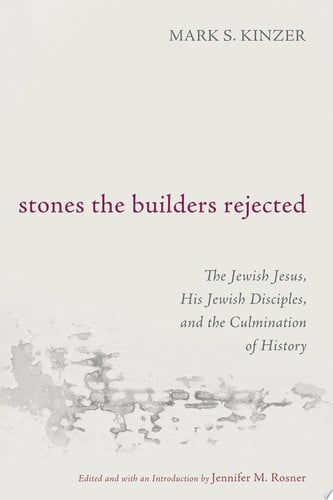
Stones the builders rejected: the Jewish Jesus, his Jewish disciples, and the culmination of history

Kinzer, Mark,Rosner, Jennifer M.
"Since the groundbreaking publication of Postmissionary Messianic Judaism (2005), Mark Kinzer has challenged theologians and religious leaders to consider the essential ecumenical vocation of Jewish disciples of Jesus. Proposing a bilateral ecclesiology in solidarity with Israel, he argued that the overcoming of Christian supersessionism required a robust affirmation of the distinctive calling of Jews within the community of Jesus the Messiah. In this way, Kinzer's work put the issue of Jewish followers of Jesus on the theological agenda for those seeking a reparative reconfiguration of the relationship between the church and the Jewish people. In recent years, Kinzer has attended to the theological implications of this perspective and has widened his focus to include not only the Messianic Jewish movement but also Jews within Catholic, Orthodox, and Protestant churches. The present collection of essays reflects this wider concern. According to Kinzer, the theological stones of contention are Christology conceived of as Messianology, ecclesiology understood as Israelology, and eschatology imagined as Zionology. Moreover, it is the presence of Jewish disciples of Jesus that concretizes these theological abstractions in the form of Jewish flesh and blood, summoning Jews and Christians to rethink their relationship to one another in ways that express their essential mutual dependence." --
Cascade Books 2024-06-04 217 pages

Poverty and charity in the Jewish community of medieval Egypt

Cohen, Mark R.
What was it like to be poor in the Middle Ages? In the past, the answer to this question came only from institutions and individuals who gave relief to the less fortunate. This book, by one of the top scholars in the field, is the first comprehensive book to study poverty in a premodern Jewish community--from the viewpoint of both the poor and those who provided for them. Mark Cohen mines the richest body of documents available on the matter: the papers of the Cairo Geniza. These documents, located in the Geniza, a hidden chamber for discarded papers situated in a medieval synagogue in Old Cairo, were preserved largely unharmed for more than nine centuries due to an ancient custom in Judaism that prohibited the destruction of pages of sacred writing. Based on these papers, the book provides abundant testimony about how one large and important medieval Jewish community dealt with the constant presence of poverty in its midst. Building on S. D. Goitein's Mediterranean Society and inspired also by research on poverty and charity in medieval and early modern Europe, it provides a clear window onto the daily lives of the poor. It also illuminates private charity, a subject that has long been elusive to the medieval historian. In addition, Cohen's work functions as a detailed case study of an important phenomenon in human history. Cohen concludes that the relatively narrow gap between the poor and rich, and the precariousness of wealth in general, combined to make charity "one of the major agglutinates of Jewish associational life" during the medieval period.
Princeton University Press 2005-09-11 287 pages

Connecting the covenants: Judaism and the search for Christian identity in eighteenth-century England

Ruderman, David B.
The first few decades of the eighteenth century witnessed an important moment in Jewish-Christian relations, as influential Christian scholars increasingly looked to Jewish texts to reveal the truths of their own faith. To what extent could postbiblical writings help them better understand the New Testament? And who would best be able to explicate these connections?Connecting the Covenants focuses on two separate but entwined stories, the first centering around the colorful character of Moses Marcus. The English-born son of wealthy parents and the grandson of the famous autobiographical author Glikl of Hameln, Marcus was a prominent Jew educated in the Ashkenazic yeshivah at Hamburg. On New Year's Day, 1723, Marcus was baptized as a Christian, later publishing a justification of his conversion and a vindication of his newly discovered faith in a small book in London. A trophy convert, he was promoted by figures at the highest levels of the Anglican Church as a cultural mediator between Judaism and Christianity. His modest successes in the world of the elite clerical establishment were followed, however, by conspicuous failures, both intellectual and material.The second story that David Ruderman tells emerges against the background of Marcus's professional decline. In the end, the prize convert proved to be a theologian of limited ability, far outstripped in sophistication and openness to rabbinic learning by a circle of Enlightenment Protestant scholars. It was not the Jew who had abjured Judaism who was willing or able to apply the Mishnah and Talmud to Christian exegesis, but figures such as William Whiston, Anthony Collins, William Wotton, and the Dutch scholar William Surenhusius who seized upon the ways to connect the covenants.
University of Pennsylvania Press 2007 141 pages

Intertwined worlds: medieval Islam and Bible criticism

Lazarus-Yafeh, Hava
Contrary to the Christians, the Muslims did not consider the Bible as a holy text, therefore their polemics against the Jews took the form of Bible criticism. The main arguments used by Muslim thinkers against Judaism was that the Jews falsified God's word, or failed to transmit it properly, or misinterpreted the Bible, or that the Bible had been abrogated by God. The most prominent Muslim writers who developed these themes in the medieval period were Ibn Hazm and the Jewish apostate Samau'al al-Maghribi in the West of the Arab world, and Ibn Qayyim al-Djawziyya in the East. The first two considered, in particular, that it was Ezra ('Uzayr) who deliberately distorted the text of the Bible. Contends that the Muslim critics of the Bible based their arguments greatly on pre-Islamic sources (such as pagan, gnostic, Christian, and anti-Christian writings), and that they, in turn, were the source of early modern European Bible criticism.
Princeton University Press 1992 178 pages

Jews and their Roman rivals: pagan Rome's challenge to Israel

Berthelot, Katell
"Across almost the entire expanse of Jewish history, Jews have had to adjust to being ruled by empires. In antiquity alone Jews lived under a succession of imperial powers - Assyrian, Babylonian, Persian, and Seleucid - before having to deal with the Romans. Judaism (of course) was shaped by each successive encounter with an imperial power. But as Katell Berthelot argues in this book, Rome and Roman imperialism presented Jews with unique ideological challenges, and compelled Jews to rethink key aspects of their own self-definition. Long before Rome became Christian, Jews recognized pagan Romans as unprecedented rivals because of some striking similarities between the two peoples. Previously Jews were ruled by empires associated with kingdoms and kings. By contrast, "Rome" was first and foremost a city and a people - and Romans thought of their city and themselves as a people in ways uncomfortably close to the ways Jews defined themselves: as an Israelite people tied to a capital city, Jerusalem. Moreover both Romans and Jews conceived of themselves as a pious people with a divine calling; both thought they possessed the most perfect laws ever written; and both believed themselves to be entrusted with a universal mission that implied bringing peace to the world. This was too close for comfort. The disturbingly close parallels led some Jews to feel that Rome was in fact trying to take Israel's place in God's plan for the world. Revealingly, the ancient rabbis depicted this rivalry by turning to the famous biblical story of the sibling rivals Jacob and Esau, associating the Jews with the former and the Romans with the latter. The perceived rivalry led to a series of innovations in Jewish self-perceptions in late antiquity in several areas that Berthelot will discuss in a series of book chapters: innovations in Jewish understandings of power, citizenship (or membership in a people), and law. Berthelot argues that in some cases the Jewish sources imitate or mimic Roman representations (of, e.g. legal thinking and practice), and in other cases propose a countermodel"--
Princeton University Press 2021 519 pages

The World Jewish Congress, 1936-2016

World Jewish Congress
"A history of the World Jewish Congress (WJC) from its founding in 1936 through 2016. Among the topics covered are the WJC's role during World War II; the WJC's contribution to the International Military Tribunal at Nuremberg; post-WWII attitudes to and relationships with Jews living in Germany; the WJC's relationship and interaction with the State of Israel; the WJc's role and impact at the United Nations; the WJC's diplomatic efforts on behalf of North African Jewry during the 1950's and 1960's; materialization of the Holocaust at Auschwitz-Birkenau; the WJC's role in launching the Jewish-Vatican dialogue; advocacy on behalf of Soviet Jewry; the WJC's role in the campaign to repeal the UN's "Zionism is Racism" resolution; forcing Swiss banks to disgorge Holocaust-era assets belonging to Jews; the Kurt Walheim Affair; the WJC's interaction with communist countries; the WJC's role regarding terrorist attacks on Jewish institutions in Buenos Aires; the World Jewish Congress today; and WJC President Ronald S. Lauder's vision of the Jewish future"--
World Jewish Congress 2017 341 pages

The Gnostic imagination: Gnosticism, Mandaeism, and Merkabah mysticism

Deutsch, Nathaniel
The Gnostic Imagination is the first comprehensive study of the relationship between Gnosticism and Merkabah mysticism. It includes an exhaustive analysis of Gershom Scholem's views on the subject, an analytical survey of other secondary literature, and a focused examination of primary sources. The work explores a wide range of topics including myth, exegesis, ascent traditions, and cosmology. Although the main focus is on western Gnostic traditions and Merkabah mysticism, the book also includes relevant material from Mandaeism and from later stages of Jewish mysticism such as German Pietism and Kabbalah. Not only is this volume the first to survey and evaluate the history of scholarship on this complex subject, but it also creates new pathways for future studies by illuminating the crucial methodological and topical issues in the field.
E.J. Brill 1995 163 pages

Jewish meaning in a world of choice: studies in tradition and modernity

Ellenson, David Harry
"Internationally recognized scholar David Ellenson shares twenty-three of his most representative essays, drawing on three decades of scholarship and demonstrating the consistency of the intellectual-religious interests that have animated him throughout his lifetime. These essays center on a description and examination of the complex push and pull between Jewish tradition and Western culture. Ellenson addresses gender equality, women's rights, conversion, issues relating to who is a Jew, the future of the rabbinate, Jewish day schools, and other emerging trends in American Jewish life. As an outspoken advocate for a strong Israel that is faithful to the democratic and Jewish values that informed its founders, he also writes about religious tolerance and pluralism in the Jewish state. The former president of Hebrew Union College-Jewish Institute of Religion, the primary seminary of the Reform movement, Ellenson is widely respected for his vision of advancing Jewish unity and of preparing leadership for a contemporary Judaism that balances tradition with the demands of a changing world. Scholars and students of Jewish religious thought, ethics, and modern Jewish history will welcome this erudite collection by one of today's great Jewish leaders"--
University of Nebraska Press 2014-10-01 345 pages