78 results for "Love"

Love itself in the letter box

Cixous, Hélène
Love’s memories, love recalling itself in letters lost and found over an interval of forty years: Cixous’s writer-narrator advances here far into a labyrinth of passions long ago delivered and yet still arriving through the mail, through letters and literature, in other words, the poetry of the post. As for the lovers’ returning scenes, they have their addresses in Paris (rue Olivier de Serres, Avenue de Choisy, street names that endlessly feed love’s unconscious language) and in New York, but also in a lost oasis of the Egyptian desert during the Napoleonic wars, in Athens and along the shores of a great lake centuries ago in the country of myth. The lovers are poets or soldiers, philosophers or students madly in love with poetry and poets. They are as well mermaids or panthers. Panthers? Yes, for it is the passion of the animal that drives all these lovers to bare themselves, and sometimes their claws, before the beloved. Misunderstandings are often, even inevitably the result. Seconded and witnessed by her passionate, truth-telling cats, Cixous’s narrator-writer returns unerringly to moments of errancy inflicted on address and language, those errors and faults when love, perhaps, is listening only to itself, without subject or object, lover or beloved, just love itself, l’amour même, l’amour m’aime, love loving me, in the letter box of memory.
Polity 2008-08-11 142 pages

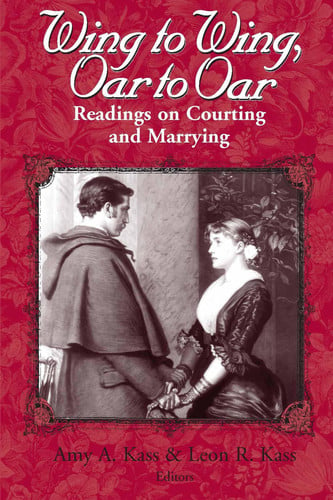
Wing to wing, oar to oar: readings on courting and marrying

Kass, Amy A.,Kass, Leon R.
Despite current concerns for “family values” and the dissolution of marriages, Amy A. and Leon R. Kass see very little attention being paid to what makes for marital success. They argue there are no longer socially prescribed forms of conduct that help guide young men and women in the direction of matrimony; the very concepts of “wooing” and “courting” seem archaic. Yet they see major discontent with the present situation and detect among their students certain longings―for friendship, for wholeness, for a life that is serious and deep, and for associations that are trustworthy and lasting―longings they do not realize could be largely satisfied by marrying well. Wing to Wing, Oar to Oar: Courting and Marrying is an anthology of source readings offered as a response to the contemporary cultural silence surrounding love that leads to marriage. It addresses important questions that emerge not from theory, but from practice: Why marry? Is this love? How can I find and win the right one to marry? What about sex? Why a wedding and the promises of marriage? What can married life be like? Using readings taken mainly from classic texts of Homer, Herodotus, Plato, Aquinas, Erasmus, Shakespeare, Rousseau, Austen, Tolstoy, C.S. Lewis, Miss Manners, and many others, this collection challenges our unexamined opinions, expands our sympathies, elevates our gaze. It offers a higher kind of sex education, one that prepares hearts and minds for romance leading to lasting marriage, and introduces us to possibilities open to human beings in everyday life that may be undreamt of in our current philosophizing. This unapologetically pro-marriage anthology is intended to help young people of marriageable age and their parents think about the meaning, purpose, and virtues of marriage and, especially, about finding the right person with whom to make a life.
University of Notre Dame Press 2000-02-22 636 pages

Object-choice: (All you need is love-- ) : on mating strategies & a fragment of a Freud biography

Theweleit, Klaus
Whom do we choose when we fall in love? How do we make the love-object into what we want? These are questions which only became important at the end of the nineteenth century, as Freud began to formulate a new discipline which would be called psycholanalysis. Freud argues Klaus Theweleit, was the first theoretician of the new situation: boy versus girl in the world series of love. Theweleit looks at a number of relationships: Alfred Hitchcock and Alma Reville; the triangle of Hannah Arendt, Martin Heidegger and Elfriede Heidegger; Jung and Sabina Spierlrein. But the key figure is Freud himself. Who would, who could Freud choose? As it happened, Freud proposed to Martha Bernays. The 1,500 letters of Freud’s courtship became something like the first psychoanalysis; without knowing it, Martha Bernays became an analytic-instance. But Object-Choice is not only a study of the founder of psychoanalysis, it is also an illuminating lexicon of love in the twentieth century. Freud is accompanied here by Jimi Hendrix, the Kinks and the Velvet Underground. Like Theweleits’s Male Fantasies , this is a collage book, mixing auto-biography, theory and pop culture, and always haunted by history, above all the history of Nazism. As an epilogue, Theweleit brings Freud back to the scene of his courtship, and the Beatles back to Hamburg, in an exploration of that city’s Wandsbek district, once home to an important Jewish community. His comments on the transformations and destruction that Wandsbek has endured form an elegiac tribute to German Jewry, and a powerful conclusion to this remarkable book.
Verso 1994-05-17 112 pages

The odd woman and the city: a memoir

Gornick, Vivian
"A contentious, deeply moving ode to friendship, love, and urban life in the spirit of Fierce Attachments A memoir of self-discovery and the dilemma of connection in our time, The Odd Woman and the City explores the rhythms, chance encounters, and ever-changing friendships of urban life that forge the sensibility of a fiercely independent woman who has lived out her conflicts, not her fantasies, in a city (New York) that has done the same. Running steadily through the book is Vivian Gornick's exchange of more than twenty years with Leonard, a gay man who is sophisticated about his own unhappiness, whose friendship has "shed more light on the mysterious nature of ordinary human relations than has any other intimacy" she has known. The exchange between Gornick and Leonard acts as a Greek chorus to the main action of the narrator's continual engagement on the street with grocers, derelicts, and doormen; people on the bus, cross-dressers on the corner, and acquaintances by the handful. In Leonard she sees herself reflected plain; out on the street she makes sense of what she sees. Written as a narrative collage that includes meditative pieces on the making of a modern feminist, the role of the flaneur in urban literature, and the evolution of friendship over the past two centuries, The Odd Woman and the City beautifully bookends Gornick's acclaimed Fierce Attachments, in which we first encountered her rich relationship with the ultimate metropolis"--
Farrar, Straus and Giroux 2015-05-19 175 pages

With all thine heart: love and the Bible

Stavans, Ilan
Is the Bible actually a love story between a deity and a people? And what does this love story have to do with the modern world? In With All Thine Heart distinguished cultural critic Ilan Stavans speaks to freelance writer Mordecai Drache about love in the Bible. Presented in an engaging, conversational format and touched with striking artwork, the textured dialogue between Stavans and Drache is meant to show how the Bible is a multidimensional text and one that, when considered over the course of history, still has the power to shape our world. The theme of love provides the connective tissue that binds this work. Addressing a wide range of topics, from biblical archaeology and fundamentalism to Hollywood movies, lexicography, and the act of praying, With All Thine Heart suggests that the Hebrew Bible is a novel worth decoding patiently, such as one does with classics like Don Quixote de la Mancha, In Search of Lost Time, and Anna Karenina. Similar to the protagonists in these tales, biblical characters, although not shaped with the artistic nuance of modern literature, allow for astonishing insight. This exploration of love through the pages of the Bible--organized chronologically from Genesis to Exodus and followed by insightful meditations on the Song of Songs and the Book of Job--is a delightful intellectual and spiritual treat . . . Shema Ysrael!
Rutgers University Press 2010 185 pages

Shuva: the future of the Jewish past

Kurtzer, Yehuda
Modern Jews tend to relate to the past through “history,” which relies on empirical demonstration and rational thought, rather than through “memory,” which relies on the non-rational architectures of mythology. By now “history” has surpassed “memory” as a means of relating to the past—a development that falls short in building identity and creates disconnection between Jews and their collective history. Kurtzer seeks to mend this breach. Drawing on key classical texts, he shows that “history” and “memory” are not exclusive and that the perceived dissonance between them can be healed by a selective reclamation of the past and a translation of that past into purposefulness.
Brandeis University Press 2012-04-10 168 pages

The defiant soul: a mystical fantasy of extraordinary love : a play in two acts

Rubenstein, Howard S.
"The play is a love story about a boy and a girl. The boy is a brilliant student, but he is poor. The girl is beautiful, intelligent, and rich. They want to marry, but the girl's father is opposed to the marriage because of the boy's poverty. So the boy turns to Jewish mystical philosophy called Kabbalah in the hope that it will enable him to win the girl. At first things appear to be going well for him, but suddenly they take a turn for the worse. Desperate, the boy turns to forbidden Kabbalah, and falls into the deepest depths. Will Kabbalah permit him to climb out of the depths and attain his goal?"--Amazon.com
Granite Hills Press 2016 82 pages

The meaning of love in human experience

Fine, Reuben
This book presents an integrative theory of love as the most important of human experiences, drawing on data from psychology, psychoanalysis, anthropology and history. It distinguishes and analyzes the differences between love cultures and hate cultures, showing how these differences affect social history, child-rearing practices and personal mental health. The book also examines the meaning of love from genetic, cultural, intrapersonal, and interpersonal perspectives.
Wiley 1985 422 pages