417 results for "Mathematics"

Combinators: a centennial view

Wolfram, Stephen
"Combinators have inspired ideas about computation ever since they were first invented in 1920, and in this innovative book, Stephen Wolfram provides a modern view of combinators and their significance. Informed by his work on the computational universe of possible programs and on computational language design, Wolfram explains new and existing ideas about combinators with unique clarity and stunning visualizations, as well as provides insights on their historical connections and the curious story of Moses Schönfinkel, inventor of combinators. Though invented well before Turing machines, combinators have often been viewed as an inaccessibly abstract approach to computation. This book brings them to life as never before in a thought-provoking and broadly accessible exposition of interest across mathematics and computer science, as well as to those concerned with the foundations of formal and computational thinking, and with the history of ideas"--
Wolfram Media, Inc 2021 362 pages

College Geometry An Introduction to the Modern Geometry of the Triangle and the Circle

Nathan Altshiller-Court
Translated into many languages, this book was in continuous use as the standard university-level text for a quarter-century, until it was revised and enlarged by the author in 1952. World-renowned writer and researcher Nathan Altshiller-Court (1881-1968) was a professor of mathematics at the University of Oklahoma for more than thirty years. His revised introduction to modern geometry offers today's students the benefits of his many years of teaching experience. The first part of the text stresses construction problems, proceeding to surveys of similitude and homothecy, properties of the triangle and the quadrilateral, and harmonic division. Subsequent chapters explore the geometry of the circle -- including inverse points, orthogonals, coaxals, and the problem of Apollonius and triangle geometry, focusing on Lemoine and Brocard geometry, isogonal lines, Tucker circles, and the orthopole. Numerous exercises of varying degrees of difficulty appear throughout the text.
Dover Publications, Incorporated 2013-12-30 336 pages

Stochastic Processes

Joseph L. Doob
The theory of stochastic processes has developed so much in the last twenty years that the need for a systematic account of the subject has been felt, particularly by students and instructors of probability. This book fills that need. While even elementary definitions and theorems are stated in detail, this is not recommended as a first text in probability and there has been no compromise with the mathematics of probability. Since readers complained that omission of certain mathematical detail increased the obscurity of the subject, the text contains various mathematical points that might otherwise seem extraneous. A supplement includes a treatment of the various aspects of measure theory. A chapter on the specialized problem of prediction theory has also been included and references to the literature and historical remarks have been collected in the Appendix.
Textbook Publishers 2003 654 pages

Proofs and refutations: the logic of mathematical discovery

Lakatos, Imre
Proofs and Refutations is essential reading for all those interested in the methodology, the philosophy and the history of mathematics. Much of the book takes the form of a discussion between a teacher and his students. They propose various solutions to some mathematical problems and investigate the strengths and weaknesses of these solutions. Their discussion (which mirrors certain real developments in the history of mathematics) raises some philosophical problems and some problems about the nature of mathematical discovery or creativity. Imre Lakatos is concerned throughout to combat the classical picture of mathematical development as a steady accumulation of established truths. He shows that mathematics grows instead through a richer, more dramatic process of the successive improvement of creative hypotheses by attempts to 'prove' them and by criticism of these attempts: the logic of proofs and refutations.
Cambridge University Press 1976-09-02 174 pages

Proofs and refutations: the logic of mathematical discovery

Lakatos, Imre
Proofs and Refutations is essential reading for all those interested in the methodology, the philosophy and the history of mathematics. Much of the book takes the form of a discussion between a teacher and his students. They propose various solutions to some mathematical problems and investigate the strengths and weaknesses of these solutions. Their discussion (which mirrors certain real developments in the history of mathematics) raises some philosophical problems and some problems about the nature of mathematical discovery or creativity. Imre Lakatos is concerned throughout to combat the classical picture of mathematical development as a steady accumulation of established truths. He shows that mathematics grows instead through a richer, more dramatic process of the successive improvement of creative hypotheses by attempts to 'prove' them and by criticism of these attempts: the logic of proofs and refutations.
Cambridge University Press 1976-01-01 174 pages

Eight lessons on infinity: a mathematical adventure

Shapira, Haim
"In this book, best-selling author and mathematician Haim Shapira presents an introduction to mathematical theories which deal with the most beautiful concept ever invented by humankind: infinity. Written in clear, simple language and aimed at a lay audience, this book also offers some strategies that will allow readers to try their ability at solving truly fascinating mathematical problems. Infinity is a deeply counter-intuitive concept that has inspired many great thinkers. In this book we will meet many sages, both familiar and unfamiliar: Zeno and Pythagoras, Georg Cantor and Bertrand Russell, Sofia Kovalevskaya and Emmy Noether, al-Khwarizmi and Euclid, Sophie Germain and Srinivasa Ramanujan. The world of infinity is inhabited by many paradoxes, and so is this book: Zeno paradoxes, Hilbert's "Infinity Hotel", Achilles and the gods paradox, the paradox of heaven and hell, the Ross-Littlewood paradox involving tennis balls, the Galileo paradox and many more. Aimed at the curious but non-technical reader, this book refrains from using any fearsome mathematical symbols. It uses only the most basic operations of mathematics: adding, subtracting, multiplication, division, powers and roots - that is all. But that doesn't mean that a bit of deep thinking won't be necessary and rewarding. Writing with humour and lightness of touch, Haim Shapira banishes the chalky pallor of the schoolroom and offers instead a truly thrilling intellectual journey. Fasten your seatbelt - we are going to Infinity, and beyond!" --
Duncan Baird Publishing, an imprint of Watkins Media Limited 2019-04-16 208 pages

A strange wilderness: the lives of the great mathematicians

Aczel, Amir D.
"Bestselling popular science author Amir Aczel selects the most fascinating individuals and stories in the history of mathematics, presenting a colorful narrative that explores the quirky personalities behind some of the most profound, enduring theorems. Through such mathematical geniuses as Archimedes, Leonardo of Pisa (a.k.a. Fibonacci), Tartaglia ("the stutterer"), Descartes, Gottfried Leibniz, Carl Gauss, Joseph Fourier (Napoleon's mathematician), Evariste Galois, Georg Cantor, Ramanujan, and "Nicholas Bourbaki," we gather little known details about the alliances and rivalries that profoundly impacted the development of what the scheming doctor-turned-mathematician Geronimo Girolamo called "The Great Art." This story of mathematics is not your dry "college textbook" account; tales of duels, battlefield heroism, flamboyant arrogance, pranks, secret societies, imprisonment, feuds, theft, and even some fatal errors of judgment fill these pages (clearly, genius doesn't guarantee street smarts). Ultimately, readers will come away from this book entertained, with a newfound appreciation of the tenacity, complexity, eccentricity, and brilliance of the mathematical genius"--
Sterling 2011 284 pages

Measure Theory

Paul R. Halmos
Useful as a text for students and a reference for the more advanced mathematician, this book presents a unified treatment of that part of measure theory most useful for its application in modern analysis. Coverage includes sets and classes, measures and outer measures, Haar measure and measure and topology in groups. From the reviews: "Will serve the interested student to find his way to active and creative work in the field of Hilbert space theory." --MATHEMATICAL REVIEWS
Springer New York 2014-01-06 304 pages

Basic Algebra: Groups, Rings and Fields

Cohn, Paul M.
Basic Algebra is the first volume of a new and revised edition of P.M. Cohn's classic three-volume text Algebra which is widely regarded as one of the most outstanding introductory algebra textbooks. For this edition, the text has been reworked and updated into two self-contained, companion volumes, covering advanced topics in algebra for second- and third-year undergraduate and postgraduate research students. In this first volume, the author covers the important results of algebra; the companion volume, Further Algebra and Applications, brings more advanced topics and focuses on the applications. Readers should have some knowledge of linear algebra and have met groups and fields before, although all the essential facts and definitions are recalled. The coverage is comprehensive and includes topics such as: - Groups - lattices and categories - rings, modules and algebras - fields The author gives a clear account, supported by worked examples, with full proofs. There are numerous exercises with occasional hints, and some historical remarks.
Springer London Ltd 2012-11-12 465 pages

Linear Programming 1 Introduction

George B. Dantzig,Mukund N. Thapa
By George B. Dantzig LINEAR PROGRAMMING The Story About How It Began: Some legends, a little about its historical sign- cance, and comments about where its many mathematical programming extensions may be headed. Industrial production, the ?ow of resources in the economy, the exertion of military e?ort in a war, the management of ?nances—all require the coordination of interrelated activities. What these complex undertakings share in common is the task of constructing a statement of actions to be performed, their timing and quantity(calledaprogramorschedule), that, ifimplemented, wouldmovethesystem from a given initial status as much as possible towards some de?ned goal. While di?erences may exist in the goals to be achieved, the particular processes, and the magnitudes of e?ort involved, when modeled in mathematical terms these seemingly disparate systems often have a remarkably similar mathematical str- ture. The computational task is then to devise for these systems an algorithm for choosing the best schedule of actions from among the possible alternatives. The observation, in particular, that a number of economic, industrial, ?nancial, and military systems can be modeled (or reasonably approximated) by mathem- ical systems of linear inequalities and equations has given rise to the development of the linear programming ?eld.
Springer New York 2013-04-26 435 pages

Foundations of Analysis Third Edition

Edmund Landau
Certainly no clearer treatment of the foundations of the number system can be offered … one can only be thankful to the author for this fundamental piece of exposition, which is alive with his vitality and genius. —American Mathematical Monthly Why does $2 times 2 = 4$? What are fractions? Imaginary numbers? Why do the laws of algebra hold? And how do we prove these laws? What are the properties of the numbers on which the Differential and Integral Calculus is based? In other words, what are numbers? And why do they have the properties we attribute to them? Thanks to the genius of Dedekind, Cantor, Peano, Frege, and Russell, such questions can now be given a satisfactory answer. This English translation of Landau's famous Grundlagen der Analysis answers these important questions.
American Mathematical Society 2022-07-14 136 pages

Theory of Finite and Infinite Graphs

König, Denes
To most graph theorists there are two outstanding landmarks in the history of their subject. One is Euler's solution of the Konigsberg Bridges Problem, dated 1736, and the other is the appearance of Denes Konig's textbook in 1936. "From Konigsberg to Konig's book" sings the poetess, "So runs the graphic tale . . . " [10]. There were earlier books that took note of graph theory. Veb len's Analysis Situs, published in 1931, is about general combinato rial topology. But its first two chapters, on "Linear graphs" and "Two-Dimensional Complexes," are almost exclusively concerned with the territory still explored by graph theorists. Rouse Ball's Mathematical Recreations and Essays told, usually without proofs, of the major graph-theoretical advances ofthe nineteenth century, of the Five Colour Theorem, of Petersen's Theorem on I-factors, and of Cayley's enumerations of trees. It was Rouse Ball's book that kindled my own graph-theoretical enthusiasm. The graph-theoretical papers of Hassler Whitney, published in 1931-1933, would have made an excellent textbook in English had they been collected and published as such. But the honour of presenting Graph Theory to the mathe matical world as a subject in its own right, with its own textbook, belongs to Denes Konig. Low was the prestige of Graph Theory in the Dirty Thirties. It is still remembered, with resentment now shading into amuse ment, how one mathematician scorned it as "The slums of Topol ogy.""
Birkhäuser 2012-10-18 436 pages

Where mathematics comes from: how the embodied mind brings mathematics into being

Lakoff, George
When you think about it, it seems obvious: The only mathematical ideas that human beings can have are ideas that the human brain allows. We know a lot about what human ideas are like from research in Cognitive Science. Most ideas are unconscious, and that is no less true of the mathematical ones. Abstract ideas, for the most part, arise via conceptual metaphor-a mechanism for projecting embodied (that is, sensory-motor) reasoning to abstract reasoning. This book argues that conceptual metaphor plays a central, defining role in mathematical ideas within the cognitive unconscious-from arithmetic and algebra to sets and logic to infinity in all of its forms: transfinite numbers, points at infinity, infinitesimals, and so on. Even the real numbers, the imaginary numbers, trigonometry, and calculus are based on metaphorical ideas coming out of the way we function in the everyday physical world. This book is about mathematical ideas, about what mathematics means-and why. The authors believe that understanding the metaphors implicit in mathematics will make mathematics make more sense. Moreover, understanding mathematical ideas and how they arise from our bodies and brains will make it clear that the brain's mathematics is mathematics, the only mathematics we know or can know. -- Publisher description.
Basic Books 2000 492 pages

One, Two, Three Absolutely Elementary Mathematics

David Berlinski
The acclaimed author of A Tour of the Calculus and The Infinite Ascent offers an enlightening and enthralling tour of the basics of mathematics, and reveals a world of fascination in fundamental mathematical ideas. One, Two, Three is David Berlinski’s captivating exploration of the foundation of mathematics, its fundamental ideas, and why they matter. By unraveling the complex answers to these most elementary questions—What is a number? How do addition, subtraction, and other functions actually work? What are geometry and logic?—Berlinski reveals the intricacy behind their seemingly simple exteriors. Peppered with enlightening historical anecdotes and asides on some of history’s most fascinating mathematicians, One, Two, Three, revels in the beauty of numbers as Berlinski shows us how and why these often slippery concepts are as essential to the field of mathematics as to who we are.
Knopf Doubleday Publishing Group 2012-05-01 224 pages

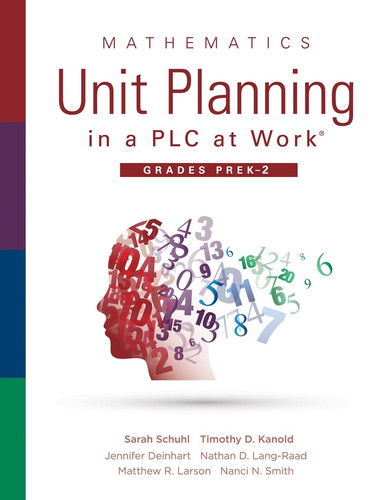
Mathematics unit planning in a PLC at work, grades PreK-2

Schuhl, Sarah,Kanold, Timothy D.,Deinhart, Jennifer,Lang, Nathan D.,Larson, Matthew R.,Smith, Nanci N.
"This book is part of the Every Student Can Learn Mathematics series. In Mathematics Unit Planning in a PLC at Work, Grades PreK-2, authors Sarah Schuhl, Timothy D. Kanold, Jennifer Deinhart, Nathan D. Lang-Raad, Matthew R. Larson, and Nanci N. Smith provide grades preK-2 mathematics teachers with a framework for collectively planning a unit of study. This book helps teams identify what students need to know by the end of each unit and how to build student self-efficacy. The authors advocate using the PLC at Work process for increasing mathematics achievement, and as teams answer the four critical questions of a PLC, they provide students with a more equitable learning experience. The authors share tools and protocols for effectively performing collaborative tasks, such as unwrapping standards, generating unit calendars, determining academic vocabulary and rigorous lessons, utilizing and sharing self-reflections, and designing foundational addition and subtraction units. By reading Mathematics Unit Planning in a PLC at Work, Grades PreK-2, teachers will receive practical insight into collaborative planning and inspiring detailed models of this work in action"--
Solution Tree Press 2021 152 pages