112 results for "Poetry"

Poems of Heinrich Heine

Louis Untermeyer,Heinrich Heine
This work has been selected by scholars as being culturally important, and is part of the knowledge base of civilization as we know it. This work is in the "public domain in the United States of America, and possibly other nations. Within the United States, you may freely copy and distribute this work, as no entity (individual or corporate) has a copyright on the body of the work. Scholars believe, and we concur, that this work is important enough to be preserved, reproduced, and made generally available to the public. We appreciate your support of the preservation process, and thank you for being an important part of keeping this knowledge alive and relevant.
Creative Media Partners, LLC 2022-10-27 346 pages

Selected Religious Poems of Solomon ibn Gabirol

Gabirol, Solomon Ibn
This is a pre-1923 historical reproduction that was curated for quality. Quality assurance was conducted on each of these books in an attempt to remove books with imperfections introduced by the digitization process. Though we have made best efforts - the books may have occasional errors that do not impede the reading experience. We believe this work is culturally important and have elected to bring the book back into print as part of our continuing commitment to the preservation of printed works worldwide.
BiblioLife 2009-04-30 160 pages

Led by language: the poetry and poetics of Susan Howe

Back, Rachel Tzvia
This first full-length study of Susan Howe illuminates the historical, autobiographical, and theoretical influences that underlie the work of this enigmatic and important contemporary American poet. In Led by Language , poet and scholar Rachel Tzvia Back offers a close and detailed reading of Susan Howe's provocative and powerful poetry. Howe's work is dense, often difficult, but always distinctive, and Back's volume explains a number of features crucial to understanding her poems. In this complete survey of Howe's major work, from 1978's Secret History of the Dividing Line to 1999's Pierce-Arrow , Back highlights the key strategies underlying Howe's work: linguistic experimentation, historical motifs, autobiographical references, and visual experimentation with types, fonts, and images. One of the book's most compelling arguments is Back's case for reading Howe's work autobiographically. An obsession with history characterizes Howe's poetry--historical figures from Mary Magdalene to Melville haunt her work--and Back deftly demonstrates the intensely personal nature of much of the historical terrain Howe traverses. This study debunks the myth of Howe's impenetrability, making her work accessible to a wide range of readers. Back has created a thorough guide to reading and understanding this important poet, and her book will be welcomed by students and scholars of contemporary poetry, American literature, literary theory, and cultural studies.
University of Alabama Press 2002 238 pages

The politics of Olympus: form and meaning in the major Homeric hymns

Clay, Jenny Strauss
Jenny Strauss Clay provides a systematic & convincing reading of the four Homeric hymns as a group, & in relation to the epics of Homer & the 'Theogony' of Hesiod. She reveals unexpected subtleties & coherence, & also shows how the hymns work in combination to provide an over-arching Greek worldview. 'This important and ground-breaking book provides a systematic and convincing reading of these four fascinating poems as a group, and in relation to the epics of Homer and the Theogony of Hesiod. Clay's expert and highly original analysis of the poems' narrative and thematic patterns succeeds brilliantly in demonstrating not only the unexpected subtlety and coherence of each Hymn, but also the ways in which they work in combination to provide an over-arching Greek world-view. This is by far the best book that has been written on this important body of poetry.' -- Mark Griffith, University of California, Berkeley 'Though controversial in many places, this book is of great value to classicists. Its assumption that the poems have an intellectual and "theological" coherence... is welcome and will benefit those who teach the Hymns.' -- Charles Platter, Classical Outlook
Bristol Classical Press 2006 291 pages

Maria Stuart

Zweig, Stefan
"Mary Stuart's execution remains an entirely unacceptable crime morally (...) However, it is equally difficult to deny that the destruction of Mary Stuart was a prudent course of action from a public policy standpoint. Because, regrettably, in politics, the determining issue is not the correctness of a legislation, but its success." Stefan Zweig was enchanted with Mary Stuart, whose life he perceived as immensely paradoxical and from whom he perceived a "inexhaustible attraction of mystery." Thus, he investigated the queen of Scotland and Elizabeth I's fierce rival through the lens of a novelistic biography. Zweig is the undisputed master of this genre: he meticulously details the tumultuous life of this amazing woman, who culminated on the scaffold. Biography Stefan Zweig (1881-1942) was born into a Jewish commercial family in Vienna. He created poetry, stories, plays, and essays, all of which were burned by the Nazis in 1933. He resided in Salzburg from 1919 until 1934, then moved to England and then to Brazil in 1941. His epic works, like his historical miniatures and biographical works, made him famous. He deliberately put up his life in Petrópolis, Brazil, on February 23, 1942.
Independently published 2021-04-05 596 pages

The apothecary's daughter

Schonstein, Patricia
"A nobleman and his wife, an apothecary nun, an astronomer-mathematician, an inquisitor, a poet who is both lover and villain, a portraitist, a queen and loyal servants deftly act out a beautiful drama of tantalizing relationships. They take up their roles in castle and convent, some surrounded by ornate interiors, garbed in velvets and silks, garlanded with precious jewels; while others abide in simple space devoid of art or representation, and dressed in plain linens and dull calicos. THE APOTHECARY'S DAUGHTER is a wondrous tale, rendered in erotic prose and poetry, stitched through with rich imagery, humour and tenderness. It is also a story of trade and exotic travel, both across the surface of the earth and among the stars."
Bantam 2004 224 pages

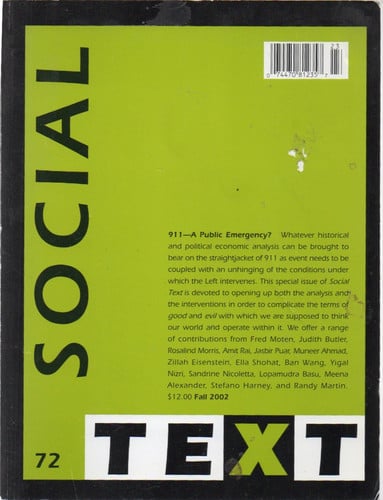
911 a Public Emergency?

Brent Hayes Edwards,Stefano Harney,Randy Martin,Ella Shohat,Timothy Mitchell,Fred Moten
Since September 11, public discourse has often been framed in terms of absolutes: an age of innocence gives way to a present under siege, while the United States and its allies face off against the Axis of Evil. This special issue of Social Text aims to move beyond these binaries toward thoughtful analysis. The editors argue that the challenge for the Left is to develop an antiterrorism stance that acknowledges the legacy of U.S. trade and foreign policy as well as the diversity of the Muslim faith and the dangers presented by fundamentalism of all kinds. Examining the strengths and shortcomings of area, race, and gender studies in the search for understanding, this issue considers cross-cultural feminism as a means of combating terrorism; racial profiling of Muslims in the context of other racist logics; and the homogenization of dissent. The issue includes poetry, photographic work, and an article by Judith Butler on the discursive space surrounding the attacks of September 11. This impressive range of contributions questions the meaning and implications of the events of September 11 and their aftermath. Contributors . Muneer Ahmad, Meena Alexander, Lopamudra Basu, Judith Butler, Zillah Eisenstein, Stefano Harney, Randy Martin, Rosalind C. Morris, Fred Moten, Sandrine Nicoletta, Yigal Nizri, Jasbir K. Puar, Amit S. Rai, Ella Shohat, Ban Wang
Duke University Press 2002-09-20 208 pages

The birth of literary fiction in ancient Greece

Finkelberg, Margalit
The purpose of this study is to find out how and why the "poetics of fiction" arose, its sources, and the materials from which it was created. A series of cultural choices made in archaic and classical Greece produced a clash between the traditional "poetics of truth", which derived poetry from divine inspiration and in the last analysis did not construe the poem as a work of art at all, and the new "poetics of fiction", which derived poetry from art. The eventual succession of the latter, culminating with the Poetics of Aristotle, amounted to an aesthetic revolution because, as a result of it, literary fiction, which since then has become a necessary framework for both the theory and practice of literature in Western tradition, was for the first time separated from non-fiction and given a status of its own.
Clarendon Press 1998-06-25 222 pages

Plato's "Laws": the discovery of being

Benardete, Seth
An insightful commentary on Plato’s Laws , his complex final work. The Laws was Plato’s last work, his longest, and one of his most difficult. In contrast to the Republic, which presents an abstract ideal, the Laws appears to provide practical guidelines for the establishment and maintenance of political order in the real world. Classicist Seth Benardete offers a rich analysis of each of the twelve books of the Laws , which illuminates Plato’s major themes and arguments concerning theology, the soul, justice, and education. Most importantly, Benardete shows how music in a broad sense, including drama, epic poetry, and even puppetry, mediates between reason and the city in Plato’s philosophy of law. Benardete also uncovers the work’s concealed ontological dimension , explaining why it is hidden and how it can be brought to light. In establishing the coherence and underlying organization of Plato’s last dialogue, Benardete makes a significant contribution to Platonic studies.
University of Chicago Press 2000 385 pages

Edge of irony: modernism in the shadow of the Habsburg Empire

Perloff, Marjorie
Among the brilliant writers and thinkers who emerged from the multicultural and multilingual world of the Austro-Hungarian Empire were Joseph Roth, Robert Musil, and Ludwig Wittgenstein. For them, the trauma of World War I included the sudden loss of the geographical entity into which they had been born: in 1918, the empire was dissolved overnight, leaving Austria a small, fragile republic that would last only twenty years before being annexed by Hitler{u2019}s Third Reich. In this major reconsideration of European modernism, Marjorie Perloff identifies and explores the aesthetic world that emerged from the rubble of Vienna and other former Habsburg territories{u2014}an 2Austro-Modernism3 that produced a major body of drama, fiction, poetry, and autobiography. Perloff explores works ranging from Karl Kraus{u2019}s drama The Last Days of Mankind and Elias Canetti{u2019}s memoir The Tongue Set Free to Ludwig Wittgenstein{u2019}s notebooks and Paul Celan{u2019}s lyric poetry. Throughout, she shows that Austro-Modernist literature is characterized less by the formal and technical inventions of a modernism familiar to us in the work of Joyce and Pound, Dada and Futurism, than by a radical irony beneath a seemingly conventional surface, an acute sense of exile, and a sensibility more erotic and quixotic than that of its German contemporaries. Skeptical and disillusioned, Austro-Modernism prefers to ask questions rather than formulate answers
The University of Chicago Press 2016-05-06 204 pages

The Apocryphal Acts of Paul, Peter, John, Andrew, and Thomas

Pick, Bernhard
The publication of the apocryphal Acts of the Apostles has unveiled a vast yet unexplored domain in ancient Christian literature. These Acts, particularly the oldest ones, provide insights into second-century Christianity. They are vital for understanding early Christian worship practices and offer a glimpse into divine services held in homes, complementing the Acts of the Apostles. They also hold significance in the history of Christian poetry, notably within Gnostic circles. Despite their mix of fact and fiction, these Acts are relevant to educators, preachers, missionaries, and historians. The oldest and most significant Acts are presented in this volume. These Acts are crucial for early Church literature and provide valuable insights into Christian history. Bernhard Pick (1842–1917) was a German-American Lutheran pastor and prolific scholar, studied at New York City's Union Theological Seminary. He contributed extensively to theological encyclopedias, provided critical indexes, and delved into hymnology. This Reader's Edition is based on a public domain text. This text has been thoroughly spellchecked and proofread to correct errors that appear in the public domain edition. The formatting has also been altered to provide a cleaner, more readable experience. Introductions and footnotes not native to the text have been removed to avoid interruptions to and distractions from the text. Many readers find that this allows them a greater ability to focus on the text itself. It is our hope that this Reader's Edition will provide you with the best possible reading experience of this classic text. Our mission is to breathe new life into the pages of the past by removing barriers between the reader and the text.
Independently published 2023-09-18 237 pages

Prayer After the Slaughter The Great War: Poems and Stories from World War I

Kurt Tucholsky
No one before or after Kurt Tucholsky has captured the horrors of the "Great War," as World War I was known, quite like he did. The famed Weimar writer, who would become one of Germany's best-known satirist and journalists, describes surviving in the trenches and fighting a losing battle, the arrogance of the officers and the desperation of the loved ones back home. His writing is similar to that of Heinrich Heine, his role model, in that it appears superficially simple but is replete with hidden meanings. His works are touching, stirring, and precisely to the point. He brings alive the war that still looms even into our own 21st century. This is the first bilingual anthology in German and in English of his works on World War I. The First World War was the "Great War". Everything that happened after this war, even into our own 21st century, is contingent on the years between 1914 and 1918. The Great War also shaped Kurt Tucholsky who emerged from the war.. His style is biting, satirical, and penetrating, full of Berlin gallows humor. This bilingual anthology contains English translation of his short stories as well as a rendition of his poetry about World War I, all representative of his style.
Berlinica 2015 118 pages

Germany A Winter's Tale: Deutschland: Ein Wintermärchen

Heinrich Heine
In 1835, the German principalities and cities banned the works of German-Jewish poet Heinrich Heine. The censors banned not only the works Heine had already published, but also prohibited, in advance, any work the writer might produce in the future. When Heine sneaked across the border from his Paris exile in 1843, the result was the poem-cycle Deutschland: Ein Wintermärchen (Germany: A Winter's Tale). The Hamburg publisher Julius Campe published this book, and kept all of Heine's work available "under the counter," so that the banned poet was read even more widely than ever. Heine's satires against German arrogance and militarism would continue in the 1840s, when the poet and Karl Marx worked together on the revolutionary newspaper Vorwärts. Heine's books would be banned again by the Nazis, who made a point of burning his books, and erasing his name from published song lyrics. Even the most famous of all German Lieder, "The Lorelei," was now said to have lyrics by "Author Unknown." Jacob Rabinowitz's adaptation of the 27-poem cycle renders Heine's verses into rapid-fire lines, almost as though Lenny Bruce were channeling his 19th century forebear. And instead of peppering the text with explanatory footnotes on the context of German culture and history in the poems, Rabinowitz incorporates helpful elucidations into the flow of the poems. For those who want to read the original German for themselves, this edition includes the complete 1844 German text on facing pages.
Yogh & Thorn Press 2016-07-15 222 pages

A Survey of Modernist Poetry

Laura Riding,Robert Graves
"A survey of modernist poetry" by renowned authors Robert Graves and Laura Riding stands as a seminal work in literary criticism, offering an indispensable examination of 20th-century poetic innovation. This landmark text provides a comprehensive and critical look at the rise of modernism in literature, delving into the foundational principles and varied expressions that shaped the movement. Graves and Riding meticulously analyze the historical trajectory of modernist poetry, tracing its evolution, identifying key figures, and exploring the profound shifts in form and content. This authoritative survey is essential for anyone interested in the history of poetry, the development of free verse, and the broader impact of modernism. It dissects the stylistic shifts and theoretical underpinnings that defined one of the most transformative periods in literary history, offering deep insights into the craft and intellectual currents of the era. "A survey of modernist poetry" remains a vital resource, offering profound understanding of the complex landscape of 20th-century poetry and the enduring legacy of modernism. As a carefully prepared print republication, it continues to serve as a cornerstone for students, scholars, and enthusiasts seeking clarity on a pivotal era of literary change. This work has been selected by scholars as being culturally important, and is part of the knowledge base of civilization as we know it. This work is in the public domain in the United States of America, and possibly other nations. Within the United States, you may freely copy and distribute this work, as no entity (individual or corporate) has a copyright on the body of the work. Scholars believe, and we concur, that this work is important enough to be preserved, reproduced, and made generally available to the public. We appreciate your support of the preservation process, and thank you for being an important part of keeping this knowledge alive and relevant.
Creative Media Partners, LLC 2025-12-12 218 pages

Modern Russian Poetry; Texts and Translations

Paul Selver
Unlike some other reproductions of classic texts (1) We have not used OCR(Optical Character Recognition), as this leads to bad quality books with introduced typos. (2) In books where there are images such as portraits, maps, sketches etc We have endeavoured to keep the quality of these images, so they represent accurately the original artefact. Although occasionally there may be certain imperfections with these old texts, we feel they deserve to be made available for future generations to enjoy.
HardPress 2012-08 94 pages