89 results for "Poetry"

Collected earlier poems

Hecht, Anthony
Pulitzer Prize-winner Anthony Hecht has long been regarded as one of the great modern American poets, and is hailed by many as the unofficial Poet Laureate' of the USA. This volume brings together all the poems contained in The Hard Hours (1967), Millions of Strange Shadows (1977), and The Venetian Vespers (1980), and versions of Joseph Brodsky's early poems, which Hecht was the first to translate. These three distinguished books affirm Hecht's reputation as a technically accomplished poet capable of powerfully expressing deep sentiment and original thought.
Oxford University Press 1991 272 pages

American odyssey, 1963-1999

Mark, Mary Ellen
The unspoken poetry of our nation revealed by an American master. The first collection of the extensive and superlative work realized by Mary Ellen Mark in the United States, Mary Ellen Mark is composed of many previously unpublished images, as well as photographs from several of her best-known projects. From "Streetwise" to "The Damm Family," Mary Ellen Mark includes the most iconic images from these groundbreaking stories, as well as powerful, never-before-seen photographs Mark accomplished in subsequent years. She makes a deeply felt commitment to her subjects, and her empathy and humanity come through in every image. Mark is unsurpassed at shaping not only the odd but the everyday into genuinely surprising visual icons. With an eye for symbolism and a gift for meticulous composition, she is drawn to a variety of spectacles and situations, and demonstrates a particular affinity for children. Her elegantly revealing imagery creates a fascinating portrait of our complex, amusing, and occasionally unsettling country.
Aperture 1999 151 pages

My cousin, my gastroenterologist

Leyner, Mark
Product Description Welcome to Mark Leyner’s America, where you can order gallium arsenide sushi at a roadside diner, get loaded on a cocktail of growth hormones and anabolic steroids, and support your habit by appearing on TV game shows. Welcome to a wildly post-Einsteinian fictional universe where the locals include a speech pathologist with a waterbug fetish, a kamikaze airline pilot, and the lead singer for Brazil’s most notoriously nihilistic samba band. From Publishers Weekly These 17 loosely linked short stories are intelligent, funny and incredibly bizarre. Though not all are science fiction, each displays a supercharged cyberpunk writing style jam-packed with elements of tabloid journalism, bits of advertising slogans, references to kung fu films, literary allusions, television trivia, deadpan non sequiturs, puns and poetry. The fiercely imaginative Leyner ( I Smell Esther Williams ) announces: "Dad was in the basement centrifuging mouse spleen hybridoma, when I informed him that I'd enrolled at the Wilford Military Academy of Beauty." He also discusses the difficulty of finding a haberdashery near the Mitsubishi Heavy Industries shipyard and speculates on a televised encounter between Tennessee's youngest member of the House of Representatives and 17th-century metaphysician Baruch Spinoza. Squads of displaced, armed and dangerous combatants inhabit a young boy's bedroom in the marvelous "In the Kingdom of Boredom, I Wear the Royal Sweatpants." It's an exuberant, adventurous and audacious collection. Some of the pieces were originally published in Esquire, Harper's and Fiction International , among other magazines. Copyright 1990 Reed Business Information, Inc. Review "I really, really liked it. It's like nothing else. I laughed out loud in the bathroom." -- David Byrne Welcome to Mark Leyner's America, where you can order gallium arsenide sushi at a roadside diner, get loaded on a cocktail of growth hormones and steroids, and support your habit by appearing on TV game shows. Welcome to a wildly post-Einsteinian fictional universe where the locals include a speech pathologist with a waterbug fetish, a kamikaze airline pilot, and the lead singer for Brazil's most notoriously nihilistic samba band. My Cousin, My Gastroenterologist is fiction the brain can dance to, by one of the funniest and most subversive young writers of this or any other decade. "Most current fiction is as well made and exciting as floral wallpaper; but here is a writer willing to decorate the room with the contents of his own dynamited head." -- Entertainment Weekly "Reading this is like fishing in some hallucinated lake of the subconscious. No telling what term, idea, or thing you'll pull up next." -- Houston Post From the Back Cover This book is fiction the brain can dance to, by one of the funniest and most subversive young writers of this or any other decade. About the Author Mark Leyner is the author of two novels, Et Tu, Babe and The Tetherballs of Bougainville; two collections of stories , I Smell Esther Williams and Other Stories and My Cousin, My Gastroenterologist; and a collection of fiction, plays, and journalism, Tooth Imprints on a Corn Dog. His work has also appeared in The New Yorker, Esquire, The New Republic, George, and Harper’s.
HarperCollins 1991 160 pages

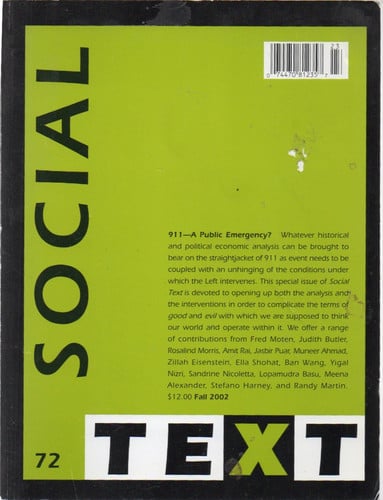
911 a Public Emergency?

Brent Hayes Edwards,Stefano Harney,Randy Martin,Ella Shohat,Timothy Mitchell,Fred Moten
Since September 11, public discourse has often been framed in terms of absolutes: an age of innocence gives way to a present under siege, while the United States and its allies face off against the Axis of Evil. This special issue of Social Text aims to move beyond these binaries toward thoughtful analysis. The editors argue that the challenge for the Left is to develop an antiterrorism stance that acknowledges the legacy of U.S. trade and foreign policy as well as the diversity of the Muslim faith and the dangers presented by fundamentalism of all kinds. Examining the strengths and shortcomings of area, race, and gender studies in the search for understanding, this issue considers cross-cultural feminism as a means of combating terrorism; racial profiling of Muslims in the context of other racist logics; and the homogenization of dissent. The issue includes poetry, photographic work, and an article by Judith Butler on the discursive space surrounding the attacks of September 11. This impressive range of contributions questions the meaning and implications of the events of September 11 and their aftermath. Contributors . Muneer Ahmad, Meena Alexander, Lopamudra Basu, Judith Butler, Zillah Eisenstein, Stefano Harney, Randy Martin, Rosalind C. Morris, Fred Moten, Sandrine Nicoletta, Yigal Nizri, Jasbir K. Puar, Amit S. Rai, Ella Shohat, Ban Wang
Duke University Press 2002-09-20 208 pages

Sketches for a Book of Psalms

Stone, Ira F.
Product Description A collection of 149 psalms (one less than King David) through which the poet discovers the dislocations in meaning and language that afflict the contemporary individual and drives the problem back to the Shoa, the destruction of the Jews of Europe and its catastrophic effect on the possibility of meaning let alone faith. By piecing together the remnants of language the poet is able to return to the world of discourse and, ultimately, prayer but in a significantly different key. About the Author Ira F. Stone is the Rabbi of Temple Beth Zion-Beth Israel in Philadelphia and a Visiting Lecturer in Jewish Philosophy at the Jewish Theological Seminary of America in New York. He is the author of three previous books, Seeking The Path To Life, (Jewish Lights) Reading Levinas/Reading Talmud,(JPS) and A Really Perfect Poem Has An Infinitely Small Vocabulary, (Mellon Poetry Press). His essays in Jewish thought have appeared in various journals including Conservative Judaism, Judaism, Kerem. His poetry has appeared in various magazines. He is married to Anna Stone and they are the parents of Tamar, Yehoshua and Shaul.
Authorhouse 2000-07-10 184 pages

Family business: selected letters between a father and son

Ginsberg, Allen
Begun in 1944 when Allen was a precocious, rebellious college student, the book charts his ascension as a revolutionary icon in poetry and ends with his father's death in 1976. Allen and Louis' letters are filled with affection, respect, and a healthy dose of argumentative zeal - they debate every major political and artistic issue that faced America in over three decades of extraordinary change, from Korea, the Beat generation and Cuba through Civil Rights and the counterculture to Vietnam and Watergate.
Bloomsbury 2003 448 pages

Jim Dine - Jewish fate

Dine, Jim
Jewish Fate is an evocative autobiographical poem by Jim Dine accompanied by 18 lithographs of one of his favorite motifs, tools. The poem shows Dine reminiscing about his childhood days spent at his grandfather's hardware store in Cincinnati, where he worked every Saturday and summer for ten years from the age of nine. Dine's vivid co-workers shape his memories. There is the head shipping clerk Joe Kibbing: tall, thin, "very dramatic and high strung and didn't take orders easily." Joe's older brother Bud was the dignified head salesman: "a soft-spoken, intelligent man who had he had an education past high school might have been a lawyer or a surgeon." And finally there was Willie Tapp, "short and lithe ... he dressed elegantly like a lot of black guys did then for a guy loading trucks and handling greasy tools and heavy boxes... This handsome, lovely man showed up for work drunk most Saturdays, but managed to perform most times." Among these characters in the inspirational, overflowing store Dine developed his love for tools which accompanies his art today and is seen in the hammers, rollers, brushes and wrenches in this book-all realized in Dine's inimitable unfinished style, in his words: "Always correcting and reinventing the drawing."
Steidl 2017 40 pages

I have a name

Ignatow, David
I have a Name is a vital engagement with life and an unflinching stare at death, concluding that love transcendent is a reality, Winner of the William Carlos Williams Award (1997) The wondrous subtlety of David Ignatow's art is brought to bear on the timeless themes of love and death. Intimate remembrances evince a rich life: Hebrew lessons, war, first love, friendships with Stanley Kunitz and others, his wife's death. One poem comments on another, often with wit and irony; no statement is ever final. In this way, Ignatow shows that we exist most fully in the fluidity of our perceptions and in our inability to attain a single state of mind or definition of things. I Have A Name is a vital engagement with life and an unflinching stare at death, concluding that love transcendent is a reality, embracing all, the living and the dead.
University Press of New England 1996-09-20 75 pages

Radical coherency: selected essays on art and literature, 1966 to 2005

Antin, David
“We got to talking”—so David Antin begins the introduction to Radical Coherency , embarking on the pursuit that has marked much of his breathless, brilliantly conversational work. For the past forty years, whether spoken under the guise of performance artist or poet, cultural explorer or literary critic, Antin’s innovative observations have helped us to better understand everything from Pop to Postmodernism. Intimately wedded to the worlds of conceptual art and poetics, Radical Coherency collects Antin’s influential critical essays and spontaneous, performed lectures (or “talk pieces”) for the very first time, capturing one of the most distinctive perspectives in contemporary literature. The essays presented here range from the first serious assessment of Andy Warhol published in a major art journal, as well as Antin’s provocative take on Clement Greenberg’s theory of Modernism, to frontline interventions in present debates on poetics and fugitive pieces from the ’60s and ’70s that still sparkle today—and represent a gold mine for art historians of the period. From John Cage to Allan Kaprow, Mark Rothko to Ludwig Wittgenstein, Antin takes the reader on an idiosyncratic, personal journey through twentieth-century culture with his trademark antiformalist panache—one thatwill be welcomed by any fan of this consummate trailblazer.
University of Chicago Press 2011-03-15 369 pages

A useful art: essays and radio scripts on American design

Zukofsky, Louis
A Useful Art is an invaluable chronicle of a major American poet’s engagement with this country’s indigenous tradition of design. In 1936, the Federal Arts Project (a division of the WPA) hired Louis Zukofsky, along with many others, to prepare a compendium of information on traditional American crafts. The Index of American Design aimed to define original U.S. culture at a time when interest in handicrafts had just begun to emerge. These previously unpublished essays and radio scripts are scrupulously researched investigations of various American handicrafts: the topics they cover include ironwork, tin ware, furniture maker Duncan Phyfe and friendship quilts. They also reflect Zukofsky’s sense of the poem as a crafted object and his attempt to reconcile the labor theory of value with aesthetic production. This book, which can be seen in the context of kindred work by William Carlos William (In the American Grain) and Ezra Pound (Guide to Kulchur), will be of special interest to readers of 20th-century poetry, cultural critics, social historians, and scholars of design.
Wesleyan University Press 2003-07-09 233 pages

The poetics of anarchy: David Edelshtat's revolutionary poetry

Kritz, Ori
David Edelshtat (1866-1892), a pioneer of Yiddish social poetry and one of the most prominent figures among communist anarchists, was born in Russia and immigrated to the United States (1882). He became a central poet during his lifetime and a legend among revolutionaries and Yiddish poets of subsequent generations, despite his short literary career which spanned a mere three and a half years (1889-1892). He was involved in the emergence of American Yiddish literature and journalism, and American Radicalism. This book treats his biography and explores major thematical, political and social aspects of his poetry, its revolutionary function, the poet's role as a political agitator and the press's role as a vehicle for the introduction of his poetry. The book also examines the diction and prosody of the poems and contributes to the theory of political poetry and the rhetoric of revolution.
P. Lang 1997-09-01 210 pages