2051 results for "Psychology"

The reproduction of mothering: psychoanalysis and the sociology of gender

Chodorow, Nancy
" The Reproduction of Mothering was that rare book that had a major impact on two different constituencies: feminists and psychoanalysts. It was a must-read in 1978, putting object-relations theory on the map in the United States, and it remains a must-read today. It continues to shape the thinking of analysts and feminists today, and it is one of the key texts available that links psyche and culture, psychoanalysis and sociology."--Ethel Spector Person, M.D., author of The Sexual Century "The book that created a Copernican Revolution in gender theory. . . . From literature to political science, from disciples to critics, no feminist theory has been untouched by Chodorow's bold and brilliant reconfiguration."--Susan Bordo, author of Unbearable Weight and The Male Body " The Reproduction of Mothering represents the boldest attempt to realign psychoanalysis and feminism in the late 20th century."--Mari Jo Buhle, author of Feminism and Its Discontents "It is difficult to imagine the shape that feminist literary criticism might have taken in the last twenty years without the enabling influence of The Reproduction of Mothering . The importance of Chodorow's work cannot be overestimated."--Marianne Hirsch, author of The Mother/Daughter Plot " The Reproduction of Mothering is a classic in its field, a book that has profoundly affected the course of psychoanalytic feminism."--Madelon Sprengnether, author of The Spectral Mother "Nancy Chodorow's The Reproduction of Mothering has been an invaluable companion to me over the years. In theorizing the cultural situation of literary men as well as literary women, I've often turned to Chodorow's revisionary readings of Freud, her meticulous accounts of the dynamics of mothering, and, more generally, her innvotative discussions of sexual sociology."--Sandra M. Gilbert, coauthor of The Madwoman in the Attic "A groundbreaking book, The Reproduction of Mothering has shaped feminist literary criticism since it was published. Chodorow's insights revolutionized the ways in which femininity itself was and is understood."--Susan Gubar, coauthor of The Madwoman in the Attic
University of California Press 1978 263 pages

Way of the wolf: straight line selling: master the art of persuasion, influence, and success

Belfort, Jordan
Jordan Belfort—immortalized by Leonardo DiCaprio in the hit movie The Wolf of Wall Street —reveals the step-by-step sales and persuasion system proven to turn anyone into a sales-closing, money-earning rock star. For the first time ever, Jordan Belfort opens his playbook and gives you access to his exclusive step-by-step system—the same system he used to create massive wealth for himself, his clients, and his sales teams. Until now this revolutionary program was only available through Jordan’s $1,997 online training. Now, in Way of the Wolf , Belfort is ready to unleash the power of persuasion to a whole new generation, revealing how anyone can bounce back from devastating setbacks, master the art of persuasion, and build wealth. Every technique, every strategy, and every tip has been tested and proven to work in real-life situations. Written in his own inimitable voice, Way of the Wolf cracks the code on how to persuade anyone to do anything, and coaches readers—regardless of age, education, or skill level—to be a master sales person, negotiator, closer, entrepreneur, or speaker.
North Star Way 2017 248 pages

Judgment detox: release the beliefs that hold you back from living a better life

Bernstein, Gabrielle
"From featured "next-generation thought leader" on Oprah Winfrey's Super Soul 100 and #1 New York Times bestselling author Gabrielle Bernstein comes a clear, proactive, step-by-step program to rid yourself of the tendency to judge yourself and others, and find your way back to true healing and oneness. Judgment--both being judged and judging others--is the core of our discomfort. While it's powerful, judgment isn't complicated. It's simply the separation from oneness. The moment we see ourselves as separate we detour into a false belief system that is out of alignment with our true nature. That separation, often a reflection of our own insecurities projected onto others, keeps us feeling alienated and alone. The Judgment Detox is an interactive process that calls on spiritual principles from the text A Course in Miracles, Kundalini yoga, meditation, EFT, and metaphysical teachings, allowing us to release the beliefs that hold us back from living a better life. Gabby has demystified these principles to make them easy to apply and commit to. The six steps include: -Witness your judgment without judgment -Honor the wound -Put love on the alter -See for the first time -Cut the cords -Bring your shadows to light This step-by-step process offers a path to true healing, oneness, and a deeper connection to the universe and those around us"--
North Star Way 2018 229 pages

In the realm of hungry ghosts: close encounters with addiction

Maté, Gabor
"...This insightful book explores the scientific and psychological causes of addiction, as well as the impact on the addicts treated at the Downtown Eastside Vancouver clinic where Mate is a physician. He widens the lens to address the larger societal problem--speaking also to the risks of more "high-status" addictions, such as wealth, power, and sex. He boldly challenges the War on Drugs, proposing a more holistic, constructive set of alternatives. A riveting, debate-provoking book about an illness that reaches all levels of society, In the Realm of Hungry Ghosts provides a much-needed glimpse of hope from an innovator who is taking on addiction with startling clarity, vision, and wisdom."--Cover, p. 4.
North Atlantic Books 2010-01-05 495 pages

Choices, values, and frames

Daniel Kahneman,Amos Tversky
This book presents the definitive exposition of 'prospect theory', a compelling alternative to the classical utility theory of choice. Building on the 1982 volume, Judgement Under Uncertainty, this book brings together seminal papers on prospect theory from economists, decision theorists, and psychologists, including the work of the late Amos Tversky, whose contributions are collected here for the first time. While remaining within a rational choice framework, prospect theory delivers more accurate, empirically verified predictions in key test cases, as well as helping to explain many complex, real-world puzzles. In this volume, it is brought to bear on phenomena as diverse as the principles of legal compensation, the equity premium puzzle in financial markets, and the number of hours that New York cab drivers choose to drive on rainy days. Theoretically elegant and empirically robust, this volume shows how prospect theory has matured into a new science of decision making.
Cambridge University Press 2000-09-25 840 pages

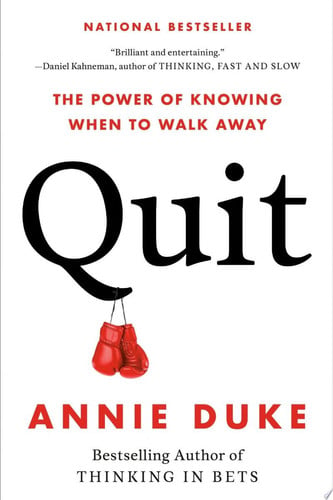
Quit: the power of knowing when to walk away

Duke, Annie
"From the bestselling author of Thinking in Bets comes a toolkit for mastering the skill of quitting to achieve greater success Business leaders, with millions of dollars down the drain, struggle to abandon a new app or product that just isn't working. Governments, caught in a hopeless conflict, believe that the next tactic will finally be the one that wins the war. And in our own lives, we persist in relationships or careers that no longer serve us. Why? According to Annie Duke, in the face of tough decisions, we're terrible quitters. And that is significantly holding us back. In Quit, Duke teaches you how to get good at quitting. Drawing on stories from elite athletes like Mount Everest climbers, founders of leading companies like Stewart Butterfield, the CEO of Slack, and top entertainers like Dave Chappelle, Duke explains why quitting is integral to success, as well as strategies for determining when to hold em, and when to fold em, that will save you time, energy, and money. You'll learn: How the paradox of quitting influences decision making: If you quit on time, you will feel you quit early What forces work against good quitting behavior, such as escalation commitment, desire for certainty, and status quo bias How to think in expected value in order to make better decisions, as well as other best practices, such as increasing flexibility in goal-setting, establishing "quitting contracts," anticipating optionality, and conducting premortems and backcasts Whether you're facing a make-or-break business decision or life-altering personal choice, mastering the skill of quitting will help you make the best next move"--
Portfolio/Penguin 2022-10-04 336 pages

Waking up: a guide to spirituality without religion

Harris, Sam
For the millions of Americans who want spirituality without religion, Sam Harris's new book is a guide to meditation as a rational spiritual practice informed by neuroscience and psychology. Waking Up is for the 30 percent of Americans who follow no religion, but who suspect that Jesus, Buddha, Lao Tzu, Rumi, and the other saints and sages of history could not have all been epileptics, schizophrenics, or frauds. Throughout the book, Harris argues that there are important truths to be found in the experiences of such contemplatives -- and, therefore, that there is more to understanding reality than science and secular culture generally allow. Waking Up is part seeker's memoir and part exploration of the scientific underpinnings of spirituality
Bantam Press 2014 245 pages

Waking up: a guide to spirituality without religion

Harris, Sam
For the millions of Americans who want spirituality without religion, Sam Harris's new book is a guide to meditation as a rational spiritual practice informed by neuroscience and psychology. Waking Up is for the 30 percent of Americans who follow no religion, but who suspect that Jesus, Buddha, Lao Tzu, Rumi, and the other saints and sages of history could not have all been epileptics, schizophrenics, or frauds. Throughout the book, Harris argues that there are important truths to be found in the experiences of such contemplatives -- and, therefore, that there is more to understanding reality than science and secular culture generally allow. Waking Up is part seeker's memoir and part exploration of the scientific underpinnings of spirituality
Simon & Schuster 2014 245 pages

Heartbreak Hotel An Alex Delaware Novel

Jonathan Kellerman
#1 NEW YORK TIMES BESTSELLER • Alex Delaware and LAPD detective Milo Sturgis investigate the death of Alex’s most mysterious patient to date in the sensational new thriller from the master of suspense, #1 New York Times bestselling author Jonathan Kellerman. At nearly one hundred years old, Thalia Mars is a far cry from the patients that child psychologist Alex Delaware normally treats. But the charming, witty woman convinces Alex to meet with her in a suite at the Aventura, a luxury hotel with a checkered history. What Thalia wants from Alex are answers to unsettling questions—about guilt, patterns of criminal behavior, victim selection. When Alex asks the reason for her morbid fascination, Thalia promises to tell all during their next session. But when he shows up the following morning, he is met with silence: Thalia is dead in her room. When questions arise about how Thalia perished, Alex and homicide detective Milo Sturgis must peel back the layers of a fascinating but elusive woman’s life and embark on one of the most baffling investigations either of them has ever experienced. For Thalia Mars is a victim like no other, an enigma who harbored nearly a century of secrets and whose life and death draw those around her into a vortex of violence. Heartbreak Hotel is classic Delaware and classic Kellerman. Praise for Heartbreak Hotel “Easy to dive into for mystery fans unfamiliar with the series, and a welcome treat for readers who have been with Officer Sturgis and Dr. Delaware since the beginning.” — Booklist Praise for Jonathan Kellerman “Jonathan Kellerman’s psychology skills and dark imagination are a potent literary mix.” —Los Angeles Times “Kellerman doesn’t just write psychological thrillers—he owns the genre.” —Detroit Free Press “A master of the psychological thriller.” —People
Random House Publishing Group 2017-11-28 416 pages

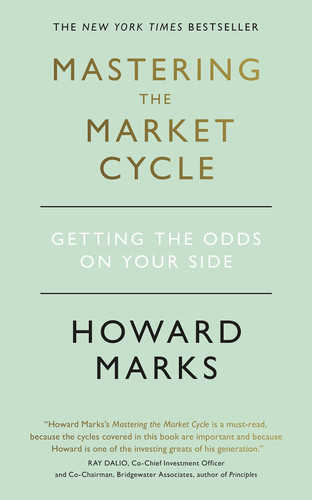
Mastering the market cycle: getting the odds on your side

Marks, Howard
A NEW YORK TIMES , WALL STREET JOURNAL , AND USA TODAY BESTSELLER The legendary investor shows how to identify and master the cycles that govern the financial markets. "A MUST-READ" Ray Dalio, bestselling author of Principles and Co-Chief Investment Officer and Co-Chairman, Bridgewater Associates "WHEN I SEE MEMOS FROM HOWARD MARKS IN MY MAIL, THEY'RE THE FIRST THING I OPEN AND READ" Warren Buffett " HOWARD IS A LEGENDARY INVESTOR" Tony Robbins We all know markets rise and fall, but when should you pull out, and when should you stay in? The answer is never black or white, but is best reached through a keen understanding of the reasons behind the rhythm of cycles. Confidence about where we are in a cycle comes when you learn the patterns of ups and downs that influence not just economics, markets, and companies, but also human psychology and the investing behaviors that result. If you study past cycles, understand their origins and remain alert for the next one, you will become keenly attuned to the investment environment as it changes. You'll be aware and prepared while others get blindsided by unexpected events or fall victim to emotions like fear and greed. By following Marks's insights - drawn in part from his iconic memos over the years to Oaktree's clients - you can master these recurring patterns to have the opportunity to improve your investing results. SEE WHAT REVIEWERS ARE SAYING ABOUT MASTERING THE MARKET CYCLE : ⭐⭐⭐⭐⭐ "This book lays the timeless fundamentals for investment success" ⭐⭐⭐⭐⭐ "A must-read" ⭐⭐⭐⭐⭐ " Excellent book on cycles and psychology"
Nicholas Brealey Publishing 2020-01-23 323 pages

The revenge of analog: real things and why they matter

Sax, David
"By now, we all know the mythology of the digital revolution: it improved efficiency, eliminated waste, and fostered a boom in innovation. But as business reporter David Sax shows in this clear-sighted, entertaining book, not all innovations are written in source code. In fact, businesses that once looked outdated are now springing with new life. Behold the Revenge of Analog. Sax has found story after story of entrepreneurs, small business owners, and even big corporations who've found a market selling not apps but real, tangible things. As e-books are supposedly remaking reading, independent bookstores have sprouted up across the country. As music supposedly migrates to the cloud, vinyl record sales have grown more than ten times over the past decade, generating more than half a billion dollars in 2015 alone. Even the offices of Silicon Valley icons like Google and Facebook increasingly rely on analog technologies like pen and paper for their business. Sax's work reveals not just an underreported trend in business, but a more fundamental truth about how humans shop, interact, and even think. Blending psychology and observant wit with old-fashioned reportage, Sax shows that humans need to work, sell, and live in the real world--not on a screen"--
PublicAffairs 2016-11-08 282 pages

The Bell Curve

Herrnstein, Richard J.
The ability to manipulate information has become the single most important element of success. High intelligence is an increasingly precious raw material. But despite decades of fashionable denial, the overriding and insistent truth about intellectual ability is that it is endowed unequally.In this audio presentation of The Bell Curve , author Charles Murray explores the ways that low intelligence, independent of social, economic, or ethnic background, lies at the root of many of our social problems. He also discusses another taboo that intelligence levels differ among ethnic groups.According to the authors, only by facing up to these differences can we accurately assess the nation's problems and make realistic plans to address them. However, if we accept that there are intelligence differences among groups, we must learn to avoid prejudicial assumptions about any individual of a given group whose intelligence level may be anywhere under the bell curve.
Free Press 1996

Imagine How Creativity Works

Jonah Lehrer
"Did you know that the most creative companies have centralized bathrooms? That brainstorming meetings are a terrible idea? That the color blue can help you double your creative output? From the best-selling author of How We Decide comes a sparkling and revelatory look at the new science of creativity. Shattering the myth of muses, higher powers, even creative 'types, ' Jonah Lehrer demonstrates that creativity is not a single gift possessed by the lucky few. It's a variety of distinct thought processes that we can all learn to use more effectively. Lehrer reveals the importance of embracing the rut, thinking like a child, daydreaming productively, and adopting an outsider's perspective (travel helps). He unveils the optimal mix of old an new partners in any creative collaboration and explains why criticism is essential to the process. Then he zooms out to show how we can make our neighborhoods more vibrant, our companies more productive, and our schools more effective. You'll learn about Bob Dylan's writing habits and the drug addictions of poets. You'll meet a Manhattan bartender who thinks like a chemist, and an autistic surfer who invented an entirely new surfing move. You'll see why Elizabethan England experienced a creative explosion, and how Pixar's office space is designed to spark the next big leap in animation. Collapsing the layers separating the neuron from the finished symphony, Imagine reveals the deep inventiveness of the human mind and its essential role in our increasingly complex world."--
Penguin Books, Limited 2012-03-20 304 pages

Brain Lock Free Yourself from Obsessive - Compulsive Behavior: A Four-Step Self-Treatment Method to Change Your Brain Chemistry

Jeffrey M. Schwartz,Mark Sosin,Beverly Beyette
?Do you perform unnecessary rituals in your daily routine? ?Are you a hoarder, afraid to throw out anything, no matter how useless? ?Are you unable to control runaway thoughts? If you answered "yes" to any of these questions, you may be among the five million Americans who suffer from OCD (obsessive-compulsive disorder), a mental disorder that can wreak havoc in the daily lives of its sufferers and their families. In Brain Lock, Dr. Jeffrey M. Schwartz shows you how to: ?Free Yourself From Obsessive-Compulsive Behavior! Dr. Schwartz's revolutionary Four-Step method helps youdefeat your irrational impulses by a process of Relabeling,Reattributing, Refocusing, and Revaluing to defeat yourobsessive-compulsive tendencies. ?Change Your Own Brain Chemistry!Dr. Schwartz's groundbreaking studies have shown that by using his Four-Step Program you can actually 3rewire2 your brain and modify your genetic disposition. ?Lead A Happier, Healthier Life!Achieve peace of mind as you banish your bothersome OCD symptoms and regain control of your own destiny.
DIANE Publishing Company 1998-12 219 pages

The age of American unreason

Jacoby, Susan
From the Publisher: A cultural history of the last forty years, The Age of American Unreason focuses on the convergence of social forces-usually treated as separate entities-that has created a perfect storm of anti-rationalism. These include the upsurge of religious fundamentalism, with more political power today than ever before; the failure of public education to create an informed citizenry; and the triumph of video over print culture. Sparing neither the right nor the left, Jacoby asserts that Americans today have embraced a universe of "junk thought" that makes almost no effort to separate fact from opinion
Pantheon Books 2008 356 pages

Mastermind

Konnikova, Maria
What is it that separates Sherlock Holmes from his long-suffering friend and side-kick Dr John Watson? What makes Holmes such a superior detective, able to piece together clues and solve problems that seem elementary to Watson only in hindsight? And can we - most of us Watsons ourselves - ever harness a bit of Holmes' extraordinary powers of mind, not to solve crimes, but simply to improve our lives at work and home?
Canongate 2014 273 pages