200 results for "Science"

A Jewish State An Attempt at a Modern Solution of the Jewish Question

Theodor Herzl,Sylvie d Avigdor
This work has been selected by scholars as being culturally important and is part of the knowledge base of civilization as we know it. This work is in the public domain in the United States of America, and possibly other nations. Within the United States, you may freely copy and distribute this work, as no entity (individual or corporate) has a copyright on the body of the work. Scholars believe, and we concur, that this work is important enough to be preserved, reproduced, and made generally available to the public. To ensure a quality reading experience, this work has been proofread and republished using a format that seamlessly blends the original graphical elements with text in an easy-to-read typeface. We appreciate your support of the preservation process, and thank you for being an important part of keeping this knowledge alive and relevant.
Creative Media Partners, LLC 2018-10-10 62 pages

Secret Societies-- and how They Affect Our Lives Today

Sylvia Browne
Fresh from the success of her book Secrets & Mysteries of the World, Sylvia Browne now writes about the clandestine world of secret societies. Sylvia's research, combined with her amazing communication with her spirit guide Francine, has uncovered the fact that many secret societies affect the lives of each of us every day . . . whether it be in the areas of religion, politics, economy, government, crime, or other worldwide influences. She shares her knowledge of the conspiracies, coverups, long-held secrets, misinformation, and power manipulations of secret societies in both the past and present and how they can affect us today and in the future. From the mysterious secrets of the Knights Templar to the powerful secret societies of the modern age, Sylvia takes us on an amazing journey to explore and unearth the truth. She discusses the amazing influence of the Freemasons on our Founding Fathers, the influence of religion on earth-shaking secrets and terrorism, the agenda of powerful secret societies for a 'New World Order,' and much more. Sylvia explores it all, and even gives us information on a powerful secret society that no one has even heard about. So lock your windows and doors and read about these societies and their secrets . . . some will really raise the hair on your neck!
Hay House 2007 224 pages

The Mind of the Islamic State

Robert Manne
So often in history, it is ideas that kill ... What are the ideas that drive the Islamic State? How did it develop and systematise its unique form of apocalyptic violence? In this gripping account, Robert Manne shows how the Islamic State's worldview evolved, from the 1960s prison writings of Sayyid Qutb all the way to its elegant online magazine of horror, Dabiq. This gripping account reveals the crucial role of texts such as The Management of Savagery, and figures such as al-Zarqawi, who set out to pit Sunni against Shi'a, tearing Iraq apart. Shortly after the fall of Mosul in June 2014, US General Michael Nagata said of the new jihadist threat: 'We have not defeated the idea. We do not even understand the idea. By examining the beliefs and strategies at the heart of the Islamic State, Manne shows how a dark ideology came into being.
ReadHowYouWant.com, Limited 2016-10-24 224 pages

The Faith and Doubt of Holocaust Survivors

Brenner, Reeve Robert
The Faith and Doubt of Holocaust Survivors reveals the victims' frank and thought-provoking answers to searching questions about their experiences: Was the Holocaust God's will? Was there any meaning or purpose in the Holocaust? Was Israel worth the price six million had to pay? Did the experience in the death camps bring about an avowal of faith? A denial of God? A reaffirmation of religious belief? Did the Holocaust change beliefs about the coming of the Messiah, the Torah, the Jews as the chosen people, and the nature of God? Drawing on the responses of seven hundred survivors, Reeve Robert Brenner reveals the changes, rejections, reaffirmations, doubts, and despairs that have so profoundly affected the faith, practices, ideas, and attitudes of survivors, and, by extension, the entire Jewish people. Many survivors carried their deepest secrets and innermost beliefs silently, from internment to interment. But Brenner's quest provided the impetus for many survivors to end their silence about the past and come forth with their feelings. In poignant vignettes scattered throughout the book, their answers to these profound questions are offered, disclosing ardent, overpowering passions and sensibilities.
[distributor] Taylor & Francis, c/o Bookpoint 2017-08-29 309 pages

An Atheist's History of Belief Understanding Our Most Extraordinary Invention

Matthew Kneale
The atheist’s poetic synopsis of the history of spirituality and religion from the Man Booker shortlisted author of English Passengers What first prompted prehistoric man, sheltering in the shadows of deep caves, to call upon the realm of the spirits? And why has belief thrived since, shaping thousands of generations of shamans, pharaohs, Aztec priests and Mayan rulers, Jews, Buddhists, Christians, Nazis, and Scientologists? As our dreams and nightmares have changed over the millennia, so have our beliefs. The gods we created have evolved and mutated with us through a narrative fraught with human sacrifice, political upheaval and bloody wars. Belief was man's most epic labor of invention. It has been our closest companion, and has followed mankind across the continents and through history.
Catapult 2015-02-10 272 pages

A Hallucinogenic Tea, Laced with Controversy Ayahuasca in the Amazon and the United States

Marlene Dobkin de Rios,Peg Thoms,James Fairbank,Roger Rumrrill
One country's sacrament is another's illicit drug, as officials in South America and the United States are well aware. For centuries, a hallucinogenic tea made from a giant vine native to the Amazonian rainforest has been taken as a religious sacrament across several cultures in South America. Many spiritual leaders, shamans, and their followers consider the tea and its main component - ayahuasca - to be both enlightening and healing. In fact, ayahuasca (pronounced a-ja-was-ka) loosely translated means spirit vine. In this book, de Rios and Rumrrill take us inside the history and realm of, as well as the raging arguments about, the substance that seems a sacrament to some and a scourge to others. Their book includes text from the United Nations Convention on Psychotropic Substances and interviews with shamans in the Amazon. One country's sacrament is another's illicit drug, as officials in South America and the United States are well aware. For centuries, a hallucinogenic tea made from a giant vine native to the Amazonian rainforest has been taken as a religious sacrament across several cultures in South America. Many spiritual leaders, shamans, and their followers consider the tea and its main component - ayahuasca - to be both enlightening and healing. In fact, ayahuasca (pronounced a-ja-was-ka) loosely translated means spirit vine. Ayahuasca has moved into the United States, causing legal battles in the Supreme Court and rulings from the United Nations. Some U.S. church groups are using the hallucinogen in their ceremonies and have fought for government approval to do so. The sacrament has also drawn American drug tourists to South America to partake, say authors de Rios and Rumrrill. But they warn that these tourists are being put at risk by charlatans who are not true shamans or religious figures, just profiteers. In this book, de Rios and Rumrrill take us inside the history and realm of, as well as the raging arguments about, the substance that seems a sacrament to some and a scourge to others. Opponents fight its use even as U.S. scientists and psychologists continue investigations of whether ayahuasca has healing properties that might be put to conventional use for physical and mental health. This book includes text from the United Nations Convention on Psychotropic Substances and interviews with shamans in the Amazon.
Bloomsbury Academic 2008-08-30 168 pages

Elijah's Violin and Other Jewish Fairy Tales

Howard Schwartz
Tales of magic and wonder can be found in every phase of Jewish literature, from the sacred to the secular. The fairy tale in particular--set in enchanted lands and populated with a variety of human and supernatural beings, both good and evil--holds a very special place in the Jewish tradition. For in the fairy tale, where good and evil engage in a timeless struggle, we have a clear reflection of the Jewish world view, where faith in God can defeat the evil impulse. In Elijah's Violin, Howard Schwartz offers a sumptuous collection of thirty-six Jewish fairy tales from virtually every corner of the world. At once otherworldy and earthy, pious and playful, these celebrated tales from Morocco and India, Spain and Eastern Europe, Babylon and Egypt, illustrate not only their Jewish character but also their universality of themes. Invoking the biblical tale of David and Goliath, we read as King David defeats the giant by hovering above its spear in King David and the Giant. In the romantic tale of The Princess in the Tower, a variant of Rapunzel, we watch as the cautious King Solomon recognizes the vanity in trying to prevent Providence from taking place. And we see the religious nature of the quest for Elijah's violin in the title story. The successful completion of the king's quest enables the violin's imprisoned melodies, emblematic of the Jewish spirit, to be set free. Throughout this richly illustrated collection, one can find the quests and riddles of the traditional fairy tale along with the divine intervention that characterizes the Jewish fairy tale. Skillfully translated, these stories will captivate children and adults alike in which romance and magic become enchantingly entwined with faith, duty, and wisdom.
Harper & Row 1985 302 pages

Why the Jews Rejected Jesus The Turning Point in Western History

David Klinghoffer
Why did the Jews reject Jesus? Was he really the son of God? Were the Jews culpable in his death? These ancient questions have been debated for almost two thousand years, most recently with the release of Mel Gibson’s explosive The Passion of the Christ . The controversy was never merely academic. The legal status and security of Jews—often their very lives—depended on the answer. In WHY THE JEWS REJECTED JESUS, David Klinghoffer reveals that the Jews since ancient times accepted not only the historical existence of Jesus but the role of certain Jews in bringing about his crucifixion and death. But he also argues that they had every reason to be skeptical of claims for his divinity. For one thing, Palestine under Roman occupation had numerous charismatic would-be messiahs, so Jesus would not have been unique, nor was his following the largest of its kind. For another, the biblical prophecies about the coming of the Messiah were never fulfilled by Jesus, including an ingathering of exiles, the rise of a Davidic king who would defeat Israel’s enemies, the building of a new Temple, and recognition of God by the gentiles. Above all, the Jews understood their biblically commanded way of life, from which Jesus’s followers sought to “free” them, as precious, immutable, and eternal. Jews have long been blamed for Jesus’s death and stigmatized for rejecting him. But Jesus lived and died a relatively obscure figure at the margins of Jewish society. Indeed, it is difficult to argue that “the Jews” of his day rejected Jesus at all, since most Jews had never heard of him. The figure they really rejected, often violently, was Paul, who convinced the Jerusalem church led by Jesus’s brother to jettison the observance of Jewish law. Paul thus founded a new religion. If not for him, Christianity would likely have remained a Jewish movement, and the course of history itself would have been changed. Had the Jews accepted Jesus, Klinghoffer speculates, Christianity would not have conquered Europe, and there would be no Western civilization as we know it. WHY THE JEWS REJECTED JESUS tells the story of this long, acrimonious, and occasionally deadly debate between Christians and Jews. It is thoroughly engaging, lucidly written, and in many ways highly original. Though written from a Jewish point of view, it is also profoundly respectful of Christian sensibilities. Coming at a time when Christians and Jews are in some ways moving closer than ever before, this thoughtful and provocative book represents a genuine effort to heal the ancient rift between these two great faith traditions.
Harmony/Rodale/Convergent 2006-03-07 256 pages

Psychology and the Soul

Otto Rank
2011 Reprint of 1950 Translation by William Turner. Full facsimile of the original edition, not reproduced with Optical Recognition Software. Recommended, both as a fascinating and little-known document in the history of psychology and as a provocative reading of the history of psychology. (Religious Studies Review). Will interest many students of the history of psychoanalysis... Rank's conclusions contribute to present-day controversies about the status of psychoanalysis as a science. (Psychiatric Times ) The first complete English translation of a work that Rank published in 1930. It draws on anthropology, sociology, mythology, religion, philosophy, history, and literature to chart the development of the human psyche... The book's antimaterialistic passion makes it a compelling counterpoint to the stern biology of our own age, and the bounds it sets to what psychoanalysis can claim are justly drawn. (Wilson Quarterly ) Unquestionably Rank's most important work... This new translation is an effort to create a Rank for our millennium... [and it] reads elegantly and comfortably in English... The argument is complex and intricate, consisting of a long historical/ethnographic sweep that takes us from a 'primitive' state, via animism through the Christian or sexual era to the scientific era and modern development of psychology... Along the way we find traces of many of Rank's other brilliant psychological surveys -- the double, Don Juan, heroes' birth myths, the theme of incest -- woven into this massive canvas and viewed on the largest scale... Throughout this book, the grand tapestry is set with some remarkable gems of observation. (Naomi Segal Psychoanalysis and History ) This is the first complete translation of Otto Rank's fascinating text on the nature and history of the concept of the Soul and Will in the psychological history of humankind... a tour de force in vigour, scope and application to many contemporary issues such as sexual behaviors, the nature of dreaming, incest prohibitions and narcissism, to name but a few. (L.R. Edgar Journal of the Royal Anthropological Society ) In his last years, Otto Rank turned his lifetime of thought and learning toward two of the most difficult topics in human history: religion and the soul. The result was this now-classic work, available in this new, very accessible English translation. Unlike many other intellectuals of the twentieth century, Rank maintains a place for the soul rather than dismissing it as a fantasy. The soul and the beliefs about it, he argues, set forth the foundation for psychology, with its complex analyses of consciousness, self-consciousness, and personality. Rank's commentary is not limited to beliefs about individual souls but includes ideas about group souls, sometimes encompassing nations or generations. Rank suggests that it is in expression of group beliefs that the idea of the soul attains its greatest power. What is the soul? Otto Rank treats it as a universal and essential belief for individuals and their societies, constant in function but evolving in form through millennia. To borrow a post-Rankian metaphor, the soul was created in the big bang of irresistible psychological force colliding with immutable biological fact-our will to live forever against death. The collision creates a spark in our individual and social consciousness which through history has become both consolation and inspiration: the immortal soul. All ideologies reflect this phenomenon and modify its expression to suit the era. Otto Rank wrote before the atom bomb or television, both of which alter our perception of death without changing the fact. Rank's introduction of the soul as an essential part of contemporary psychology helps explain a number of perplexing, irrational phenomena in contemporary life.
Martino Fine Books 2011 206 pages

The Perfect Stranger's Guide to Wedding Ceremonies A Guide to Etiquette in Other People's Religious Ceremonies

Stuart M. Matlins
Based on the Award-Winning How to Be a Perfect Stranger: A Guide to Etiquette in Other Peoples's Religious Ceremonies Wedding day jitters aren't reserved for brides and grooms! A wedding is a joyous event--but you can feel awkward while everyone else is enjoying the wedding if you're unfamiliar with the religious tradition and customs involved. You want to be sure that you know how to behave and what to expect. There's no need to enter an unfamiliar atmosphere unprepared, wondering: What will happen? What should I wear? How long will it last? Is it okay to take pictures? Will there be a reception? Should I bring a gift? When is it okay to leave? The Perfect Stranger's Guide to Wedding Ceremonies helps to answer these questions and many more, telling you everything you need to know to avoid embarrassment, relax, and have a good time. Covers all the major (and many minor) denominations and religions found in North America: African American Methodist Churches * Assemblies of God * Baha'i * Baptist * Buddhist * Christian and Missionary Alliance * Christian Church (Disciples of Christ) * Christian Congregation * Christian Science (Church of Christ, Scientist) * Church of the Brethren * Church of the Nazarene * Churches of Christ * Episcopalian and Anglican * Evangelical Free Church * *Greek Orthodox * Hindu * International Church of the Foursquare Gospel * International Pentecostal Holiness Church * Islam * Jehovah's Witnesses * Jewish * Lutheran * Mennonite/Amish * Methodist * Mormon * (Church of Jesus Christ of Latter-day Saints) * Native American/First Nations * Orthodox Churches * Pentecostal Church of God * Presbyterian * Quaker (Religious Society of Friends) * Reformed Church in America/Canada * Roman Catholic * Seventh-day Adventist * Sikh * Unitarian Universalist * United Church of Canada * United Church of Christ * Wesleyan
LongHill Partners, Incorporated 2000-09 208 pages

Homosexuality and the Politics of Truth

Satinover, Jeffrey Burke
Psychiatrist Jeffrey Satinover examines recent research reported in medical journals (and the popular press). He finds many of these studies flawed and cites evidence that homosexuality is indeed changeable. He explains how psychology, biology, choice, and habit all interweave to produce deeply imbedded patterns of sexual behavior. The model Dr. Satinover develops is based on modern science and psychological understandings of habit, compulsion, and addiction. Homosexuality, he writes, "is one of the many forms of soul sickness that is innate to our fallen nature."
Baker Pub Group 1994-10 336 pages

Religions, Values, and Peak-Experiences

Abraham H. Maslow
Proposing religious experience as a legitimate subject for scientific investigation, Maslow studies the human need for spiritual expression. About the Author Abraham H. Maslow taught at Brooklyn College and the Western Behavioral Sciences Institute, and was Chairman of the Department of Psychology at Brandeis University. From 1967 to 1968 he was Preseident of the American Psychological Association. Dr. Maslow was one of the foremost spokesmen of the humanistic, or "Third Force," psychologies, and author of many books and articles, including Toward a Psychology of Being, The Psychology of Science, and Religions, Values, and Peak-Experiences.
www.bnpublishing.com 2019-10-07 122 pages

Protestant, Catholic, Jew: an essay in American religious sociology

Herberg, Will
"The most honored discussion of American religion in mid-twentieth century times is Will Herberg's Protestant-Catholic-Jew . . . . [It] spoke precisely to the mid-century condition and speaks in still applicable ways to the American condition and, at its best, the human condition."—Martin E. Marty, from the Introduction "In Protestant-Catholic-Jew Will Herberg has written the most fascinating essay on the religious sociology of America that has appeared in decades. He has digested all the relevant historical, sociological and other analytical studies, but the product is no mere summary of previous findings. He has made these findings the basis of a new and creative approach to the American scene. It throws as much light on American society as a whole as it does on the peculiarly religious aspects of American life. Mr. Herberg. . . illumines many facets of the American reality, and each chapter presents surprising, and yet very compelling, theses about the religious life of this country. Of all these perhaps the most telling is his thesis that America is not so much a melting pot as three fairly separate melting pots."—Reinhold Niebuhr, New Yorks Times Book Review
University of Chicago Press 1983-10-15 309 pages

Hard Sayings A Catholic Approach to Answering Bible Difficulties

Trent Horn
Have you ever read something in the Bible that made you just scratch your head? Has a skeptic ever challenged you to defend a seemingly scandalous verse of Scripture? You're not alone. The Bible contains more than a few "hard sayings" (John 6:60): ancient idioms, apparent contradictions, myth-like events and figures, and passages that seem to be embarrassingly out of step with modern culture or science. How can a Catholic reconcile such things with his own faith, and with what the Church teaches about the inspiration and inerrancy of Sacred Scripture? Don't worry. As Trent Horn (Answering Atheism) explains in Hard Sayings, God's revelation in the Bible is not something Catholics need to be ashamed of or read with a mental reservation. Trent examines dozens of the most confounding passages in Scripture and offers clear, reasonable, Catholic explanations to unlock their true meaning. He also provides basic principles for reading and interpreting Scripture that the wisdom of the Church has developed over the centuries.
Catholic Answers Press 2016-10-02 437 pages

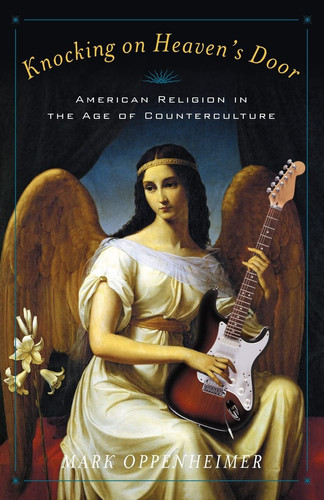
Knocking on Heaven's Door American Religion in the Age of Counterculture

Mark Oppenheimer
A witty and provocative reappraisal of the impact of the cultural upheavals of the sixties on American religious life What happened to American religion during the cultural revolution of the 1960s and early 1970s? The era has long been associated with the ascendancy of Eastern religions and fringe cults. But in this provocative book, Mark Oppenheimer demonstrates that contrary to conventional wisdom, most Americans did not turn on, tune in, and drop out of mainstream religious groups during the Age of Aquarius. Instead, many Americans brought the counterculture with them to their churches and temples, changing the face of American religion. Introducing us to America's first gay ministers and first female priests, to hippie Jews and folk-singing Catholics, Oppenheimer demonstrates that this was an era of extraordinary religious vitality. Drawing on a rich range of archival material as well as interviews with many of the protagonists, Knocking on Heaven's Door offersa wry and iconoclastic reappraisal of the ways in which the upheavals of the sixties changed America's relationship with God.
Yale University Press 2003 284 pages