99 results for "Technology"

America by design: science technology and the rise of corporate capitalism

Noble, David F.
Oxford University Press paperback. Includes bibliographical references and index. pt. 1: Technology as social production. The wedding of science to the useful arts--1: The rise of science-based industry. The wedding of science to the useful arts--2: The development of technical education. The wedding of science to the useful arts--3: The emergence of the professional engineer. Preservation through change: Corporate engineers and social reform -- pt. 2: Corporate reform as conscious social production. Laying the foundation: Scientific and industrial standardization. The corporation as inventor: Patent-law reform and patent monoply. Science for industry: The organization of industrial and university research. Technology as people: The industrial process of higher education --1. Technology as people: The industrial process of higher education--2. A technology of social production: Modern management and the expansion of engineering. * dss 20081210.
Oxford University Press 1979 384 pages

Putting meat on the American table: taste, technology, transformation

Horowitz, Roger
Engagingly written and richly illustrated, Putting Meat on the American Table explains how America became a meat-eating nation -- from the colonial period to the present. It examines the relationships between consumer preference and meat processing -- looking closely at the production of beef, pork, chicken, and hot dogs. Roger Horowitz argues that a series of new technologies have transformed American meat. He draws on detailed consumption surveys that shed new light on America's eating preferences -- especially differences associated with income, rural versus urban areas, and race and ethnicity. Putting Meat on the American Table will captivate general readers and interest all students of the history of food, technology, business, and American culture.
The Johns Hopkins University Press 2006 170 pages

Lillian Bassman

Bassman, Lillian
This monograph of Bassman's legendary work - the first ever published - presents the romantic, experimental visions, seen mostly in Harper's Bazaar, that brought a sophisticated new aesthetic to print photography. Yet the story of Bassman's life and newfound celebrity at age eight and the extraordinary tale of how her work survived are as remarkable as the images themselves. From the 1940s to the 1960s Bassman was at fashion's cutting edge, working as both art director and photographer. At Junior Bazaar she worked with young photographers like Richard Avedon, Robert Frank, Louis Faurer, Arnold Newman and Paul Himmel. Then, under Russian emigre and Modernist guru Alexey Brodovitch (and while using George Hoyningen-Huene's darkroom), Bassman started to shoot pictures herself - diffuse, moody images with an idiosyncratic vocabulary of gestures, and an unsettling edge. Bassman soon was in constant demand and, in addition to her editorial work, shot advertising campaigns for clients like Chanel and Balenciaga. By the 1970s, Bassman's interest in pure form began to clash with fashion's changing aesthetic. Her increasing disenchantment with fashion as an industry led her to abandon commercial photography for personal projects instead. In a bold attempt to free herself creatively from the past, she jettisoned forty years of negatives and prints - her life's work. Over twenty years later, luck resurrected a forgotten bag, brimful of hundreds of images. Now, Bassman is enjoying a resurgence at fashion's forefront, with exhibitions at museums and art galleries in New York, Paris, London, and Milan, several portfolios in the New York Times Magazine, the coveted Neiman Marcus campaign, and an upcoming 1997 retrospective exhibition at the Fashion Institute of Technology, New York, that plans to travel to Germany and Milan. This long-awaited monograph, presenting both past and recent work, is not only a tribute to a great talent in the annals of fashion and photography but also the story of an indomitable creative personality.
Bulfinch 1997 108 pages

Mind wars: brain research and national defense

Moreno, Jonathan D.
In his fascinating new book, Jonathan D. Moreno investigates the deeply intertwined worlds of cutting-edge brain science, U.S. defense agencies, and a volatile geopolitical landscape where a nation's weaponry must go far beyond bombs and men. The first-ever exploration of the connections between national security and brain research, Mind Wars: Brain Research and National Defense reveals how many questions crowd this gray intersection of science and government and urges us to begin to answer them. From neuropharmacology to neural imaging to brain-machine interface devices that relay images and sounds between human brains and machines, Moreno shows how national security entities seek to harness the human nervous system in a multitude of ways as a potent weapon against the enemy soldier. Moreno charts such projects as monkeys moving robotic arms with their minds, technology to read the brain’s thought patterns at a distance, the development of "anti-sleep" drugs to enhance soldiers’ battle performance and others to dampen their emotional reactions to the violence, and advances that could open the door to "neuroweapons"—virus-transported molecules to addle the brain. "As new kinds of weapons are added to the arsenal already at the disposal of fallible human leaders," Moreno writes, "we need to find new ways to address the problem"--of the ethical military application of so powerful and intimate a science. This book is the first step in confronting the quandaries inherent in this partnership of government and neuroscience, serves as a compelling wake-up call for scientists and citizens, and suggests that, with imagination, we might meet the needs of both security and civil liberty.
Dana Press 2006-11-17 210 pages

A matter of choices: memoirs of a female physicist

Ajzenberg-Selove, Fay
When Fay Ajzenberg-Selove became a nuclear physicist, the number of women in the field could be counted on one hand. In this engaging memoir, Fay Ajzenberg-Selove writes candidly about her difficult journey to international recognition in physics. She is frank about the ways being a woman has made a difference in her opportunities and choices as a scientist--and how, by being a woman, she has made a difference in the world of physics. Ajzenberg-Selove came to America at the age of 15 after narrowly escaping the Nazi takeover of France. She had planned to become an engineer like her father, but switched to physics after she was told the only engineering jobs open to women were in drafting: Marie Curie's example proved to her that women could do physics. Her first attempt at graduate work at Columbia University was a disaster, but she was sturck with the intellectual beauty of the field. After taking a Ph.D. in physics at University of Wisconsin, she did post-doctoral work with Thomas Lauritsen at the California Institute of Technology, where she began writing the first of a series of major review papers on the nuclear spectroscopy of the light nuclei, a subject of fundamental importance to nuclear physics, astrophysics, and applied physics. She continued this work and experimental research for thirty-eight years while teaching at Boston University, Haverford College, and the University of Pennsylvania. During her early career, Ajzenberg-Selove was shielded by her male mentors from experiencing much of the discrimination directed against women in science. Her simultaneous battles to become a tenured professor and to overcome breast cancer opened her eyes and confirmed her as a feminist. The lay reader and the scientist alike will be fascinated by Ajzenberg-Selove's clear portrayal of her interlinked lives as physicist, teacher, wife of particle physicist, Walter Selove, and a woman who relishes both competition and friendship in a male-dominated field. An invaluable book for anyone contemplating a career in science.
Rutgers University Press 1994 234 pages

Google me: one-click democracy

Cassin, Barbara
"Google is a champion of cultural democracy, but without culture and without democracy." In this witty and polemical critique the philosopher Barbara Cassin takes aim at Google and our culture of big data. While impressed by the search engine's brilliance, Cassin enlists her formidable knowledge of the rhetorical tradition to challenge on the Google myth of a "good" tech company and its "democracy of clicks," laying bare the philosophical poverty and political naiveté ́hat underwrites its founding slogans: "Organize the world's information," and "Don't be evil." For Cassin, this conjunction of globalizing knowledge and moral imperative is frighteningly similar to the way American demagogues justify their own universalizing mission before the world. While sensitive to the possibilities of technology and to Google's playful appeal, Cassin shows what is lost when a narrow worship of information becomes dogma, such that research comes to mean data mining and other languages become provincial "flavors" folded into an impoverished Globish, or global English. As the Internet continues to intensify the neoliberal effacement of difference and corporate reduction of the common, Cassin's refreshing polemic takes technology seriously enough to scrutinize the beliefs upon which it operates.
Fordham University Press 2018 148 pages

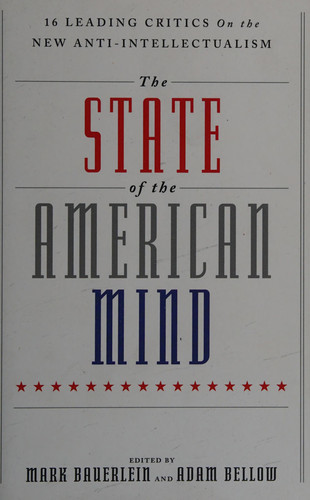
The state of the American mind: 16 leading critics on the new anti-intellectualism

Mark Bauerlein,Adam Bellow
In 1987, Allan Bloom’s The Closing of the American Mind was published; a wildly popular book that drew attention to the shift in American culture away from the tenants that made America—and Americans—unique. Bloom focused on a breakdown in the American curriculum, but many sensed that the issue affected more than education. The very essence of what it meant to be an American was disappearing. That was over twenty years ago. Since then, the United States has experienced unprecedented wealth, more youth enrolling in higher education than ever before, and technology advancements far beyond what many in the 1980s dreamed possible. And yet, the state of the American mind seems to have deteriorated further. Benjamin Franklin’s “self-made man” has become a man dependent on the state. Independence has turned into self-absorption. Liberty has been curtailed in the defense of multiculturalism. In order to fully grasp the underpinnings of this shift away from the self-reliant, well-informed American, editors Mark Bauerlein and Adam Bellow have brought together a group of cultural and educational experts to discuss the root causes of the decline of the American mind. The writers of these fifteen original essays include E. D. Hirsch, Nicholas Eberstadt, and Dennis Prager, as well as Daniel Dreisbach, Gerald Graff, Richard Arum, Robert Whitaker, David T. Z. Mindich, Maggie Jackson, Jean Twenge, Jonathan Kay, Ilya Somin, Steve Wasserman, Greg Lukianoff, and R. R. Reno. Their essays are compiled into three main categories: States of Mind: Indicators of Intellectual and Cognitive Decline These essays broach specific mental deficiencies among the population, including lagging cultural IQ, low Biblical literacy, poor writing skills, and over-medication. Personal and Cognitive Habits/Interests These essays turn to specific mental behaviors and interests, including avoidance of the news, short attention spans, narcissism, and conspiracy obsessions. National Consequences These essays examine broader trends affecting populations and institutions, including rates of entitlement claims, voting habits, and a low-performing higher education system. The State of the American Mind is both an assessment of our current state as well as a warning, foretelling what we may yet become. For anyone interested in the intellectual fate of America, The State of the American Mind offers an accessible and critical look at life in America and how our collective mind is faring.
Templeton Press 2015-06-16 260 pages

Waiting for Daisy: the true story of one couple's quest to have a baby

Orenstein, Peggy
Waiting for Daisy is about doing all the thinsg you swore you'd never do to get something you hadn't even been sure you wanted. It's a real-life journey of loss, love, anger and redemption. Told with raw candour and a rare wit that marks Waiting for Daisy as a future classic, Peggy Orenstein's story begins when she tells her new husband that she's not certain she ever wants to be a mother. It ends six years later after she's done almost everything humanly possible to have a baby. Along the way she visits an ex-boyfriend who now has fifteen children, encounters 'parasite singles' in Tokyo (women who are rejecting marriage and motherhood in favour of shopping sprees and foreign travel), and shares stories with women survivors of the atomic bomb in Hiroshima. The world's professional women are only now beginning to become aware of the risks and realities of 'having it all', and Orenstein's poignant saga unfolds as infertility is developing scarily into a boom industry, with many thousands of women a year seeking treatment.
Bloomsbury 2008 224 pages

Design for liberty: private property, public administration, and the rule of law

Epstein, Richard A.
Following a vast expansion in the twentieth century, government is beginning to creak at the joints under its enormous weight. The signs are clear: a bloated civil service, low approval ratings for Congress and the President, increasing federal-state conflict, rampant distrust of politicians and government officials, record state deficits, and major unrest among public employees. In this compact, clearly written book, the noted legal scholar Richard Epstein advocates a much smaller federal government, arguing that our over-regulated state allows too much discretion on the part of regulators, which results in arbitrary, unfair decisions, rent-seeking, and other abuses. Epstein bases his classical liberalism on the twin pillars of the rule of law and of private contracts and property rights—an overarching structure that allows private property to keep its form regardless of changes in population, tastes, technology, and wealth. This structure also makes possible a restrained public administration to implement limited objectives. Government continues to play a key role as night-watchman, but with the added flexibility in revenues and expenditures to attend to national defense and infrastructure formation. Although no legal system can eliminate the need for discretion in the management of both private and public affairs, predictable laws can cabin the zone of discretion and permit arbitrary decisions to be challenged. Joining a set of strong property rights with sound but limited public administration could strengthen the rule of law, with its virtues of neutrality, generality, clarity, consistency, and forward-lookingness, and reverse the contempt and cynicism that have overcome us.
Harvard University Press 2011-11-15 233 pages

The offensive Internet: speech, privacy, and reputation

Saul Levmore,Martha C. Nussbaum
The Internet has been romanticized as a zone of freedom. The alluring combination of sophisticated technology with low barriers to entry and instantaneous outreach to millions of users has mesmerized libertarians and communitarians alike. Lawmakers have joined the celebration, passing the Communications Decency Act, which enables Internet Service Providers to allow unregulated discourse without danger of liability, all in the name of enhancing freedom of speech. But an unregulated Internet is a breeding ground for offensive conduct. At last we have a book that begins to focus on abuses made possible by anonymity, freedom from liability, and lack of oversight. The distinguished scholars assembled in this volume, drawn from law and philosophy, connect the absence of legal oversight with harassment and discrimination. Questioning the simplistic notion that abusive speech and mobocracy are the inevitable outcomes of new technology, they argue that current misuse is the outgrowth of social, technological, and legal choices. Seeing this clearly will help us to be better informed about our options. In a field still dominated by a frontier perspective, this book has the potential to be a real game changer. Armed with example after example of harassment in Internet chat rooms and forums, the authors detail some of the vile and hateful speech that the current combination of law and technology has bred. The facts are then treated to analysis and policy prescriptions. Read this book and you will never again see the Internet through rose-colored glasses.
Harvard University Press 2010 299 pages

Four arguments for the elimination of television

Mander, Jerry
A total departure from previous writing about television, this book is the first ever to advocate that the medium is not reformable. Its problems are inherent in the technology itself and are so dangerous -- to personal health and sanity, to the environment, and to democratic processes -- that TV ought to be eliminated forever. Weaving personal experiences through meticulous research, the author ranges widely over aspects of television that have rarely been examined and never before joined together, allowing an entirely new, frightening image to emerge. The idea that all technologies are "neutral," benign instruments that can be used well or badly, is thrown open to profound doubt. Speaking of TV reform is, in the words of the author, "as absurd as speaking of the reform of a technology such as guns."
Morrow Quill 1978-03-01 371 pages

Another century of war?

Kolko, Gabriel
Another Century of War? is a candid and critical look at America's "new wars" by a brilliant and provocative analyst of its old ones. Gabriel Kolko's masterly studies of conflict have redefined our views of modern warfare and its effects; in this urgent and timely treatise, he turns his attention to our current crisis and the dark future it portends. Another Century of War? insists that the roots of terrorism lie in America's own cynical policies in the Middle East and Afghanistan, a half-century of realpolitik justified by crusades for oil and against communism. The latter threat has disappeared, but America has become even more ambitious in its imperialist adventures and, as the recent crisis proves, even less secure. America, Kolko contends, reacts to the complexity of world affairs with its advanced technology and superior firepower, not with realistic political response and negotiation. He offers a critical and well-informed assessment of whether such a policy offers any hope of attaining greater security for America. Raising the same hard-hitting questions that made his Century of War a "crucial" ( Globe and Mail ) assessment of our age of conflict, Kolko asks whether the wars of the future will end differently from those in our past.
New Press 2002-09-01 165 pages

Acting in the night: Macbeth and the places of the Civil War

Nemerov, Alexander
"Alexander Nemerov is one of the greatest readers of American visual culture. This book has the revelatory power that only wide-ranging curiosity and true independence of mind can achieve." Richard H. Brodhead President of Duke University and author of Cultures of Letters: Scenes of Reading and Writing in Nineteenth-Century America ; "A benchmark in the writing of art history and in studies of the Civil War, Acting in the Night occupies a category unto itself. It uniquely immerses the reader in a holistic experience of the Civil War and shows Nemerov as a cosummate stylist in the field of American art history."Kathleen Pyne author of Modernism and the Feminine Voice ; "This is a work of criticism that borders on poetry, a brilliant and extremely original book that invites us to rethink to the artistic world we study."Julia Reinhard Lupton author of Thinking with Shakespeare: Essays on Politics and Life ; What can the performance of a single play on one night tell us about the world this event inhabited so briefly? Alexander Nemerov takes a performance of Macbeth in Washington, D.C., on October 17, 1863--with Abraham Lincoln in attendance--to explore this question and illuminate American art, politics, technology, and life as it was being lived. Nemerov's inspiration is Wallace Stevens and his poem "Anecdote of the Jar,"in which a single object organizes the wilderness around it. For Nemerov, that evening's performance of Macbeth reached across the tragedy of civil war to acknowledge the horrors and emptiness of a world it tried and ultimately failed to change. --Book Jacket
University of California Press 2010-09-01 299 pages

Sawdust Empire The Texas Lumber Industry, 1830-1940

Robert S. Maxwell,Robert D. Baker
This first comprehensive story of logging, lumbering, and forest conservation in Texas records the industry's history from the earliest days of the Republic, when a few isolated operations provided for local needs, through the first four decades of the twentieth century. Supplemented by over one hundred photographs, many never before published, the text re-creates Texas' heyday as one of the nation's leading timber producers. At that time, the forested area equaled the state of Indiana. In the words of one visitor, the forest was "like a vast wave that has rolled in upon a level beach . . . creeping forward, thinning out, and finally disappearing, except where, along a river course, it pushes far inland." The industry's most significant growth occurred between the end of Reconstruction and the beginnings of World War II, when entrepreneurs from the North, the South, and the East ventured into the vast stands of virgin timber in the Texas Piney Woods. These pioneers, attracted by the great potential fortunes to be made, provided the capital, expertise, and energy that introduced large mills and railroads to Texas lumbering and developed markets for their products--not only in Houston, Dallas, and other Texas cities but also across the United States and throughout the world. Various lumber companies, logging and mill operations, company towns, and the genesis of forest conservation are all featured in the text and illustrations. This account will appeal to historians, conservationists, and general readers interested in the Texas lumber industry and in Texas economic history.
Texas A&M University Press 2000-06 244 pages

The China tangle: the American effort in China from Pearl Harbor to the Marshall mission

Feis, Herbert
Contents: Foreword. Part One: From Pearl Harbor to the Cairo Conference. Part Two: From the Cairo Conference to the Surrender of Japan. Part Three: From the Surrender of Japan to the Marshall Mission. Originally published in 1953. The Princeton Legacy Library uses the latest print-on-demand technology to again make available previously out-of-print books from the distinguished backlist of Princeton University Press. These editions preserve the original texts of these important books while presenting them in durable paperback and hardcover editions. The goal of the Princeton Legacy Library is to vastly increase access to the rich scholarly heritage found in the thousands of books published by Princeton University Press since its founding in 1905.
Princeton University Press 1953 445 pages

The American dream in the information age

Newman, Otto
This book explores the changing nature of the American Dream in the context of current and impending developments. Effective as they have been, traditional values need to be reassessed. Trends such as the informatics revolution, globalization, and changing patterns of work and free time ought to be taken into account. While the main focus is on the United States, the content is equally relevant to other major industrial societies experiencing similar forms of change. These changes have profound implications within the political, economic, and social realms. Particular attention is given to the rising incidence and significance of advance technology, which is capable of transforming not only the workplace but equally social relationships, family life, and individual development in a positive way.
St. Martin's Press 1999-07-30 229 pages

His and hers: gender, consumption, and technology

Roger Horowitz,Arwen Mohun
The pathbreaking essays in this collection explore the history of consumption by synthesizing discrete historical literatures on consumer culture, gender, and the history of technology. Luxury hotels and the chocolate industry are among the diverse array of topics these authors use to demonstrate that consumption is both a material and a cultural process. Production and consumption become equally inextricable under close analysis. Tools from both the history of technology and gender studies illuminate how these categories intersect. Although broad social and technological trends influence the outcome of these stories, the authors emphasize the agaency of particular groups, including consumers, workers, manufacturers, and the "mediators" who communicate between producers and consumers. This volume will be of interest to historians in a wide range of fields.
University Press of Virginia 1998 240 pages