196 results for "World History"

Revolution for the hell of it

Hoffman, Abbie
From one of America’s most renowned dissidents and the author of Steal This Book — a new edition of the counterculture manifesto that helped stir up a revolution in the 1960sWhile the supremely popular Steal This Book is a guide to living outside the establishment, Revolution for the Hell of It is a chronicle of Abbie Hoffman’s radical escapades that doubles as a guidebook for today’s social and political activist.Hoffman pioneered the use of humor, theater, and surprise to change the world for the better. In Revolution for the Hell of It he gives firsthand accounts of his legendary adventures, from the activism that led to the founding of the Youth International Party (“Yippies!) to the 1968 Democratic National Convention protests (“a perfect mess”) that resulted in his conviction as part of the Chicago Seven.Also chronicled is the the mass antiwar demonstration he helped lead in which over 50,000 people attempted to levitate the Pentagon using psychic energy and the time he threw fistfuls of dollar bills onto the floor of the New York Stock Exchange and watched the traders scramble. With antiwar sentiment once again on the rise and an incendiary political climate not seen since the book’s original printing, Abbie Hoffman’s voice is more essential than ever.
Thunder's Mouth Press 2005 259 pages

Idea makers: personal perspectives on the lives & ideas of some notable people

Wolfram, Stephen
This book of thoroughly engaging essays from one of today's most prodigious innovators provides a uniquely personal perspective on the lives and achievements of a selection of intriguing figures from the history of science and technology. Weaving together his immersive interest in people and history with insights gathered from his own experiences, Stephen Wolfram gives an ennobling look at some of the individuals whose ideas and creations have helped shape our world today. Contents includes biographical sketches of: Richard Feynman Kurt Godel Alan Turing John von Neumann George Boole Ada Lovelace Gottfried Leibniz Benoit Mandelbrot Steve Jobs Marvin Minsky Russell Towle Bertrand Russell Alfred Whitehead Richard Crandall Srinivasa Ramanujan Solomon Golomb
Wolfram Media, Inc 2016 239 pages

Ramesses III: the life and times of Egypt's last hero

Eric H. Cline,David B. OConnor
In the tumultuous and vivid history of New Kingdom Egypt, Ramesses III's reign was prosperous and culturally rich. He fended off attacks by the "Sea Peoples" and others who threatened the state, he built the great temple of Medinet Habu, and he left wonderfully complete documents describing contemporary social structure and the economy. Amazingly, we even have an account from a contemporary judicial document that describes events leading to Ramesses III's assassination. This edited collection presents a detailed and informative look at the life, career, and world of one of Egypt's most important pharaohs, providing insight both on his reign and its aftermath and on the study of the political and cultural history of ancient Egypt.
University of Michigan Press 2012 542 pages

Begin: a portrait

Hurwitz, Harry Zvi
Menachem Begin, Prime Minister of Israel from 1977 to 1983, principal figure of the Israeli right, co-author of the historic peace between Israel and Egypt, and arguably one of the principal figures in the history of the Jewish People in the 20th century, is carefully portrayed in this extraordinary biography by Harry Hurwitz, a trusted friend and compatriot. Begin the man, the elected leader of Israel, and by force of personality, character and ideas, one of the Israeli Prime Ministers who became a leader of the Jewish People, is what Hurwitz excels at revealing. Here is the story of Begin's life told with the insights of a journalist who was also a close friend of more than forty years. The struggle of Begin's life, his early attachment to the Zionist prophet Vladimir Ze'ev Jabotinsky, his life in Poland, his suffering during the Holocaust, and his leadership of the Irgun Zvai Leumi's revolt against British rule in Eretz Yisrael, is the well-told prelude to his thirty years as a leader of the opposition to Israel's Labor government. Especially rich in detailing the years of Begin's Premiership, the reader will be enthralled by the careful review of these six momentous years, and enriched by the opportunity to read many of Begin's most important speeches and statements. Hurwitz believes that Begin is best understood when he speaks for himself, and he skillfully weaves together a well paced biography with the public utterances of his subject. This biographical portrait succeeds in giving the reader a vivid sense of what motivated Menachem Begin to seek peace with Egypt, to demand much of the 'peace process' and to deal firmly with the enemies of Israel and the Jewish People. Though not a study of ideas, every reader will come away with an understanding of Begin's view of the world, the strategic needs of the State of Israel, the importance of democratic values in Israeli life, and his commitment to the security and continuity of the Jewish People. In the end the author's admiration for his subject is a case well made.
B'nai B'rith Books 1994 255 pages

The great escape: nine Jews who fled Hitler and changed the world

Marton, Kati
The journey of nine extraordinary men from Budapest to the New World, wht they experienced along their dangerous route and how they changed America and the world. They are the scientists Leo Szilard, Edward Teller, Eugene Wigner, and John von Neuman; Arthur Koestler author of Darkness at Noon; Robert Capa, the first photographer ashore on D-Day; Andre Kertesz, pioneer of modern photojournalism and iconic filmmakers Alexander Korda and Michael Curtiz.
Simon & Schuster 2006 271 pages

When the Game Was War The NBA's Greatest Season

Rich Cohen
The gritty, no-holds-barred account of the 1987 NBA season, a thrilling year of fierce battles and off-the-court drama between Magic Johnson, Larry Bird, Isiah Thomas, and Michael Jordan—from New York Times bestselling author Rich Cohen. “Plug in to a world where rivalries really mattered.”—Bob Ryan, sports columnist emeritus, The Boston Globe AN ESQUIRE BEST BOOK OF THE YEAR Four historic teams. Four legendary players. One unforgettable season. The 1980s were a transformative decade for the NBA. Since its founding in 1946, the league had evolved from a bruising, earthbound game of mostly nameless, underpaid players to one in which athletes became household names for their thrilling, physics-defying play. The 1987–88 season was the peak of that golden era, a year of incredible drama that featured a pantheon of superstars in their prime—the most future Hall of Famers competing at one time in any given season—battling for the title, and for their respective legacies. In When the Game Was War, bestselling author Rich Cohen tells the story of this incredible season through the four teams, and the four players, who dominated it: Larry Bird and the Boston Celtics, Magic Johnson and the Los Angeles Lakers, Isiah Thomas and the Detroit Pistons, and a young Michael Jordan and his Chicago Bulls. From rural Indiana to the South Side of Chicago, suburban North Carolina to rust-belt Michigan, Cohen explores the diverse journeys each of these iconic players took before arriving on the big stage. Drawing from dozens of interviews with NBA insiders, Cohen brings to vivid life some of the most colorful characters of the era—like Bill Laimbeer, Kareem Abdul-Jabbar, Danny Ainge, and Charles Oakley—who fought like hell to help these stars succeed. For anyone who longs to understand how the NBA came to be the cultural juggernaut it is today—and to relive the magic and turmoil of those pivotal years— When the Game Was War brilliantly recasts one unforgettable season and the four transcendent players who were at the center of it all.
Random House 2024-10-15 288 pages

Patton: legendary commander

Blumenson, Martin
Shortly after World War II, when the Allies interrogated Field Marshal Gerd von Rundstedt, the senior commander who opposed the Allied invasion of France, they asked him to rate the skills of his opponents. He is reputed to have said, "Patton, he was your best." Praise for his performance was precisely what George Smith Patton, Jr., had sought all his life. As a cadet at the Virginia Military Institute and West Point, he was already searching for what he called "the undefinable difference" that distinguished a great general from the good ones. He led a mechanized attack in Mexico and a tank battalion during World War I. In World War II he turned American fortunes around in North Africa, chased the Germans out of Sicily, and sparked the breakout and liberation of France. When the Germans attacked the American First Army in the Battle of the Bulge, Patton turned his army north and smashed the German salient. He then drove into the heart of Germany and reached Czechoslovakia by war's end. Brilliant yet flawed, Patton's leadership style drove himself and his men to acts of bravery and victory. Half uncouth, provincial cowboy and half cultured sophisticate, the man behind the warrior mask was a complex and paradoxical person. He became an icon of the American military leader and the uncompromising individual.
Potomac Books 2008 117 pages

The Man Who Knew Too Much: Alan Turing and the Invention of the Computer

David Leavitt
A "skillful and literate" ( New York Times Book Review ) biography of the persecuted genius who helped create the modern computer. To solve one of the great mathematical problems of his day, Alan Turing proposed an imaginary computer. Then, attempting to break a Nazi code during World War II, he successfully designed and built one, thus ensuring the Allied victory. Turing became a champion of artificial intelligence, but his work was cut short. As an openly gay man at a time when homosexuality was illegal in England, he was convicted and forced to undergo a humiliating "treatment" that may have led to his suicide. With a novelist's sensitivity, David Leavitt portrays Turing in all his humanity?his eccentricities, his brilliance, his fatal candor?and elegantly explains his work and its implications.
W. W. Norton & Company 2006-11-17 336 pages

The trial of Henry Kissinger

Hitchens, Christopher
With the detention of Augusto Pinochet, and intense international pressure for the arrest of Slobodan Milosovic, the possibility of international law acting against tyrants around the world is emerging as a reality. In this incendiary book, Hitchens takes the floor as prosecuting counsel and mounts a devastating indictment of a man whose ambitions and ruthlessness have directly resulted in both individual murders and widespread, indiscriminate slaughter. He investigates and reveals Kissingers' involvement in: the deliberate mass killings of civilian populations in Indochina; the deliberate collusion in mass murder and assassination in Bangladesh; the personal suborning and planning of a murder, of a senior constitutional officer in a democratic nation that the USA was not war with - Chile; the incitement and enabling of a mass genocide in East Timor; and the personal involvement in the kidnap and murder of a journalist living in Washinton DC.
Verso 2001 159 pages

Newspaperman: inside the news business at the Wall Street journal

Phillips, Warren
An inside look at America’s largest newspaper— The Wall Street Journal ”Phillips offers fascinating insights about American business, politics, and journalism. He traveled in the circles of CEOs, U.S. presidents, prime ministers, and royalty; always at his core he was a reporter. That is the beauty of Newspaperman .” —Vernon E. Jordan Jr., civil rights leader; senior managing director, Lazard Freres & Company; adviser to President Bill Clinton “[Phillips] captures the fabulous stories of a scrawny, precocious boy from reporter to publisher and then CEO, participating in and then presiding over the Journal ’s years of greatest growth.” —Joan Konner, Dean Emerita, Columbia University Graduate School of Journalism “Phillips fell in love with newspapers when he was a boy. He’s still infatuated but he doesn’t skip over his tough times or mistakes. That’s what makes Newspaperman such a telling guide to the newsroom and to the top office in the executive suite.” —Lou Boccardi, former president and chief executive, Associated Press; former chairman, Pulitzer Prize Board “This lovely book recounts the life of a wise, thoughtful, and admired newspaper editor and publisher. The tiny Wall Street Journal Warren Phillips joined grew up to be a giant. Newspaperman tells that story.” —Donald E. Graham, chairman and chief executive, The Washington Post Company “[Phillips provides] perceptive commentaries on Germany, Greece, Turkey, England, Spain, China, Russia, and the Middle East. All is told with modest good humor, but repeatedly emphasizes the need for integrity and high standards.” —George B. Munroe, retired chairman and chief executive, Phelps Dodge Corporation “The story of a boy born in Brooklyn, a reporter, an editor, a publisher, a corporate executive, and now the author of a fascinating book.” —James Q. Riordan, former vice chairman, Mobil Corporation “In spite of a few hiccups, honestly related here, Dow Jones was rated by Fortune magazine as the second most-admired company in the United States, and so proved that an outstanding newspaperman can also achieve enormous success as a business builder and leader.” —Hamish Maxwell, former chairman and CEO, Philip Morris Companies Inc. “A memoir from a man who helped transform The Wall Street Journal from a local newspaper to a global operation.. . . Throughout the book, Phillips looks at his part in shaping the Journal ’s news and editorial coverage, and these sections provide insight into his highly successful methods. The author includes many anecdotes culled from his diaries, some very funny, which illustrate the variegated aspects of his life and the people who shared in it.. . . A well-rounded autobiography about the journalism industry and the people who shaped the news over the past 50 years.” —Kirkus Reviews “The sections about the rise of the Wall Street Journal 's quality and influence are fascinating - for journalists and non-journalists alike.” — Philadelphia Inquirer ”Phillips provides an arresting retrospective on modern world history that general readers will find informative and delightful.” — Star-Telegram About the Book When Warren Phillips was eleven years old, his father took him on a guided tour of the New York Daily News , where he got his first look at the frenzied yet surprisingly ordered and controlled world of newspaper publishing. He saw everything from the industrial printing presses churning out newspapers at astonishing speeds to reporters hunched over their typewriters, writing the very stories those presses would be producing within hours—or even minutes. Phillips was hooked. He knew exactly what he wanted to do with his life. Newspaperman tells the story of how an immigrant’s shy son from Queens, New York, rose to the top of his industry powered by little more than passion, brains, and hard work. Phillips began his career working as a copyboy for the New York Herald Tribune for sixteen dollars a week—and ended it as publisher of The Wall Street Journal and CEO of its parent corporation, Dow Jones & Company. The life story of Warren Phillips is the story of the American newspaper business. Here, the details of his vast experience come together to create a broad picture of the newspaper business— revealing how news is discovered, reported, edited, published, and disseminated. Sharing vivid tales of working as a reporter around the world and describing the many colorful characters he meets along the way, Phillips provides a level of insight that only a leading figure in the industry could offer. Newspaperman gives you an up-close look at one of the most influential people in the history of The Wall Street Journal —and an unprecedented view of the business, from its rapid modernization during the post–WWII , cold war era to the early years of digital publishing and the rise of the Internet, which may mark the decline of the printed page forever. Phillips’s entertaining, penetrating, and impressively detailed account is a must-read for both devotees of America’s most iconic business publication and anyone with an interest in how news is reported.
McGraw-Hill 2012 316 pages

33 days: [a memoir]

Werth, Léon,Johnston, Austin Denis
"A rare eyewitness account by an important author of fleeing the Nazis' march on Paris in 1940, featuring a never-before-published introduction by Antoine de Saint-Exupery. In June of 1940, Leon Werth and his wife fled Paris before the advancing Nazis Army. 33 Days is his eyewitness account of that experience, one of the largest civilian dispacements in history. Encouraged to write 33 Days by his dear friend, Antoine de Saint-Exupery, author of The Little Prince, Werth finished the manuscript while in hiding in the Jura mountains. Saint-Exupery smuggled the manuscript out of Nazi-occupied France, wrote an introduction to the work and arranged for its publication in the United States by Brentanos. But the publication never came to pass, and Werth's manuscript would disappear for more than fifty years until the first French edition, in 1992. It has since become required reading in French schools. This, the first-ever English language translation of 33 Days, includes Saint-Exupery's original introduction for the book, long thought to be lost. It is presented it here for the first time in any language. After more than seventy years, 33 Days appears--complete and as it was fully intended"--
Melville House Publishing 2015-05-12 116 pages

Once we were slaves: the extraordinary journey of a multiracial Jewish family

Leibman, Laura Arnold
"An obsessive genealogist and descendent of one of the most prominent Jewish families since the American Revolution, Blanche Moses firmly believed her maternal ancestors were Sephardic grandees. Yet she found herself at a dead end when it came to her grandmother's maternal line. Using family heirlooms to unlock the mystery of Moses's ancestors, Once We Were Slaves overturns the reclusive heiress's assumptions about her family history to reveal that her grandmother and great-uncle, Sarah and Isaac Brandon, actually began their lives as poor Christian slaves in Barbados. Tracing the siblings' extraordinary journey throughout the Atlantic World, Leibman examines artefacts they left behind in Barbados, Suriname, London, Philadelphia, and, finally, New York, to show how Sarah and Isaac were able to transform themselves and their lives, becoming free, wealthy, Jewish, and-at times-white. While their affluence made them unusual, their story mirrors that of the largely forgotten population of mixed African and Jewish ancestry that constituted as much as ten percent of the Jewish communities in which the siblings lived, and sheds new light on the fluidity of race-as well as on the role of religion in racial shift-in the first half of the nineteenth century"--
Oxford University Press 2021 294 pages

Rahel Varnhagen: the life of a Jewish woman

Arendt, Hannah
"Rahel Varnhagen: The Life of a Jewish Woman was Hannah Arendt's first book, largely completed when she went into exile from Germany in 1933, though it would not be published until the 1950s. It is the biography of a remarkable, complicated, troubled, passionate woman, an important figure in German romanticism, the person who in a sense founded the Goethe cult that would become central to German cutural life in the nineteenth century, as well as someone who confronted and bore the burden of being both a woman in a man's world and an assimilated Jew in Germany with unusual determination. Rahel Levin Varnhagen, was, Hannah Arendt writes, "neither beautiful nor attractive... and possessed no talents with which to employ her extraordinary intelligence and passionate originality." Arendt sets out to tell the story of Rahel's life as Rahel might have told it and, in doing so, to reveal the way in which intellectual and social assimilation works out in one person's destiny. On her deathbed Rahel is reported to have said, "The thing which all my life seemed to me the greatest shame, which was the misery and misfortune of my life--having been born a Jewess--this I should on no account now wish to have missed." Only because she had remained both a Jew and a pariah, Hannah Arendt observes, "did she find a place in the history of European humanity.""--
New York Review Books 2021 236 pages

Icon of evil: Hitler's Mufti and the rise of radical Islam

Dalin, David G.
A political biography of Haj Amin al-Husaini (1895-1974), the Palestinian Arab nationalist leader and one-time Mufti of Jerusalem. Husaini adopted aggressive antisemitism in his youth, while studying in Cairo. He bears responsibility for the bloody anti-Jewish riots in the Land of Israel in 1920, 1921, and 1929, and was an instigator of the Arab revolt of 1936-39 in the country. In the 1930s he was close with Nazi leaders, with whom he shared extreme antisemitism and the goal of annihilation of the Jews. In the 1940s Husaini was instrumental in the establishment of pro-Nazi Muslim military formations in Europe, among them the Bosnian SS division "Handschar", which killed 12,600 Bosnian Jews. Argues that Husaini's legacy is alive in the modern Muslim world. He was the link between World War II antisemitism and the modern Islamic one, as well as a founding father of radical Islamic antisemitism. Dwells on the latter, which adopted from the West belief in the "Protocols of the Elders of Zion", blood libels, Holocaust denial, etc.
Transaction Publishers 2009 227 pages

Why Mahler? how one man and ten symphonies changed our world

Lebrecht, Norman
"Why Mahler? Why does his music affect us in the way it does? Norman Lebrecht, one of the world's most widely read cultural commentators, has been wrestling obsessively with Mahler for half his life. Pacing out his every footstep from birthplace to grave, scrutinizing his manuscripts, talking to those who knew him, Lebrecht constructs a compelling new portrait of Mahler as a man who lived determinedly outside his own times. Mahler was - along with Picasso, Einstein, Freud, Kafka, and Joyce - a maker of our modern world."--Book jacket.
Pantheon Books 2010 326 pages

The age of Clinton: America in the 1990s

Troy, Gil
"The 1990s was a decade of extreme change. Shifts in culture, politics, and technology radically altered the way Americans did business, expressed themselves, and thought about their role in the world. At the center of it all was Bill Clinton, the charismatic and flawed baby boomer president, along with his polarizing but increasingly popular wife, Hillary. Although it was in many ways a Democratic Gilded Age, the 1990s was also a time of great anxiety. The Cold War was over. America was stable and prosperous. Yet Americans felt more unmoored and isolated. This was the era of glitz and grunge, when we relished living in the Republic of Everything even as we feared it might degenerate into the Republic of Nothing. Bill Clinton dominated this era, but his complex legacy has yet to be clearly defined. Historian Gil Troy examines Clinton's presidency alongside the decade's cultural changes. Taking the '90s year by year, Troy shows how the culture of the day shaped the Clintons even as the Clintons shaped it, offering answers to two enduring questions about Bill Clinton's legacy: How did such a talented politician leave Americans thinking he accomplished so little when he actually accomplished so much? And to what extent was Clinton responsible for the catastrophes of the following decade, specifically 9/11 and the collapse of the housing market? Even more relevant as we head toward the 2016 election, The Age of Clinton will appeal to readers on both sides of the aisle as it chronicles the wild, transformative decade and the president at its center"--
Thomas Dunne Books/St. Martin's Press 2015-10-06 368 pages

Driven: a daughter's odyssey

Heldman, Julie
"In the mid-20th century, the Heldmans were tennis royalty. Julie was a volatile and gutsy tennis star, twice ranked number 5 in the world. Her mother Gladys was broadly admired for her unique magazine, World Tennis, and for engineering the women's tennis revolution. No one guessed that Gladys's hidden emotional abuse was the source of Julie's powerful drive. Driven is a highly readable insider's account of a pivotal time in women's tennis history; an in-depth look at Gladys's complex character; and the revealing story of Julie's interior journey, both on and off the court."--Page 4 of cover
Julie Heldman 2019 435 pages

Getting to the heart of the matter: my 36 years in the Senate

Levin, Carl
"Representing Michigan for thirty-six years in the U.S. Senate, Carl Levin, the longest-serving senator in Michigan history, was known for his dogged pursuit of the truth, his commitment to holding government accountable, and his basic decency. Getting to the Heart of the Matter: My 36 Years in the Senate is his story - from his early days in Detroit as the son of a respected lawyer to the capstone of his career as chair of both the Senate Armed Services Committee and the Senate Permanent Subcommittee on Investigations. Levin's career placed him at the center of some of our nation's most critical points in modern times: from the aftermath of the 1967 Detroit riots, to the Clinton impeachment, through 9/11 and the wars in Iraq and Afghanistan, and the 2008 financial crisis. He met with numerous world leaders, including Egypt's Anwar Sadat and China's Jiang Zemin. Getting to the Heart of the Matter recounts Levin's experiences, thoughts, and actions during these historic moments. Consisting of seventeen chapters, the book takes the reader through Levin's early life in Detroit of the 1940s, 50s, and 60s where he met his wife, started a family, practiced law and served as the first General Counsel for the newly created Michigan Civil Rights Commission and the chief appellate defender for Detroit's Legal Aid Office. Elected to the Detroit City Council in 1969, where Levin served for eight years including four as Council president, the book describes how his fight against the Department of Housing and Urban Development's devastating housing practices in the neighborhoods of Detroit led him to run for the U.S. Senate with a pledge to make government work more effectively. Winning election six times, Levin had an illustrious career in the Senate where he challenged leaders in government and the private sector for the greater good of the nation. Levin describes how, as a Democrat, throughout his time in the Senate, he worked with Republican senators who often held different policy positions in order to find common ground to achieve national goals, and how he and his Senate staff searched for creative solutions to trade issues, support for the auto industry and manufacturing sector, U.S. military action in Iraq and Afghanistan, and efforts to protect the Great Lakes and the environment, among many other issues. Levin's hope in writing this memoir is that by sharing his deeply held beliefs about the responsibility of elected officials, the book will serve as a resource for people beginning a career in, or contemplating running for, public office. Readers with an interest in politics, history, facts, and perseverance will find kinship in this book" -- provided by the publisher
Wayne State University Press 2021 338 pages

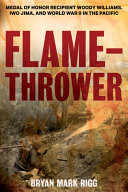
Flamethrower: Medal of Honor recipient Woody Williams, Iwo Jima, and World War II in the Pacific

Rigg, Bryan Mark
"Imagine strapping on a highly flammable 70-pound pack and entering combat as a surefire walking target-and you'd only begin to understand the job, and the horror, of Marine Corps flamethrower man. That's precisely what Hershel "Woody" Williams did in World War II, most importantly in February 1945 on Iwo Jima, one of the Pacific War's toughest battles. A few days into the battle, Marines were fighting hard for an airfield, and his captain asked Woody if he could do anything. He responded, "I'll try"-and for the next four hours, he virtually singlehandedly took on and ultimately destroyed seven enemy pillboxes and helped secure the airfield. Accomplished military historian Bryan Mark Rigg reconstructs Williams' remarkable story, from his youth in West Virginia to his experiences on Guadalcanal, Saipan, Guam, and most significantly Iwo Jima. In Rigg's telling, Williams's Medal of Honor action is not "just" a brave deed, but one of only a few strategically significant brave deeds-one that secured a strategic objective during a major campaign. Rigg tells Williams' story vividly, and objectively, and places it in the context of the broader Pacific theater of World War II."--
Stackpole Books 2020 544 pages