118 results for "World History"

Body of power spirit of resistance: the culture and history of a South African people

Comaroff, Jean
In this sophisticated study of power and resistance, Jean Comaroff analyzes the changing predicament of the Barolong boo Ratshidi, a people on the margins of the South African state. Like others on the fringes of the modern world system, the Tshidi struggle to construct a viable order of signs and practices through which they act upon the forces that engulf them. Their dissenting Churches of Zion have provided an effective medium for reconstructing a sense of history and identity, one that protests the terms of colonial and post-colonial society and culture.
University of Chicago Press 1985 296 pages

From Empathy to Denial Arab Responses to the Holocaust

Meir Litvak,Esther Webman
Based on years of research conducted mostly in Arabic sources, Meir Litvak and Ester Webman track the evolution of post-World War II perceptions of the Holocaust and their parallel emergence in the wake of the Arab-Israeli conflict of 1948. Following the establishment of the State of Israel, Arab attitudes toward the Holocaust became entangled with broader anti-Zionist and anti-Semitic sentiments. Litvak and Webman track this discourse through the work of leading intellectuals and turn to representations of the Holocaust in the media and culture of Egypt, Lebanon, Jordan, and among the Palestinian people. Their chronological history, which spans sixty years, provides a remarkable perspective on the origins, development, and tenaciousness of anti-Holocaust belief. From Empathy to Denial is the first comprehensive investigation of Holocaust denial in the Arab world, and is based on years of painstaking historical research of mostly Arabic language sources. The authors explore how Holocaust denial emerged after the Second World War, how it paralleled the wider Arab-Israeli conflict after the establishment of the State of Israel in 1948 and how it subsequently became entangled with broader anti-Zionist and anti-Semitic sentiment. In particular Litvak and Webman look at the role of leading intellectuals, the media and other cultural forms in Egypt, Lebanon, Jordan and among the Palestinians and how their representation of the Holocaust has evolved in the last sixty years.
Oxford University Press 2011-04-19 416 pages

Beyond death: theological and philosophical reflections on life after death

Dan Cohn-Sherbok,Christopher Lewis
Throughout history human beings have been preoccupied with personal survival after death. As a consequence, most world religions proclaim that life continues beyond the grave, and they have depicted the Hereafter in a variety of forms. These various conceptions constitute answers to the most perplexing spiritual questions: Will we remember our former lives in the Hereafter? Will we have bodies? Can bodiless souls recognize each other? Will we continue to have personal identity? Will we be punished or rewarded, or absorbed into the Godhead? These issues serve as the basis of this collection of essays which provide a framework for understanding traditional conceptions of the Hereafter as well as new perspectives.
Macmillan 1995 219 pages

The Evian Conference of 1938 and the Jewish Refugee Crisis

Paul R. Bartrop
This book provides the first dedicated study of the Evian Conference of July 1938, an international initiative called by U.S. President Franklin D. Roosevelt. While on the surface the conference appeared as an attempt to alleviate the distress faced by Jews being forced out of Germany and Austria, in reality it only served to demonstrate that the nations of the world were not willing to accept Jews as refugees. Since the Holocaust, a generally-held assumption has been that the Evian Conference represented a lost opportunity to save Germany’s Jews, and that the conference failed to rescue the Jews of Europe. In this study, Paul Bartrop argues that in fact it did not fail when measured against the original reasons for which it was called. Exposing many of the myths surrounding the meeting, this work addresses a glaring lacuna in the literature of the Holocaust, and places the so-called 'failure' of the Evian Conference into its proper context.
Springer International Publishing 2018-08-11 128 pages

Rome and Jerusalem A Study in Jewish Nationalism

Meyer Waxman,Moses Hess
This classic work of Jewish political theory explores the relationship between nationalism, religion, and history in the context of the Zionist movement. Waxman analyzes the political thought of Moses Hess, a precursor of Zionism, and argues that the Jewish people have a historical claim to the land of Israel. A must-read for anyone interested in the history of Jewish political thought. This work has been selected by scholars as being culturally important, and is part of the knowledge base of civilization as we know it. This work is in the "public domain in the United States of America, and possibly other nations. Within the United States, you may freely copy and distribute this work, as no entity (individual or corporate) has a copyright on the body of the work. Scholars believe, and we concur, that this work is important enough to be preserved, reproduced, and made generally available to the public. We appreciate your support of the preservation process, and thank you for being an important part of keeping this knowledge alive and relevant.
Creative Media Partners, LLC 2023-07-18 264 pages

Civil Disobedience in Antiquity

David Daube
This book derives from the Messenger Lectures at Cornell. In it Daube provides a synoptic view of nonviolent civil disobedience in the Ancient World. His learning lets him draw freely on Greek and Roman sources--theological, legal historical, literary, dramatic, and popular. From these he shows that there is hardly a variety of civil disobedience known today which is not anticipated in some form or another by the ancients. Is this book more than an entertaining exercise of scholarship? Professor Daube writes, "To speak through historical figures is sometimes wiser than to declare in one's own name. The word 'person' originally means a mask . . . Civil disobedience can at all times profitably avail itself of persons."
Wipf and Stock Publishers 2011-08-03 180 pages

Triumph of Survival The Story of the Jews in the Modern Era 1650-1995

Berel Wein
Through his hundreds of lectures, Rabbi Wein has brought the Torah perspective on history to thousands of listeners. In this original work, he paints a magnificent, panoramic picture of our people in the centuries that shaped us and our world. This major work has the touches of luxury you expect in books of this magnitude, including a ribbon place-marker and embossed foil-stamped jacket. Large 8-1/2 x 11 coffee-table format. Beautifully written and illustrated, it is accurate and incisive, yet personal and passionate. It is informative, provocative, and inspiring. Seldom is must reading so enjoyable.
Mesorah Publications 1990-09 508 pages

The Irrevocable Calling Israel's Role as a Light to the Nations

Daniel C. Juster,Don Finto
Referring to the chosen-ness of the Jewish people, Paul, the Apostle, ?For God's free gifts and his calling are irrevocable? (Rom. 11: 29). This messenger to the Gentiles understood the unique calling of his people, Israel. So does Daniel Juster. In The Irrevocable Calling, he expands Paul's words, showing how Israel was uniquely chosen to bless the world and how these blessings can be enjoyed today.
Messianic Jewish Publishers 2007 52 pages

Oh My God! the Scientific Evidence for God's Existence

Richard Foreman
This easy-to-read and must-read short book represents a small collection of valuable and interesting information, arguments and contra-arguments for the existence of God. It is recommended for both skeptics and those who want to strengthen their faith in God. Atheists who want to find out the truth are also welcomed to read it, and especially those who are ready to change their world-view and beliefs if they encounter new facts and strong evidence for the opposite views. After reading it, you will have an elementary knowledge about the question of God, the purpose of life, the world origin, and the whole humankind history. You will possess a basic theological education necessary for everyone interested in vital questions about life and death. You may not agree with the arguments presented in the book, nevertheless, you will surely gain useful knowledge and acquire new information about your own life. There are six main scientific arguments presented in the book for the existence of God. All of them are explained in a very simple and understandable manner, providing answers to all fundamental questions people have been asking themselves during the past centuries. The basic outline of six major logical arguments for the existence of God will help you find the most important Words you were looking for your whole life...
CreateSpace Independent Publishing Platform 2015-05-10 40 pages

I Studied Inscriptions from Before the Flood Ancient Near Eastern, Literary, and Linguistic Approaches to Genesis 1-11

Richard S. Hess,David Toshio Tsumura
This volume collects the best of recent research and classic essays on the Primeval History, including several articles that have not appeared heretofore in English. The articles provide students and scholars with easy access to significant scholarship illuminating both the world outside the text and the world within the text.
Pennsylvania State University Press 1994 496 pages

From Berlin to Berkeley (Routledge Revivals)

Bendix, Reinhard
Originally published in 1986, From Berlin to Berkeley is an intellectual portrait of one of America's leading 20th century social scientists, Reinhard Bendix, and his father, Ludwig Bendix. It discusses cultural identity and assimilation and provides a profound account of Ludwig Bendix's life as a lawyer and critic of the German judicial system, his identification with German culture and his emigration to Palestine during Hitler's regime. Bendix then examines the relationship with his father and details his youth in Germany, his emigration to America, and his early career as a scholar. Covering the period from 1877 to the 1980s, Bendix shows how the two lives were touched by the culture of Imperial Germany, the German legal profession, World War I, the revolution of November 1918 in Germany and subsequent inflation, the Great Depression of the 1930s and the crisis of the Weimar Republic, the Hitler regime, emigration to Palestine and the United States, World War II, the division of Germany, and the world-political role of the United States. A moving exploration which melds sociological case study and family history, the book is a significant measure of a family and a civilization.
Routledge 2026-05-01 316 pages

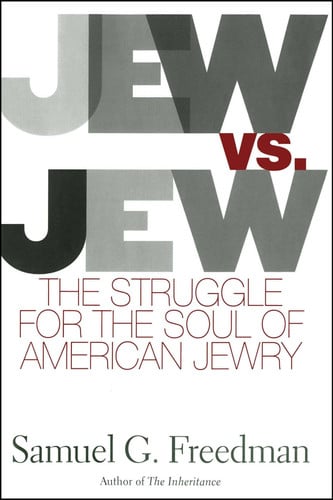
Jew Vs Jew The Struggle For The Soul Of American Jewry

Samuel G. Freedman
At a time when American Jews should feel more secure and cohesive than ever, civil war is tearing apart their community. Congregations, neighborhoods, even families are taking sides in battles about Jewish identity and Jewish authenticity. The conflict pits fundamentalist against secularist, denomination against denomination, even liberal against conservative within each branch of Jewry. Jew vs. Jew tells the story of how American Jewry has increasingly -- and perhaps terminally -- broken apart in the last forty years. Jew vs. Jew stretches in time from 1960 to 2000. It travels the country from Florida to New England, from Los Angeles to the Catskills in New York, from Cleveland to Denver, and it also crosses the ocean to Israel to show how tensions within the Jewish state inflame those among American Jews. The flash-points range from conversion standards to the role of women, from the peace process in Israel to the sexual climate on an Ivy League campus. But behind them all, as Samuel Freedman writes, lie common causes. First, far from unifying American Jews, Israel now divides them on both political and religious grounds. Second, neither America nor the larger world presents Jews with a single enemy against whom to coalesce. Third, and most important, nothing in the Jewish history of persecution, oppression, and exile prepared the Chosen People for the challenge posed by America, the challenge of being absorbed into a tolerant and diverse nation, being accepted so thoroughly that the intermarriage rate tops 50 percent. Jew vs. Jew introduces readers to memorable places and characters. Freedman describes one of the final summers at a Labor Zionist camp in the Catskills whose brand of secular Jewishness is becoming obsolete because Zionism succeeded in creating Israel. He tells the story of Orthodox and Reform Jews in a Cleveland suburb who are fighting about the construction of several synagogues -- and, on a deeper level, about whether unity or pluralism ought to be the goal of Jewish life. He portrays a Florida Jew so violently opposed to the Oslo peace accords that he planted a bomb in a synagogue where Shimon Peres was speaking. He tells about a Los Angeles congregation that spent three years debating whether or not to honor the Biblical matriarchs in its liturgy.We come to know the Long Island neighbors who cannot tolerate sharing even a property line because their versions of Jewish identity are so irreconcilably different. Jew vs. Jew is a work of vigorous reporting, lucid writing, and intellectual curiosity. And even as it chronicles an embittered and polarized community, it refuses to take sides or pass judgment. Instead, with compassion and acuity, Jew vs. Jew bears witness.
Simon & Schuster 2007-09-21 400 pages

Confronting Creation How Judaism Reads Genesis

Jacob Neusner
By setting forth the book of Genesis as it is re-presented in the rabbinic statement Genesis Rabbah, Neusner demonstrates the way in which Judaism confronted creation and the Genesis story. In 'Confronting Creation', the author presents a new, analytical translation of Genesis Rabbah, a document that came to closure around 400 C.E. What made that particular time crucial in the life of Israel and the Jewish people is an event that also helped shape the entire history of Western civilization - the rise of Christianity to the status of the official religion of the Roman Empire. The Judaic sages' rereading of the Torah's accounts of the beginning of the world and of Israel took place during a time of significant change in Western civilization. That fact explains the importance of this reading of Genesis to Western civilization, because Genesis Rabbah illuminates the Judaic tradition in contemplating God's creation of the world.
Wipf and Stock Publishers 2004-06-15 400 pages

Covenantal Rights: A Study in Jewish Political Theory

Novak, David
Covenantal Rights is a groundbreaking work of political theory: a comprehensive, philosophically sophisticated attempt to bring insights from the Jewish political tradition into current political and legal debates about rights and to bring rights discourse more fully into Jewish thought. David Novak pursues these aims by presenting a theory of rights founded on the covenant between God and the Jewish people as that covenant is constituted by Scripture and the rabbinic tradition. In doing so, he presents a powerful challenge to prevailing liberal and conservative positions on rights and duties and opens a new chapter in contemporary Jewish political thinking. For Novak, "covenantal rights" are rooted in God's primary rights as creator of the universe and as the elector of a particular community whose members relate to this God as their sovereign. The subsequent rights of individuals and communities flow from God's covenantal promises, which function as irrevocable entitlements. This presents a sharp contrast to the liberal tradition, in which rights flow above all from individuals. It also challenges the conservative idea that duties can take precedence over rights, since Novak argues that there are no covenantal duties that are not backed by correlative rights. Novak explains carefully and clearly how this theory of covenantal rights fits into Jewish tradition and applies to the relationships among God, the covenanted community, and individuals. This work is a profound and provocative contribution to contemporary religious and political theory.
Princeton University Press 2009-11-22 248 pages

From Suburb to Shtetl The Jews of Boro Park

Egon Mayer,William B. Helmreich
"From Suburb to Shtetl" is an outstanding ethnography that moves beyond simple demographics. Mayer weaves an intricate tapestry of how family, school, and community leaders influence each other. Whether discussing the role of the rebbe or the matchmaker, those who know these communities will find what he says as relevant today as it was when first penned. This is hardly surprising, for the ultra-Orthodox community takes great pride in not changing, in maintaining itself as it was in Europe despite the allure of modern American society. His discussion of synagogue life is particularly informative and evocative. Those in charge of helping immigrants adopted the path of least resistance, allowing and even encouraging them to retain their identities except for those few aspects that might threaten the country's national interests. The American Orthodox community was tremendously augmented by the arrival from Europe, after World War Two, of thousands of Orthodox Jews who remained devoted to that way of life. Egon Mayer was himself part of a smaller, but significant group of Jews who came to the U.S. and settled mostly in Boro Park in the wake of the 1956 Hungarian Revolution. The interaction between the Hasidim and their less fervent Orthodox counterparts described and analyzed in this volume tells us a great deal about how people negotiate their beliefs, values, and norms when forced into close contact with each other in an urban setting within the larger American culture. By exploring these and many other related issues Mayer has given us the chance to assess and forecast the future of American Jewish life as a whole.
Taylor & Francis Group 2017-10-12 214 pages

Ramses II and His Time

Immanuel Velikovsky
In his book "Ramses II and His Time", Immanuel Velikovsky continues his reconstruction of ancient history. This volume covers the best-known of old Egypt's pharaohs, Ramses II. Velikovsky points out how little we know about this famous ruler. His revised chronology places Ramses II firmly into the 7th century B.C. and not, as we have been led to believe, hundreds of years earlier in the 13th century B.C.. Ramses II's adversary was thus none other than Nebuchadnezzar. We are made privy to fascinating personal details about this great Chaldean ruler, whose autobiography Velikovsky was able to locate. As in the first part of the series "Ages in Chaos", this volume unearths a string of erroneous theories and dismisses as pure fantasy several other aspects of the traditional written history concerning the ancient world. We learn, for example, that the so-called Hittite Empire is an historical invention and, in another critical paragraph, Velikovsky leads us the to the proper understanding of the Bronze- and Iron Ages. In the extensive supplement, Velikovsky deals with the age-calculating method of radiocarbon dating and its surprising connections to his own theories.
Paradigma 2018-06 286 pages

The Jewish Approach to Repairing the World (Tikkun Olam) A Brief Introduction for Christians

Elliot N. Dorff,Rector and Professor of Philosophy Elliot N Dorff, PhD
A window into the Jewish idea of responsibility to care for the world--written especially for Christians. The concept of repairing the world (tikkun olam) is an integral part of Jewish life. It helps shape Jewish social and family relationships, and even mandates how Jews should speak to others. But why is it important for Christians to understand this Jewish approach to life? And what kind of impact can understanding this fundamental aspect of Judaism have on Christians seeking to develop a deeper understanding of their own faith? With insight and wisdom, award-winning author Rabbi Elliot Dorff provides an accessible, honest and thorough exploration of this important Jewish concept. With easy-to-understand explanations of Jewish terms, practices and history, each chapter explores a different facet touched by the tradition of tikkun olam. Rabbi Dorff also addresses parallel themes and practices in the Christian tradition, helping you better understand the roots of Christianity and how the fundamentals of Judaism relate and reflect your own aspirations to repair the world. Caring for the Poor The Power of Words The Ministry of Presence Duties of Spouses to Each Other Children's Duties to Their Parents Parent's Duties to Their Children The Traditional Jewish Vision of the Ideal World
LongHill Partners, Incorporated 2008-09 256 pages

A History of the Jews in Babylonia, Part 1 The Parthian Period

Jacob Neusner
Jacob Neusner is Research Professor of Religion and Theology at Bard College and Senior Fellow of the Institute of Advanced Theology at Bard. He has published more than 900 books and unnumbered articles, both scholarly and academic and popular and journalistic, and is the most published humanities scholar in the world. He has been awarded nine honorary degrees, including seven US and European honorary doctorates. He received his AB from Harvard College in 1953, his PhD from Columbia University and Union Theological Seminary in 1961, and rabbinical ordination and the degree of Master of Hebrew Letters from the Jewish Theological Seminary of America in 1960. Neusner is editor of the 'Encyclopedia of Judaism' (Brill, 1999. I-III) and its Supplements; Chair of the Editorial Board of 'The Review of Rabbinic Judaism, ' and Editor in Chief of 'The Brill Reference Library of Judaism', both published by E. J. Brill, Leiden, The Netherlands. He is editor of 'Studies in Judaism', University Press of America. Neusner resides with his wife in Rhinebeck, New York. They have a daughter, three sons and three daughters-in-law, six granddaughters and two grandsons.
Wipf and Stock Publishers 2008-12-15 274 pages

Storytelling and Spirituality in Judaism

Yitzhak Buxbaum
"The purpose of this book is to elevate stories and storytelling in people's esteem, so they will understand their holiness and appreciate them at their full worth. There are those who enjoy stories and storytelling but in the back of their minds think, 'After all, they're only stories.' But in the same way that the Western Wall of the Temple is not just a wall, a mere pile of stones, neither are the stories of the Torah or of the tzaddikim 'just stories.' Holy stories are the light of the world. When we understand that, when both tellers and listeners know they are engaged in sacred activity, we will hold stories and storytelling more dear. The teller will tell with the tongue of faith, the listeners will hear with ears of faith, and the circle of holiness will be closed." -from the Introduction
Bloomsbury Academic 2001-05-31 255 pages