14302 results for "History"

The great debate: Edmund Burke, Thomas Paine, and the birth of right and left

Levin, Yuval
"In The Great Debate Yuval Levin explores the origins of the familiar left/right divide in American politics by examining the views of the men who best represent each side of that debate: Edmund Burke and Thomas Paine. In a groundbreaking exploration of the origins of our political order, Levin shows that our political divide did not originate (as many historians argue) in the French Revolution, but rather in the Anglo-American debate about that revolution. Burke and Paine were both utterly fascinating figures--active in politics, versed in philosophy, and two of the best, most effective and powerful political writers and polemicists in the history of the English speaking world. Levin sets the work of these two men against the dramatic history of their era and shows how they mixed theory and practice to advance their very different notions of liberty, equality, nature, history, reason, revolution, and reform. Paine believed in radical change and saw the American and French Revolutions as catalysts for creating a new society; Burke believed in a significantly more gradual approach with each generation acting merely as part of a long chain of history. These differing approaches to revolution and reform created a division that continues to shape our current political discourse--including issues ranging from gun control and abortion to welfare and economic reform"--
Basic Books 2014 275 pages

Hollow city: the siege of San Francisco and the crisis of American urbanism

Solnit, Rebecca
Hollow City surveys San Francisco's transformation - skyrocketing residential and commercial rents that are driving out artists, activists, nonprofit organizations and the poor; the homogenization of the city's architecture, industries and population; the decay of its public life; and the erasure of its sites of civic memory. California's Bay Area is home to nearly a third of the venture capital and internet businesses in the United States, generating a boom economy and a massive influx of well-paid workers that has transformed the face of San Francisco. Once the great anomaly among American cities, San Francisco is today only the most dramatically affected among the many urban centers experiencing cultural impoverishment as a result of new forms and distributions of wealth. A collaboration between writer-hiostorian Rebecca Solnit and photographer Susan Schwartzenberg, Hollow City surveys San Francisco's transformation - skyrocketing residential and commercial rents that are driving out artists, activists, nonprofit organizations and the poor; the homogenization of the city's architecture, industries and population; the decay of its public life; and the erasure of its sites of civic memory. Written as a tour of the city's distinctive characters and locales, Solnit's text grounds the current evictions in earlier histories of urban renewal and the economic geography of artists, from Haussmann's impact on the Paris of Baudelaire, to the relationship between the Beats and San Francisco's African-American community during 'negro removal' of the 1950s. She investigates the ways wealth is now clear-cutting the cultural richness of American urban life, erasing space for idealism, dissent, memory and vulnerable populations. Schwartzenberg's photo-essays document the profusion of construction and demolition projects in the city, the imperial spaces of dot-com businesses, the proliferation of retail chains, and the rapid disappearance of areas in which artists can live and create. They feature works by more than a dozen San Francisco artists.
Verso 2018 182 pages

Beyond the Melting Pot The Negroes, Puerto Ricans, Jews, Italians, and Irish of New York City (Classic Reprint)

Nathan Glazer
Excerpt from Beyond the Melting Pot: The Negroes, Puerto Ricans, Jews, Italians, and Irish of New York City History, or perhaps historians, keep passing New York by. During the Civil War New York [state] pro vided the greatest number of soldiers, the greatest quantity of supplies, and the largest amount of money. In addition, New York's citizens paid the most taxes, bought the greatest number of war - bonds, and gave the most to relief organiza tions. 1 Yet it is recalled as a war between Yankees and Southerners. The Union preserved, the American mind roams westward with the cowboys, returning, if at all, to the Main Streets of the Midwest. The only New York image that has permanently impressed itself on the national mind is that of Wall Street - a street on which mobod lives. Paris may be France, London may be England, but New York, we continue to reassure ourselves, is not America. About the Publisher Forgotten Books publishes hundreds of thousands of rare and classic books. Find more at www.forgottenbooks.com This book is a reproduction of an important historical work. Forgotten Books uses state-of-the-art technology to digitally reconstruct the work, preserving the original format whilst repairing imperfections present in the aged copy. In rare cases, an imperfection in the original, such as a blemish or missing page, may be replicated in our edition. We do, however, repair the vast majority of imperfections successfully; any imperfections that remain are intentionally left to preserve the state of such historical works.
1kg Limited 2017-09-17 372 pages

Take arms against a sea of troubles: the power of the reader's mind over a universe of death

Bloom, Harold
"The great poems, plays, novels, stories teach us how to go on living. . . . Your own mistakes, accidents, failures at otherness beat you down. Rise up at dawn and read something that matters as soon as you can." So Harold Bloom, the most famous literary critic of his generation, exhorts readers of his last book: one that praises the sustaining power of poetry. "Passionate. . . . Perhaps Bloom's most personal work, this is a fitting last testament to one of America's leading twentieth-century literary minds." -- Publishers Weekly "An extraordinary testimony to a long life spent in the company of poetry and an affecting last declaration of [Bloom's] passionate and deeply unfashionable faith in the capacity of the imagination to make the world feel habitable"--Seamus Perry, Literary Review "Reading, this stirring collection testifies, 'helps in staying alive.'"-- Kirkus Reviews , starred review This dazzling celebration of the power of poetry to sublimate death--completed weeks before Harold Bloom died--shows how literature renews life amid what Milton called "a universe of death." Bloom reads as a way of taking arms against the sea of life's troubles, taking readers on a grand tour of the poetic voices that have haunted him through a lifetime of reading. "High literature," he writes, "is a saving lie against time, loss of individuality, premature death." In passages of breathtaking intimacy, we see him awake late at night, reciting lines from Dante, Shakespeare, Milton, Montaigne, Blake, Wordsworth, Hart Crane, Jay Wright, and many others. He feels himself "edged by nothingness," uncomprehending, but still sustained by reading. Generous and clear‑eyed, this is among Harold Bloom's most ambitious and most moving books.
Yale University Press 2021-10-12 672 pages

Speaking Freely Trials of the First Amendment

Floyd Abrams
Attorney Floyd Abrams, re-creates eight of the most important cases of his career--landmark trials and Supreme Court arguments in cases involving key First Amendment protections, including the famous Pentagon Papers case. With adversaries as diverse as Richard Nixon, Wayne Newton, and Rudy Giuliani, and allies as unlikely as Kenneth Starr and Senator Mitch McConnell, Abrams takes readers behind the scenes to examine his strategies, the ramifications of each of the decisions, and the long-term significance of each case, while presenting a clear and compelling look at the law in action.
RB Large Print 2005 493 pages

The paranoid style in American politics, and other essays

Hofstadter, Richard
"The distinguishing thing about the paranoid style is not that its exponents see conspiracies or plots here and there in history, but that they regard a vast' or gigantic' conspiracy as the "motive force" in historical events...The paranoid spokesman sees the fate of this conspiracy in apocalyptic terms--he traffics in the birth and death of whole worlds, whole political orders, whole systems of human values. He is always manning the barricades of civilization." --From the book.
Harvard University Press 1996-02-01 330 pages

The great experiment: how to make diverse democracies work

Mounk, Yascha
* SELECTED FOR BARACK OBAMA'S SUMMER READING LIST 2022 * 'Anyone interested in the future of liberal democracy should read this book' ANNE APPLEBAUM -- One of our most important political thinkers looks to the greatest challenge of our time: how to live together equally and peacefully in diverse democracies. It's easy to be pessimistic about the fate of democracy in multi-ethnic societies. At the end of the Second World War, fewer than one in twenty-five people living in the UK were born abroad; now it is one in seven. The history of humankind is a story of us versus them, and the project of diverse democracies is a relatively new one - it is, in other words, a great experiment. How do identity groups with different ideologies and beliefs live together? Is it possible to embark on a democracy with shared values if our values are at odds? Yascha Mounk argues that group identity is both deeply rooted and malleable. No community is beyond conciliation: groups are moving towards cooperation across the world. The Great Experiment offers a profound understanding of the problem behind all our other problems, and genuine hope for our capacity to solve it.
Bloomsbury 2023 356 pages

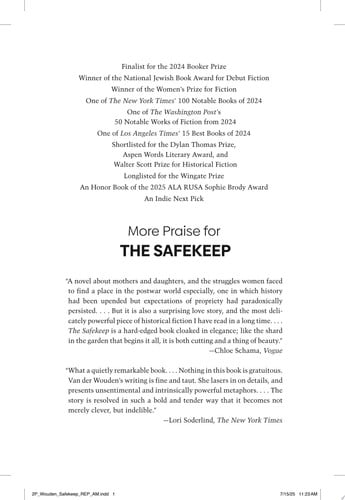
The safekeep

van der wouden, Yael
"*Shortlisted for the 202 Booker prize* "Remarkable...Compelling...Fine and taut...Indelible." -The New York Times "Moving, unnerving, and deeply sexy." -Tracy Chevalier, author of Girl with the Pearl Earring "A brilliant debut, as multi-faceted as a gem." -Kirkus Reviews A "razor-sharp, perfectly plotted" (The Sunday Times, London) tale of desire, suspicion, and obsession between two women staying in the same house in the Dutch countryside during the summer of 1961-a powerful exploration of the legacy of WWII and the darker parts of our collective past. A house is a precious thing... It is 1961 and the rural Dutch province of Overijssel is quiet. Bomb craters have been filled, buildings reconstructed, and the war is truly over. Living alone in her late mother's country home, Isabel knows her life is as it should be-led by routine and discipline. But all is upended when her brother Louis brings his graceless new girlfriend Eva, leaving her at Isabel's doorstep as a guest, to stay for the season. Eva is Isabel's antithesis: she sleeps late, walks loudly through the house, and touches things she shouldn't. In response, Isabel develops a fury-fueled obsession, and when things start disappearing around the house-a spoon, a knife, a bowl-Isabel's suspicions begin to spiral. In the sweltering peak of summer, Isabel's paranoia gives way to infatuation, leading to a discovery that unravels all Isabel has ever known. The war might not be well and truly over after all, and neither Eva-nor the house in which they live-are what they seem. Mysterious, sophisticated, sensual, and infused with intrigue, atmosphere, and sex, The Safekeep is "a brave and thrilling debut about facing up to the truth of history, and to one's own desires" (The Guardian)"--
Avid Reader Press 2025-05-27 262 pages

The rider

Krabbé, Tim
A literary sports classic, finally available in the U.S. Originally published in Holland in 1978, The Rider became an instant cult classic, selling over 100,000 copies. Brilliantly conceived and written at a breakneck pace, it is a loving, imaginative, and, above all, passionate tribute to the art of bicycle road racing. Not a dry history of the sport, The Rider is beloved as a bicycle odyssey, a literary masterpiece that describes in painstaking detail one 150-kilometer race in a mere 150 pages. We are, every inch of the way, inside amateur biker Tim Krabbé's head as his mind churns at top speed along with his furious peddling. Privy to his every thought-on the glory and vagaries of the sport itself, the weather, the characters and lineage of his rival cyclists, almost hallucinogenic anecdotes about great riders of the past-the book progresses kilometer by kilometer, thought by thought, and the reader is left breathless and exhilarated. A thrillingly realistic look at what it is like to compete in a road race, The Rider is the ultimate book for bike lovers as well as the arm-chair sports enthusiast.
Bloomsbury 2002-06-01 148 pages

Long Time No See

Susan Isaacs
It's been twenty years, and Judith's life has definitely changed. Now a history professor and a widow, she hasn't seen Nelson Sharpe of the Nassau County Police Department in all that time. But she still can't get her one-time lover out of her head. Her life takes an unexpected turn, however, when former investment banker turned suburban mommy extraordinaire Courtney Logan vanishes from Long Island into thin air. Everyone suspects husband, Greg, the darkly handsome son of flashy Long Island mobster Fancy Phil Lowenstein. Ever the good neighbor, Judith offers her services to Greg, but he shows her the door, thinking she's just a nut. His father, however, isn't so sure -- he just may have other plans for the wily Judith...
HarperCollins 2002-07-02 496 pages

Division street: America

Terkel, Studs
Division Street is the book that first made Studs Terkel's reputation as America's foremost oral historian, as "one of those rare thinkers who is actually willing to go out and talk to the incredible people of this country". Viewing the inhabitants of a single city, Chicago, as a microcosm of the nation at large, Terkel chronicles the thoughts and feelings of some seventy people from widely varying backgrounds in terms of class, race, and personal history. From a mother and son who migrated from Appalachia to a Native American boilerman, from a streetwise ex-gang leader to a liberal police officer, from the poorest African Americans to the richest socialites, these unique accounts form a multifaceted collage that defies any simple stereotype of America.
the New press 2006 381 pages

How class works: power and social movement

Aronowitz, Stanley
Americans like to believe that they live in a classless society. Most Americans defiantly identify themselves as middle class, although economic inequality is greater in the United States than in most advanced Western nations. Offering an important revision of conventional wisdom, Stanley Aronowitz demonstrates that class remains a potent force in the United States. Aronowitz shows that class need not be understood simply in terms of socioeconomic stratification, but rather as the power of social groups to make a difference. Aronowitz explains that social groups from different economic and political positions become ruling classes when they make demands that change the course of history. For instance, labor movements, environmental activists, and feminists have engaged in class struggles as their demands for power reconfigured the social order. The emerging global justice movements--comprised of activists from heterogeneous social and political backgrounds--also show potential for class formation. Written by a prominent scholar and social activist, this book offers a stunning reconceptualization of the meaning and significance of class in modern America.
Yale University Press 2003 263 pages

India and Pakistan: continued conflict or cooperation?

Wolpert, Stanley A.
Beginning in 1947, when 'India and Pakistan were born to conflict', renowned India scholar Stanley Wolpert provides an authoritative, accessible primer on what is potentially the world's most dangerous crisis. He concisely distills sixty-three years of complex history, tracing the roots of the relationship between these two antagonists, explaining the many attempts to resolve their disputes, and assessing the dominant political leaders. While the tragic Partition left many urgent problems, none has been more difficult than the problem over Kashmir, claimed by both India and Pakistan. This intensely divisive issue has triggered two conventional wars, killed some 100,000 Kashmiris, and almost ignited two nuclear wars since 1998, when both India and Pakistan openly emerged as nuclear-weapon states. In addition to providing a comprehensive perspective on the origin and nature of this urgent conflict, Wolpert examines all the proposed solutions and concludes with a road map for a brighter future for South Asia.
University of California Press 2010-09-13 126 pages

Inheritance: how our genes change our lives, and our lives change our genes

Moalem, Sharon
In this book, the author, a physician and writer employs his wide-ranging and interdisciplinary approach to science and medicine, explaining how art, history, superheroes, sex workers, and sports stars all help us understand the impact of our lives on our genes, and our genes on our lives. He explains new concepts in human genetics and health that indicate that the fundamental nature of the human genome is much more fluid and flexible than originally thought. He reveals how genetic breakthroughs are completely transforming our understanding of both the world and our lives. Conventional wisdom dictates that our genetic destiny is fixed at conception. But this book shows us that the human genome is far more fluid and fascinating than your ninth grade biology teacher ever imagined. By bringing us to the bedside of his unique and complex patients, he demonstrates what rare genetic conditions can teach us all about our own health and well-being. In the brave new world we are rapidly rocketing into, genetic knowledge has become absolutely crucial. This book provides a roadmap for this journey by teaching: Why you may have recovered from the psychological trauma caused by childhood bullying, but your genes may remain scarred for life ; How fructose is the sugar that makes fruits sweet, but if you have certain genes, consuming it can buy you a one-way trip to the coroner's office ; Why ingesting common painkillers is like dosing yourself repeatedly with morphine, if you have a certain set of genes ; How insurance companies legally use your genetic data to predict the risk of disability for you and your children, and how that impacts the coverage decisions they make for your family ; How to have the single most important conversation with your doctor, one that can save your life ; And finally, Why people with rare genetic conditions hold the keys to medical problems affecting millions. This book will alter how you view your genes, your health, and your life.
Grand Central Publishing 2014 255 pages

An empire wilderness: travels into America's future

Kaplan, Robert D.
Having reported on some of the world's most violent, least understood regions in his bestsellers Balkan Ghosts and The Ends of the Earth, Robert Kaplan now returns to his native land, the United States of America. Traveling, like Tocqueville and John Gunther before him, through a political and cultural landscape in transition, Kaplan reveals a nation shedding a familiar identity as it assumes a radically new one. An Empire Wilderness opens in Fort Leavenworth, Kansas, where the first white settlers moved into Indian country and where Manifest Destiny was born. In a world whose future conflicts can barely be imagined, it is also the place where the army trains its men to fight the next war. "A nostalgic view of the United States is deliberately cultivated here," Kaplan writes, "as if to bind the uncertain future to a reliable past." From Fort Leavenworth, Kaplan travels west to the great cities of the heartland--to St. Louis, once a glorious shipping center expected to outshine imperial Rome and now touted, with its desolate inner city and miles of suburban gated communities, as "the most average American city." Kaplan continues west to Omaha; down through California; north from Mexico, across Arizona, New Mexico, and Texas; up to Montana and Canada, and back through Oregon. He visits Mexican border settlements and dust-blown county sheriffs' offices, Indian reservations and nuclear bomb plants, cattle ranches in the Oklahoma Panhandle, glacier-mantled forests in the Pacific Northwest, swanky postsuburban sprawls and grim bus terminals, and comes, at last, to the great battlefield at Vicksburg, Mississippi, where an earlier generation of Americans gave their lives for their vision of an American future. But what, if anything, he asks, will today's Americans fight and die for? At Vicksburg Kaplan contemplates the new America through which he has just traveled--an America of sharply polarized communities that draws its population from pools of talent far beyond its borders; an America where the distance between winners and losers grows exponentially as corporations assume gov-ernment functions and the wealthy find themselves more closely linked to their business associates in India and China than to their poorer neighbors a few miles away; an America where old loyalties and allegiances are vanishing and new ones are only beginning to emerge. The new America he found is in the pages of this book. Kaplan gives a precise and chilling vision of how the most successful nation the world has ever known is entering the final, and highly uncertain, phase of its history.
Random House 1998-08-18 393 pages

The bill of obligations: the ten habits of good citizens

Haass, Richard
"A bold guide to how we must re-envision citizenship if American democracy is to survive The United States faces dangerous threats from Russia, China, North Korea, Iran, terrorists, climate change, and future pandemics, but the greatest peril to the country comes not from abroad but from within, from none other than ourselves. The question facing us is whether we are prepared to do what is necessary to save our democracy. The Bill of Obligations is a bold call for change. In these pages, New York Times bestselling author Richard Haass argues that the very idea of citizenship must be revised and expanded if American democracy is to endure. The Bill of Rights is at the center of our Constitution, yet our most intractable conflicts often emerge from contrasting views as to what our rights ought to be. As former Supreme Court Justice Stephen Breyer pointed out, "Many of our cases, the most difficult cases, are not about right versus wrong. They are about right versus right." Rights alone, however, do not provide a strong enough foundation for a democracy to succeed in the twenty-first century. But there is a cure: to place obligations on the same footing with rights. The ten obligations that Haass introduces here are essential for healing our divisions and safeguarding the future of our country. These obligations re-envision what it means to be an American citizen. They are not a burden, but rather commitments that we make to fellow citizens and to the government to uphold our democracy and fight back against the growing apathy, anger, selfishness, and division that threaten us all. Through an expert blend of civics, history, and political analysis, this book illuminates how Americans can rediscover and recover the attitudes and behaviors that have contributed so much to this country's success over the centuries. As Richard Haass argues, "We get the government and the country we deserve. Getting the one we need, however, is up to us." The Bill of Obligations gives citizens across the political spectrum a plan of action to achieve it"--
Penguin Press 2023 217 pages